Skip to content
A court order feels meaningless when your former spouse ignores it. You may have expected the divorce decree to end the fight, only to find yourself chasing missed exchanges, unpaid obligations, or property transfers that never happened.
Texas gives you a direct tool for that problem. A motion to enforce asks the same court that signed your order to require compliance with what was already ordered. That distinction matters. You are not starting the divorce over, and you are not asking the judge to rewrite the deal. You are asking the court to act because someone didn't follow a binding order.
That's why enforcement cases are often won or lost on precision. Judges don't respond well to broad complaints like “my ex never cooperates” or “this whole decree is being ignored.” They need the exact paragraph, the exact violation, and proof that ties the two together. If your request is focused, documented, and served correctly, the court has a path to help you. If it's vague or asks for changes to the original order, the case can stall quickly.
People often think the hardest part is proving that the other side behaved badly. In practice, the harder part is building an enforcement case the court can legally grant. That means using the decree's language, following notice rules, and asking for relief that enforces the order instead of reopening it.
Introduction When Your Divorce Decree Is Ignored
You may be dealing with a decree that says one thing while daily life looks very different. A parent refuses to turn over the child at the scheduled time. A former spouse keeps delaying a refinance, vehicle transfer, or account division. Support that was ordered never arrives. After enough broken promises, it's normal to feel angry, tired, and unsure whether the paper you fought for still has any value.
It does.
A signed Texas divorce decree is a court order, not a suggestion. When one party fails to comply, a motion to enforce is the vehicle that puts the issue back in front of the judge in a form the court can act on. The purpose is accountability. The court isn't there to referee every argument between former spouses, but it can enforce obligations that are already written into the order.
What a motion to enforce actually does
A motion to enforce tells the court three things:
What order exists
You identify the decree or prior order that controls.What part was violated
You point to the exact language the other side failed to follow.What remedy you want
You ask the judge to compel compliance, enter an enforcement order, or grant other relief allowed by the existing order.
Practical rule: The stronger enforcement case is usually the one built as a line-by-line compliance record, not a narrative about how unreasonable the other person has been.
That approach helps both clients and courts. It keeps emotion from taking over the pleading, and it shows the judge that you understand the difference between enforcement and re-litigation. In family court, that difference is everything.
If you're trying to learn how to file a motion to enforce in a Texas divorce case, start with this mindset: your job is not to tell the whole history of the marriage. Your job is to show the court a violated order, proof of the violation, and a lawful request for enforcement.
Determining If You Have Grounds to File a Motion
Not every frustration after divorce is enforceable. Before you spend time and money filing, you need to know whether the decree says enough for a judge to enforce it.
Texas courts can enforce obligations that are stated clearly. They struggle with language that sounds fair in conversation but isn't specific enough in a courtroom. If the decree says a party must perform a defined act, make a defined payment, or follow a defined schedule, you may have grounds. If the wording is broad or implied, you may need a different strategy.
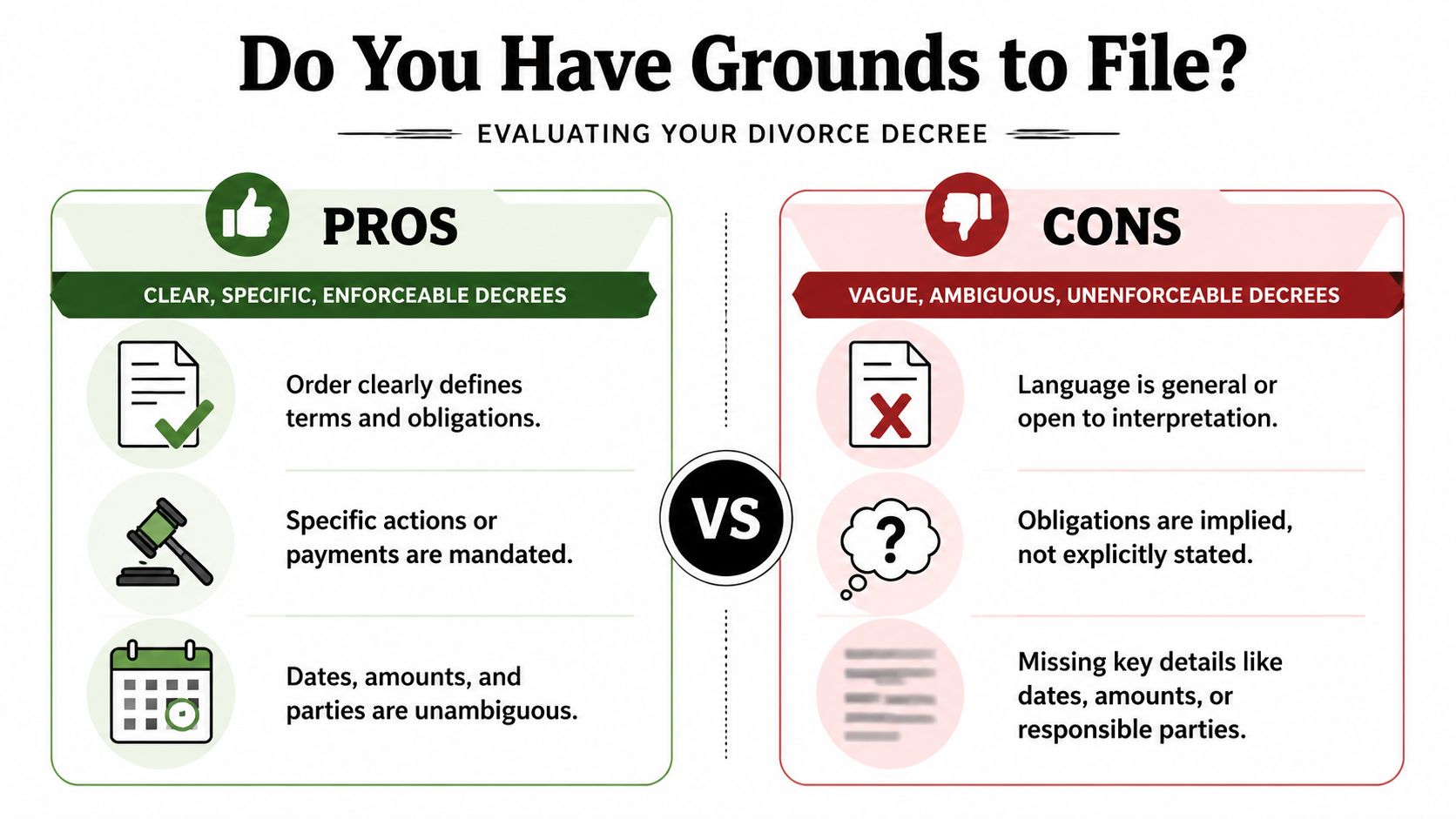
Clear language versus vague language
A decree is easier to enforce when it identifies the duty in a way that leaves little room for argument.
| More likely enforceable | Harder to enforce |
|---|---|
| A party must sign a vehicle title transfer | A party should cooperate with vehicle paperwork |
| A party must pay a stated monthly amount under the order | A party should help with expenses |
| A parent must surrender the child under the possession schedule in the order | A parent should be flexible and reasonable |
That doesn't mean every problem is hopeless if the wording is messy. It means enforcement depends on what the signed order says, not what both people thought it meant.
Common areas where enforcement comes up
Most post-divorce enforcement disputes fall into a few categories.
Property division
These cases often involve retirement funds, home sale obligations, debt payment duties, account transfers, or delivery of specific property.Support obligations
If the order requires payment and the payment wasn't made, enforcement may be available. If your issue involves post-divorce support, this overview of spousal support enforcement in Texas can help you see how these cases are framed.Possession and access
Visitation disputes are often emotional, but the court still looks for specifics. Which date? Which exchange? What exact part of the schedule was violated?
Some readers confuse enforcement of a final decree with temporary rules entered while the case was still pending. Temporary Orders During a Texas Divorce address how the court sets the rules while the divorce is pending. A motion to enforce after divorce focuses on the signed order that remained in place after the case ended.
Timing can decide whether your claim survives
For property division enforcement, timing matters as much as proof. Texas Law Help states that Texas law imposes a two-year statute of limitations for enforcing the division of property, starting from the date the divorce decree was signed or became final after an appeal, and you must wait at least 30 days after the decree is signed before filing an enforcement action in its guide on enforcing the property division in a divorce.
If you wait too long, a strong factual complaint can still become a weak legal case.
That's one reason clients should pull out the signed decree early, not after months of informal texts and repeated second chances.
How to Draft a Powerful Motion to Enforce
A good motion to enforce reads less like a complaint and more like a structured proof packet. The court needs to see the order, the breach, and the relief in a sequence that is easy to follow.

The biggest drafting mistake is writing the motion as an emotional summary of the relationship. Judges don't need every disappointment. They need a filing that tracks the decree with enough detail to support an enforceable ruling.
Start with the exact order
Identify the court, the case, and the order you want enforced. If the decree has later modifications or related orders, make sure you are using the one that controls the disputed issue.
Then quote the provision that matters. Don't paraphrase when the precise wording is available. If the violation concerns one paragraph, use that paragraph. If there are multiple violations, list them separately.
A practical format looks like this:
Name the order
State the date and title of the decree or later order.Quote the controlling language
Put the relevant paragraph or subsection into the motion.Match facts to that language
Describe exactly what the other party did or failed to do.Ask for specific relief
Tell the judge what enforcement action you want.
Build each allegation line by line
Many self-represented filings lose force by asserting the other side violated the order “repeatedly” or “for months” without detailing each event. A stronger pleading separates each alleged violation into its own entry and ties it to one clause.
For example, in a possession case, you would identify the date of exchange, the required action under the order, and what happened instead. In a property case, you would identify the transfer duty, any deadline in the decree, and the proof that it was not completed.
The more your motion reads like a ledger of compliance failures, the easier it is for a judge to rule on it.
That same discipline applies to your exhibits. Text messages, screenshots, receipts, bank records, calendars, and logs matter when they are organized and connected to a particular allegation. If you want a deeper look at how to organize proof, this article on what evidence matters most in a Texas divorce case gives a useful framework for sorting documents that will help the court.
Ask for relief the court can grant
Your requested relief needs to enforce the existing order, not improve it. That is where legal strategy matters.
Texas guidance on property-division enforcement says the court may clarify the decree or provide instructions to implement it, but it may not alter the property division itself. That means you should avoid requests that effectively rewrite who gets what. If the decree already awarded the asset or imposed the duty, your motion should ask the court to carry that existing obligation into action.
Here is a helpful way to think about the relief section:
Good enforcement request
Ask the court to compel signing of documents already required by the decree.Risky request
Ask the court to change the division because the original deal now feels unfair.Good enforcement request
Ask the court to enforce missed exchanges under the possession schedule already in place.Risky request
Ask the court to create a different parenting schedule through an enforcement motion.
This overview may help you visualize how lawyers present these requests in real cases:
Draft for the hearing you want to win
When I review draft motions, I look for one question: can the judge sign an order based on this wording without guessing what happened? If the answer is no, the motion usually needs revision.
Use plain facts. Use the decree's language. Attach proof that was created at the time of the event, not just a summary written later. That combination gives your motion weight.
The Critical Steps of Filing and Service
A strong draft can still fail if the filing and service steps are sloppy. In Texas enforcement practice, procedure is not paperwork for paperwork's sake. It is what gives the court authority to act.
Why service matters so much
If you are seeking contempt-style relief, strict notice rules matter. Texas Law Help explains in its guide on filing a motion to enforce visitation that the other party must receive at least 10 days' notice for a contempt hearing, and for property division enforcement the respondent must be served with citation and file a written answer to avoid a default judgment.
That is why defective notice is such a common failure point. A judge may agree that the order was ignored and still refuse the relief you requested because the notice or service was not done correctly.
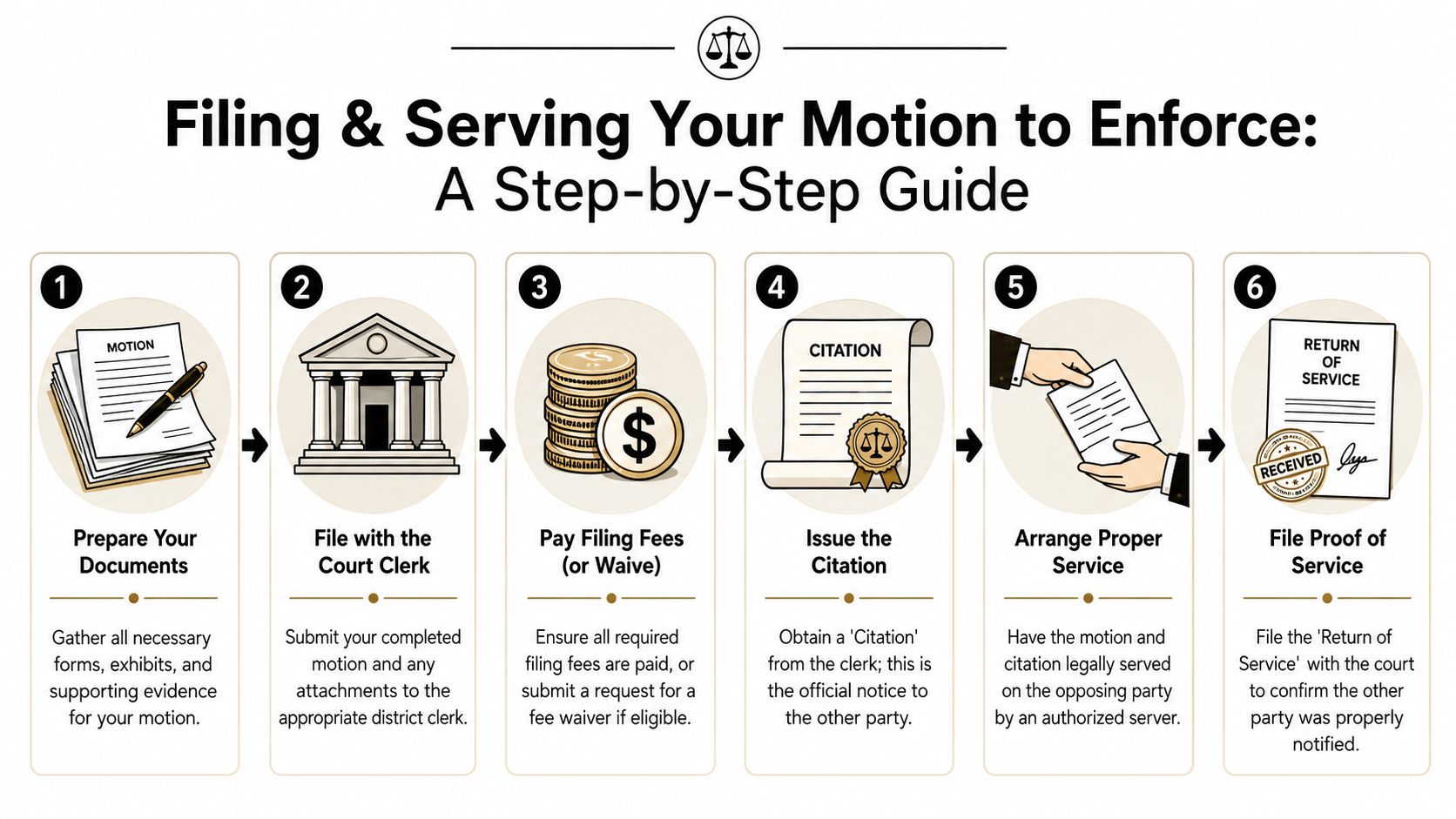
The filing sequence that usually works
Treat filing as a sequence of separate tasks, not one trip to the courthouse.
File in the original court
Enforcement usually goes back to the court that signed the order you want enforced.Get a hearing date
Coordinate with the court coordinator rather than assuming the court will set it automatically.Handle issuance and service carefully
If citation is required, make sure it is issued and served properly.File proof of service
Keep the record clean. If service happened, the court file should show it.
Texas Law Help adds a practical scheduling point for visitation enforcement. Set the hearing at least 20 days after filing so there is enough time to provide the required notice for a contempt hearing, as described in that same visitation enforcement guide referenced above.
What people get wrong
The most common errors are not dramatic. They are small procedural misses that become major barriers in court.
| Common mistake | Why it hurts the case |
|---|---|
| Treating enforcement like a general motion | The court expects the filing to track the existing order precisely |
| Giving short or unclear notice | Contempt-style relief often depends on strict compliance |
| Serving informally when formal service is required | The court may not be able to proceed as requested |
| Forgetting the proposed order | Even a favorable hearing can end with a weak or incomplete ruling |
Bring a proposed order that matches the relief you asked for and the evidence you expect to prove. Don't leave the final step to memory at the hearing.
Some people hire a process server or constable. Others work through counsel so the administrative steps are handled in sequence. The method matters less than accuracy. Filing, service, hearing setup, evidence preparation, and the final order all have to line up.
Preparing for Court and Understanding the Remedies
The hearing often turns on a simple moment. The judge asks where the decree imposed the duty, what the other party failed to do, and what proof supports that claim. If you can answer those three questions in a clean, organized way, your case is easier to hear and easier to rule on. If you cannot, even a legitimate complaint can lose force.
That is the practical difference between being upset and being ready for court.
Match your evidence to the exact language of the decree
Judges enforce orders. They do not enforce assumptions, side agreements, or broad claims that the other side has been unfair. Your exhibits need to track the decree line by line, the same way your motion should.
If paragraph 12 required one spouse to sign a deed by a certain date, bring the signed decree, the written request to sign, the missed deadline, and any follow-up showing the refusal or nonresponse. If the issue is denied possession, bring the possession order, a calendar showing the exchange date, your messages about the exchange, and any neutral record that confirms what happened.
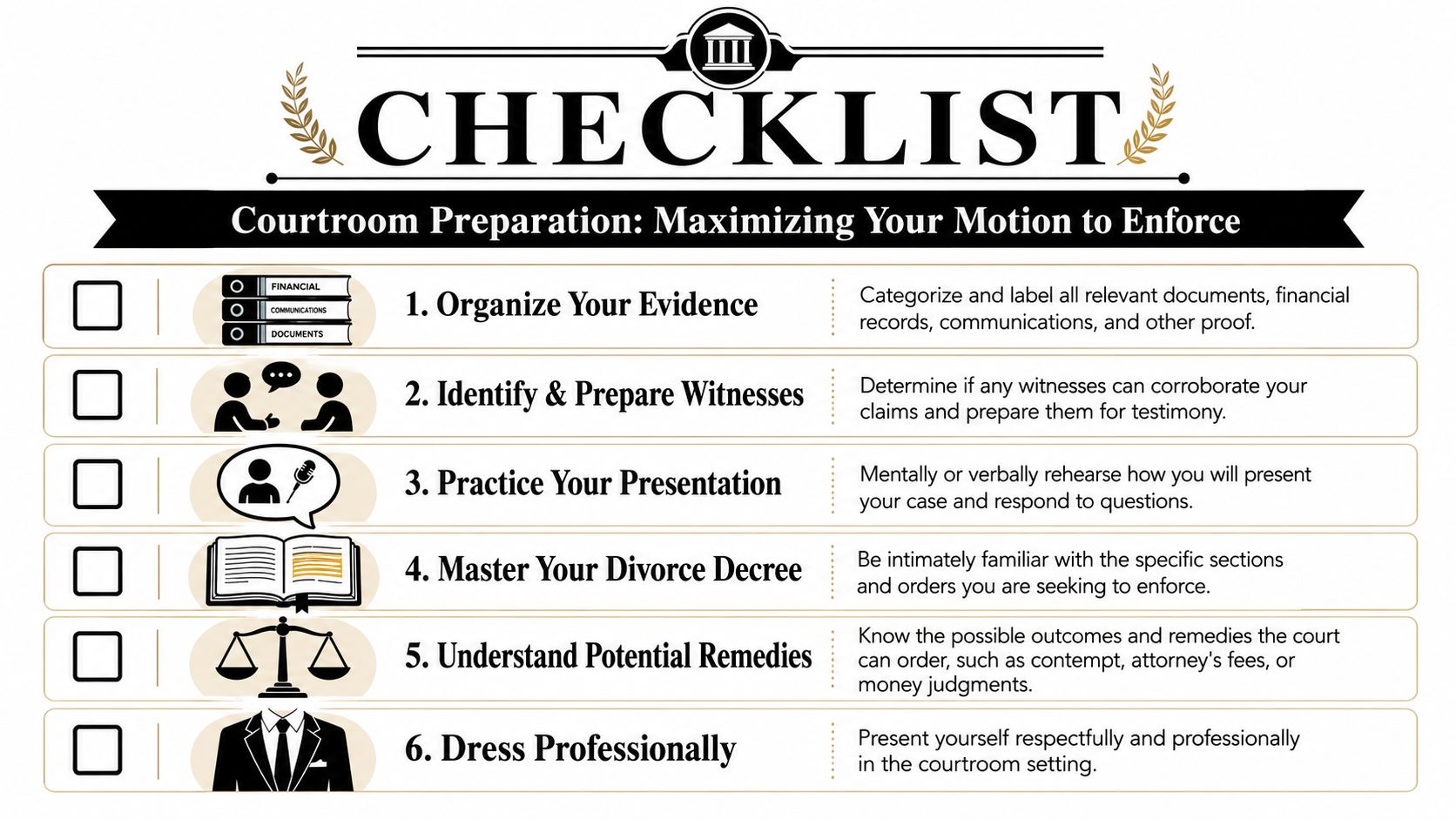
A useful hearing file usually includes:
The signed decree or controlling order
Mark the exact provisions you want enforced.A violation log
List each violation by date and connect it to one clause.Contemporaneous records
Screenshots, receipts, bank statements, emails, calendars, school records, and similar documents usually carry more weight than a long summary written later.A proposed order
Give the court language it can sign if it rules in your favor.
Good preparation also means knowing what to leave out. Judges rarely need every hostile text message or every detail of the history between the parties. They need the parts that prove a violation of a specific order.
Ask for a remedy that fits the violation
One of the most common strategic mistakes is overreaching. A motion to enforce is tied to an order that already exists, so the remedy needs to match both the decree and the proof.
If the evidence shows a missed property transfer, ask the court to compel that transfer and set out the steps required to complete it. If the evidence shows missed reimbursement payments, ask for a money judgment if the law and the order support it. If the evidence shows denied visitation, ask for enforcement of the possession terms and any relief the court can grant under those facts.
That restraint matters. When the requested relief fits the violation, the judge has a clearer path to act. When the request goes beyond the order or beyond the proof, the court may narrow the relief or deny that part of the case.
Present the case so the judge can rule from the bench
Courtroom presentation matters because enforcement hearings move quickly. The judge may have read the motion, but do not assume every detail is top of mind when your case is called.
A practical way to present each issue is:
Identify the exact provision
State where the duty appears in the decree or prior order.Describe the violation briefly
Give the date, deadline, or event and explain what did not happen.Tie the testimony to an exhibit
Point the court to the text, receipt, ledger, calendar entry, or other record.State the relief requested
Ask for the specific enforcement remedy you pled.
Clear, controlled testimony usually helps more than anger. A judge deciding an enforcement case is looking for precision, credibility, and a proposed remedy that can be written into an order.
If contempt is part of the request, treat that issue with extra care. Contempt can carry serious consequences, and courts expect the motion, notice, and proof to be exact. This guide on contempt of court in Texas divorce cases explains why those hearings require tighter pleading and preparation than a general complaint about noncompliance.
Decide whether the hearing is still manageable without counsel
Some enforcement hearings are straightforward. One missed payment, one clear deadline, one clean set of documents. Others are not.
Cases get harder when the decree uses vague property language, the other side disputes service, several violations are bundled together, or contempt is requested. At that point, the legal issue is no longer just whether the other party disobeyed the order. The issue becomes whether your motion, your proof, and your requested remedy are precise enough for the judge to act.
In that situation, some people choose to work with counsel, including Law Office of Bryan Fagan, PLLC, to prepare the motion, organize the evidence, and present the case at the hearing. That does not change the facts. It can improve how those facts are presented and whether the final order is written in a way the court can enforce later.
What to Do Next Protect Your Rights and Your Decree
A motion to enforce works best when you treat it as a precision tool. It is not a new divorce case. It is not a chance to renegotiate what feels unfair in hindsight. It is a request for the court to act on an order that already exists.
If you're deciding how to file a motion to enforce in a Texas divorce case, focus on what moves the court:
Locate your signed decree
Use the filed version, not a draft or memory of what was discussed.Create a dated violation log
Separate each event and connect it to one specific clause.Gather contemporaneous proof
Texts, receipts, screenshots, bank records, calendars, and logs usually carry more weight than general accusations.Review your requested relief
Ask for enforcement of the original order, not a rewrite of it.Take procedure seriously
Filing, notice, service, and the proposed order all matter.
The practical trade-off is simple. Waiting and hoping the other side will cooperate may feel easier today, but delay often makes proof harder to collect and patterns harder to untangle. A focused enforcement strategy gives you a better chance of getting a clear result.
If the decree has been ignored and you're tired of getting nowhere, it may be time to put the issue back before the court in a form that can be enforced. You don't have to stay stuck between informal arguments and repeated noncompliance.
If you need help enforcing a divorce decree, Law Office of Bryan Fagan, PLLC offers free consultations so you can discuss your order, your evidence, and the next legal step with a Texas family law team.