Skip to content
Texas doesn't require you to live separately for any set time before filing for divorce. What does matter is that at least one spouse has lived in Texas for six consecutive months and in the filing county for 90 days, and after filing there is a mandatory 60-day cooling-off period before most divorces can be finalized.
If you're sitting in the same house as your spouse and wondering whether you have to move out before you can start the process, you're not alone. Many Texas families assume separation starts the legal clock. In most cases, it doesn't. The risk isn't filing too early. It's waiting too long without a plan.
The Direct Answer to Your Texas Separation Question
The short answer is simple. You do not have to be separated before filing for divorce in Texas.
Texas allows most couples to file under Texas Family Code Section 6.001, which uses the no-fault ground of insupportability. In plain English, that means the marriage has broken down because of conflict or discord, and there isn't a reasonable expectation of fixing it. That ground doesn't require you to prove adultery, abandonment, or any period of living apart.
You can file even if you're still living together
A lot of people hesitate because they think moving out is a legal requirement. It usually isn't. You can still live in the same home and file for divorce. For some families, that's a practical choice while finances, parenting schedules, or housing decisions are still up in the air.
That matters because delaying a filing based on a myth can affect your property, your parenting routine, and your peace of mind.
Practical rule: In Texas, separation is usually a personal decision, not a filing requirement.
The question behind the question
When people ask how long must you be separated before a divorce in Texas, they're often really asking something deeper:
- Can I start now
- Do I need to move out first
- Will the court refuse my case if we're under one roof
- How long until the divorce is final
The answer to the first three is usually reassuring. You can often start now, you usually don't need to move out first, and the court won't reject a standard no-fault divorce just because you're still cohabitating.
The last question depends on the legal timeline after filing. Texas law uses a waiting-period system, not a pre-filing separation system. If you want a plain-English look at that timeline, The Texas 60-Day Divorce Waiting Period is a useful starting point.
One narrow exception exists
There is a fault-based ground called living apart under Texas Family Code Section 6.006. That ground requires spouses to have lived apart without cohabitation for at least three years. But that is a strategic option in a smaller set of cases, not the usual rule for getting divorced in Texas.
For most readers, the takeaway is this: you don't need to wait to separate before filing. What you do need is a legal strategy that fits your property, your children, and the reality of your home life.
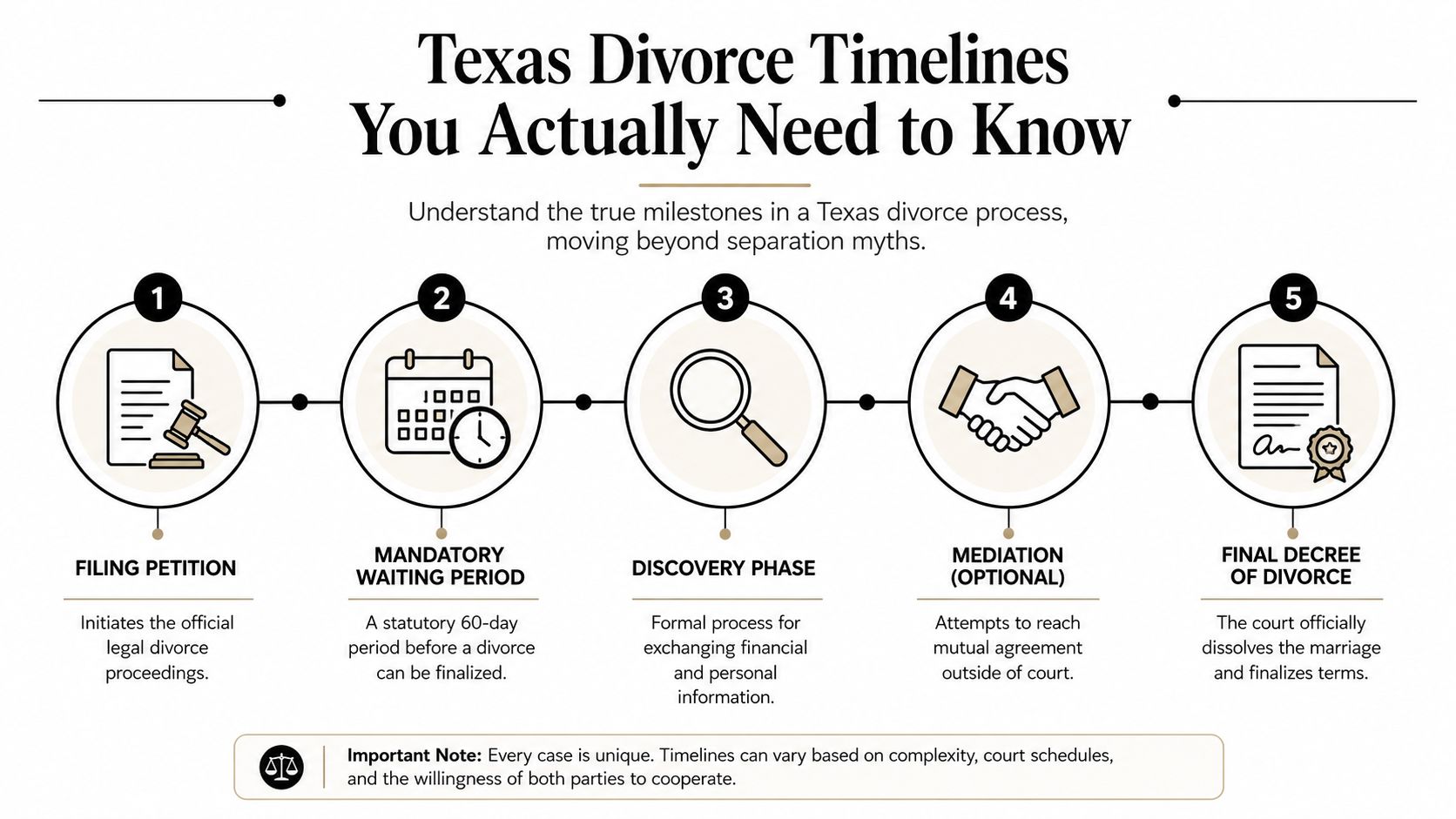
Texas Divorce Timelines You Actually Need to Know
Texas divorce law focuses on two timelines at the front end of a case. One determines whether you can file in a particular court. The other controls when a judge can sign the final decree.
The residency rules come first
Before you file, at least one spouse must have lived in Texas for six consecutive months and in the county where you file for at least 90 days under Texas Family Code § 6.301. That rule gives the Texas court authority to hear your divorce.
If you've recently moved, or if you and your spouse live in different counties, filing in the wrong place can slow you down. This is one of the first things a lawyer checks.
From a practical standpoint:
- State residency must be long enough for Texas to hear the case.
- County residency must be long enough for that local court to hear it.
- Only then does filing make sense.
The 60-day waiting period starts after filing
Once the Original Petition for Divorce is filed, Texas requires a 60-day waiting period before the divorce can be finalized under Texas Family Code Section 6.702. The rule starts the day after filing, and a judge can't finalize the case before that period expires unless there is documented family violence, as explained in this discussion of Texas divorce timing.
What happens between filing and final decree
The waiting period isn't dead time. It's usually when the real work gets done.
| Stage | What it usually involves |
|---|---|
| Filing | One spouse files the Original Petition for Divorce |
| Service or waiver | The other spouse is formally served or signs a waiver |
| Temporary issues | The court may address home use, parenting, support, or bill payment |
| Discovery | Information is exchanged about finances, property, and children |
| Mediation | Many couples try to settle before a final hearing |
| Final decree | The judge signs the divorce when the case is ready |
If you want a broader look at realistic uncontested and contested timelines, How Long Does a Divorce Take in Texas? walks through the process in more detail.
What works and what doesn't
Some choices help move a case forward. Others create delay.
- What works: gathering financial records early, dealing with temporary parenting issues quickly, and using mediation when both sides are capable of productive negotiation.
- What doesn't: waiting for an informal separation to “count,” assuming agreement alone can bypass the statute, or filing before checking residency.
- What often matters most: whether you and your spouse disagree about children, property, debt, or support.
One note on the internal link requirement for this section. The provided internal link text was unusable, so no accurate additional internal link is included here beyond the required catalog link already used.
The Dangerous Myth of Legal Separation in Texas
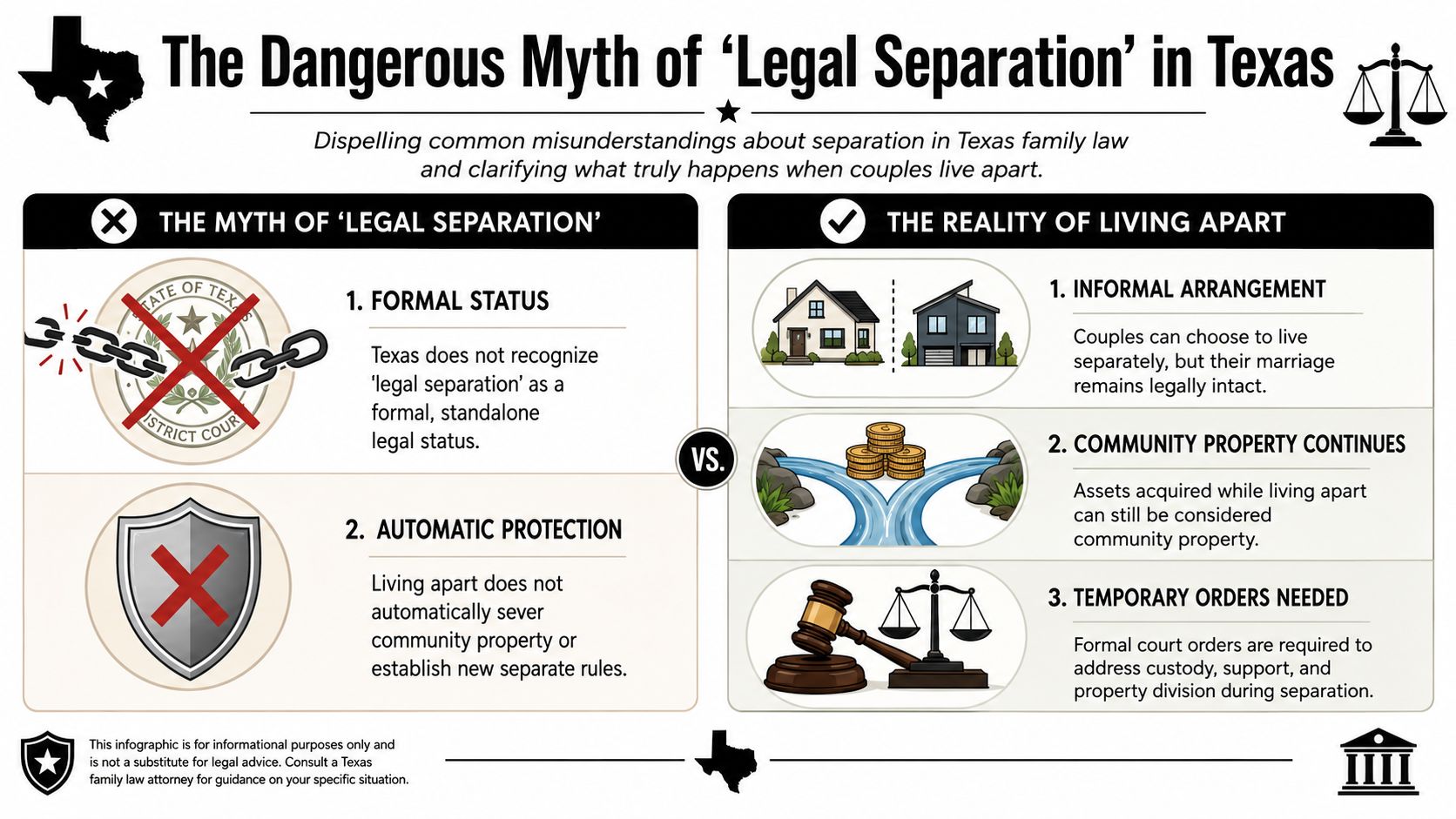
Many people believe they can become “legally separated” in Texas and hold everything in place until they're ready to divorce. That belief causes expensive mistakes.
Texas doesn't recognize legal separation as a formal legal status. You are either married or divorced. As explained in this discussion of legal separation versus divorce in Texas, assets and debts acquired during an informal physical separation can remain community property and still be divided in the divorce.
Why this myth is so costly
If you move out and agree to live separate lives, you may feel like you've ended the marriage in every practical way. The law may see it differently. Until a court signs a divorce decree, the marriage remains legally intact.
That can affect:
- Income earned after the split if one spouse believes those earnings are now fully their own
- Debt taken on during the separation if accounts, purchases, or business obligations continue
- Parenting expectations if there are no court orders setting conservatorship, possession, or support
- Property decisions if one spouse sells, transfers, or spends money without a formal framework
Handshake agreements don't replace court orders
Couples often try to keep things civil with an informal arrangement. Sometimes that works for a short time. It does not give you the same protection as a signed court order.
Living apart changes your daily life. It does not automatically change your legal status, your property rights, or your parenting rights.
This matters even more if you own a business, receive bonuses or commissions, manage investments, or expect a large asset event during the separation period. Without a legal plan, you can spend months or years assuming you protected yourself when you haven't.
For readers dealing with this exact problem, separated but not divorced in Texas is a useful follow-up topic because it focuses on what informal separation does and doesn't accomplish.
What actually helps
If you need space but aren't ready for a final divorce, legal structure still matters. Depending on your facts, that may include temporary orders, a divorce filing, or a separate case involving children. What usually doesn't help is waiting and hoping an informal split will sort itself out.
A calm separation without legal protection can still produce a hard property fight later.
How Your Separation Date Affects Property Custody and Support
Your separation date usually doesn't control when you can file. It can still matter a great deal in how your case unfolds.

Under Texas no-fault law, you can file with zero days of physical separation, and the waiting period starts the day after filing, not from a separation date, as noted in this explanation of Texas filing rules. But once spouses begin living separately, that date often becomes an important factual marker.
Why the date still matters in real life
Lawyers pay attention to separation dates because they can help frame disputes about money, parenting, and responsibility. The date may show when a couple stopped functioning as a unit, when one spouse began paying certain bills alone, or when a parenting routine changed.
Here are some common ways that date becomes important:
- Property tracing: if one spouse claims an asset should be treated differently, the timeline matters.
- Debt disputes: the court may need to understand when and why new debt was incurred.
- Temporary parenting arrangements: if one parent has already been handling school pickups, overnights, or medical appointments, that pattern can matter.
- Support questions: a clear timeline can help explain changes in household expenses and who has been covering what.
If you're trying to understand the bigger picture, separate property vs. community property in Texas is one of the most useful topics to review early.
How to document the separation date
You don't need a ceremonial move-out day for the date to matter. Courts and lawyers often look at practical evidence.
Consider keeping:
- Written communications such as texts or emails confirming the relationship changed
- Housing records if one spouse moved into another residence
- Financial records showing separate payment patterns
- Parenting calendars reflecting where the children stayed and who handled daily care
A documented timeline is often more persuasive than a memory-based argument months later.
This short video gives more context on divorce planning issues that often arise early in a case.
Keep this in mind: the separation date may not open the courthouse door, but it can shape negotiations about the house, the children, and financial responsibility while the case is pending.
Special Circumstances and Strategic Separation
Most divorces follow the usual no-fault path. Some don't. In a smaller group of cases, separation can matter as a legal tool rather than a requirement.
Family violence changes the timing
Texas has a narrow exception to the standard waiting rule. When there is documented family violence, a judge may waive the usual waiting period. That exception exists because safety comes first.
If abuse, threats, or coercive control are part of your situation, strategy changes fast. The focus may shift to protective orders, immediate parenting protections, exclusive use of the home, and urgent court relief. In those cases, delay can create more risk.
The three-year living apart ground
Texas Family Code Section 6.006 allows a fault-based divorce if spouses have lived apart without cohabitation for at least three years. As explained in this analysis of the waiting period and divorce grounds, this is a strategic option, not a mandatory one, and it is used in less than 10% of cases.
That matters because some spouses hear “Texas doesn't require separation” and assume separation is never relevant. That's too broad. It is usually not required, but in a narrower set of cases it can be part of a deliberate litigation strategy.
When this ground may be worth discussing
This ground can be useful when the facts already fit it and using it offers a practical advantage. Examples include long-term estrangement, some military family situations involving extended time apart, and certain high-asset cases where a clearly documented timeline may help frame the dispute.
A strategic conversation may focus on questions like these:
- Has the couple already lived apart long enough to use this ground without forcing the case into an unnatural theory
- Would alleging this ground simplify proof compared with fighting over other fault allegations
- Does the property picture benefit from a cleaner long-term timeline
- Are there children whose routines have already stabilized during the separation
Some legal grounds are not common, but they can still be useful when they match the facts instead of being forced onto them.
Mediation and case design still matter
Even in special circumstances, most cases still turn on preparation. A thoughtful lawyer looks at filing grounds, temporary orders, safety issues, financial records, and whether mediation can resolve part of the dispute. The right move depends less on slogans and more on what your case needs.
What to Do Next Your Path Forward in a Texas Divorce
Once you know Texas doesn't require separation before filing, the next step is practical action. Good outcomes usually start with clear records, realistic expectations, and early legal advice.
Start with the basics you can control
To file in Texas, at least one spouse must have lived in the state for six consecutive months and in the county for 90 days under Texas Family Code § 6.301, as outlined in this Texas residency overview. If you meet that threshold, you can begin planning even if you haven't moved out.
A solid first-week checklist often includes:
- Collect core financial documents such as bank statements, tax returns, retirement statements, pay information, mortgage records, and business records if applicable.
- List major concerns involving the children, the house, debt, separate property claims, and immediate household expenses.
- Document your timeline if you and your spouse have already begun living separate lives.
- Build a post-separation budget so you know what you can realistically afford.
- Avoid informal promises you can't enforce without court orders.
Use tools carefully and know their limits
If you're organizing paperwork or drafting simple summaries for your lawyer, digital tools can help you get started. Some people also use services that create legal documents with AI to prepare outlines or first drafts for review. That can be useful for organization, but it shouldn't replace case-specific legal advice when property rights, custody, or enforceable orders are on the line.
For readers comparing process resources, The Texas 60-Day Divorce Waiting Period explains why no Texas divorce can finalize in under the statutory minimum.
Think in terms of protection, not just filing
The filing itself is only one move. You may also need temporary orders, mediation, child-related relief, or enforcement planning depending on your circumstances. Parents should pay close attention to conservatorship, possession schedules, child support, and school-day logistics. Business owners should identify what records exist now and what valuation issues may arise later. If you have a high-value estate, the earlier you map your assets and claims, the better positioned you'll be.
The Law Office of Bryan Fagan, PLLC handles Texas divorce, custody, support, mediation, and enforcement matters, which makes a consultation useful when your case touches more than one issue at once.
What to do next
- If you're still living together: don't assume you must move out before speaking with a lawyer.
- If you've already separated: don't assume the separation protected future income or debt.
- If children are involved: don't rely on a verbal parenting plan when conflict is growing.
- If property is complex: don't wait for a dispute to become harder to trace.
The right plan usually feels calmer than the uncertainty you're living with now. Once you understand the timelines and the risks, you can make decisions from a position of strength instead of fear.
You don't have to guess your way through this. If you're considering divorce, living separately without orders, worried about custody, or trying to protect property before filing, schedule a free consultation with the Law Office of Bryan Fagan, PLLC. You'll get a clearer view of your options, the court process, mediation possibilities, and the steps that can protect your family and your future.