Skip to content
You may be sitting at your kitchen table right now, wondering whether divorce means public hearings, courtroom stress, and months of conflict.
In Texas, it often doesn't.
Your Divorce Does Not Have to Be a Courtroom Battle
A lot of people delay filing because they assume divorce always turns into a fight in front of a judge. That fear is understandable. You're already dealing with enough emotion, uncertainty, and disruption at home. The idea of adding a courtroom battle on top of that can make it feel impossible to start.
But that worst-case picture isn't the norm. In Texas, approximately 72% of divorce cases are resolved without either spouse appearing in court for a contested hearing, largely because many couples reach agreement on the major issues and complete the process outside a courtroom, according to this Texas divorce overview.
That matters because it changes the question. Instead of asking whether divorce will become a courtroom battle, the better question is this: which out-of-court path fits your situation best?
Agreement is the real dividing line
If you and your spouse already agree on the key issues, an uncontested divorce may be the most efficient route. In plain English, that means you both agree the marriage should end and you also agree on the terms, including:
- Property division: who keeps what, and who takes responsibility for which debts
- Children's issues: conservatorship, possession, decision-making, and child support
- Final paperwork: the terms are written clearly enough for a judge to sign
Texas family law gives spouses room to settle these issues privately. That's often better for families, especially when children are involved. Parents who can cooperate on a parenting plan usually preserve more control over school schedules, holidays, exchanges, and communication than parents who leave those decisions to a court.
Private solutions often work better than forced outcomes
You don't have to choose between “do it all yourself” and “go to trial.” There's a middle ground, and often several of them. Some couples need only paperwork. Others need one structured mediation session. Some need a more supported process because they own a business, have retirement issues, or need help keeping conflict low for the children.
Practical rule: The more you and your spouse can agree on in writing, the less likely you are to need court involvement.
That doesn't mean every divorce stays peaceful. It means you have options. If your spouse is reasonable, organized, and willing to exchange information in good faith, there is a strong chance your divorce can move forward with very little courtroom involvement. If the situation is more complicated, you can still aim for resolution outside court while protecting your rights.
Choosing Your Out-of-Court Divorce Path in Texas
Not every no-court divorce looks the same. Some cases are simple because the marriage was short, there are no children, and there isn't much property to divide. Others involve a house, retirement accounts, a family business, reimbursement claims, or disagreements about a parenting schedule. The right process depends on the level of trust, the quality of communication, and the complexity of the issues.
The three main paths
The most common out-of-court options are uncontested divorce, mediation, and collaborative divorce.
An uncontested divorce works best when everything important is already settled. Mediation works when you need help getting from disagreement to agreement. Collaborative divorce fits cases that need more structure, more professional support, and a deliberate plan to avoid litigation.
If you already know that your spouse won't cooperate, it helps to understand how Contested Divorce in Texas: What to Expect works, because that's the process a case follows when spouses cannot agree.
Comparing Out-of-Court Divorce Options in Texas
| Method | Best For | Key Feature | Typical Cost |
|---|---|---|---|
| Uncontested divorce | Couples already in full agreement | Minimal conflict, document-driven process | Usually the lowest-cost option |
| Mediation | Couples who are close to agreement but stuck on a few issues | Neutral mediator helps negotiate settlement | Moderate, depending on scope and preparation |
| Collaborative divorce | Families with complex property, business interests, or parenting concerns | Team-based problem solving without going to court | Usually higher than mediation or simple uncontested cases |
Uncontested divorce works when the details are already settled
This is the cleanest route. You and your spouse agree on the house, debts, accounts, vehicles, parenting terms, support, and the language of the final decree. If that's your situation, the process is often more administrative than adversarial.
This path usually works well for:
- Shorter marriages with limited property
- Couples without minor children
- Parents who already follow a workable schedule
- Spouses who can exchange financial information without gamesmanship
What doesn't work is calling a case “uncontested” when there are real unresolved issues. If one of you is still arguing over the retirement account, the house refinance, or where the children will spend school nights, it's not ready for an uncontested finish.
Mediation helps when you need a bridge, not a judge
Many couples don't need a courtroom. They need a structured conversation with rules, preparation, and someone neutral in the middle. That's where mediation can be useful. A mediator doesn't represent either spouse and doesn't impose a ruling. The mediator helps you narrow disputes and turn broad positions into workable terms.
If you want a fuller look at that process, this overview of mediation for divorce in Texas explains how negotiated settlement typically works.
A good mediation session is focused. The spouses arrive with documents, concrete proposals, and a willingness to solve actual problems instead of replaying the marriage.
Mediation often makes sense when:
- one parent wants a different possession schedule than the other
- there's disagreement about how to divide one or two major assets
- communication has become tense, but not impossible
- both spouses want privacy and control
Collaborative divorce fits complex families and complex finances
Collaborative divorce is more deliberate. Each spouse has a collaboratively trained attorney, and the process is designed to resolve issues without litigation. Depending on the case, the team may also include a neutral financial professional or a mental health professional who helps with communication and parenting issues.
This can be a smart choice for:
- Business owners
- People with high-value estates
- Parents who want a detailed parenting plan
- Spouses who value privacy and want to reduce public conflict
The trade-off is simple. Collaborative divorce usually requires more time, more preparation, and more professional involvement than a basic uncontested matter. But in the right case, that investment can prevent expensive disputes later.
How to choose the right path
Start with honesty, not optimism.
Ask yourself:
- Do you agree on everything important right now?
- Can you both exchange information without hiding assets or delaying?
- Do you need help negotiating one issue, or many?
- Would a structured process lower conflict for your children?
- Are there business interests, retirement assets, or real estate that need careful drafting?
If the answers point to full agreement, uncontested may be enough. If the answers point to partial agreement, mediation is often the practical next step. If the answers point to complexity and fragile communication, collaborative divorce may give you the best chance to stay out of court while still protecting what matters.
The Texas Uncontested Divorce Process From Start to Finish
A lot of Texas divorces stay out of the courtroom, but they do not run on autopilot. The couples who finish efficiently are usually the ones who choose the right out-of-court path early, then follow the filing and drafting sequence carefully. If your agreement is already in place, an uncontested case may be the shortest route. If you still need help on one or two issues, mediation often gets you to the same finish line without turning the case into a fight.
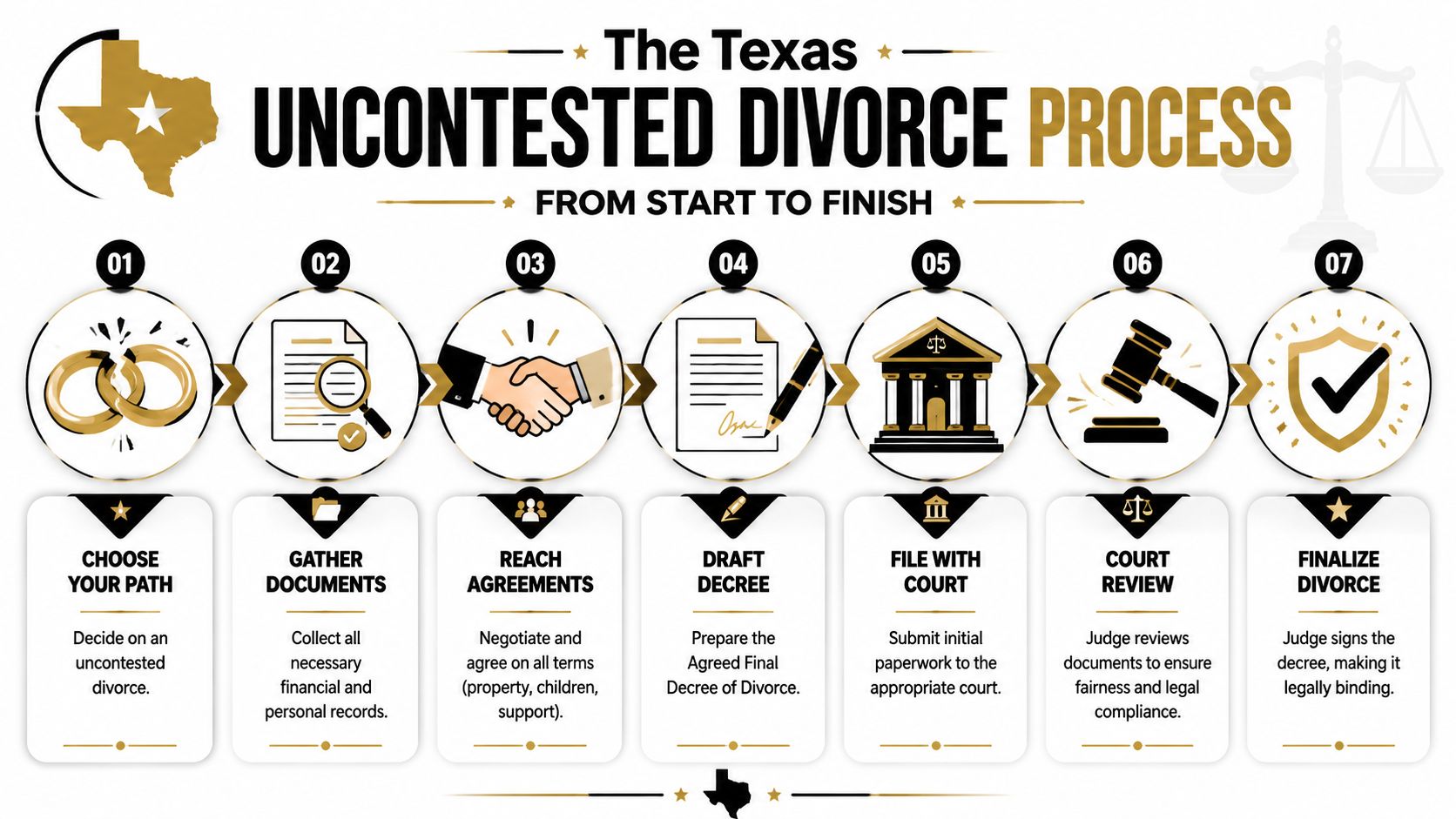
Step one is confirming that Texas can hear your case
Before anyone files, at least one spouse must meet Texas residency requirements. One spouse must have lived in Texas for at least six months and in the filing county for at least 90 days. This guide on how to file divorce in Texas explains the basics.
Then the case starts with the Original Petition for Divorce. That document tells the court that a divorce is being requested and identifies the general issues involved, such as children, property, or support. If you want a closer look at that document, The Original Petition for Divorce in Texas explains what it typically includes.
Step two is filing in the right county and setting the case in motion
The petition is filed with the district clerk. Many counties allow electronic filing, while some people still prefer to file in person. Once the clerk accepts the petition, the court assigns a cause number and the divorce case officially exists.
That filing step matters even when nobody expects a courtroom dispute. Texas still requires a formal case, a judge, and a signed final order. The difference is that in an agreed divorce, the work usually happens through disclosures, drafting, signatures, and approval of the paperwork rather than contested hearings.
Step three is giving proper notice to the other spouse
The other spouse must be legally notified. In many agreed cases, that happens through a signed Waiver of Service instead of formal service by a constable, sheriff, or private process server.
This is one of the first strategic checkpoints in the process. A cooperative spouse who signs a valid waiver usually keeps the case on track. A spouse who delays, refuses to sign, or cannot be located often pushes the case out of the uncontested lane and into a more complicated process.
Step four is using the waiting period to finish the real work
Texas has a 60-day waiting period after filing before the divorce can be finalized. That time should be used well.
The strongest uncontested cases use those weeks to gather account statements, confirm balances, review titles and deeds, decide how debts will be paid, and work through child-related details. If retirement accounts, a house, restricted stock, or business interests are involved, this is also the time to make sure the agreement is specific enough to carry out in practice.
For a fuller procedural checklist, this step-by-step guide to the uncontested divorce process in Texas is a useful reference.
If you are signing related documents electronically during this stage, some clients also find this background piece on digital signing sales agreements helpful for understanding secure signature workflows.
Step five is preparing the final papers with enough detail to hold up
The key document is the Agreed Final Decree of Divorce. This is the order the judge signs, and it needs to be precise. It should state who receives each asset, who pays each debt, what happens with the marital home, and how parenting rights and duties will work if children are involved.
In practice, simple cases and complex cases have different requirements. A couple with no children, no house, and separate bank accounts may need a fairly short decree. A couple with retirement accounts, reimbursement claims, or a custom possession schedule needs much tighter drafting. Agreement alone is not enough. The language has to be usable.
Step six is completing the prove-up or submitting the paperwork your county requires
Some counties allow finalization without a personal appearance in limited situations, especially if there are no minor children and the paperwork is complete. Other counties still require a short prove-up, whether in person, by affidavit, or by remote appearance if the court allows it.
Clients are often surprised by this part. “No court” usually means no contested hearing and no trial. It does not always mean zero contact with the court system. A brief prove-up is still far easier, cheaper, and less stressful than litigating temporary orders or a final trial.
Step seven is carrying out the decree after the judge signs
Once the judge signs the decree, the marriage is legally dissolved. The practical work is not always finished that day.
Follow through on the items the decree requires, including:
- Signing deeds or title transfer documents
- Updating beneficiary designations
- Submitting retirement division paperwork
- Closing or separating joint financial accounts
- Setting up child support payment procedures
- Keeping copies of all signed documents and confirmations
I tell clients to treat the signed decree as both an ending and a to-do list. The couples who stay out of future disputes are usually the ones who complete the transfer steps promptly and keep good records.
Drafting Your Settlement to Avoid Future Problems
Two spouses can agree in principle, shake hands on the main points, and still end up back in a dispute six months later. The problem is usually not the decision to settle outside court. The problem is that the written terms did not cover how the agreement would work in real life.

A settlement only keeps you out of court if the decree is precise enough to carry out and enforce. That matters whether you reached terms through a straightforward uncontested case, a mediated settlement, or collaborative divorce. The more complex the property or parenting issues, the less room there is for shorthand.
Your decree needs operational language
I tell clients to draft for the first disagreement, not the day everyone is getting along.
If one spouse keeps the house, the decree should say who lives there until refinance or sale, who pays the mortgage, taxes, insurance, and repairs, what the deadline is for removing the other spouse from the debt if possible, and what happens if that deadline passes. If retirement accounts are divided, the decree should match the language needed for later transfer documents. If a business is involved, the terms should address records, control, valuation-related assumptions, and who is responsible for ongoing liabilities.
If you are dividing digital records or signed contracts for a business, it can also help to understand how secure electronic execution works in other legal and commercial settings. This short piece on digital signing sales agreements is useful background when you're thinking about document integrity and signature workflows.
Parents need specifics, not good intentions
Parents often tell me they want to “stay flexible.” Flexibility can work when trust is high and communication is steady. In a decree, vague language usually creates room for conflict.
Texas orders use terms like conservatorship, possession, and support, but the practical question is simpler. Can both parents read the order and know exactly what happens on a school morning, a holiday exchange, or an unexpected medical issue?
A workable parenting section should address:
- Exchange details: exact times, location, transportation responsibility, and what happens if a parent is late
- School issues: who can make educational decisions, receive records, and handle tutoring or special services
- Medical care: who carries insurance, how unreimbursed expenses are shared, and how notice is given
- Holidays and summer: exact start and end times, not broad references
- Communication: how parents share information and how the child contacts the other parent
If a sentence can reasonably be read two ways, expect a future argument over it.
Debt terms deserve the same attention as asset terms
Property division gets the spotlight. Debt causes many of the post-divorce surprises.
The decree should assign responsibility for credit cards, personal loans, tax debt, medical bills, and business obligations with the same level of detail used for assets. It should also address deadlines for payoff, refinance, indemnity language where appropriate, and what documents each spouse must sign to complete the transfer.
There is also a trade-off here. An uncontested case may be enough when the debt picture is simple and both spouses can close or refinance accounts quickly. Mediation or collaborative divorce may be the better route when one spouse runs a business, cash flow is uneven, or tax issues need negotiated timing. For a closer look at how these negotiated terms are usually put together, see this article on settlement agreement divorce in Texas.
A decree can assign a debt between spouses. It does not force a lender to release a borrower from the original contract. That often requires separate action after the divorce, such as refinancing, paying off the balance, or closing the account.
Technical mistakes can still slow down an agreed case
Even a fully agreed divorce can stall if the paperwork is careless. Service rules, local standing orders, required notices, and county-specific filing practices still matter. Texas Law Help's divorce guide is a useful starting point for understanding the basic paperwork, especially in simpler cases without children.
This is one reason many people choose a middle path. They handle much of the process themselves, then pay for a lawyer to review the settlement and decree before filing the final papers. That approach can make sense in a simple uncontested divorce. In higher-conflict or higher-asset cases, drafting support earlier in the process usually saves more trouble than it costs.
The Law Office of Bryan Fagan, PLLC handles Texas divorce, custody, support, mediation, and enforcement matters for people who need guidance on settlement language, negotiation strategy, or final-order review.
What Happens When You Cannot Reach an Agreement
A case isn't a failure because it stops being cooperative.
Sometimes one spouse won't disclose financial information. Sometimes parents have a real disagreement about where the children should live during the school week. Sometimes a business valuation, reimbursement claim, or separate-property issue can't be solved by goodwill alone. When that happens, the court becomes a tool, not a punishment.
Court involvement can be narrow
People hear “contested divorce” and imagine a full trial right away. That usually isn't what happens first. In many cases, court involvement begins with a focused hearing on one temporary issue, such as use of the house, temporary support, or a temporary parenting schedule.
That kind of hearing is different from a final trial. It addresses immediate needs while the larger case continues toward negotiation, mediation, or eventual settlement.
The usual pressure points
Out-of-court resolution becomes harder when one or more of these issues is present:
- Custody conflict: one parent wants a schedule or decision-making structure the other believes is not workable
- Hidden or unclear finances: one spouse controls accounts, business records, or income information
- High-value property issues: real estate, businesses, retirement assets, or inherited property need closer analysis
- Bad-faith negotiation: one side delays, refuses to exchange documents, or uses agreement as a stalling tactic
You can want peace and still need court orders. Those two ideas aren't inconsistent.
Texas Family Code protections still matter
Texas family courts can issue temporary orders to stabilize a case. Those orders often address conservatorship, possession, support, use of property, payment of bills, and conduct while the case is pending. For parents, temporary orders can provide needed structure quickly when day-to-day conflict is affecting the children.
Property issues can also require judicial help. Texas community property rules don't mean every asset is split down the middle in a casual way. Classification, tracing, reimbursement claims, and debt responsibility can become disputed. When that happens, careful legal analysis matters more than optimism.
If your case turns contested, that doesn't mean you'll spend months in trial. It means the legal process gives you a framework to protect yourself, secure information, and move toward a result that can hold.
What to Do Next A Clear Path Forward
Once you understand your options, the process feels less like chaos and more like a set of decisions.

Key Takeaway
If you're asking how to file for divorce without going to court, the answer depends less on one form and more on one fact. Can you and your spouse reach clear, workable agreements? If yes, an uncontested process may fit. If you need help getting there, mediation or collaborative work may be the better strategy. If cooperation breaks down, court can still protect your rights without defining the entire case.
Start with these next steps:
- Identify your path: uncontested, mediation, collaborative, or contested if needed.
- Gather documents: deeds, account statements, debt records, tax returns, and parenting information.
- List unresolved issues: don't call the case agreed if it isn't.
- Focus on the decree: the final order matters more than broad verbal promises.
- Protect your children's routine: clear parenting terms reduce future conflict.
If your separation also affects shared digital storage, family photos, or account access, this guide to family cloud file access is a practical reminder that divorce planning often reaches beyond court forms and bank accounts.
A short video can also help if you're weighing your next move.
What to do next
If your case is simple and fully agreed, move carefully and make sure the paperwork is complete. If children, a business, retirement assets, real estate, or high-value property are involved, don't rely on informal promises or generic forms alone. The money you save upfront can disappear fast if the decree is unclear.
You don't need to have every answer before you take the first step. You just need a realistic plan and the right level of support for your situation.
If you're ready to move forward, schedule a free consultation with Law Office of Bryan Fagan, PLLC. You can talk through whether your case is uncontested, whether mediation or collaborative divorce makes more sense, and what steps will protect your children, your property, and your peace of mind under Texas law.