Skip to content
You and your spouse finally had one calm conversation at the kitchen table, and now you're wondering whether the agreement you reached means anything in a Texas divorce.
That question matters more than is commonly realized. In Texas, some divorce agreements are just part of ongoing negotiations. Others can lock you in. If you sign the wrong document too casually, or leave out one required part, you can create a mess that takes far more time and money to fix.
Texas Family Code § 6.604 gives you a real path to settle your divorce outside a formal mediation session. It can work like a do-it-yourself alternative to mediation, but only if you follow the rules exactly. If you don't, what felt like a solid agreement may turn out to be unenforceable.
When a Handshake Becomes Binding in Your Texas Divorce
You and your spouse sit down after the children go to bed. For the first time in weeks, the conversation stays calm. You agree that one of you will keep the house, the school routine will stay the same, and the retirement account can be divided once the paperwork is finished. You write it down, both sign, and feel relieved for about ten minutes.
Then the question shows up. Did you just make a plan, or did you just make a binding divorce agreement?
A private deal can carry the same force as mediation
Texas Family Code § 6.604 gives spouses a do-it-yourself settlement option that can carry the same binding power as a formal mediation agreement, but only if the writing is done the right way.
That is why this section matters. Many spouses assume an agreement is either completely informal or fully official, with nothing in between. Texas law is not that simple. A kitchen-table divorce deal can move from "we are still talking" to "we are locked in" faster than people expect.
If you have been trying to understand why some papers matter and others do not, this practical overview of ref_domains helps explain how wording, signatures, and intent can change the legal effect of a document.
Why this catches people off guard
Informal divorce talks happen everywhere. At home. In a lawyer's conference room. Over email. During a short meeting between spouses and counsel.
That creates confusion because several Texas settlement tools can sound alike while working very differently. An informal settlement agreement under § 6.604 is not the same thing as a casual note, and it is not the same thing as a standard Rule 11 agreement in Texas family law.
A simple way to look at it is this. Mediation usually involves a neutral mediator and a more formal process. Section 6.604 lets you and your spouse try a private, lower-cost version on your own. If you satisfy the statute's requirements, the result can have the same practical force. If you miss those requirements, you may have nothing enforceable at all.
A peaceful conversation is a good start. In some Texas divorces, a signed writing from that conversation can also become the point where your options narrow sharply.
What this means for you right now
If you want to settle without paying for a full mediation day, § 6.604 may give you a useful path. It can save time, lower conflict, and help you keep decisions in your hands. It can also create problems if you sign first and ask questions later.
Your immediate job is not to memorize the statute. It is to know that the moment of enforceability does not turn on a handshake alone. It turns on whether your informal deal is put into a written form that Texas treats as binding.
That is where worried spouses usually need clarity most. You want the benefit of a DIY settlement without accidentally locking yourself into terms you did not fully understand.
Understanding Family Code 6.604 in Plain English
You and your spouse sit at the kitchen table after the kids go to bed. You finally make progress. You agree on the house, the bank accounts, and a parenting schedule that feels fair. The next question is the one that makes many spouses nervous. Did that private deal just become binding?
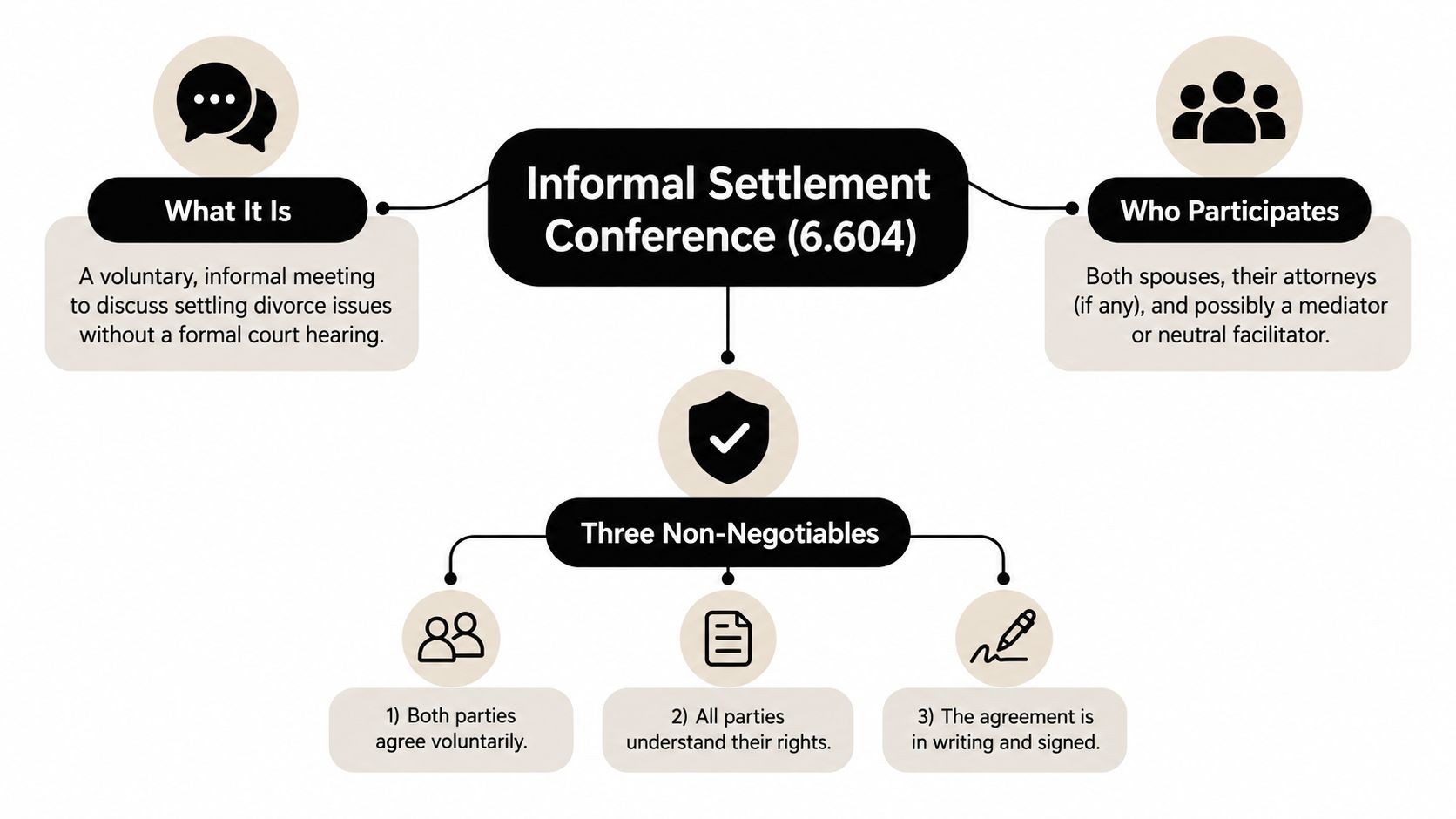
Family Code 6.604 answers that question. It gives you a do-it-yourself settlement option that can carry the same practical force as mediation, but only if you lock it in the way the statute requires.
What an informal settlement conference really is
An informal settlement conference is a private meeting where you and your spouse try to resolve divorce issues without a mediator running the discussion. Lawyers can be there, or the two of you can meet alone. Either way, the goal is the same. You try to reach a written agreement on the terms of your divorce.
This process works like a DIY version of mediation. You skip the formal mediation session, but you can still end up with a settlement that binds both of you if the paperwork is done correctly.
The topics are usually the same ones a mediator would help you address:
- Property division, including the home, bank accounts, retirement, vehicles, and debts
- Parenting terms, including conservatorship, possession, and decision-making
- Support issues, including child support and, when appropriate, spousal maintenance
One caution matters here. Agreement is only part of the job. Under 6.604, the conference itself does not lock you in. The written document does.
When the agreement becomes binding
Many spouses assume the point of no return happens when both people say yes out loud. That is not the rule. A 6.604 agreement becomes binding when the settlement is put in writing and includes the features the statute requires.
In plain English, your written agreement must have all three of these parts:
- A prominently displayed statement that the agreement is not subject to revocation
- The signature of each party
- The signature of any attorney who is present when the agreement is signed
Miss one piece, and you may have an agreement in principle but not an enforceable 6.604 settlement.
That distinction matters a lot. It is the difference between "we had a productive talk" and "we signed something Texas courts will usually treat as binding."
Why the nonrevocation language matters so much
The nonrevocation statement is the warning label on the document. It tells everyone, clearly and up front, that this is not a draft and not a proposal either side can withdraw later.
For that reason, the language needs to stand out. If it is buried in dense text, squeezed into boilerplate, or left out altogether, you create room for a fight over whether the document qualifies under the statute.
A careful spouse should pause here. Signing a written deal at an informal conference can be every bit as serious as signing at mediation. If you still need answers about missing assets, unclear debt balances, or retirement values, get those questions resolved before you sign.
Why this works differently from Rule 11
Section 6.604 has its own framework. Once the statutory requirements are met, the agreement is treated under that statute's rules rather than the usual Rule 11 analysis people often hear about in Texas family cases.
That is why 6.604 causes confusion. The setting feels casual compared to a formal mediation session, but the legal effect can be very similar. If you want to compare the two side by side, this explanation of a Family Code 6.602 mediated settlement agreement in a Texas divorce shows how closely the statutes track each other.
A good way to view 6.604 is this. Mediation is the supervised route. An informal settlement conference is the private route. Both can end with a binding result. The risk in the private route is not that it is weaker. The risk is that spouses sometimes sign a binding document without realizing they have reached the lock-in point.
How Informal Agreements Compare to Other Texas Settlement Options
You and your spouse sit down at the kitchen table, work through the house, the debts, and the parenting schedule, and reach a deal without a mediator. That can save time and money. It can also create the same kind of binding result people expect only from mediation, if your written agreement fits Texas Family Code § 6.604.
That is the key comparison. Section 6.604 is the do-it-yourself path with real legal force. Mediation adds a neutral third person and more structure. Rule 11 serves a different job altogether.
Three options, three different rules
People often group these together because all three can help settle a divorce. The legal effect is not the same.
An informal settlement agreement under § 6.604 is for spouses who choose to confer directly, with or without lawyers, and reduce their deal to a writing that meets the statute. A mediated settlement agreement follows a formal mediation session with a mediator. A Rule 11 agreement is a separate procedural tool used in Texas cases for agreements that are in writing, filed, or stated in open court.
If you want a broader look at the mediation process, Divorce Mediation in Texas How It Works discusses why many contested Texas divorces settle in mediation.
Choosing Your Texas Divorce Settlement Path
| Feature | Informal § 6.604 | Mediated Settlement | Rule 11 Agreement |
|---|---|---|---|
| Setting | Private conference agreed to by spouses | Formal mediation session with a neutral mediator | Written agreement or agreement made on the record |
| Lawyer required | No, spouses may meet with or without lawyers | Lawyers often participate, mediator is separate | Usually handled through counsel or court record |
| Mediator involved | Not required | Yes | Not required |
| Binding trigger | Written agreement with nonrevocation statement, party signatures, and signatures of any attorneys present at signing | Similar statutory nonrevocation and signature structure | Different framework |
| Revocation risk | Lower once statutory requirements are met | Lower once statutory requirements are met | Can raise different enforcement issues |
| Best fit | Couples who can negotiate directly and document carefully | Couples who need structure and a neutral go-between | Narrow procedural or interim agreements |
A simple way to sort them out helps. Mediation is the guided route. Section 6.604 is the private route. Rule 11 is often the courtroom paperwork route.
Why § 6.604 appeals to some couples
Section 6.604 can work well when you do not need a mediator to keep the conversation productive. It gives you more control over the pace, the setting, and the cost. For some spouses, that feels less formal and less draining than spending a day in mediation.
It also carries a hidden risk. Because the setting feels informal, a spouse may sign too early, before checking account balances, retirement values, reimbursement claims, or the wording of a possession schedule. That is where accidental enforceability becomes a real problem. Once the statutory requirements are met, you may be locked into a deal you thought was still a draft.
When mediation is the safer route
Mediation usually makes more sense when direct discussion keeps breaking down or one spouse feels outmatched. A good mediator does not decide your case, but the process can slow things down and keep the conversation focused.
That added structure often helps in cases involving:
- Hard parenting disputes
- Closely held businesses or self-employment income
- Large estates, retirement division, or tracing questions
- A history of pressure, intimidation, or uneven financial knowledge
If your case has those features, the extra structure is often worth it.
Where Rule 11 fits
Rule 11 is often useful for smaller agreements made during the case. For example, spouses may use it to confirm a continuance, temporary exchange deadlines, or a limited agreement on one issue while larger disputes remain unresolved.
It is usually not the cleanest substitute for a full § 6.604 or mediated settlement agreement when your goal is a complete divorce settlement with the strongest possible protection against later backtracking.
If you want the do-it-yourself alternative to mediation, § 6.604 is the closest match. Just remember the tradeoff. You get flexibility, but you also lose the guardrails that come with a formal mediator-led process.
How to Create and Memorialize a Valid Informal Settlement Agreement
You sit down at the kitchen table, work through the house, the debts, and the parenting schedule, then type up what you both agreed to. It feels informal because no mediator was in the room. Under Family Code § 6.604, though, a do-it-yourself settlement can carry the same binding force if you handle it the right way. That is the benefit and the risk.
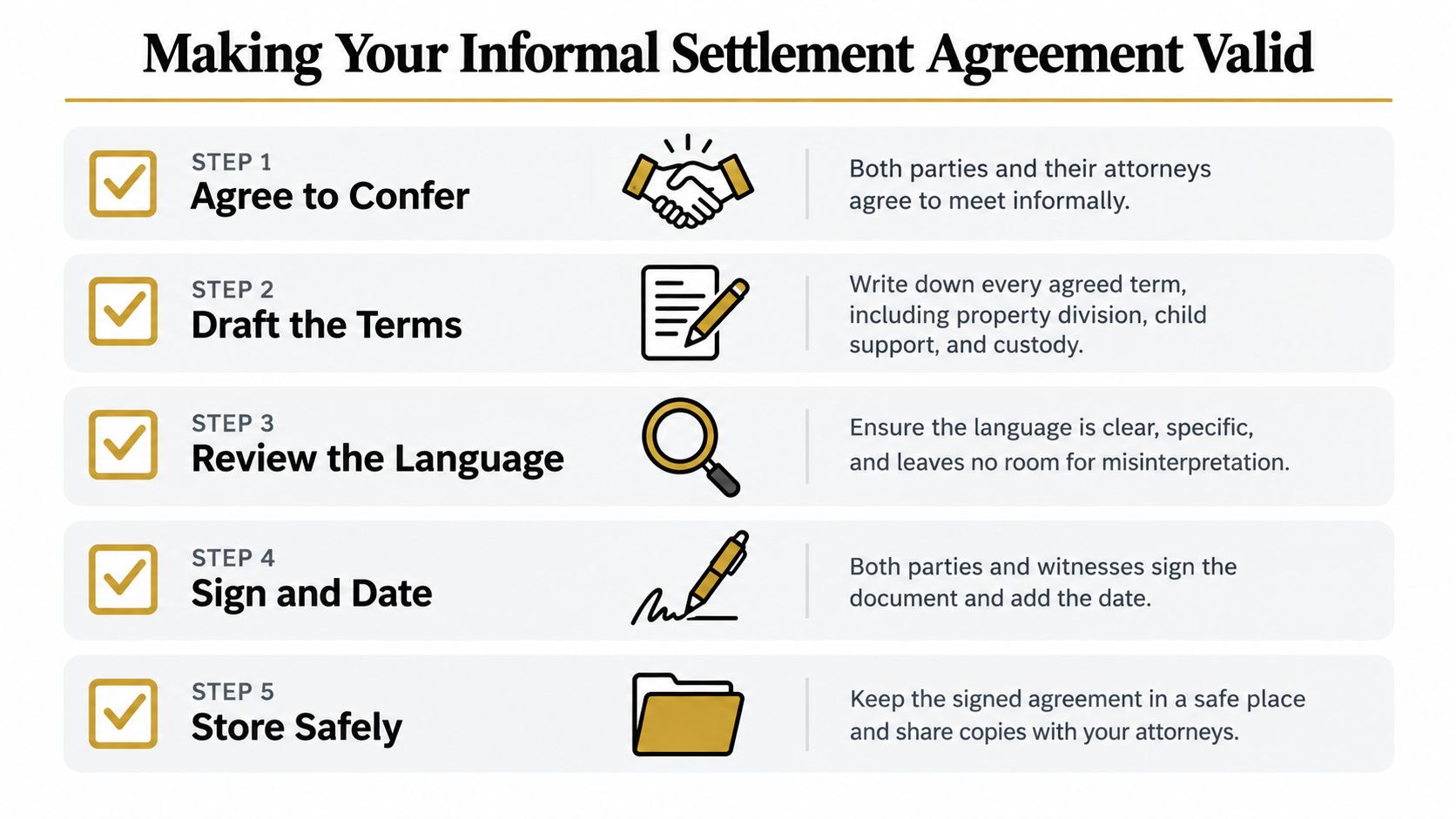
A helpful way to view this process is simple. Mediation has guardrails because a neutral person helps structure the discussion. A § 6.604 informal settlement conference is the DIY version. You and your spouse create the structure yourselves, so the paperwork has to do more of the work.
Start by treating the conference like a real settlement meeting
An informal settlement agreement should grow out of an actual settlement conference, even if that conference happens at home, in a lawyer's office, or by video. Casual back-and-forth texts are a poor substitute when you are trying to create a document a judge can later rely on.
Set an agenda before you talk. Cover each subject that belongs in the final decree, not just the easy ones. If you only settle half the case, say that clearly. If your goal is a full settlement, make sure you address every major topic:
- Real estate, including who keeps the home and who handles refinancing or sale terms
- Vehicles, bank accounts, retirement accounts, and personal property
- Credit cards, tax debt, loans, and other liabilities
- Parenting terms, if children are involved
- Child support, spousal support, or other payment obligations
- Deadlines for transfers, deeds, titles, and decree paperwork
That agenda works like a packing list before a trip. If one category gets left off, you may not discover the problem until later, when the decree is being drafted.
Reduce the agreement to one clear written document
For § 6.604, spoken promises are not enough. The terms need to be written down in a way that leaves as little guesswork as possible.
Write the deal so a stranger could read it and understand who must do what, by when, and with which property or debt. “Wife keeps the car” leaves room for argument if there is more than one vehicle. “The 2018 Toyota Camry goes to Wife, and Wife will pay the note owed to ABC Credit Union” is much harder to fight about later.
The same rule applies to parenting terms. “We will work out weekends later” is not a finished agreement. If you are settling possession, pickup times, holiday schedules, and exchange locations need real words on paper.
Include the nonrevocation language prominently
This is the line that often changes a draft into a binding settlement. The agreement must include a prominently displayed statement that it is not subject to revocation.
Put that statement where it stands out. Use a separate paragraph, bold text, capital letters, or another format that makes it obvious on the page. If the sentence is buried in fine print, you are inviting a later argument over whether the statute was satisfied.
That requirement is why spouses sometimes get trapped by surprise. Once all statutory pieces are in place, the agreement may stop being a rough draft and start being a binding deal.
Make sure the right people sign
The document must be signed by each spouse. If an attorney is present when the agreement is signed, that attorney must sign too.
This point causes confusion because people focus on the spouses and forget about counsel who was in the room. A missing attorney signature can create an avoidable fight over enforceability. Before anyone signs, pause and confirm who is present and whose signature the statute requires.
Date it and keep a clean final version
Use one final version for signature. Dating the agreement helps show when the conference concluded and which version was accepted.
Avoid editing the document after signatures are added unless both sides clearly approve the revised version in writing and sign again if needed. A settlement agreement should read like a finished recipe, not a page with ingredients crossed out and added in the margins.
Draft with the final decree in mind
Your informal settlement agreement is the blueprint for the divorce decree. If the blueprint is vague, the decree stage gets harder and more expensive.
That is why careful drafting matters most in cases involving business interests, retirement division, reimbursement claims, separate property disputes, or complicated debt. The Law Office of Bryan Fagan, PLLC handles divorce matters involving property division, child support, custody, mediation, and enforcement, which are the same categories that often need careful drafting in a settlement document.
One more timing point matters. Even if you reach agreement quickly, Texas still requires a waiting period before the divorce can be finalized. The Texas 60-Day Divorce Waiting Period still applies.
Sample Language and Common Pitfalls to Avoid
You and your spouse can reach a deal at the kitchen table, in a lawyer's conference room, or by trading one final draft over email. But if the words on the page meet Section 6.604's requirements, that “informal” deal can carry the same binding force as a mediated settlement agreement. That is why the wording matters so much. A casual sentence can lock you in. A careful sentence can protect you.
What clear language looks like
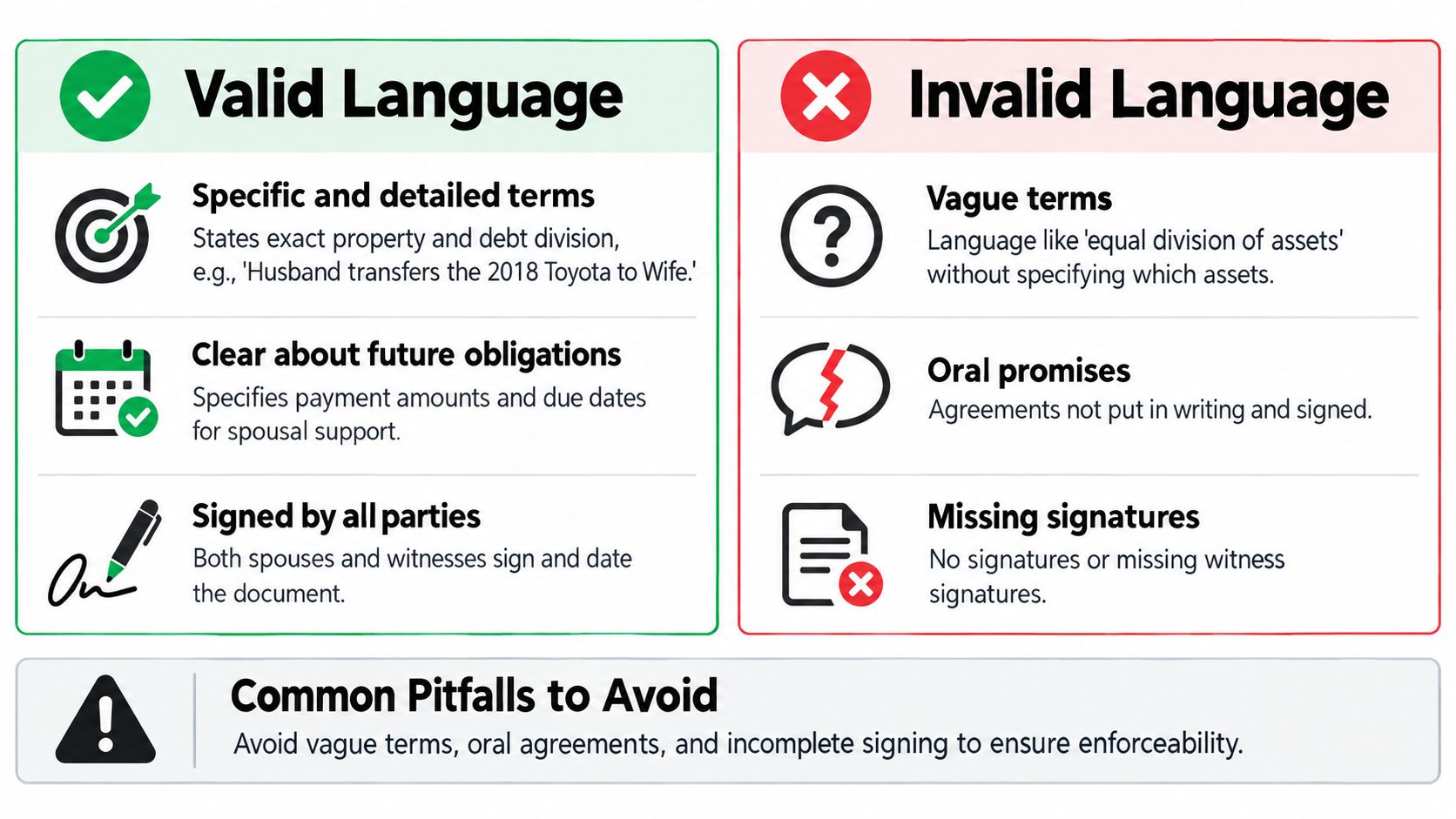
Start with the line that gives the agreement its binding effect under § 6.604:
Example concept: “This agreement is not subject to revocation.”
Put that sentence where no one can miss it. If it is hidden in the middle of a dense paragraph, you invite an argument later about whether the statute was satisfied.
Then make each deal term concrete enough that a stranger could read it and know who gets what, who pays what, and what must happen next. A divorce agreement works like a set of assembly instructions. If a step is fuzzy, the whole project slows down.
Clear terms often sound like this:
Specific property term
“Husband is awarded the 2018 Toyota Camry and will pay the debt secured by that vehicle, indemnifying Wife from that debt.”Specific home term
“Wife is awarded the marital residence located at 123 Main Street, Houston, Texas, and Husband will sign all documents reasonably necessary to transfer his interest within 10 days of presentment.”Specific parenting term
“The parties agree that Mother will have the exclusive right to designate the child's primary residence within Harris County, Texas, and Father will have possession under the Standard Possession Order.”
Weak terms create room for a later fight:
Vague division
“We will divide everything equally.”Future promise without details
“We'll work out child issues later.”Unclear debt language
“Each party pays their fair share.”
Those sentences may feel cooperative in the moment. They often create trouble when someone remembers the deal differently a month later.
Common drafting mistakes that create expensive problems
The biggest risk with a § 6.604 agreement is accidental enforceability. You may believe you are signing a rough draft or a temporary outline, while the other side treats it as the final deal. Once the statutory language and signatures are in place, backing out can be much harder.
Watch for these problems:
The nonrevocation language is missing
Without a clear statement that the agreement is not subject to revocation, you may not have an enforceable § 6.604 informal settlement agreement.The agreement says too little
“He keeps his retirement” is usually not enough. Which account? As of what date? Who prepares the transfer order if one is needed? Specifics prevent decree-stage disputes.The document mixes final terms with open issues
If one paragraph says the house is awarded to one spouse, but another says the parties will later decide whether to sell it, the agreement can become harder to enforce because the writing does not show a complete meeting of the minds.Parents use casual parenting language
“We'll split time with the kids” is not an enforceable possession schedule. If children are involved, terms must be detailed enough to become court orders.A party signs too soon
If you are still waiting on account balances, deed language, or debt information, signing a “final” informal agreement can lock you into terms before you have the full picture.
A simple safety rule helps here. If you do not want the document to be binding yet, do not include the statutory nonrevocation language, and do not sign a draft that looks complete. Label working drafts clearly as proposals for discussion only.
Before signing, ask yourself: if a judge read this without hearing any explanation from me, would the judge know exactly what we agreed to?
Special caution if children or major assets are involved
Some cases need more than plain, short sentences. They need precise ones.
Parenting provisions often require details about conservatorship rights, possession, exchange times, holiday schedules, and decision-making. Major assets can raise similar issues. Retirement accounts may need a later division order. Real property may require deed language. Business interests may need a valuation date or transfer terms. If those details are left out, the agreement may still be binding, but much harder to carry into a final decree without another dispute.
If your case involves children, a house, retirement funds, a business, or large debts, slow down before you sign. Section 6.604 gives informal conferences real legal force. Used carefully, that can save time and money. Used carelessly, it can turn a DIY solution into a fight over what your own agreement means.
Filing With the Court and Enforcing Your Agreement
You and your spouse finally signed the agreement. That feels like the finish line. In a Texas divorce, it is closer to having the blueprint than having the house built. The agreement can bind both of you, but the court still needs a final decree that matches it.
From signed agreement to final decree
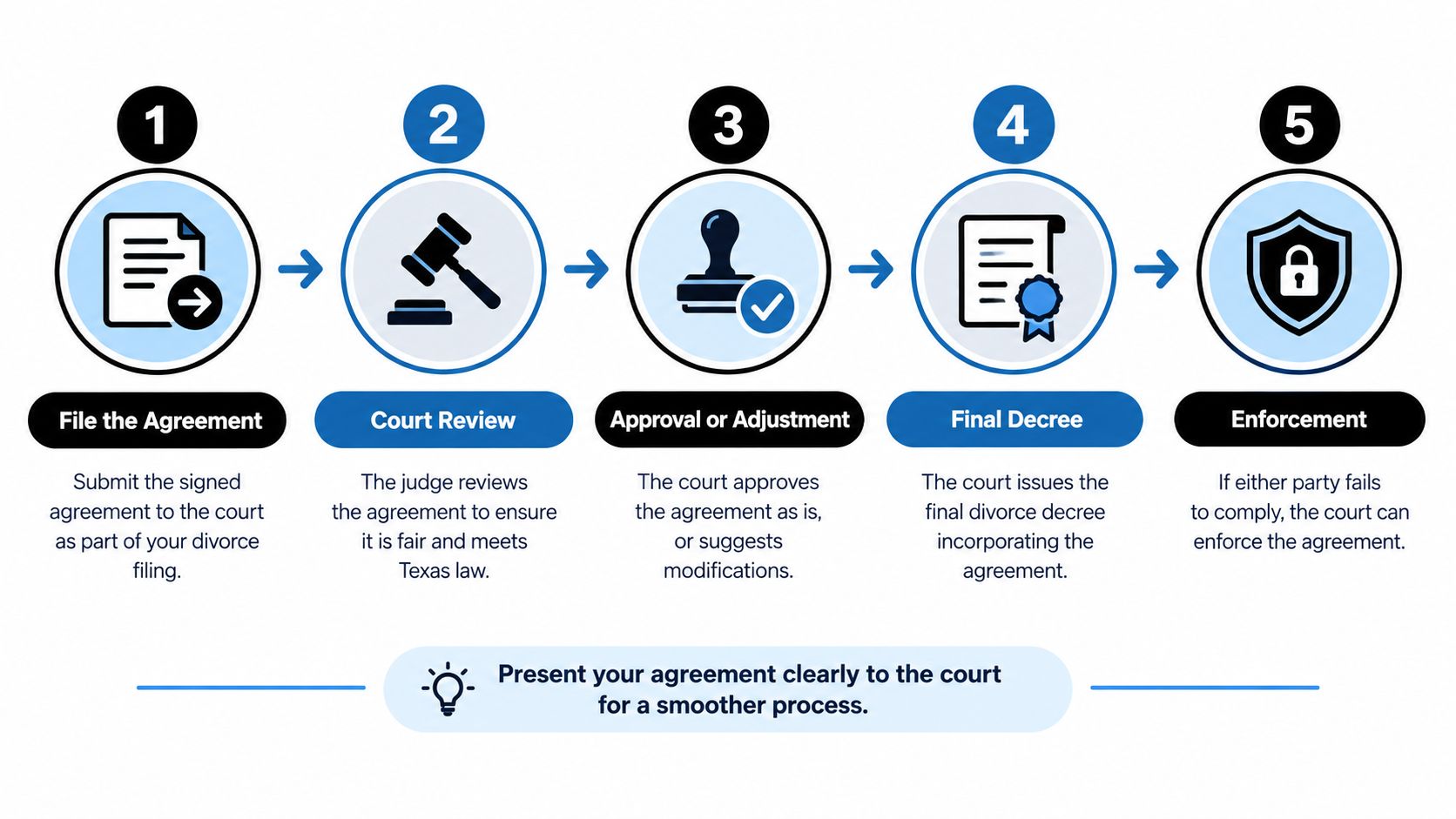
Once a valid § 6.604 agreement is signed, the job shifts from reaching terms to getting those terms into a court order the judge can sign. As noted earlier, the statutory waiting period still applies before the court can finalize the divorce, even if you settled early. Some uncontested cases wrap up soon after that point. Others take longer because the decree needs revisions, the court has scheduling requirements, or one spouse drags their feet.
The usual steps are straightforward:
- Draft the final decree so it tracks the written agreement closely
- File the decree and any related papers in the pending divorce case
- Appear for a prove-up hearing if your court requires brief testimony
- Get the judge's signature so the agreement becomes an enforceable court order
That last point matters. A § 6.604 agreement is powerful because it can lock in your deal without formal mediation. But enforcement is much easier once the terms are in a signed decree, not just on a settlement sheet.
What the judge still reviews
The court does not rubber-stamp whatever is handed up. Under Texas Family Code § 6.604, a properly signed agreement is binding, but the judge still reviews the proposed decree and decides whether it should be entered as a just and right division.
For you, that means clarity matters twice. First, when you sign the agreement. Second, when the decree is drafted from it.
If the agreement says one spouse keeps the house, the decree should also say who signs the deed, who refinances if needed, and when that has to happen. If the agreement divides retirement funds, the decree may need companion orders before the transfer can happen. A short agreement can still be binding. A thin decree can still create problems.
Your signed agreement settles the deal between you and your spouse. The final decree is the tool the court uses to make that deal work in real life.
If your spouse stops cooperating
This is the problem many spouses worry about most. Your husband or wife agrees in the room, signs the paper, then later refuses to sign closing documents, turn over property, pay money, or follow the decree.
When that happens, you may need to ask the court to enforce what was ordered. This guide on filing a motion to enforce in a Texas divorce case explains the procedure in plain English.
One more practical issue comes up after the court signs. If your decree will be used in another country or presented to a non-English agency, certified legal translation for divorce decrees can help you prepare the signed order and related records for that use.
What to Do Next to Protect Your Agreement and Your Family
If you're considering a Family Code 6.604 informal settlement agreement in a Texas divorce, the biggest lesson is simple. Informal doesn't mean casual.
Key takeaway
Section 6.604 can give your homegrown agreement the same kind of binding force people usually associate with mediation, but only when the writing and signatures are handled correctly. That makes it a powerful option for spouses who want control, privacy, and less conflict.
A quick decision check for your situation
You may be a good fit for an informal settlement conference if:
- You already agree on most major issues
- You can exchange information without constant conflict
- You want to avoid a full mediation session
- You're ready to put every term in writing clearly
You should get legal advice quickly if:
- You have children and the parenting terms are incomplete
- You or your spouse own a business
- Your estate includes retirement accounts, real property, or separate property claims
- You're worried you signed something you didn't fully understand
- Your spouse is pressuring you to sign “just a simple agreement”
What to do before you sign anything
Take one more pass through the document and ask:
- Is the nonrevocation statement prominent?
- Did both spouses sign?
- Did any attorney present at signing sign too?
- Are the terms specific enough to go into a final decree?
- Will the judge likely see the outcome as just and right?
If any answer is uncertain, stop and get guidance before signing. That pause can save you from a much harder fight later. You should also stay informed about related issues like custody, support, mediation, and enforcement because a settlement agreement often touches all of them at once.
If you're trying to decide whether your divorce agreement is already binding, or you want help drafting one that will hold up in court, Law Office of Bryan Fagan, PLLC offers free consultations for Texans dealing with divorce, custody, support, property division, mediation, and enforcement issues. You can talk through your exact situation, find out whether § 6.604 fits your case, and get clear next steps before you sign something that affects your family and future.