 Skip to content
Facing a divorce can feel like you're lost at a crossroads, unsure which path leads to the best future for you and your family. In Texas, divorce mediation offers a structured, compassionate, and cost-effective alternative to a drawn-out court battle, giving you the power to control the outcome. Think of it as a guided conversation where you and your spouse make the big decisions together, with a neutral professional there to help you find common ground.
Choosing a Smarter Path Through Divorce
When the stress of ending a marriage is piling up, it’s easy to think a bitter courtroom fight is your only option. But that’s not the case. In fact, Texas family law actively encourages a more constructive approach. Divorce mediation isn't about one person "winning" and the other "losing"—it’s about finding a fair resolution and building a stable foundation for the future, especially when children are involved.

Mediation is a private, confidential negotiation where a trained, neutral third party—the mediator—acts as a facilitator. This person doesn't make decisions for you or take anyone's side. Their job is to keep the conversation productive, help you manage emotions, and guide you and your spouse toward creative solutions for everything from dividing your property to creating a parenting plan that works for your family.
Why Mediation Makes Sense for Texas Families
Simply put, mediation puts the power back in your hands. Instead of a judge who doesn’t know you or your children making life-altering decisions, you and your spouse get to craft an agreement that fits your unique situation. This collaborative approach has major advantages:
- You Have Greater Control: You and your spouse have the final say on the terms of your divorce decree.
- Your Privacy is Protected: All your discussions happen behind closed doors, not in a public courtroom.
- Conflict is Reduced: The process is designed to solve problems, not to assign blame or escalate arguments.
- It's More Cost-Effective: Mediation is almost always significantly less expensive than taking your divorce to trial.
Protecting Your Children’s Well-Being
For many parents, the biggest reason to choose mediation is to shield their children from the emotional damage of a contentious divorce. The process encourages communication and cooperation, which helps set a positive tone for your future co-parenting relationship. By working together, you show your children that even though your marriage is ending, your commitment to them as parents remains as strong as ever. Protecting their emotional health is a priority, and it's helpful to understand the impact of divorce on a child's mental health as you navigate this transition.
Why Texas Courts Push for Mediation
If you're heading toward a divorce in Texas, you'll quickly hear the word "mediation" from your attorney and the court. Judges in Texas almost always require couples to try mediation before they will consider a contested trial. This isn't just a procedural step; it's a core philosophy of Texas family law.
The court system is designed to steer you and your family toward finding your own solutions. A judge knows that the best, most lasting agreements are the ones you create yourselves, not the ones handed down from a bench. The Texas Family Code is built around protecting children from the emotional crossfire of a drawn-out court battle. A public, adversarial trial can quickly burn bridges and make future co-parenting nearly impossible.
Mediation provides a private, controlled space to work through your disagreements constructively. It’s also about practical efficiency. Court dockets are overloaded, and a divorce trial can drag on for months, sometimes years. By requiring mediation first, the courts empower you to find resolutions on your own timeline, freeing up judges for the high-conflict cases that truly need a courtroom decision.
The Legal Framework for Mediation in Texas
The key law governing this process is Section 153.0071 of the Texas Family Code. This section gives judges the authority to order you and your spouse to mediate your divorce or custody case. This is called court-ordered mediation, and it means that in most Texas counties, you will have to attend at least one mediation session before a judge will hear your case in a final trial.
The court's goal is to give you a meaningful opportunity to resolve your own disputes. The law recognizes that you and your spouse know your family's needs better than a stranger in a black robe ever could. You should be the primary architects of your own futures.
This legal preference for out-of-court settlements has reshaped the divorce landscape in Texas. Mediation is no longer an alternative strategy; it's a standard and essential part of the process for the vast majority of families. The goal is to spare everyone—you, your children, and your finances—the immense strain of litigation. To learn more about how this saves you money, check out our guide on the factors that influence mediation costs in Texas.
How Mediation Works in High-Conflict Situations
But what if you and your spouse can barely be in the same room together? That’s a common concern, and Texas mediators are well-equipped to handle it. For high-conflict cases, the process used is called "shuttle mediation."
This setup is designed to keep the peace and promote productive negotiation:
- Separate Rooms: You and your attorney will be in one conference room, while your spouse and their attorney are in another. You never have to see or speak to each other directly.
- The Mediator as Go-Between: The neutral mediator "shuttles" back and forth between the rooms, carrying offers, relaying messages, and helping you both find common ground.
- Reduced Tension: This structure removes the risk of direct confrontation, allowing you and your lawyer to speak freely and strategize without emotions escalating.
This approach ensures that even in the most tense situations, the negotiation can move forward safely and effectively.
Are There Exceptions to Mandatory Mediation?
While mediation is the norm, it's not an absolute requirement. Texas law allows for rare exceptions. A judge can waive the mediation requirement in specific circumstances, such as cases with a documented history of family violence. If a protective order is in place or there is other credible evidence of domestic abuse, a court will likely agree that forcing the parties into mediation would be inappropriate and unsafe. These situations, however, are the exception. For most Texas families, mediation is a vital and beneficial step toward finding a peaceful way forward.
Navigating the Texas Mediation Process Step by Step
Thinking about mediation can feel overwhelming, like heading into a high-stakes negotiation without a map. But the process is far more structured and supportive than you might realize. Let’s break down divorce mediation in Texas into a clear, manageable series of steps so you know exactly what to expect.
Remember, your mediator isn't a judge. They're a neutral guide whose only job is to help you and your spouse have a productive conversation and find common ground. The journey starts with choosing the right professional and ends with a legally binding agreement that lets you move forward.
Step 1: Selecting Your Mediator and Scheduling the Session
The first step is for you and your spouse to agree on a neutral, third-party mediator. Your attorneys usually make this simple by providing a short list of trusted, experienced mediators they've worked with before. This helps you find someone whose style and expertise fit your family’s unique situation.
Once you’ve selected a mediator, your attorneys will schedule the session. In Texas, mediations are typically booked for either a half-day (four hours) or a full day (eight hours). If your divorce involves complex issues like a family business, significant assets, or a difficult custody dispute, a full day is usually recommended to ensure there's enough time to reach a full agreement.
Step 2: The Opening Session and Setting Ground Rules
Your mediation day will begin with an opening session. While some mediations start with everyone in the same room, it's far more common in Texas to use “shuttle mediation.” You and your lawyer will be in one private room, and your spouse and their lawyer will be in another.
The mediator starts by explaining the ground rules for the day. These rules are crucial for creating a safe and productive environment:
- Confidentiality: Everything said in mediation is completely confidential. It cannot be used against you in court if you don’t reach an agreement.
- Neutrality: The mediator is there for both of you. They will not take sides, offer legal advice, or make any decisions for you.
- Voluntary Agreement: You are in control. No one can force you to sign an agreement; the final decisions are yours alone.
This introduction ensures everyone is on the same page before the negotiations begin.
The flowchart below illustrates how Texas courts use mediation to guide families from conflict toward a peaceful resolution.
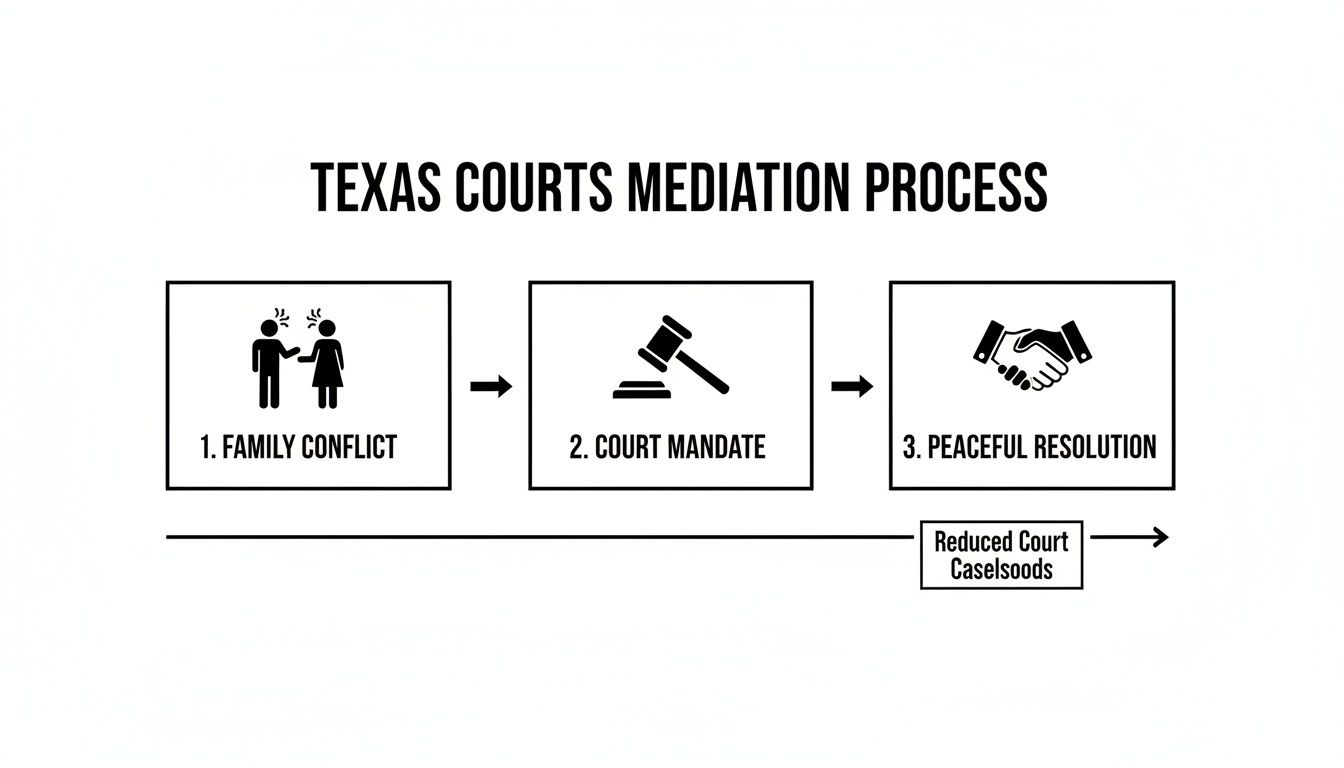
This process shows why mediation is the preferred path for turning family disputes into durable, private agreements.
Step 3: Identifying Issues and Exploring Solutions
With the ground rules established, the negotiation begins. The mediator will move back and forth between the two rooms, listening to each side's perspective on key issues like property division, child custody, child support, and spousal maintenance.
A skilled mediator does more than just relay offers. They help you explore the underlying interests behind your positions—not just what you want, but why you want it. This is where you can find creative solutions a judge might not be able to order, such as an arrangement where one spouse keeps the family home until the children graduate. This phase is about finding common ground and building compromises, a key benefit explained in our overview of family mediation in the court system.
Step 4: Drafting and Signing the Mediated Settlement Agreement (MSA)
If you and your spouse resolve all your issues, the mediator will draft a Mediated Settlement Agreement (MSA). This document is the finish line. It outlines every detail you've agreed upon, from who gets which assets to how you'll divide retirement accounts and share parenting time.
You and your attorney will review the MSA carefully to ensure it accurately reflects your understanding and protects your interests.
Under Section 153.0071(e) of the Texas Family Code, a signed MSA is binding and irrevocable. This is critical. Once you and your spouse have both signed it, you cannot go back and change your mind. That finality provides certainty and closure.
The signed MSA is then filed with the court. Your attorney uses it to draft the Final Decree of Divorce, which the judge signs to make your divorce official. You will have successfully settled your case without the stress, cost, and public exposure of a trial.
To help you visualize the journey, this table breaks down the Texas mediation process into clear, predictable phases.
The Four Key Stages of Your Mediation Journey
| Stage | What Happens During This Stage | Your Primary Goal |
|---|---|---|
| Stage 1: Preparation | You and your attorney gather financial documents and define your priorities. | To enter mediation fully informed and prepared to negotiate effectively. |
| Stage 2: Opening | The mediator explains the rules (confidentiality, neutrality) and each side outlines their starting positions. | To establish a respectful tone and clarify the issues to be resolved. |
| Stage 3: Negotiation | The mediator "shuttles" between rooms, helping you explore options and find common ground on all issues. | To brainstorm creative solutions and work toward a mutually acceptable compromise. |
| Stage 4: Agreement | If successful, the mediator drafts the Mediated Settlement Agreement (MSA) for everyone to review and sign. | To finalize a binding, irrevocable agreement that resolves your entire case. |
These four stages provide a reliable roadmap for turning conflict into resolution, giving you control over the final outcome.
How to Prepare for a Successful Mediation Session
Walking into mediation unprepared is like trying to build a house without a blueprint. Success in mediation doesn't start when you walk into the room; it begins with the thoughtful preparation you do beforehand. This is your chance to get organized, clarify what you truly need, and set the stage for a productive, solution-focused negotiation.

The goal isn't to build a case to "win" against your spouse. Instead, you're gathering the information needed to have a meaningful conversation about your shared assets, debts, and future—a future where you can both move forward with a fair and lasting agreement. A little preparation now can save you an incredible amount of time, money, and stress.
Gather Your Financial Documents
The foundation of any property division discussion is a clear financial picture. Your attorney will guide you on the specifics, but you can get a head start by gathering these key documents:
- Income Verification: Recent pay stubs and the last two years of tax returns for both you and your spouse.
- Bank Statements: At least 12 months of statements for all checking and savings accounts.
- Retirement and Investment Accounts: The most recent statements for any 401(k)s, IRAs, pensions, or brokerage accounts.
- Debt Information: Statements for mortgages, car loans, credit cards, and student loans.
- Business Records (if applicable): If you or your spouse own a business, you'll need profit and loss statements, balance sheets, and tax returns.
Organizing these materials gives everyone—you, your attorney, and the mediator—a complete snapshot of your community estate, which makes negotiations much more straightforward.
Create a Clear Inventory of Assets and Debts
Once you have your documents, the next step is to create a simple inventory of everything you own and owe as a couple. A spreadsheet works perfectly for this. List your assets (house, cars, bank accounts, retirement funds) and your liabilities (mortgages, loans, credit card balances).
This isn't just busywork; it's a tool for clarity. Seeing all the numbers laid out in one place often removes much of the emotion and anxiety, transforming a vague financial worry into a concrete set of figures you can work with.
For many couples, this is the first time they’ve seen their complete financial landscape. This exercise is invaluable for a productive divorce mediation in Texas.
Clarify Your Personal Priorities
Mediation is a process of give-and-take. To negotiate effectively, you need to know what matters most to you. Before your session, take some time to think about your non-negotiables and the areas where you can be more flexible.
Consider these practical questions:
- For Your Children: What parenting schedule do you truly believe serves their best interests?
- For Your Finances: Is keeping the family home your top priority, or would you prefer a larger share of the retirement accounts for long-term security?
- For Your Future: What outcome will best help you start your next chapter on solid financial ground?
Knowing your priorities helps you and your attorney advocate effectively for an agreement that meets your most important needs. And if your situation involves parties or documents from different countries, understanding how to accurately translate legal documents is another crucial part of your preparation.
What to Do Next
- Start a "Mediation Binder": Use a physical binder or a digital folder to organize all your financial documents.
- Draft Your Inventory: Create your list of assets and debts. It doesn’t have to be perfect on the first try; just get it started.
- Schedule a Meeting with Your Attorney: Before mediation, meet with us to review your documents, clarify your priorities, and develop a negotiation strategy. This preparation session is one of the most important steps you can take toward a successful outcome.
Breaking Down the Cost of Mediation in Texas
Let's talk about the financial side of divorce. The cost of the legal process is a major source of stress for many people, but this is where mediation truly shines. Choosing mediation is often one of the smartest financial decisions you can make for your family’s future.
Think of the investment in mediation not as an expense, but as a strategic move to preserve your marital assets for your next chapter.
Mediator Fees vs. Litigation Costs
In Texas, mediators usually charge by the hour or for a half-day or full-day session. This cost is almost always split evenly between you and your spouse. While it’s a direct cost, it is significantly less than the alternative.
A contested court battle means you’re paying for two separate legal teams to bill hourly for every deposition, hearing, and court appearance. Those fees can spiral out of control, draining your savings and the very community property you’re fighting over. Mediation contains these costs within a few focused sessions.
The core financial benefit of mediation is simple: you are paying one neutral professional to help you find a resolution, rather than paying two opposing attorneys to fight. This collaborative approach keeps your hard-earned money in your family, not tied up in the legal system.
What Factors Influence the Final Price?
The cost of divorce mediation in Texas isn’t a one-size-fits-all number. A few key factors will shape the total investment. A typical full-day session in Texas might cost anywhere from $1,500 to $4,000 or more per spouse, depending on the mediator's expertise and the complexity of your case.
Several key variables come into play:
- Mediator's Experience: Seasoned mediators, especially former family law judges or highly experienced attorneys, charge more for their expertise. However, their skill can help you reach a resolution faster, often saving you money in the long run.
- Complexity of Your Case: A straightforward divorce with minimal assets will take less time than a high-net-worth case involving business valuations, complex property division, or a heated custody dispute.
- Number of Issues: The more topics you need to resolve—from the house and retirement accounts to the parenting plan—the more time you'll need with the mediator.
Understanding these variables helps you get a clearer picture of the potential costs. For a more detailed look, check out our guide on the 5 factors that affect the cost of divorce mediation in Texas.
What to Do Next
- Have an Honest Financial Conversation: Talk with your attorney about a realistic budget for mediation in your specific case.
- Prioritize Efficiency: Come to your mediation session prepared. The more organized you are, the more efficiently you can use your time—which directly impacts your final bill.
- Focus on the Big Picture: Remember that the money you spend on mediation is an investment in your financial stability, your privacy, and a more peaceful start to your new life.
Your Next Steps Toward a Peaceful Resolution
You now have a clear picture of how **divorce mediation in Texas** can transform one of life’s most difficult chapters into a manageable process. It is a path that puts you back in control, and the power to choose it for your family is in your hands.
When you opt for mediation, you’re choosing control over courtroom chaos, privacy over public conflict, and practical solutions over sky-high legal bills. This isn't just about ending a marriage; it's about setting the stage for a stable, healthy co-parenting relationship for years to come.
What to Do Next
Your next step is simple but powerful: get expert guidance tailored to your situation. Every family is different, and you deserve advice that fits your specific circumstances. We invite you to schedule a free, no-obligation consultation with our team at The Law Office of Bryan Fagan, PLLC.
Let us listen to your story, understand your goals, and help you determine if mediation is the right path for your family.
You don't have to walk through this challenging time alone. We’re here to offer the compassionate support and clear-headed legal guidance you need to make confident decisions as you begin your next chapter.
Taking this first step is an act of strength. Contact The Law Office of Bryan Fagan today to schedule your free consultation and discover how we can help you find a peaceful way forward. We're ready to help you protect your family and your future with confidence and care.
Your Top Questions About Texas Divorce Mediation, Answered
Even with a clear understanding of the process, it's natural to have questions about how divorce mediation in Texas will work in your specific case. Every family's situation is unique. Below are straightforward answers to the questions we hear most often from our clients, designed to give you clarity as you consider your next steps.
What if My Spouse Won't Be Reasonable in Mediation?
This is one of the most common fears, and it's a valid concern. However, a skilled mediator is an expert in managing difficult personalities and high-conflict emotions. Their job is to keep the conversation focused on solutions, not get stuck on old arguments. They know how to reframe problems, manage expectations, and guide even the most stubborn person toward a reasonable compromise.
Remember, the structure of mediation is designed to de-escalate conflict. In shuttle mediation, you and your spouse are in separate rooms, which creates a buffer. Your own attorney will be right there with you, ensuring your interests are protected and that any offers being discussed are fair under Texas law.
Can We Mediate if We Have a High-Net-Worth Estate or a Business?
Absolutely. In fact, for divorces involving complex finances, mediation is often the best option. The privacy and flexibility of mediation are huge advantages in high-asset cases. Instead of having your sensitive financial information become part of the public court record, all discussions and documents in mediation remain completely confidential.
Furthermore, mediation allows for creative solutions that a judge simply cannot order. You can bring in financial experts like business valuators or forensic accountants to help structure custom agreements for dividing business interests, stock options, or complex investment portfolios in a way that preserves the value of your assets for both of you.
Do I Still Need My Own Attorney if We Use a Mediator?
Yes, without a doubt. This is non-negotiable. A mediator must remain neutral, which means they cannot give legal advice to either you or your spouse. Their role is to facilitate an agreement, not to protect your individual legal rights.
Your attorney is your personal advisor and advocate during mediation. They will:
- Explain Your Rights: Clarify your rights under the Texas Family Code so you know what a fair outcome looks like.
- Prepare You for Success: Help you gather the necessary documents and develop a clear negotiation strategy.
- Advocate for You: Ensure that the proposals being discussed are in your best interests.
- Review the Final Agreement: Meticulously review the Mediated Settlement Agreement (MSA) before you sign it to ensure it is accurate and legally sound.
Having your own lawyer is the only way to be certain you're walking away with a fair agreement that protects your future.
What Happens if We Can't Agree on Everything?
Mediation isn’t an all-or-nothing process. It is very common to reach a partial agreement. For instance, you might resolve all of your property division issues but reach an impasse on one aspect of the parenting plan.
This is still a major win. A partial agreement dramatically narrows the scope of your dispute, saving you significant time and money. The issues you resolved are locked in, and you only need to ask the court to decide on the one or two items you couldn't settle on your own.
This approach allows you to maintain control over most of your divorce while using the court system efficiently for only what is absolutely necessary.
How Binding Is a Mediated Settlement Agreement?
In Texas, it is rock-solid. Once you and your spouse have both signed the Mediated Settlement Agreement (MSA), it becomes an irrevocable contract. The Texas Family Code is very clear on this: you cannot simply change your mind later because you have "signer's remorse."
This finality is one of the greatest strengths of the mediation process. It provides you with certainty and closure, allowing both of you to move on with your lives knowing the terms are set in stone. Your attorney will then use the signed MSA to draft the Final Decree of Divorce for the judge to sign, making your divorce official.
Taking the next step can feel overwhelming, but you don't have to figure it out alone. The experienced and compassionate team at The Law Office of Bryan Fagan, PLLC is here to answer your questions and help you find a peaceful path forward. We offer free, no-obligation consultations to help you explore your options and see if mediation is the right fit for your family. Contact us today to start the conversation and protect your future.


