Skip to content
Facing divorce and worrying about how your life's assets will be divided is a deeply personal and stressful experience.
When you’re facing a divorce, the thought of untangling a lifetime of shared finances can feel completely overwhelming. In Texas, the law operates under a community property system, which means most assets and debts you both acquired during your marriage are considered jointly owned. But here’s the most important thing for you to understand right from the start: this doesn’t guarantee a clean 50/50 split. Instead, Texas courts aim for a division that is “just and right.”
This guide will walk you through exactly what “just and right” means in a Texas courtroom. We’ll break down how to tell the difference between what’s yours, what’s theirs, and what’s ours. Our goal is to replace your feelings of uncertainty with a clear, manageable plan, empowering you to protect your financial future as you move forward.

Navigating Property Division in a Texas Divorce
The guiding principle for every judge in a Texas divorce is achieving a "just and right" division of your community estate. While many people assume this is just legal speak for an even split, the Texas Family Code actually gives judges a great deal of leeway. They can divide your assets and debts in a way they believe is fair based on the unique facts of your marriage. A court will look at a long list of factors to decide what's fair, and this is where the specific details of your relationship can become legally significant.
The Step-by-Step Divorce Process in Texas
To understand how property division fits into the bigger picture, it’s helpful to know the typical steps of a Texas divorce:
- Filing the Original Petition: One spouse files a petition with the court, officially starting the divorce case.
- Serving the Other Spouse: The other spouse is formally notified of the lawsuit.
- The Discovery Process: Both you and your spouse exchange financial information, including creating an inventory of all assets and debts. This is when characterization and valuation begin.
- Mediation: Most Texas courts require you to attend mediation to try and reach a settlement agreement before going to trial. This is your best opportunity to negotiate a property division that works for you.
- Trial: If you cannot agree, a judge will hear evidence from both sides and make the final decisions on property, custody, and support.
- Final Decree of Divorce: The judge signs the final order, legally ending the marriage and detailing the final division of your property.
Factors That Influence a "Just and Right" Division
Judges don’t just look at a spreadsheet; they consider the human story behind the numbers. A court has the power to award a disproportionate share of the assets to one spouse based on several key considerations laid out in Texas law.
- Differences in Earning Power: If you or your spouse has significantly more education or a much higher earning potential, a judge might award a larger share of the current assets to the spouse with less financial stability to help them get on their feet.
- Fault in the Breakup: If one spouse is at fault for the end of the marriage due to reasons like adultery or cruelty, a judge can—and often will—award a larger portion of the estate to the innocent spouse.
- Wasting Community Funds: Did your spouse spend community money on an affair, a gambling problem, or other non-marital purposes? This is known as "fraud on the community," and the court can penalize that spouse in the final property division.
- The Needs of Your Children: The court will always consider who has primary custody of the children and what their needs are. This can heavily influence major decisions, like who gets to remain in the family home.
A critical misconception exists among many Texans: the law does not mandate a strict 50/50 split. Instead, a judge will consider factors like earning capacity, misconduct, and the needs of children. A notable Texas appeals court case even affirmed an unequal 70/30 property division, emphasizing that a spouse's credibility and earning power can matter more than simple math. You can discover more about what influences Texas courts from this insightful legal transcript.
Understanding Community vs. Separate Property
Sorting out who owns what is often the most confusing—and most critical—part of your divorce. The best way to think about it is to picture your finances as two different containers. One is the community property "piggy bank" that you and your spouse filled together during the marriage. The other is your separate property "savings jar," holding everything you owned on your own. Under Texas law, this distinction is the foundation for how your assets will be divided. Getting it right will shape your entire financial future after the divorce is final.
What Is Separate Property in Texas?
The Texas Family Code is very specific about what qualifies as your separate property. These are the assets that belong to you and you alone, meaning a judge cannot divide them in your divorce.
Specifically, your separate property includes:
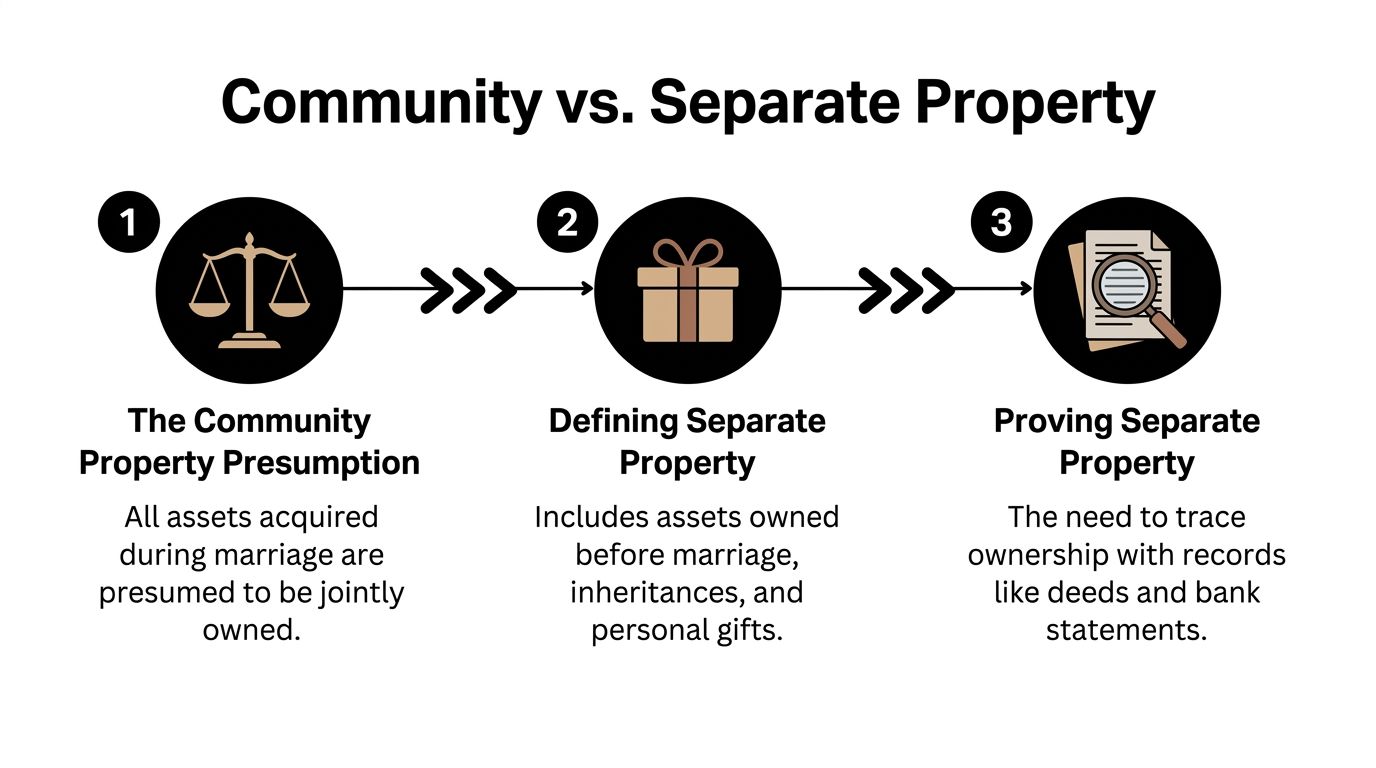
- Property owned before marriage: Anything you owned outright before saying "I do" remains yours. This could be a house, car, bank account, or an investment portfolio you started years ago.
- Gifts received during marriage: If someone gave you a gift intended only for you—like family jewelry or a cash gift with only your name on it—it stays your separate property.
- Inheritances received during marriage: Any money or property you inherit from a loved one's estate while you are married is considered yours alone.
- Personal injury settlements: The portion of a settlement meant to compensate you for your own pain and suffering is typically separate. However, any part meant to cover lost wages during the marriage might be considered community property.
Defining what belongs to whom is also critical when it comes to debts. Many couples use legal agreements to draw these lines clearly from the start. For instance, a prenuptial agreement can formally classify assets and liabilities. If you're wondering about this, it's worth asking, Can a Prenup Protect You From a Spouse's Debt?
The Powerful Community Property Presumption
Now, this is where things get tricky. Texas law starts with a huge assumption called the community property presumption.
Under the Texas Family Code § 3.003, all property that either you or your spouse possess at the time of divorce is presumed to be community property.
What does this mean for you in plain English? A judge will automatically treat everything—the house, the cars, the retirement accounts, even the living room couch—as part of the marital estate to be divided.
The burden of proof is 100% on you to prove an asset is your separate property. If you can't back up your claim with "clear and convincing evidence," it gets divided. It's as simple as that.
How to Prove Your Separate Property Claim
Because the law assumes everything is community property, you can't just tell the judge, "I owned that before we got married." You have to prove it with a paper trail.
To successfully protect what's yours, you'll need meticulous documentation, such as:
- Deeds and titles showing your name and a purchase date from before the marriage.
- Bank and investment statements dated before your wedding day.
- Gift letters or wills that explicitly state a gift or inheritance was for you and you alone.
- A trail of financial records proving that separate funds were never mixed, or "commingled," with community funds. For example, if you sold a pre-marital stock and immediately used those exact proceeds to buy another, you need statements showing that clean transaction from start to finish.
Failing to produce this proof can be a devastatingly expensive mistake. An asset that is rightfully yours could end up being split with your spouse simply because you couldn't find the paperwork to overcome the powerful community property presumption.
The Four Steps for Dividing Your Marital Estate
When you're in the middle of a divorce, trying to figure out how to divide everything you’ve built can feel like navigating a storm without a compass. Thankfully, Texas courts don't leave it to chance. They follow a clear, methodical, four-step path to bring order to the chaos. Understanding this framework gives you a roadmap. It helps you get your financial life in order and prepares you for what’s ahead, giving you a sense of control during a turbulent time.
Step 1: Identification
First, you and your spouse must create a full and honest inventory of everything you own and everything you owe. Think of it as creating a complete financial snapshot of your marriage.
This list needs to cover all assets and liabilities, no matter how big or small.
- Assets: Real estate, vehicles, bank accounts, retirement plans (401(k)s, pensions), stocks and bonds, business interests, furniture, and even collectibles.
- Liabilities: Mortgages, car loans, credit card balances, student loans, and any other outstanding debts.
This is a formal part of the divorce process called "discovery," where both sides are legally obligated to disclose all financial details. Hiding assets is a serious mistake that can lead to significant penalties from the court.
Step 2: Characterization
Next, you will apply the law to determine if each item is community property (part of the marital estate) or separate property (yours alone). Remember, in Texas, everything is presumed to be community property unless you can prove otherwise with clear and convincing evidence.
This is where all your hard work of tracing funds and digging up old documents really pays off. If you can successfully prove an asset is your separate property, it's taken off the table completely—the judge can't award any portion of it to your spouse. You can learn more about how property is divided in Texas divorces and see how these principles are applied in real-world scenarios.
Step 3: Valuation
With all your property identified and characterized, the next vital step is Valuation. Every single piece of community property must be assigned a fair market value. This isn't what you paid for it; it's what it would reasonably sell for in today's market. For some things, this is straightforward, but for complex assets like a business or real estate, it requires professional expertise.
Step 4: Division
Finally, we arrive at the Division of the community estate. After every community asset and debt has been valued, the judge will divide it all in a "just and right" manner. This is where the court weighs all the factors we’ve talked about, from each spouse's earning potential and health to who was at fault for the end of the marriage. A judge has broad discretion here. They can award specific assets to each spouse, order a house to be sold and the profits split, or even issue a money judgment to one person to balance out a lopsided division.
Four Steps to Property Division in Texas
| Step | Goal | Your Action Items |
|---|---|---|
| 1. Identification | Create a complete list of all assets and debts acquired during the marriage. | Gather financial statements, titles, deeds, and account information. Disclose everything honestly. |
| 2. Characterization | Determine if each item is community property (divisible) or separate property (not divisible). | Find documents proving when and how an asset was acquired (e.g., gift letters, inheritance records, pre-marital bank statements). |
| 3. Valuation | Assign a current fair market value to all community property. | Get balances for financial accounts. Hire professional appraisers for real estate, businesses, or unique items. |
| 4. Division | Achieve a "just and right" distribution of the community estate based on legal factors. | Negotiate a settlement agreement or present your case to the judge, highlighting factors that support a favorable division for you. |
How to Value Complex and High-Value Assets for Business Owners and Professionals
When your financial life is more complicated than a single house and a checking account, figuring out what everything is worth during a divorce can feel incredibly daunting. For many Texas families, especially those with businesses, professional practices, or significant investments, this is often the single most challenging part of the entire process. This isn’t about just picking a number out of thin air. It’s a methodical process that almost always requires bringing in specialized experts.Valuing Your Business Interests
If you or your spouse own a business, it's one of the most complex assets to value in a divorce. The court needs to know its fair market value—what a willing buyer would realistically pay for it on the open market today. Typically, a business valuation expert will be hired to analyze the company from top to bottom. They'll look at everything from hard assets like equipment to intangible assets like "goodwill," which is the value of the business's reputation. For a deep dive into this topic, you can read also our guide on business valuation in Texas divorce.
Dividing Retirement and Investment Accounts
For many couples, retirement funds are a massive part of their marital estate. It's critical to remember that the portion of any 401(k), pension, or IRA that was earned during the marriage is community property and must be divided. For accounts like a 401(k), the division is handled through a special court order called a Qualified Domestic Relations Order (QDRO). This legal document tells the plan administrator to create a separate account for the non-employee spouse, allowing their share to be transferred without triggering immediate taxes or penalties.
The Critical Role of Forensic Accountants
Unfortunately, not every divorce involves full and honest financial disclosure. If you suspect your spouse is hiding money or undervaluing assets, a forensic accountant can become your most powerful ally. These financial detectives are trained to uncover inconsistencies and trace funds. Knowing how a forensic accountant finds hidden assets can give you a better understanding of how they provide the hard evidence needed to ensure every single dollar is on the table before division begins.
Protecting Your Financial Future During Divorce
The thought of divorce often brings a wave of financial fear, and it's completely normal to worry about what the future holds. Taking proactive steps to safeguard your financial stability is one of the most empowering things you can do. This isn’t about being secretive; it’s about creating clarity and protecting yourself during a period of immense uncertainty.
Your Immediate Action Plan
As soon as divorce becomes a real possibility, there are immediate actions you can—and should—take to protect your interests. This is about securing your personal financial footing, not about hiding assets, which is illegal and will backfire in court.
Your first move should be to create a detailed inventory and gather every critical financial document you can find. Collect at least three years' worth of bank statements, tax returns, investment account reports, and credit card statements. Having this information gives you a clear picture of the marital estate.

Next, it's time to build your own financial foundation:
- Create a Personal Budget: Start by figuring out your post-separation living expenses. Knowing exactly what you'll need is crucial for negotiating temporary support.
- Open Your Own Accounts: Open a new checking and savings account in your name only. You can direct your paycheck there and begin building a fund for your legal and living expenses.
- Secure Your Own Credit: Apply for a credit card in your name to establish your own individual credit history.
Using Legal Tools for Protection
Texas law provides powerful tools to prevent a spouse from squandering marital assets once a divorce is filed. One of the most important is the Standard Temporary Restraining Order (TRO).
A TRO is a court order issued at the beginning of a divorce case. It legally freezes the marital estate, preventing either spouse from taking unusual financial actions—like selling property, draining bank accounts, or changing insurance beneficiaries—without the court's permission.
A TRO ensures that the community property estate remains intact while the division of marital assets in Texas is being determined. For a deeper understanding of how these orders work and other protective strategies, you can read also our guide on how to protect assets during divorce.
Common Questions About Asset Division in Texas
When you're going through a divorce, the questions about your property and your money can feel endless. Getting straightforward answers can help you feel more in control. Here are some of the most common questions we hear, answered in plain English.
Can I Keep the Marital Home?
For many of our clients, this is the most emotional question. The short answer is, it depends. Because the marital home is typically community property, Texas law provides a few paths forward:
- One Spouse Buys Out the Other: If you have the means, you can "buy out" your spouse's interest, usually by refinancing the mortgage in your name and paying them for their share of the equity.
- An Owelty Lien: If you want the house but don't have cash for a buyout, an owelty lien creates a lien on the home for the amount you owe your spouse, which you can pay off when you refinance or sell later.
- Court-Ordered Sale: If neither of you can afford the home, or you both agree to sell, a judge will order the sale, and the proceeds will be divided.
How Is Debt Handled in a Divorce?
Debts taken on during the marriage are community debt and must be divided in a "just and right" manner. A judge will assign who is responsible for paying each debt. However, it's critical to understand that your creditors don't care what your divorce decree says. If your name is on a loan your ex was ordered to pay, and they stop paying, the lender can still come after you.
Is My Inheritance Considered Community Property?
No, your inheritance is your separate property in Texas. The Texas Family Code is very clear that property received through a gift or inheritance is not part of the marital estate and cannot be divided.
CRITICAL WARNING: You can accidentally turn your separate property into community property through "commingling." If you deposit inheritance funds into a joint bank account, tracing it back becomes a legal nightmare. Always keep inherited money in a separate account in your name only.
How Long Does Property Division Take?
The timeline for dividing property varies widely. An uncontested divorce where you and your spouse agree on everything can be finalized in as little as 61 days, which is the mandatory waiting period in Texas. On the other hand, a high-conflict divorce with complex issues like business valuations can easily take a year or more. Mediation is often the fastest and most cost-effective path to a resolution.
What to Do Next: Take Control of Your Future
We've covered a lot, from the core principles of community property to the challenges of valuing a business. The goal was to pull back the curtain on how Texas law handles property division so you can face your divorce with a clear understanding of what’s at stake.
You now know that a "just and right" division isn't always 50/50 and that you have the burden of proving an asset belongs solely to you. Understanding these fundamentals is the first step, but putting that knowledge into practice is what truly protects your future.
The principles we've discussed apply to every Texas divorce, but how they shape your specific case is entirely unique. The most critical next step is to move from general knowledge to a concrete strategy built around your family, your assets, and your goals. An experienced attorney doesn’t just explain the law; they apply it to your life, helping you create a clear plan that turns the uncertainty of divorce into the confidence that you are prepared for whatever comes next.
The dedicated attorneys at the Law Office of Bryan Fagan, PLLC, are here to provide that compassionate, authoritative guidance. We help Texas families navigate divorce with empathy and confidence.
We invite you to schedule a free, confidential consultation with our team. Let's start the conversation about building a strategy to protect what matters most to you. Visit us online or call The Law Office of Bryan Fagan, PLLC, today to get started. https://texasdivorcelawyer.us