Skip to content
When you’re trying to leave a marriage and also trying to stay safe, every legal choice feels urgent.
A protective order during divorce texas case is not just about stopping contact. It can change who stays in the home, how child custody is handled, how communication happens, and how fast your divorce starts moving. If violence, threats, stalking, or coercive behavior are part of your situation, you need to understand how this tool works inside the larger divorce case, not beside it.
Texas courts use protective orders often. From 2021 through 2023, courts issued an estimated 162,497 protective orders of several types, which shows how central these cases are in Texas family law and divorce-related disputes, according to the Texas protective order report. That volume matters for one reason. Judges know these requests are serious, and they expect clear facts, fast action, and compliance with procedure.
Understanding Protective Orders in a Texas Divorce
You file for divorce on Monday. By Wednesday, your spouse is texting nonstop, showing up at the house, and making threats about the children or the bank account. In that situation, a protective order is not just about immediate safety. It can change the ground rules of the divorce before the larger case even gets traction.
A protective order is a court order meant to stop family violence, threats, stalking, harassment, or other dangerous conduct recognized by Texas law. In a divorce, it often intersects with the same issues the family court is already dealing with, including who stays in the home, how parents communicate, whether children need restrictions for safety, and what conduct is prohibited while the case is pending.
A lot of spouses confuse a protective order with a Temporary Restraining Order, or TRO. The difference matters because they solve different problems. A TRO in a divorce usually addresses property and case management issues, such as draining accounts, hiding a child, canceling insurance, or destroying records. A protective order addresses safety. It can also carry criminal consequences if the restrained person violates it.
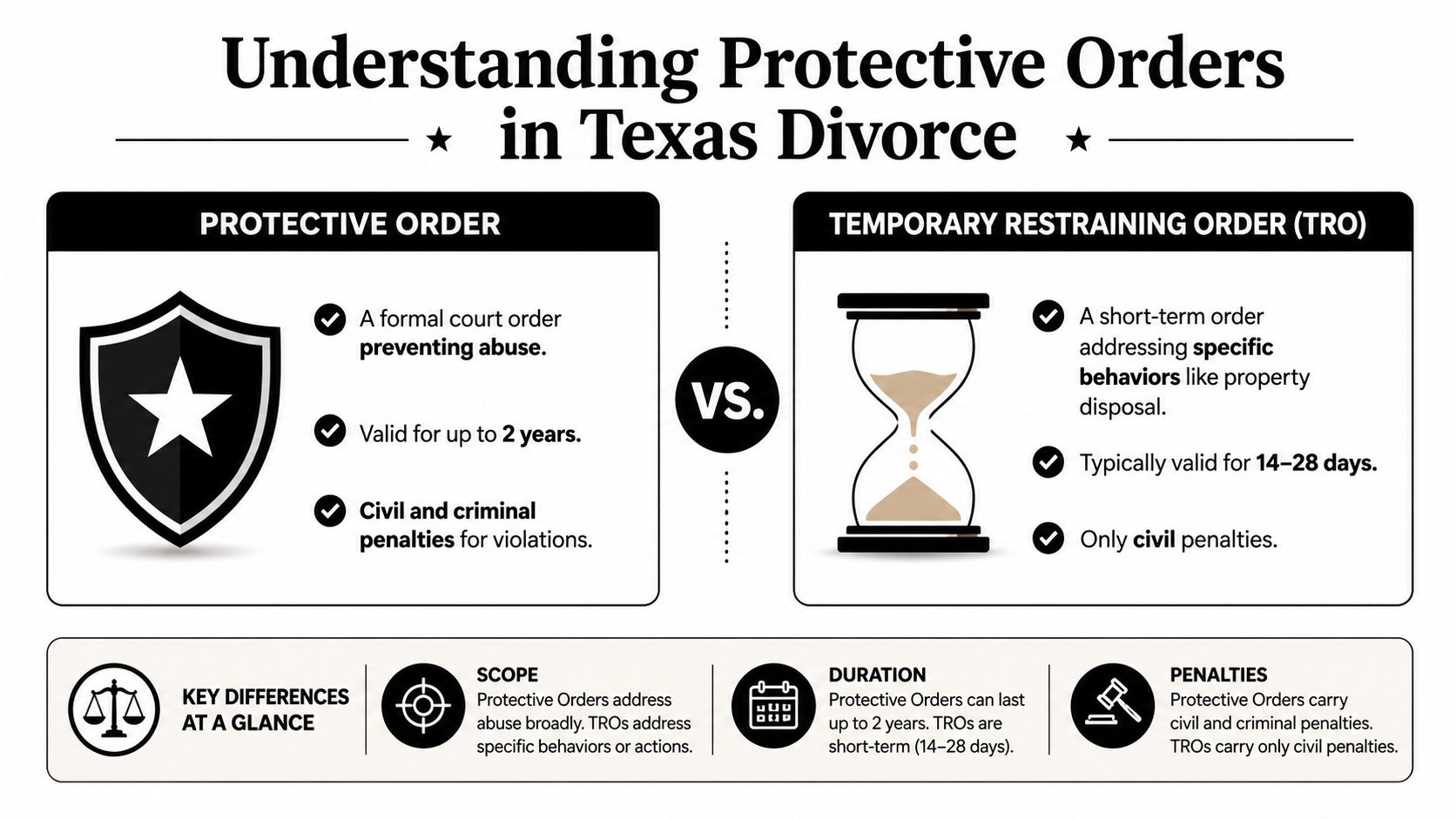
If you want a clearer side-by-side explanation, this guide on protective order vs restraining order in Texas lays out when each request fits.
What Texas law means by family violence
In many divorce cases, the order at issue is a Family Violence Protective Order. Texas law does not treat every ugly breakup or hostile argument as family violence. The court is looking for violence, bodily injury, assault, or a threat that puts someone in fear of imminent physical harm. That is a legal threshold, not just a description of a toxic marriage.
Judges want specifics. What happened, when it happened, whether there was a threat of immediate harm, whether children saw it, whether police were called, and whether the conduct is likely to happen again all matter.
Here is the practical rule I give clients. Protective orders are issued to prevent harm, not to punish a spouse for being difficult.
That line is important in divorce strategy. Controlling money, tracking your location, isolating you from family, or escalating during separation may support a protective order if those facts connect to threats, stalking, assault, or fear of imminent harm. If the complaint is only that your spouse is dishonest, verbally rude, or refusing to cooperate, the better tool may be temporary divorce orders rather than a protective order.
The main types you may see in divorce-related cases
Texas courts can issue different protective orders, and the category affects what the court focuses on and how the divorce may be reshaped. Family violence cases are the most common in divorce. Stalking or sexual-assault-based protective orders can also arise, and those cases often lead to tighter communication limits and sharper disputes over child exchanges and contact.
| Order type | What the court focuses on | Common divorce impact |
|---|---|---|
| Family Violence Protective Order | Abuse or threat of imminent harm by a spouse, family member, or dating partner | Removal from home, supervised child contact, firearm restrictions |
| Stalking Protective Order | Repeated conduct causing reasonable fear | No direct communication, attorney-only contact, scheduling complications |
| Sexual Assault Protective Order | Protection based on sexual assault allegations | Strong limits on contact and possible parenting restrictions |
| Human Trafficking Protective Order | Protection tied to trafficking conduct | Severe restrictions and broad safety terms |
Duration matters too. Some protective orders remain in place well beyond the early temporary phase of the divorce. That can affect settlement pressure, possession schedules, discovery logistics, and even whether mediation is practical at the usual point in the case.
Why this affects your divorce immediately
A protective order can reshape the divorce from the start. If one spouse is excluded from the residence, limited in contact with the children, or barred from direct communication, that temporary reality often influences later rulings and negotiations. Judges are careful not to treat temporary orders as automatic proof of the final result, but the facts developed in a protective-order case often carry into custody disputes, exclusive use of the home, and arguments about who needs decision-making authority.
That is why I tell clients to treat a protective-order request as both a safety matter and a case-shaping event. The hearing may happen early, the evidence may be presented fast, and the outcome can define the tone of the divorce for months.
For some families, enforced separation also creates the breathing room needed for clearer decisions, sobriety, or reduced conflict. A non-legal discussion of court-sanctioned distance for recovery can help explain why court-ordered distance sometimes protects more than physical safety alone.
What a protective order can and can’t do
A protective order can prohibit contact, keep a person away from the residence or workplace, restrict access to children, require communication through lawyers or monitored channels, and impose other conduct limits backed by serious enforcement. In some cases, it also affects firearms possession and the structure of child exchanges.
It does not finish the divorce. It does not divide retirement accounts, assign debts, value a business, or write the full final parenting plan.
It is one legal tool. In the right case, it is also the tool that changes everything else.
How to Get a Protective Order Step by Step
The process feels intimidating when you’re in the middle of fear, exhaustion, and a possible divorce filing. It helps to think of it as a sequence. Each step has a purpose, and missing one can slow down protection or weaken your case.

Step one: decide which court request fits the danger
Your first legal decision is whether you need a protective order, a TRO, temporary orders in the divorce, or some combination of them. If there is violence, credible threat, stalking, or sexual assault, a protective order may be the right request. If the immediate problem is property transfer, account drainage, business interference, or taking a child out of school without consent, you may also need divorce-based temporary relief.
Not knowing the legal label often causes people to lose time. They ask for the wrong thing because they know they need help but don’t yet know the legal label.
Step two: file the application and related divorce pleadings
The protective order starts with a petition or application. In divorce-related family violence matters, the paperwork should be fact-specific. Dates, locations, prior incidents, injuries, police involvement, witnesses, child presence, access to weapons, and escalating conduct all matter.
Don’t write your application like a diary. Write it like a timeline a judge can trust.
A useful working checklist includes:
- Recent incidents: Include the most current events first, especially any conduct showing immediate danger.
- Past pattern: If there is a history, summarize it clearly. Repetition often explains why current fear is reasonable.
- Child exposure: Note whether children saw the event, were threatened, or were exploited.
- Relief requested: Ask for the exact protections you need, such as no contact, exclusive use of the home, school restrictions, or limits on communication.
Step three: request a temporary ex parte order
Texas law allows a court to issue a temporary ex parte protective order without first notifying the other party when the facts show immediate danger. Verified Texas legal background on these cases states that the temporary ex parte order is valid for 20 days, with a later hearing to determine whether a final order should be entered, as described in the same Texas family law discussion cited earlier.
That hearing matters because the temporary order is emergency relief, not the finish line.
A strong ex parte request is specific, recent, and supported by details that show why waiting would put you at risk.
Step four: make sure service happens
After the temporary order is signed or the hearing is set, the other party must be formally served. This is not a technical side issue. Service is what gives the court authority to move the case forward fairly.
People sometimes assume text message notice or a verbal warning is enough. It isn’t. If service is delayed, the final hearing can be delayed, and emergency orders may need attention before the matter is fully resolved.
Step five: prepare for the final hearing
At the final hearing, both sides can present evidence. The judge decides whether the legal standard has been met and, if so, what terms should be included. At this point, your divorce and your protective order strategy start overlapping in a serious way.
A practical preparation list looks like this:
- Build a clean timeline of incidents and key dates.
- Organize exhibits in the order you’ll discuss them.
- Prepare your testimony so it’s direct and consistent.
- Identify witnesses who observed conduct or its aftermath.
- Anticipate defenses such as denial, minimization, or claims that the event was mutual.
Step six: follow the order exactly after court
If the judge grants a protective order, read every line. Clients often focus on the stay-away language and miss other terms about child exchanges, residence access, communication, school pickups, or return of property.
Compliance is critical for both sides. If you are protected by the order, keep a copy accessible and document violations carefully. If you are the respondent, even one careless text or unplanned appearance can create major criminal and family-law consequences.
Step seven: fold the order into your divorce plan
The order doesn’t sit on a shelf. It changes your divorce path. Once it is entered, your lawyer should align the protective order with requests for temporary custody, support, possession schedules, and home-use arrangements. If mediation becomes appropriate later, the process may need separate rooms, staggered arrival times, or attorney-only communication.
That’s especially important if your divorce also involves a business, a professional practice, or high-value property. Safety issues can change who controls records, who enters a shared office, and how inventories and appraisals are handled.
Gathering Strong Evidence for Your Hearing
The hearing often arrives fast. A spouse has moved out, the divorce has just been filed or is about to be filed, and now one short court setting may affect who stays in the house, how the children are exchanged, and how much direct contact is allowed during the case. In that moment, evidence matters more than emotion.
A protective order hearing is not just about whether something bad happened. In a divorce, it can set the tone for temporary orders, influence conservatorship, and affect who controls access to records, property, or the family home while the case is pending. Good evidence helps the judge act quickly and gives your divorce case a clearer factual record from the start.
What evidence usually carries the most weight
Judges usually give the most weight to evidence created close in time to the incident. A photo taken that night is usually stronger than a description written months later. A threatening voicemail is usually stronger than a general statement that the other party was “scary.” Specific proof is easier to trust.
Useful evidence often includes:
- Texts, emails, voicemails, and call logs: Keep communications that show threats, stalking, repeated harassment, admissions, or efforts to control where you go, who you see, or how you access money.
- Photos and video: Clear images of injuries, torn clothing, broken locks, damaged phones, holes in walls, or other physical aftermath can help the court connect your testimony to a real event.
- Police, EMS, and medical records: These records can corroborate timing, injury, and what was reported to third parties.
- Witnesses: A neighbor, teacher, relative, babysitter, coworker, or responding officer may have seen the conduct, heard the threats, or observed the aftermath.
- A clean timeline: Dates, locations, prior incidents, and what happened before and after each event help the judge see a pattern instead of isolated conflict.
If your family is in the military, housing restrictions and command involvement can add another layer to the proof you need. This guidance for military families on protective orders explains some of those practical complications.
What weakens otherwise valid cases
I often see truthful cases presented poorly. The problem is not always a lack of facts. The problem is scattered proof, missing dates, or testimony that turns into argument instead of evidence.
Here are common mistakes:
| Mistake | Why it hurts |
|---|---|
| Exaggerating or guessing | If one detail is overstated, the other side will attack credibility across the board |
| Screenshots with no date, sender, or context | The judge may not know when the message was sent or what it refers to |
| Bringing hundreds of irrelevant messages | Strong exhibits get buried under material that does not prove family violence |
| Trying to bait the other party into a confession | That can create new safety problems and may damage your position in court |
| Failing to tie evidence to the requested relief | The judge needs to understand why the proof supports stay-away terms, child exchange limits, residence exclusion, or other protections |
One clear exhibit is better than twenty confusing ones.
How to prepare evidence so the judge can use it
Organize your materials in the order the story happened. Start with the most recent or most serious incident, then include prior events that show a pattern. Label each exhibit. Print hard copies if your court prefers paper. Save electronic copies in case the judge wants to review a message chain, voicemail, or metadata.
A simple file structure works well. One folder for communications. One for photos. One for medical or police records. One for witness information. One for your timeline. That same organization will help later if the divorce turns into formal document exchange, and this guide to discovery in a Texas divorce case explains how that process works.
Video can also help you understand what preparation feels like in practice:
The strategic point many people miss
Evidence at this hearing does more than support a request for protection. It can shape the divorce record early, before temporary orders fights over custody, possession, use of the home, or access to business information are fully underway. If the proof is strong and focused, it may affect how the court views later disputes about child safety, exchanges, financial control, and credibility.
That is why lawyers sort evidence carefully. Some facts belong front and center because they prove family violence and justify immediate relief. Other facts may be true but distracting, better saved for the divorce itself. Good strategy is knowing the difference.
How a Protective Order Reshapes Your Divorce
A protective order changes legal strategy, timing, and judicial focus.
One verified Texas family-law summary states that the presence of a protective order can profoundly influence divorce outcomes. In custody disputes, a finding of family violence can severely restrict a parent’s access and may reduce it well below the roughly 33% custody time Texas fathers often receive, while the case begins with a temporary ex parte order under Texas Family Code §81.001 and can lead to a final order that becomes strong evidence in the divorce itself, as explained in this Texas divorce statistics and protective order discussion.

Child custody changes first and fastest
If family violence is established, custody issues usually move immediately. Courts focus on child safety before they focus on convenience, fairness between parents, or preserving a familiar possession schedule.
That can mean:
- Temporary possession limits: One parent may have supervised visitation only, limited contact, or no direct access pending further orders.
- Exchange restrictions: Pickups and drop-offs may move to a neutral location or be handled through third parties.
- Communication controls: Parents may be ordered to communicate only through lawyers or tightly structured written channels.
For parents, this is often the sharpest turn in the whole case. A custody arrangement that felt routine can change quickly once the court finds violence or credible danger.
The house often becomes the next battle
A protective order can also determine who gets exclusive use of the marital residence. In practical terms, a kick-out order changes daily life overnight. It affects access to clothing, work materials, records, medication, children’s routines, pets, and financial paperwork.
For business owners and high-net-worth spouses, that carries extra consequences. If your home contains servers, ledgers, tax files, inventory records, safe contents, or business devices, your legal team needs a controlled plan to secure access without violating the order.
When safety and property rights collide, courts usually address safety first and property logistics second.
Property negotiations don’t happen the same way afterward
Once a protective order is in place, ordinary settlement conversations often stop being ordinary. The parties may no longer be able to speak directly. Informal handoffs become risky. “Let’s just work this out ourselves” is usually off the table.
That affects:
| Divorce issue | Likely effect of a protective order |
|---|---|
| Inventory of assets | Requires controlled exchange of records and property access |
| Mediation | May require shuttle mediation, separate rooms, or attorney-only negotiation |
| Temporary support discussions | Often become more formal and court-driven |
| Personal property retrieval | Usually needs a scheduled, documented process |
If your family includes a service member or military spouse, housing and chain-of-command concerns can add another layer. This resource on guidance for military families on protective orders can help you understand how family protection issues may interact with military life.
The timeline of the divorce can shift
Some people expect a protective order to speed up the entire divorce. Sometimes it does. Often it changes the path rather than accelerating it.
A case with a protective order may require more hearings, tighter scheduling, more formal communication, and careful handling of witnesses and records. It can also make mediation more structured and narrow the issues that can be resolved informally. In some cases, that added structure protects you. In others, it increases cost and stress. The trade-off is often worth it when safety is at stake, but you should expect the divorce to proceed differently than a standard contested case.
Spousal support and credibility are affected too
Protective order findings can also influence temporary support requests and the court’s overall view of household decision-making. A judge deciding who should stay in the home, who should care for the children day to day, or who should manage bills during separation will look at safety facts through that lens.
That’s why a protective order is not just a side motion. It can become one of the defining documents in your divorce.
Defending Against a Protective Order in a Divorce
Texas courts take these requests seriously, but they do not grant or keep final protective orders without legal standards and evidence. If a protective order has been filed against you during divorce, your response matters immediately.
Start with the obvious but critical point. Follow the temporary order exactly as written. Even if you believe the allegations are false, overblown, or strategically timed for divorce advantage, violating the order can damage both your defense and your divorce case.
What the court is actually deciding
At the final hearing, the judge is not deciding whether you are a perfect spouse. The judge is deciding whether the legal basis for a protective order has been proven and what restrictions, if any, are necessary.
A defense often focuses on one or more of these issues:
- The conduct doesn’t meet the legal definition: Marital conflict, insults, or ordinary arguments are not automatically family violence.
- The facts are incomplete or inaccurate: Context may matter, especially when messages, injuries, or witness accounts tell a fuller story.
- The evidence is weak: Missing dates, altered screenshots, hearsay problems, and inconsistent testimony can matter.
- The request is broader than necessary: Even where some protection is justified, the proposed terms may be too expansive.
What works better than emotional denials
Saying “none of this is true” is rarely enough by itself. Courts respond better to documented, focused rebuttal.
Useful defense material can include:
| Defense tool | Why it matters |
|---|---|
| Clean communication records | May contradict claims of threats or harassment |
| Witness testimony | Can challenge the timeline or describe what actually happened |
| Photos and location evidence | May show a different version of events |
| Prior orders or pending litigation context | Can help explain why allegations appeared when they did |
Don’t try to “clear things up” by contacting the protected party yourself. Let your lawyer handle communication.
How this affects your divorce position
Even if you plan to contest the order, you still need a parallel divorce strategy. That includes temporary parenting proposals, home access requests, document retrieval, and compliance planning. If children are involved, the court will look closely at how you handled restrictions while the case was pending.
Can the order be changed later
In some situations, circumstances change and a modification or later challenge may become possible. That depends on the type of order, the wording of the ruling, and the facts that developed after entry. But the first hearing is still the most important stage. If you’re the respondent, treat it that way.
What to Do Next A Safety Plan and Legal Strategy
A protective order is a legal boundary. It is not a physical shield.
If you are thinking about seeking one, or if one has just been entered, your next steps should combine safety planning with case planning. Those are two different jobs, and you need both.
Build a real-world safety plan
Start with practical protection outside the courthouse. Depending on your situation, that may include changing passwords, securing identification documents, gathering financial records, arranging a safe place to stay, notifying your child’s school, and telling a few trusted people what is happening.
Your list may include:
- Important records: Driver’s license, passports, social security cards, insurance information, bank records, and medication details.
- Household access planning: Keys, garage codes, alarm updates, and device security.
- Children’s logistics: School pickup instructions, emergency contacts, and copies of court paperwork.
- Workplace protection: Alerting security or reception if there are stay-away concerns.
Build a legal strategy that matches the danger
Your legal plan should answer more than one question at once. Are you filing divorce now or first securing emergency protection? Do you need temporary child support or exclusive use of the home? Is mediation realistic, or would direct negotiation put you at risk? Will business records, community property documents, or separate property evidence need to be collected quickly?
If your matter includes staffing, document preparation, or a large volume of records, some families also explore outside administrative support such as Legal assistants to keep paperwork organized under attorney direction.
Prepare for the first hearing, not just the final trial
Most divorce clients spend too much mental energy on what happens months later and not enough on the next hearing. In these cases, the early rulings often shape everything that follows.
Temporary hearings are especially important. If you need a practical overview of how those hearings work, this guide on a temporary orders hearing in Texas divorce is a good place to start.
Know what usually works and what usually fails
The people who protect themselves best usually do four things well. They act early, document clearly, follow orders carefully, and stop trying to negotiate safety through private promises.
What tends to fail is waiting for one more incident, relying on verbal understandings, sending emotional messages that muddy the record, or assuming the divorce court will “sort it out later.” By the time later arrives, the early damage may already be shaping custody, possession, and property control.
For people who need direct legal help with filing, evidence preparation, hearings, and coordination with the divorce case, the Law Office of Bryan Fagan, PLLC handles Texas family-law matters involving protective orders, temporary orders, custody disputes, and property issues.
Key takeaway
If you are dealing with a protective order during divorce texas issue, think strategically. The order is about safety first, but it also changes custody pressure points, home possession, negotiation structure, and the pace of your divorce. The strongest approach is not just getting into court. It is entering court with a plan that protects your immediate safety and your long-term position.
You don’t have to sort through fear, paperwork, custody questions, and emergency court hearings alone. The Law Office of Bryan Fagan, PLLC offers free consultations for Texans dealing with divorce, protective orders, and urgent family-law issues. If you need a clear plan for safety, custody, property, or your next hearing, schedule a confidential consultation and get guidance specific to your situation.