Skip to content
That feeling of uncertainty at the start of a divorce can be overwhelming. You’re worried about your finances, your children, and what your spouse might do next. In Texas, a Temporary Restraining Order (TRO) is a legal tool designed to hit the 'pause' button, protecting your family and assets until a judge can hear from both sides and establish clear rules for everyone.
What is a Temporary Restraining Order (TRO)?
When you file for divorce, a million "what ifs" can race through your mind. What if your spouse empties the joint bank account? Sells the family car? Kicks you off the health insurance? These are completely valid fears, and Texas law provides a powerful way to address them right from the start.
A Temporary Restraining Order, or TRO, is a standard and often crucial first step in many Texas divorces. It's not about punishment; it's about preservation. The main purpose of a TRO is to maintain the “status quo”—the way things are right now—so that neither you nor your spouse can make any big, potentially damaging moves before the court can put temporary orders in place. It creates a stable, predictable environment during an incredibly unpredictable time.
What a TRO Can Prevent
Think of a TRO as a set of court-ordered ground rules for the initial phase of your divorce. A judge can issue it "ex parte"—meaning, without your spouse present—based on the sworn information you provide in your divorce petition. This order provides immediate protection while you wait for a full court hearing.
A TRO can legally stop your spouse from taking actions such as:
- Draining Finances: Withdrawing large sums from bank accounts, selling off stocks, or maxing out joint credit cards.
- Selling Marital Property: Getting rid of vehicles, furniture, art, or other shared assets that are part of the community estate.
- Disrupting the Kids' Lives: Suddenly changing the children’s school, pulling them out of daycare, or taking them out of the county without your agreement.
- Harassing You or Your Family: Making threats, calling or texting excessively, or showing up uninvited to your home or work.
- Changing Important Policies: Removing you as a beneficiary on life insurance policies or retirement accounts.
- Destroying Records: Hiding or deleting financial documents, emails, or other evidence relevant to your divorce.
How a TRO Legally Protects You
Texas courts routinely grant TROs to prevent "immediate and irreparable harm"—damage that can't be undone later—before a full hearing can be held where both sides get to present their case. Under the Texas Family Code, Section 6.501, a judge is empowered to issue these orders to preserve your property and protect you and your family.
In Texas, a TRO typically lasts for 14 days. After that, the court will schedule a hearing to decide whether these rules should be converted into Temporary Orders that last for the duration of the divorce. While you navigate the legal steps, it's also important to care for your emotional well-being. Finding the right support system can make all the difference as you navigate post-divorce healing.
What a Texas TRO Can and Cannot Do
It's important to understand exactly what a TRO is designed to do—and what it's not. The primary goal is to freeze the current situation, not to create a new one. This table breaks down what a TRO typically covers.
| What a TRO Typically Prohibits | What a TRO Typically Does Not Do |
|---|---|
| Disrupting the children's routine (school, daycare) | Kick a spouse out of the family home (this requires a different legal standard) |
| Selling, transferring, or hiding marital property | Grant a divorce or finalize property division |
| Incurring new, non-essential debt on joint accounts | Establish a permanent child custody schedule |
| Changing beneficiaries on insurance or retirement plans | Order permanent child or spousal support |
| Harassing, threatening, or bothering the other spouse | Force a spouse to sell property |
| Removing a spouse from health insurance | Order a spouse to pay your attorney's fees (this happens later) |
In short, a TRO is a temporary shield. It prevents bad behavior and preserves assets, but it doesn't make the final decisions in your case. Those bigger issues are handled at the temporary orders hearing and in the final divorce decree.
TRO vs. Protective Order: Which One Do You Need?
When you’re in the middle of a contentious divorce, legal terms like "restraining order" and "protective order" get thrown around a lot. It’s easy to get them mixed up, but in Texas, they are two completely different legal tools built for very different purposes. Knowing which one you need is the first step to protecting yourself, your children, and your assets.
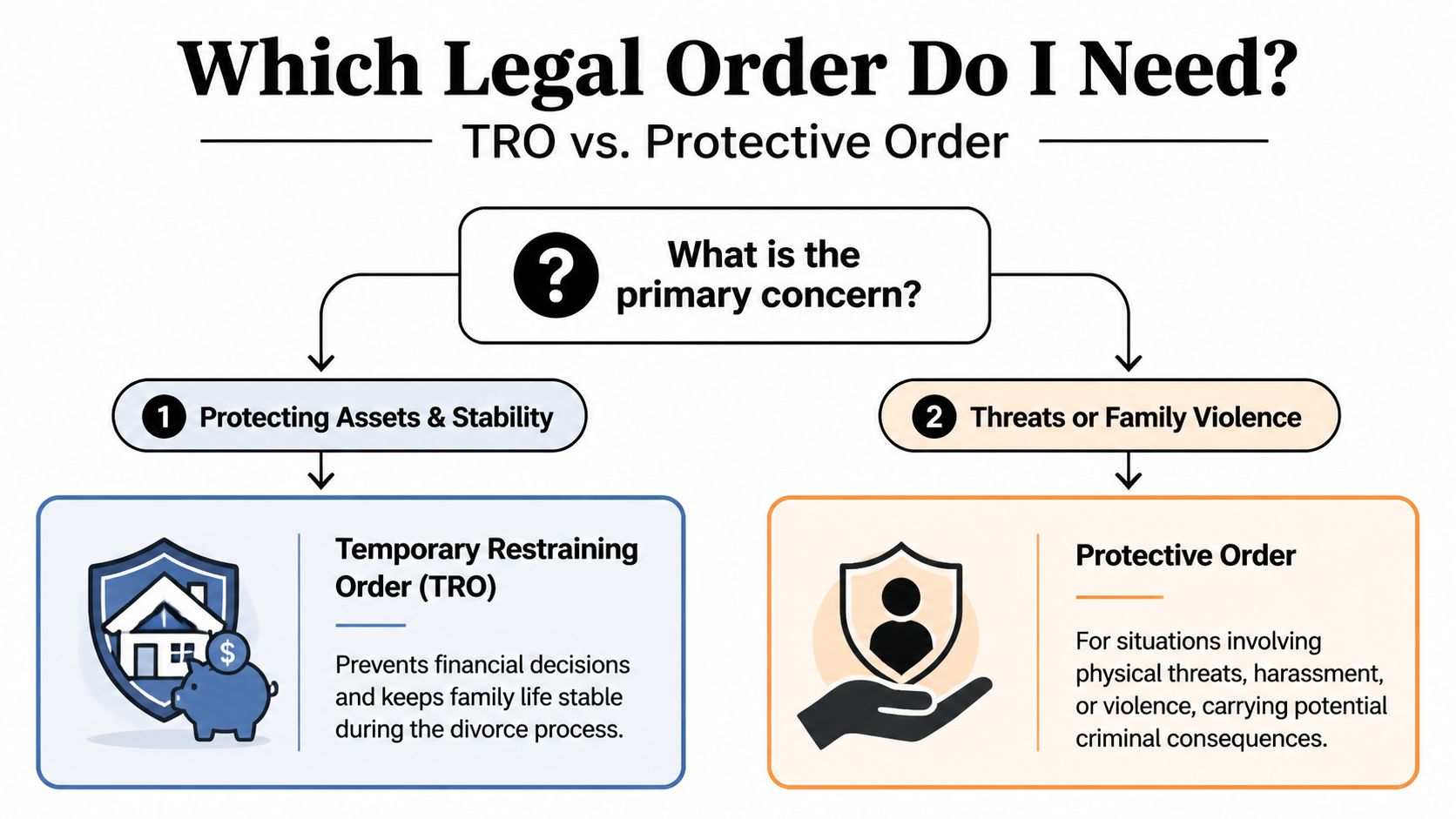
A Temporary Restraining Order (TRO) is a civil court order, most often used in a Texas divorce to manage behavior and preserve the community estate. Think of it as the court hitting a "pause" button on your marital life. It's a standard tool we use in many divorce filings to stop one spouse from making rash decisions that could drain your finances or destabilize the children's lives.
On the other hand, a Protective Order is a much more serious legal action directly tied to family violence. You seek a Protective Order only when there has been an act of violence, a credible threat, or a pattern of stalking and harassment.
When to Seek a TRO for Your Divorce
A TRO is the right move when your main worries are about finances and disruptive behavior—not physical safety. It’s all about maintaining the status quo while the divorce is sorted out. You should absolutely talk to your attorney about filing a TRO if you’re concerned your spouse might:
- Empty the joint bank accounts or cash out their 401(k).
- Try to sell the family home or car from under you.
- Pull the children out of their school or daycare without your agreement.
- Run up huge debts on shared credit cards.
- Harass you with endless, non-threatening calls, texts, or emails.
These actions are incredibly stressful, but they don't rise to the level of family violence. The civil court handles them with a TRO.
When a Protective Order Is Necessary
A Protective Order is the right tool when you or your children have experienced family violence or you live in fear of immediate harm. This is a completely different legal standard than a TRO and comes with far more serious consequences for the person it's filed against.
You need a Protective Order in situations involving:
- Physical abuse, assault, or injury.
- Threats of bodily harm to you or your children.
- Stalking, whether it's happening in person or online.
- Any action that makes you genuinely fear for your safety or your children's safety.
Unlike a TRO, a Protective Order can force an abuser out of the home (often called a "kick-out order"), prohibit them from owning a firearm, and order them into counseling or anger management programs. Violating a Protective Order is a criminal offense that can result in immediate arrest and jail time. As you weigh your options, learning more about the differences between a Protective Order vs. a Restraining Order in Texas is crucial for deciding which path gives you the safety and stability you need.
Scenario Comparison: If your spouse threatens to "take every penny from the retirement account so you get nothing," a TRO is your solution. If your spouse threatens to "make you pay" in a way that implies physical violence, you need a Protective Order immediately.
It’s also important to know that it is absolutely possible—and sometimes necessary—to have both a TRO for financial control and a Protective Order for personal safety active at the same time in your divorce case.
Step-by-Step: How to Get a TRO in Your Texas Divorce
Taking legal action during a divorce can feel intimidating, but the process for getting a TRO in Texas is designed for speed. It’s a way to quickly establish ground rules and prevent your spouse from making rash decisions that could harm you or your family’s finances. Let's walk through the steps.
Step 1: Filing the Divorce Petition and TRO Application
The first step is always preparing and filing an Original Petition for Divorce, which is the document that officially starts your divorce case. At the same time, your attorney will draft an Application for a Temporary Restraining Order to be filed alongside it. This application includes a sworn statement, called an affidavit, where you explain under oath exactly why you need immediate protection.
Vague fears won’t cut it; you have to provide specific, concrete reasons why you believe you'll face "immediate and irreparable injury" if the court doesn't intervene.
For example, instead of saying, “I’m worried he’ll drain our accounts,” a much stronger statement would be, "On June 5, 2026, my spouse threatened to transfer all funds from our joint savings account, number ending in 1234, to a private account I can't access."
Step 2: The Ex Parte Hearing and Judge's Signature
Once your paperwork is filed, your attorney will present it to a judge. This is usually done ex parte—a legal term that just means your spouse isn't present and hasn't been notified yet. Based on your sworn affidavit and the evidence you provide (like texts or bank statements), a judge can sign the TRO on the spot.
The law allows for this because time is often of the essence. If you had to notify your spouse before getting the order, it could give them the perfect opportunity to do exactly what you're afraid of. The ex parte TRO freezes the situation instantly.
Step 3: Serving Your Spouse
A TRO has no legal power over your spouse until they are formally notified. This happens through a process called "service," where a neutral third party—like a sheriff's deputy or a private process server—personally delivers a copy of the divorce petition and the signed TRO to your spouse.
This official delivery does two very important things:
- It legally informs your spouse that you have filed for divorce.
- It puts them on notice of the court's orders and the strict rules they must now follow.
From the moment they are served, your spouse is legally bound to every prohibition in the TRO. The documents they receive will also include a notice for the next critical step: the Temporary Orders Hearing.
How to Prepare for Your Temporary Orders Hearing
Getting that initial Temporary Restraining Order (TRO) is a significant first step, but it's a short-term fix. The main event, where the real groundwork for your divorce is laid, is the Temporary Orders Hearing. This hearing is usually scheduled within 14 days of the TRO being signed, and it's the first time you and your spouse will both present your cases to a judge.
This is your chance to convert the protections of the TRO into a more durable temporary injunction. These are the court-ordered rules that will dictate custody, child support, who lives in the house, and how bills get paid for the entire time your divorce is pending. The decisions a judge makes here often set the tone for the rest of your case, so showing up thoroughly prepared is non-negotiable.

Building Your Case with Solid Evidence
To persuade a judge that your requests are reasonable and in your child's best interest, you need more than just your side of the story. You need organized, compelling evidence that paints a clear picture. While your attorney will guide you on legal strategy, start gathering these documents right away:
- Financial Proof: This is critical. Pull together recent pay stubs (for both of you, if possible), bank statements, credit card bills, and a simple spreadsheet of your monthly living expenses. This is what a judge uses to figure out child support and temporary spousal support.
- Custody-Related Documents: Who is the primary parent? Prove it. Gather the kids’ report cards, school attendance records, and any emails or texts with teachers. A simple calendar showing who has historically handled school drop-offs, doctor’s appointments, and extracurriculars can be incredibly powerful.
- Evidence of Bad Behavior: If your spouse's actions are putting the family at risk, you have to show the judge. This is where you bring screenshots of threatening text messages, emails admitting to hiding money, or credit card statements showing wild spending sprees on a new partner.
- Witness Information: Make a list of people who have firsthand knowledge of what’s been going on. This could be a grandparent who witnessed harassment, a neighbor who knows you handle all the childcare, or even a financial advisor aware of your spouse trying to move assets.
What to Expect Inside the Courtroom
Walking into a courtroom for the first time is nerve-wracking for anyone. Your attorney will do the heavy lifting—presenting your evidence, questioning your witnesses, and cross-examining your spouse. But you will almost certainly have to testify.
When it’s your turn, stay calm. Answer the questions you're asked honestly and directly, addressing the judge as "Your Honor." Your role is to be a credible, truthful witness who presents the facts. All the preparation you did beforehand will be your best asset, allowing you to speak confidently and clearly.
For a deeper look into the mechanics and strategy of this critical step, read our comprehensive guide on the Temporary Orders Hearing in a Texas divorce.
What to Do if Your Spouse Violates the TRO
It’s a moment of pure frustration. You went through the trouble of getting a court order—a Temporary Restraining Order—and your spouse just ignored it. Maybe they drained the bank account, tried to sell the boat, or won't stop sending you harassing text messages. It can feel like the rules don't matter. But they do. A TRO isn't just a suggestion; it's a direct command from a judge.
While your first instinct might be anger or panic, the most important thing to do is act strategically. A violation is a direct defiance of the court's authority, and judges take that very, very seriously.
Filing a Motion for Enforcement
The legal tool we use to address a TRO violation is called a Motion for Enforcement. This is a formal document we file that tells the judge, "My spouse broke your order, and you need to do something about it." In legal terms, you’re asking the court to hold your spouse in contempt of court.
This motion can't be vague. We have to be incredibly specific, pointing out:
- Which exact part of the TRO was violated.
- The date and, if possible, the time the violation happened.
- A clear, factual description of how your spouse broke the rule.
Gathering Evidence of the Violation
An accusation alone won't cut it. You have to prove the violation happened. The faster you can gather clear documentation, the stronger your case will be.
Start collecting proof the moment you suspect a violation:
- Financial Violations: Print bank or credit card statements showing the prohibited transaction. Save any emails or texts where your spouse discusses selling an asset.
- Harassment Violations: Take screenshots of every single text message, social media post, or email. Keep a log of unwanted phone calls with dates and times. Save voicemails.
- Child-Related Violations: Forward emails from the school if your spouse tries to remove a child from class or save texts where they refuse to follow the temporary custody schedule.
Potential Consequences for Violating a TRO
Once you prove the violation, a judge has a lot of power to enforce the order. These aren't just slaps on the wrist. The penalties are designed to punish the bad behavior, fix the damage, and make sure it never happens again.
A judge can order your spouse to:
- Pay significant fines.
- Serve jail time for contempt, especially if the violation was severe or it’s not the first time.
- Repay any money they took or return property they weren't supposed to touch.
- Pay for your attorney's fees and the court costs you spent bringing the motion.
Beyond the immediate penalties, violating a TRO completely tanks your spouse's credibility with the judge. If you even suspect a violation has occurred, contact your attorney immediately. To understand the specifics of the legal filing, you can learn more about how to file a contempt of court motion in Texas.
Common Questions About Texas TROs
When you’re facing divorce, the legal process can feel like a tangled mess of questions. We want to provide you with clear, plain-English answers to some of the most common concerns we hear from clients.
Can my spouse and I agree to our own temporary orders?
Yes, and this is often the best path forward for everyone involved. If you and your spouse can still communicate—even if it's only through your lawyers—you can work together to create an "Agreed Temporary Order."
This agreement covers all the same ground as a court-ordered injunction (custody, support, property rules) without a stressful court hearing. It's usually cheaper, faster, and gives you both more control over the outcome. Once signed by a judge, this agreed order is just as binding and enforceable as one issued after a court battle.
Will asking for a TRO make me look bad in my divorce?
No, not if you’re using it for its intended purpose. Family court judges in Texas see these requests every single day. They know that asking for a TRO to stop a spouse from draining bank accounts, selling assets, or disrupting the children's lives is a standard, protective measure. It's seen as a reasonable step to maintain stability.
Where you can run into trouble is if you try to use a TRO as a weapon based on false claims. If a judge believes you requested the order simply to harass your spouse, it can seriously damage your credibility. The key is to use this powerful tool honestly and for the right reasons.
What does it cost to get a Temporary Restraining Order?
There’s no separate fee just for the TRO itself. The cost is part of the initial expenses of filing for divorce.
You’re typically looking at a few key expenses:
- Court Filing Fees: The standard fee paid to the county clerk when your attorney files the Original Petition for Divorce, which includes the TRO application.
- Service Fees: The cost to have a professional process server or sheriff's deputy formally deliver the lawsuit and court orders to your spouse.
- Attorney's Fees: This covers your lawyer’s time and expertise in drafting the necessary legal documents, preparing your evidence, and appearing in court on your behalf.
During your consultation, we can provide a clearer picture of what these costs might look like based on the specifics of your situation.
What to Do Next: Take Control of Your Divorce with Confidence
Navigating a Texas divorce is tough, especially when a temporary restraining order is involved. This guide gives you a clear roadmap, but knowing the rules is one thing—putting them into practice in a real-world courtroom is another. That’s where having an experienced family law attorney who understands the nuances of Texas courts can make all the difference. You don't have to face this alone.
The choices made in the first few weeks of a divorce can set the tone for your family’s future. Every step matters, from filing the right motions to protect your finances with a TRO to preparing for that critical temporary orders hearing. Having a confident, compassionate advocate in your corner ensures your rights are protected and your voice is heard.
The Law Office of Bryan Fagan, PLLC is dedicated to helping Texas families just like yours move forward with clarity and strength. We know what you are going through, and we are here to help you get back on your feet. We have guided countless men and women through the complexities of divorce, from standard TROs to high-conflict custody battles and the division of businesses and high-value estates.
Don't let anxiety about the future keep you from acting. The most powerful thing you can do right now is take a proactive step toward securing your family’s well-being. We offer free, no-obligation consultations to discuss your unique situation. This is your chance to ask direct questions, understand your legal options, and get a clear picture of what to expect.
Contact The Law Office of Bryan Fagan, PLLC today to schedule your confidential consultation. Let us help you start your journey toward a stable and secure future with confidence. You can also visit us at https://texasdivorcelawyer.us to learn more.