Skip to content
When your marriage is ending and you know agreement isn't likely, one question tends to keep you up at night: How much is this fight going to cost?
That fear is justified. In Texas, a contested divorce can move from manageable to overwhelming when one disagreement turns into several, or when one issue that might have settled ends up in front of a judge. If you're trying to budget, protect your children, keep a business intact, or hold onto the house, broad answers aren't enough.
Texas law gives you the framework for divorce, child-related orders, and property division, but your final cost usually comes down to process. Under the Texas Family Code, a divorce can involve conservatorship, possession and access, child support, characterization of property as community or separate, temporary orders, discovery disputes, mediation, and trial. Each step can be necessary. Each step can also add expense.
A practical cost discussion has to answer the actual question clients ask in my office: not just whether a divorce is contested, but how contested it is. That's where the cost ladder matters.
The Financial Uncertainty of a Contested Divorce
Individuals often don't start a divorce with a clear budget. They start with worry. You may be looking at the mortgage, your paycheck, your children's schedule, and a spouse who disagrees with you on custody, support, or who keeps what.
A contested divorce in Texas means you and your spouse don't agree on one or more major issues. That could be child custody, child support, spousal maintenance, use of the home, division of retirement accounts, or whether property is separate or community. Texas is a community property state, which means the court must divide community property in a manner the judge considers just and right. If you have children, the court also has to address conservatorship, possession, access, and support.
Why cost feels so hard to predict
The filing itself is rarely what shocks people. The uncertainty comes from what happens after filing.
One couple may disagree on only one issue and settle after exchanging a few documents and attending mediation. Another may argue over temporary orders, demand broad discovery, dispute custody, fight over a business valuation, and go to trial. Those aren't remotely the same case, even if both are called contested divorces.
Practical rule: The more decisions you leave for the judge, the more you usually spend getting there.
The process that drives the bill
A Texas divorce often follows this path:
- Filing the Original Petition for Divorce
- Service or waiver of service
- Temporary orders, if the parties need immediate rules on parenting, finances, or use of property
- Discovery, where both sides request documents and information
- Negotiation and mediation
- Final trial, if settlement doesn't happen
- Final Decree of Divorce, which turns the agreement or court ruling into enforceable orders
Texas also has a 60-day waiting period in most divorce cases before a divorce can be finalized. That does not mean every case finishes quickly. In contested matters, the legal work between filing and final decree is what drives the total.
The Bottom Line on Texas Divorce Costs
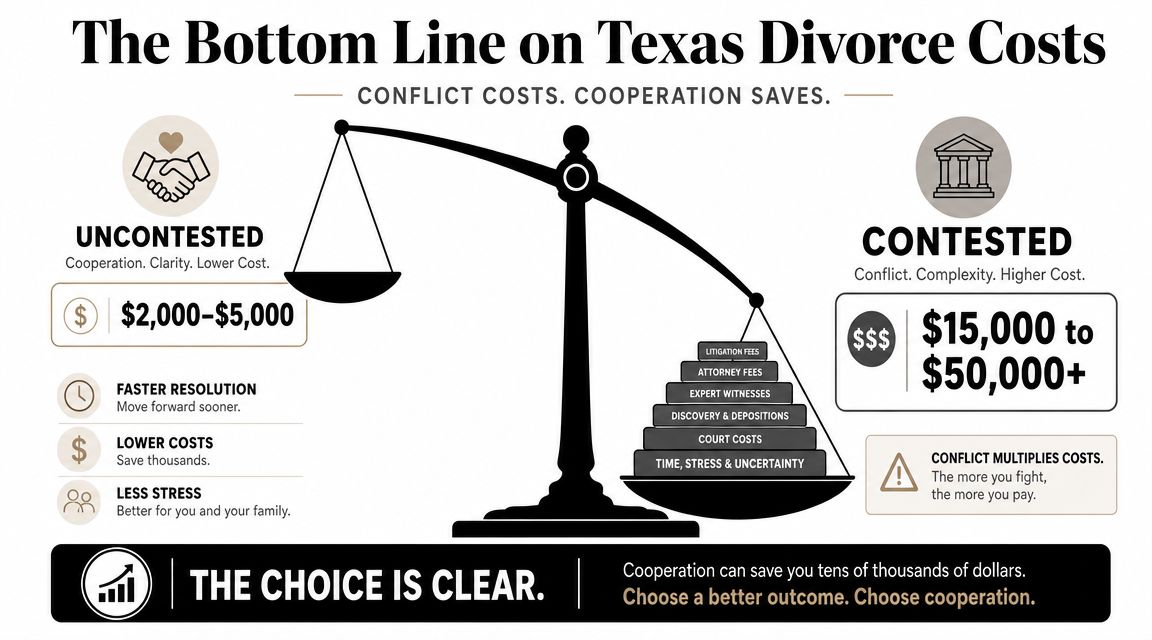
If you want the shortest honest answer to How Much Does a Contested Divorce Really Cost in Texas?, it's this: conflict is expensive, and trial is more expensive than settlement.
The baseline ranges you need to know
Texas-specific guidance from one law firm summary states that contested divorces commonly range from $5,000 to $20,000+, with cases involving children averaging about $23,500 and cases without children averaging about $15,600. The same summary states that uncontested divorces typically fall between $300 and $5,000. It also notes filing fees alone are usually $250 to $350 in many Texas counties, with attorney rates often around $300 to $750 per hour. You can review that breakdown in this Texas divorce cost overview.
That difference matters. It shows why a case that looks simple at filing can become a major financial event once disputes over children, property, or support start to multiply.
For a broader starting point on filing and budgeting, this guide on how much divorce costs in Texas is a useful companion.
The real issue is not just contested versus uncontested
The label “contested” hides too much. A case can be contested in a narrow way or in a way that touches every part of your family and finances.
A divorce where you disagree only on one support issue and settle in mediation is very different from a divorce where you fight over conservatorship, the home, retirement, reimbursement claims, and separate property tracing. Both are contested. Their costs won't be close.
Here's the practical distinction:
| Divorce posture | What it usually means for cost |
|---|---|
| Uncontested | Limited drafting, fewer hearings, minimal conflict |
| Narrowly contested | One issue may drive legal work, but settlement remains realistic |
| Broadly contested | Multiple issues increase attorney time, hearings, and document review |
| Trial-bound | Costs rise sharply because preparation becomes much more intensive |
What clients often misunderstand
People often focus on the filing fee because it is the only number the court posts clearly. But the filing fee isn't what makes a contested divorce expensive. The serious expense comes from lawyer time, expert work, repeated hearings, and the work required to prepare for trial if settlement fails.
A contested divorce bill usually reflects labor, not paperwork.
That's why two divorces filed in the same county can end with very different totals.
Breaking Down Your Bill Where the Money Goes
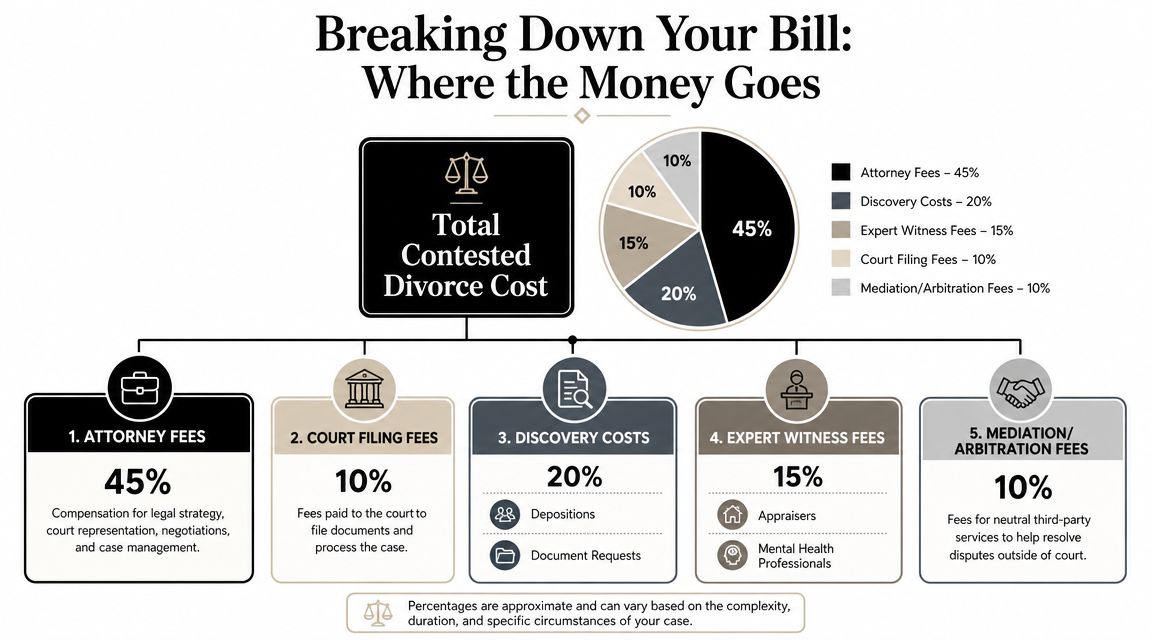
A contested divorce bill works like an itemized project invoice. You aren't paying one flat price for “the divorce.” You're paying for the work your case requires.
The fixed costs versus the moving costs
One Texas divorce cost guide notes that county filing fees are usually around $250 to $350, while attorney hourly rates in Texas commonly range from $250 to $750. It also explains that every motion, hearing, or deposition adds to the total, pushing the average contested case into the $12,000 to $25,000 range. You can read that discussion in this breakdown of contested divorce expenses in Texas.
That distinction is the heart of budgeting. Filing is fixed. Litigation is variable.
For a closer look at attorney billing structures and what legal representation may cost, review this page on the cost of a divorce lawyer in Texas.
What usually appears on the bill
Here are the categories that most often drive the total:
Attorney fees
This is usually the largest category. Most contested divorce work is billed by time spent on drafting, reviewing records, preparing for hearings, negotiating, and appearing in court.Court filing fees
These are the fees paid to open the case and, in some situations, for additional filings.Service and notice costs
Your spouse must be formally served unless service is waived. Extra notice issues can create more expense.Discovery work
Discovery includes requests for documents, inventories, appraisals, business records, financial statements, interrogatories, and depositions. If one side is disorganized or withholding records, attorney time climbs quickly.
A short explanation from a Texas family law attorney can help if you want to see how these pieces show up in actual representation:
The costs people don't plan for
Many clients expect legal fees. They don't expect the supporting costs that can come with a hard-fought case.
Mediation fees
Texas courts often expect parties to attempt mediation before final trial. Mediation can save money compared to trial, but it still has a cost.Expert witnesses
If your case needs a business valuation, real estate valuation, separate property tracing, or a mental health opinion, experts may become necessary.Court reporter and transcript expenses
Hearings, especially contested hearings, may require a reporter and later transcripts.Document management and review time
Large volumes of financial records take time to organize and analyze.
What works: giving your attorney organized records in one clean package.
What doesn't: sending scattered screenshots, partial bank statements, and unexplained transfers over weeks or months.
Why attorney time grows fast
A contested divorce doesn't become expensive because one hearing happened. It becomes expensive because one hearing often requires many hours behind the scenes. Drafting motions, preparing exhibits, reviewing opposing filings, and communicating about strategy all happen before anyone walks into court.
That's why controlling the scope of the dispute matters so much.
Four Key Factors That Drive Up Divorce Costs
Some cases stay contained. Others spread into every corner of a family's life. The difference usually comes from four cost drivers.
Conflict level between you and your spouse
If both sides want a resolution, even a difficult case can remain efficient. If either side fights every issue, delays responses, or turns minor disagreements into legal battles, costs rise fast.
High conflict affects nearly every stage of the case. It increases attorney communication, motion practice, hearing preparation, and the risk that mediation will fail. It also tends to make temporary orders more important because the parties can't function under informal arrangements.
In practical terms, conflict is expensive because every unresolved disagreement requires process. Process means more drafting, more preparation, and more court involvement.
Child-related disputes
When children are involved, the case stops being only about money. It becomes about conservatorship, possession schedules, exchange logistics, school decisions, child support, medical support, and how to handle conflict after divorce.
Texas courts focus on the best interest of the child. That standard is necessary, but it also means child-related disputes often require more evidence and more court scrutiny than property disputes.
One Texas-focused article notes that a custody evaluation may cost about $1,000 to $2,500 through the county, and as high as $15,000 with a private evaluator. That's a major reason custody fights can increase the total cost of a divorce. You can review that discussion in this Texas article on filing and hidden divorce costs.
Complex property and business interests
If your marital estate includes a closely held business, multiple real properties, investment accounts, or claims that certain assets are separate property, the legal work becomes more technical.
Texas courts divide community property in a just and right manner. That requires identifying what exists, valuing it, and deciding whether an asset is community or separate. Business owners also have to think about cash flow, goodwill questions, tax consequences, and whether a buyout is even realistic.
Many people make a costly mistake. They focus only on the legal bill and ignore the long-term effect of a rushed or poorly documented property division. Saving money on the front end can be expensive later if a decree is unclear or a valuable asset is mishandled.
Discovery fights and information problems
Discovery is where many contested divorces become much more expensive than expected. If one spouse has full access to the records and the other doesn't, the case often requires formal requests, follow-up letters, subpoenas, depositions, and motions to compel.
If you suspect missing accounts, unexplained transfers, hidden income, or incomplete business records, discovery may be unavoidable. But it should still be strategic.
For a practical overview of this phase, this guide to discovery in a Texas divorce case explains how document requests, disclosures, and depositions can shape both cost and outcome.
Discovery should answer the questions that matter. It shouldn't become punishment for the other side.
Contested Divorce Cost Scenarios in Texas
General ranges help, but understanding where one's own case may land is a common concern. The most useful way to think about cost is not a single average. It's a ladder.

A strong Texas benchmark comes from survey data summarized in a legal guide showing that a divorce with no contested issues averages $4,000 to $5,000. With one dispute resolved without trial, the average rises to $6,000 to $7,000. With two or more disputes settled out of court, it reaches $10,000 to $12,000. If issues go to court, average costs increase to $13,000 to $17,000 for trial on one issue and $18,000 to $23,000 for trial on two or more issues. You can review that cost ladder in this Texas divorce cost survey summary.
That ladder is useful because many divorces are mixed cases. Some issues settle. Others don't.
Scenario one with one focused dispute
You and your spouse agree on most property issues and both want the divorce finalized without a final trial. The main disagreement is whether one spouse should pay spousal maintenance or contractual support, and for how long.
This kind of case may still require:
- filing and service
- some exchange of financial records
- lawyer negotiation
- one mediation session
- drafting a detailed final decree
If that single dispute settles outside of trial, the survey data places a one-issue negotiated dispute around the $6,000 to $7,000 range in average total cost from that benchmark source. This is often the least expensive kind of contested divorce because the disagreement stays narrow.
What helps here is discipline. If both sides keep the dispute focused, the case can remain financially contained even if emotions are strong.
Scenario two with multiple issues but no final trial
Now consider a family with children. The spouses disagree over a parenting schedule and what to do with the marital home. They need temporary orders because someone must move out, bills still have to be paid, and the children need a workable routine right away.
This kind of case often involves:
| Step in the case | Why it adds cost |
|---|---|
| Temporary orders hearing | Immediate court involvement requires preparation and evidence |
| Discovery | Parenting records, financial statements, and home-related documents must be exchanged |
| Mediation | More issues mean a longer and more detailed settlement process |
| Detailed decree drafting | Parenting terms and property terms have to be precise |
If two or more disputes are resolved through settlement rather than trial, the benchmark survey places average total cost at $10,000 to $12,000. This is the kind of hybrid case many Texas families face. It is contested, but not fully litigated through a final hearing on every issue.
This is also where strong mediation can save substantial money. A home can be sold, refinanced, or awarded to one spouse. Parenting schedules can be customized. But once those issues move into a trial setting, the cost profile changes.
Scenario three with trial on major issues
The highest-cost cases usually involve several disputes at once. A business owner may be accused of hiding income. A spouse may claim certain funds are separate property. The parents may disagree sharply about conservatorship and who should determine the child's residence. Temporary orders may not solve the conflict, and settlement efforts may stall.
A case like that can include:
- extensive document review
- depositions
- business valuation work
- custody-related experts
- repeated court settings
- trial preparation on multiple disputed issues
When two or more issues go to trial, the benchmark survey places average total cost at $18,000 to $23,000. In practice, some Texas guidance also notes trial-driven contested cases can exceed that in especially difficult disputes, particularly where custody and substantial assets are both in play. The key lesson remains the same: once multiple issues are prepared for a judge to decide, the bill often accelerates fast.
The jump from settlement to trial is not a small step. It's usually the steepest step on the ladder.
How to place your own case on the ladder
Ask yourself three questions:
- How many issues are disputed?
- Can any of them be resolved through negotiation or mediation?
- Is there one issue worth trying, or are several issues drifting toward trial?
Those answers often tell you more than the label “contested divorce” ever will.
Practical Strategies to Control Your Divorce Costs
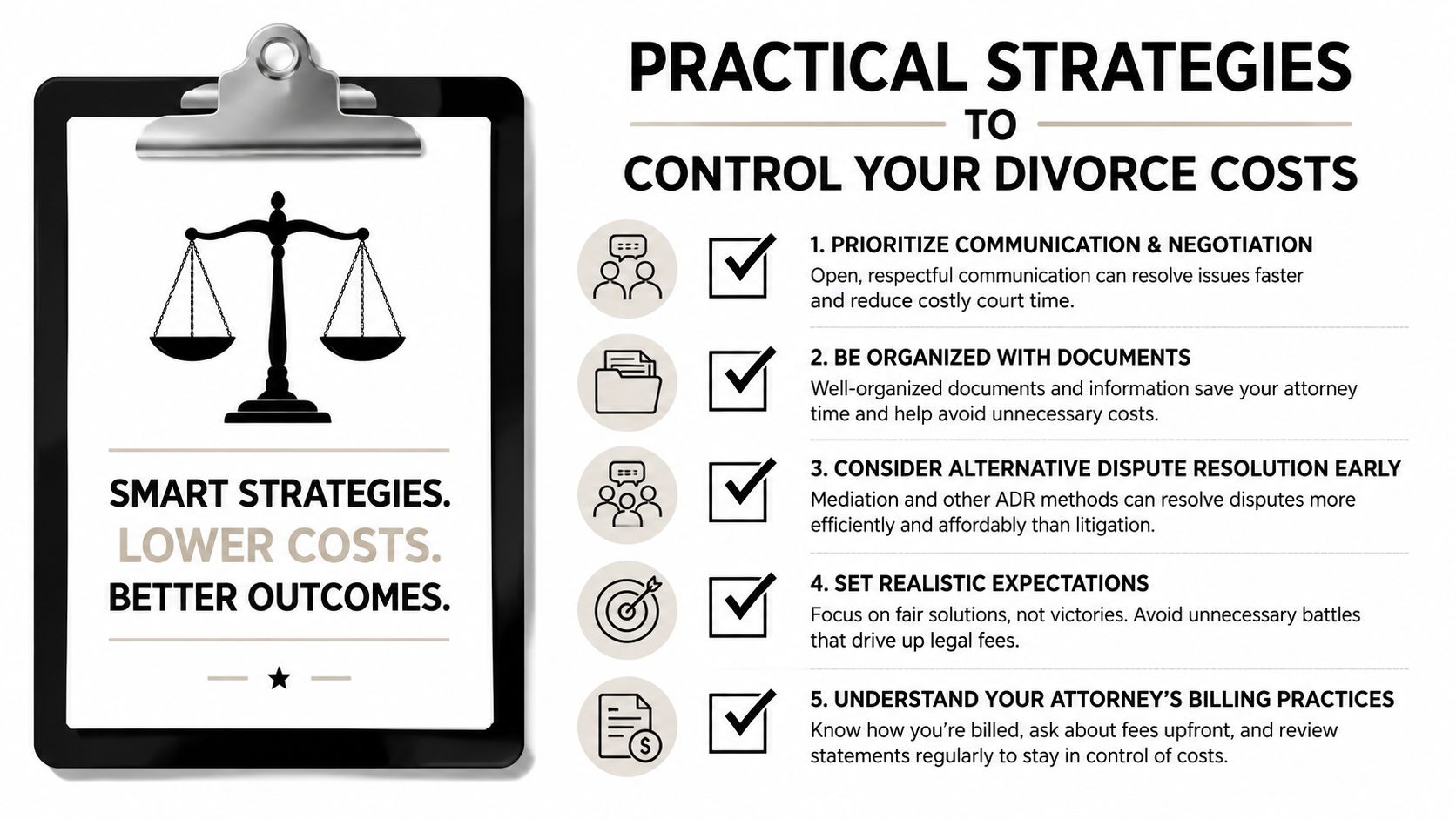
A contested divorce gets expensive one decision at a time. Clients usually do not overspend because of one dramatic event. The bill grows when small disputes turn into formal discovery, emergency hearings, expert work, and trial preparation.
Decide which fights are worth paying for
The cheapest issue to litigate is the one you resolve early.
That does not mean giving in. It means separating what affects your long-term finances or your children from what feels offensive in the moment. I often tell clients to rank disputed issues in three buckets: matters that affect the next ten years, matters that affect the next year, and matters that are mostly about principle. The first bucket usually deserves the legal budget. The third often does not.
For example, it may make sense to spend money tracing separate property, valuing a business, or protecting a parenting schedule that fits the children. It rarely makes sense to spend the same money arguing over furniture, minor reimbursements, or old resentments dressed up as legal claims.
Mediate before the case gets trial-shaped
Mediation is usually most productive before both sides have spent heavily preparing exhibits, witness outlines, and expert opinions. Once that work starts, each side has more money sunk into the fight and less room to compromise.
A good mediation can also solve problems a judge may address only in broad strokes. Parents can work out exchange times around school and work. Spouses can set realistic refinance deadlines, agree on repairs before listing a house, or structure a buyout over time. If the marital home is draining cash and keeping the case stuck, some families look at quick home sale solutions to see whether a faster sale would remove pressure and open the door to settlement.
Use your lawyer for legal judgment, not avoidable cleanup
Clients lower their fees when they make it easier to move the case forward.
- Bring organized records such as tax returns, pay stubs, bank statements, retirement statements, and loan documents.
- Answer questions fully the first time so your attorney is not billing time to chase basic facts.
- Send one clear email instead of six scattered ones when the issue can wait.
- Keep a written timeline of major dates, payments, incidents, and agreements.
- Save emotional venting for a counselor or trusted support person when possible. Lawyer time is expensive, and it should be spent on strategy.
One practical rule helps. Before you call or email, ask: does this problem require a court response, a settlement proposal, or simple documentation for later use?
Ask what each step is likely to cost before you approve it
Many clients can control costs better once they understand the price of the next rung on the ladder. A motion for temporary orders costs more than an exchange of letters. Written discovery costs more than an informal document swap. Depositions, experts, and trial exhibits each add another layer.
Ask direct questions. Do we need formal discovery yet? Is this hearing likely to change the result, or just increase the bill? Would mediation now make sense? If an expert may be needed, what issue justifies that expense?
Law Office of Bryan Fagan, PLLC handles contested divorce matters in Texas. Clients should expect any firm they hire to explain which tasks are necessary, which are optional, and which steps are likely to move the case toward resolution instead of only adding fees.
Key Takeaways and Your Path Forward
The most important thing to understand about How Much Does a Contested Divorce Really Cost in Texas? is that there usually isn't one fixed number waiting for you at the end. The cost is shaped by the number of disputed issues and by whether those issues settle or go to trial.
That's why the cost ladder is so useful. It reflects reality that many divorces are not fully peaceful or fully scorched-earth. They are mixed cases. You may settle property but fight over parenting. You may resolve support but dispute the house. Every issue you take off the trial list usually helps control both cost and stress.
What to do next
Start by identifying the pressure points in your case:
Children
Are you arguing about conservatorship, the right to determine residence, or exchange schedules?Property
Is there a home, business, retirement account, or separate property claim that needs close review?Procedure
Do you need temporary orders, or is there a path to early mediation?
If children are involved, structure matters as much as intent. Tools like Everblog's guide to coparenting calendars can help you think through transitions, exchanges, school obligations, and daily logistics before those issues become bigger fights.
A smart next step is to sit down with a Texas family law attorney and map your case realistically. Which issues are worth fighting over. Which can be settled. Which records need to be gathered now. Which steps can wait. That kind of strategy often saves more than it costs, because it keeps your case from drifting into unnecessary litigation.
You don't need vague reassurance. You need a plan that protects your children, your property, and your ability to move forward.
If you're facing a contested divorce, schedule a free consultation with Law Office of Bryan Fagan, PLLC. You can talk through the issues driving your case, get a clearer sense of likely cost pressure points, and build a practical strategy for settlement, mediation, temporary orders, or trial if trial becomes necessary.