Skip to content
Ending a marriage is painful enough without wondering whether you can even afford to file the paperwork.
If you're searching for how to get a free divorce in Houston, you need a clear answer, not wishful thinking. In Harris County, a completely free divorce is possible for some people, but it usually means combining two separate forms of help. First, you try to waive court filing fees. Second, if you qualify, you look for free legal representation through legal aid or pro bono programs. Those are not the same thing, and many people lose time because they treat them like one issue.
The practical reality is simple. You may be able to avoid paying the court. You may be able to get a lawyer for free. You may get one but not the other. And if you don't qualify for either, you still have ways to keep costs down through an agreed divorce, careful document preparation, and mediation.
Houston also has a local reality that many general articles miss. Free help is limited, eligibility is strict, and timing matters. The people who do best usually take a disciplined approach. They confirm they can file in Harris County, gather income documents early, use the right forms, and stay realistic about whether their case is uncontested.
If your divorce involves children, a business, retirement accounts, military service, separate property claims, or a house, the process gets more complicated fast. Texas family law also requires the court to address property division, and if children are involved, issues like conservatorship, possession, and support have to be handled correctly. That doesn't always mean you need full litigation. It does mean you should be careful before choosing a DIY route.
The Reality of a Free Divorce in Houston
A Houston spouse sits at the kitchen table with rent due, a bank account already stretched thin, and one immediate question. Can this divorce be filed without paying hundreds or thousands of dollars up front?
Sometimes, yes. But “free” in Harris County usually means limited relief from one part of the process, not a cost-free case from start to finish.
The first expense is the court. The second is legal help. Those are separate problems, and they are solved in different ways. A filing fee waiver may cover the clerk's costs to open the case. It does not automatically get you a lawyer. Free legal representation, if you can get it, is limited and usually reserved for lower-income applicants with cases the program is able to take. For a practical overview of the local filing process itself, see this guide to filing a divorce in Harris County.
What “free” usually means in practice
In Houston, a low-cost or no-upfront-cost divorce usually looks like one of these paths:
- Court fees are waived. You file a Statement of Inability to Afford Payment of Court Costs, and the clerk accepts the case without the standard filing charge if the court approves it.
- A legal aid or pro bono program provides limited help. That may mean advice, document review, drafting assistance, or representation in a narrower uncontested matter.
- You handle an agreed divorce yourself. This works best when both spouses fully agree and the case does not involve property disputes, parenting conflict, or hard-to-value assets.
Houston residents should go into this with clear expectations. There is no broad local program where anyone who asks gets both free filing and a free lawyer.
The gap between demand and available help is longstanding. In a 2023 history summary published in the Houston Lawyer Referral Service guide on FREE LEGAL SERVICES, Lone Star Legal Aid reported that only 18% of divorce applicants in 2023 received services, citing funding limits and heavy demand.
That number matters because it changes how you should plan. Apply for free help if you may qualify, but do not wait for an answer before organizing your documents, identifying whether your case is agreed, and preparing a backup option.
What tends to work, and where cases get stuck
Some options are realistic for low-income filers. Some look cheaper at the start than they are at the finish.
| Approach | When it tends to work | Where people run into trouble |
|---|---|---|
| Fee waiver | Low income, complete financial proof, straightforward filing | Missing benefit letters, pay stubs, or required financial details |
| Pro bono help | Uncontested cases that are organized and ready for review | Long wait times, strict screening, and cases that are more complicated than the applicant realized |
| DIY agreed divorce | Full agreement on property, debt, and if applicable, children | Decrees that leave out retirement issues, house terms, or enforceable parenting language |
| Mediation | Both spouses will participate in good faith | One spouse hides information, refuses to compromise, or uses delay as a tactic |
Houston's free-lawyer pipeline is especially tight. The Houston Volunteer Lawyers Program reports a waiting period of 3 to 6 months, and on the Houston Volunteer Lawyers Program page, it states that in 2024, 1,200 of 8,500 intake requests were matched with an attorney.
That does not make the program unhelpful. It means applicants need realistic timing expectations.
I tell people to be careful with the word “simple.” A divorce can look simple until someone mentions a 401(k), a house deed, unpaid taxes, a child support disagreement, or separate property claims. At that point, the cheapest option on paper can become the most expensive one to fix later if the decree is vague, incomplete, or legally unenforceable.
If your case is contested, emotionally volatile, or tied to children, real estate, retirement accounts, or a family business, a fully free path may not be available. A lower-cost strategy is still possible, but it usually requires picking the right corners to save on and the wrong corners to avoid cutting.
Confirming Your Eligibility to File in Harris County
A lot of Houston divorces get delayed before the case really starts. The problem is not strategy. It is filing in the wrong county, or filing before the residency clock has run.
Texas law requires that at least one spouse must have lived in Texas for at least six months and in Harris County for at least 90 days before filing, under Texas Family Code Chapter 6. If you file too early, the court can dismiss the case. For someone trying to keep costs down, that kind of mistake matters. You lose time, you may have to refile, and you can create avoidable problems with service and scheduling.

The first two gatekeepers
These are the fundamental basics:
- Texas residency: One spouse must have lived in Texas for six months before filing.
- Harris County residency: One spouse must have lived in Harris County for 90 days before filing there.
Those dates sound simple, but people often count them wrong after a move, a separation, or a temporary stay with family. The court is looking at actual residency, not just where you get mail. If you want a practical overview of the local process, this guide on filing a divorce in Harris County explains what the clerk and court typically expect.
What else affects whether a low-cost divorce is realistic
Meeting the residency rules only gets you in the courthouse door. It does not mean your case will stay easy or inexpensive.
Many people file on insupportability, Texas's no-fault ground. That is usually the most practical route for an agreed or low-conflict divorce. Fault-based claims such as adultery or cruelty may matter in some cases, but they often increase conflict, require more proof, and make a free or near-free path harder to maintain.
Children change the case in a major way. If you have minor children, the court must address conservatorship, possession and access, child support, and medical support. That means more paperwork and closer review by the judge, even when both parents agree.
Property issues do the same thing. A house, retirement account, business interest, or large debt balance can turn a cheap divorce into an expensive cleanup job if the decree is vague. Texas courts divide community property in a way the court considers just and right, so clear drafting matters.
I tell clients this often: agreement helps, but complete agreement is what saves money. If you and your spouse agree on divorce but have not pinned down the house, retirement, taxes, or a parenting schedule, the case is not really ready.
The timing issue people miss
Texas also imposes a 60-day waiting period after the Original Petition is filed before the divorce can be finalized. That catches people off guard, especially when they are trying to coordinate a move, switch insurance, or refinance a car or home.
If family violence, a protective order, or immediate safety concerns are part of the situation, get legal advice right away. Those cases usually need a different plan from the start.
How to Waive Court Filing Fees
If you're trying to make the divorce itself free, this is the first place to focus.
The main tool is the Statement of Inability to Afford Payment of Court Costs. Texas uses this form so the court can decide whether you qualify to file without paying upfront court costs. TexasLawHelp explains the process in its guide to court fee waivers in Texas.
The form that matters most
This filing isn't a casual note saying money is tight. It has to give the court a usable financial picture. The verified guidance provided for Harris County practice is very specific. The statement should detail your post-tax household income, dependents, and essential living expenses to show eligibility under the Texas Poverty Guideline. A common pitfall is failing to attach verified proof, such as a Medicaid card, SNAP award letter, or TANF or SSI benefit statement.
That missing documentation is one of the most common reasons people get delayed. In Harris County, if you submit the statement without proof, the case can stall while you amend the filing.
How to improve your odds
Use a checklist before you file:
- Complete the financial details fully: Don't leave income, expenses, or household support questions vague.
- Attach proof documents: Benefit letters and eligibility cards matter because courts want verification, not conclusions.
- File in the right sequence: The verified guidance indicates the statement should be filed before the Petition so the clerk can process the waiver with the case opening.
- Keep copies of everything: Bring printed copies and save electronic ones.
- Prepare for follow-up: If the clerk or court asks for clarification, respond quickly.
A detailed explanation of the process is also available in this article on understanding divorce fee waivers and how to qualify.
What the waiver does and does not do
A fee waiver can be the difference between filing now and delaying the case. Without it, the standard Harris County filing fee is described in the verified guidance as $325 to $350, and that fee is non-refundable even if the divorce is later granted. But a waiver only addresses court costs. It doesn't automatically get you a free lawyer, free service of process, or free help drafting your decree.
That distinction matters because many people think the waiver solves the entire affordability problem.
Keep this separate in your mind: A fee waiver gets you into court. It doesn't turn a contested divorce into a simple one.
If your divorce is agreed and straightforward, waiving court costs may get you most of the way there. If your spouse is fighting over custody, support, or property, your real cost pressure may come later in negotiation, mediation, or hearings.
For parents, mistakes can become expensive. Child-related orders need enforceable language. For business owners, the decree has to address who keeps the business interest and what happens with related debt. For high-asset households, retirement accounts, brokerage accounts, reimbursements, and separate-property claims can create problems that self-help forms don't fully solve.
Finding Pro Bono and Legal Aid Attorneys
Free legal representation exists in Houston, but it's limited, selective, and usually aimed at the cases the system can move efficiently.
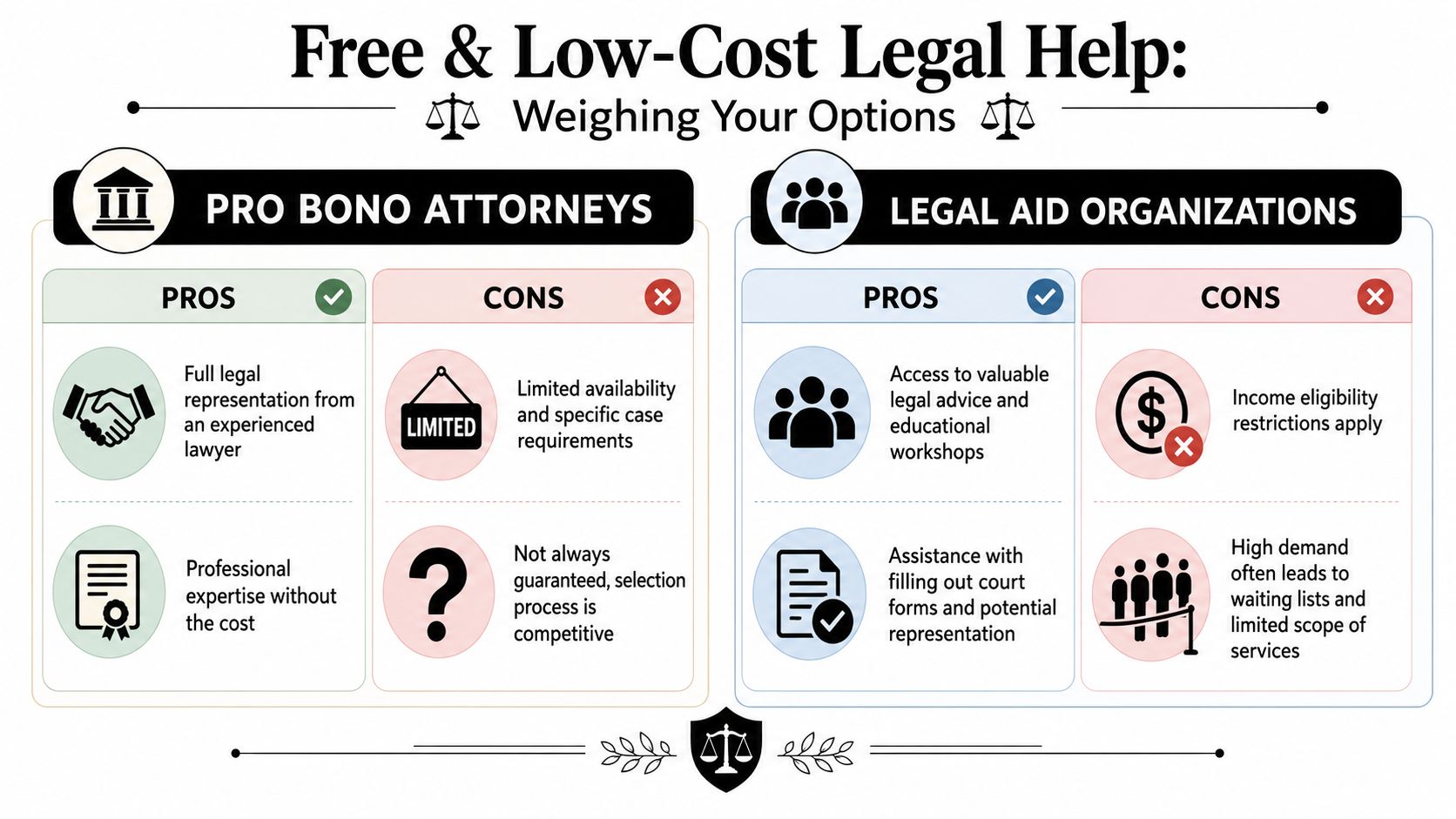
The two names many people start with are Lone Star Legal Aid and Houston Volunteer Lawyers. Verified guidance states that Lone Star Legal Aid may assist people earning less than 200% of the federal poverty level, approximately $29,160 per year for a single person without children in Harris County, and that both Lone Star Legal Aid and Houston Volunteer Lawyers require applications and financial screening. That same verified guidance also notes they generally do not handle contested divorces involving complex asset division or high-value estates.
The Houston reality check
The Houston Volunteer Lawyers program can help, but it is not open-ended. Verified data shows the success rate for securing pro bono representation through Houston Volunteer Lawyers for an uncontested divorce is about 40% to 50%, according to Houston Volunteer Lawyers.
That range tells you two things. Some eligible applicants do get help. Many still don't get matched.
A second verified point matters just as much. A common failure point is applying without a Final Decree of Divorce draft already prepared. Volunteer lawyers handling large case volume often need a case that is ready to move, not one that starts from scratch.
Here is a short overview that may help you think through the decision:
| Option | Best fit | Main trade-off |
|---|---|---|
| Legal aid | Very low income, limited issues | Eligibility screening can be strict |
| Pro bono attorney | Uncontested case that is nearly ready | Matching is competitive |
| Reduced-fee referral | Above legal aid limits but still cost-sensitive | You still pay, but often less than full private rates |
To support your research, you may also find this discussion helpful:
How to make your application stronger
You can't control program capacity, but you can control whether your file looks workable.
- Bring a draft decree: This is one of the biggest practical differences between people who are intake-ready and people who are not.
- Apply when your case is ripe: Verified guidance indicates applying more than 90 days before the Texas county residency requirement expires often leads to rejection because the program prioritizes cases ready for immediate filing.
- Know your case type: Domestic violence and child-related emergencies often receive priority, which can slow routine agreed divorces.
- Be honest about complexity: If you have a business, major property disputes, or unusual retirement issues, your case may fall outside what a volunteer program can realistically take.
If you're asking for free representation, make it easy for the program to see that your case is organized, eligible, and ready to move.
If you don't qualify or don't get matched, that isn't the end of the road. It usually means the best next step is a controlled low-cost strategy. For some people, that means limited-scope legal advice. For others, it means mediation, self-help forms, or a paid review of the final decree before prove-up.
Low-Cost Alternatives DIY and Uncontested Divorce
A common Houston scenario looks like this. You do not qualify for legal aid, you cannot afford full representation, and you and your spouse both say you want a divorce. The hard question is whether you agree on the terms well enough to keep costs low.

In Harris County, "low-cost" usually means one of three paths: do it yourself with approved forms, handle most of the case yourself and pay a lawyer for limited review, or settle the disputed terms early so the case can finish as an agreed divorce. A free divorce is rare. A controlled-cost divorce is often realistic.
When DIY makes sense
DIY works best in a narrow set of cases. The marriage is short or straightforward, there are no minor children, no house or land to divide, and both spouses are prepared to sign the needed papers without a fight.
Texas does provide approved forms for some simple agreed divorces. If you have no minor children and no real property, the TexasLawHelp guide for an agreed divorce without minor children or real property can point you to the standard petition, waiver, and final decree forms.
This option saves money only when the forms fit your facts.
If you want a clearer explanation of what counts as an agreed case, this guide to uncontested divorce in Texas is a useful reference. Wanting the divorce is not enough. You need agreement on property, debt, and, if children are involved, conservatorship, possession, support, medical support, and practical exchange terms.
Where people underestimate the cost
I see DIY cases get more expensive when people file too soon and draft too little. The filing may be cheap compared to hiring full counsel, but fixing a bad decree, redoing service, correcting missing language, or fighting over vague parenting terms costs more later.
These cases often need more than forms:
- Parents with children: The decree has to do real work. It should cover schedules, holidays, pickup logistics, decision-making, support, and health insurance in language the court will sign and the parents can follow.
- Homeowners: The order should address who stays in the house, who pays the mortgage, whether someone must refinance, when the property will be sold, and what happens if deadlines are missed.
- Retirement accounts: Division may require a separate order after divorce, and people often miss that.
- Self-employment or side businesses: Income, debt, and ownership questions are harder to paper over than many couples expect.
- Unequal bargaining power: If one spouse controls the money, records, or access to the children, a "simple agreement" may not stay simple for long.
That is the Houston reality check many generic articles miss. Cheap paperwork does not automatically produce a workable Harris County decree.
The middle path that often saves the most
For many families, the best value is limited-scope help. You prepare basic information, use self-help forms where appropriate, then pay a lawyer for targeted work such as reviewing the decree, advising on property language, or preparing for prove-up.
That approach usually makes sense when the dispute is narrow. Maybe you agree on everything except the car loan payoff date. Maybe you need someone to clean up the final order so it can be signed without rejection.
Mediation can also reduce cost if both spouses are close to agreement but keep stalling over details. Paying for a few hours of focused settlement work is often cheaper than turning a manageable case into contested litigation.
Divorce also has a practical and emotional side. People who are trying to stay organized and make steady decisions during the process may find these expert insights on divorce help useful alongside the legal steps.
One practical option some Texans consider is the Law Office of Bryan Fagan, PLLC. The firm handles divorce and related family law matters and offers consultations that can help you decide whether your case is a fit for DIY filing, limited-scope assistance, mediation, or full representation.
Your Action Plan and What to Do Next
A lot of Houston divorces stall at the same point. One spouse is ready to file, money is tight, the forms look manageable, and then the practical questions start. Which county should the case be filed in? Can the filing fee be waived? Is the decree complete enough for a judge to sign?

The best next step is to get organized before you file anything else. In Harris County, "free divorce" usually means reducing or avoiding specific costs, not avoiding the legal requirements. A missed residency rule, an incomplete Statement of Inability, or a weak final decree can cost more time and money than the filing fee you were trying to save.
Your practical checklist
Use this order:
- Confirm you can file in Harris County. If residency is not in place, wait until it is.
- Decide whether the case is uncontested. You need agreement on property, debts, and any child-related terms, not just agreement that the marriage should end.
- File a Statement of Inability if court costs are the barrier. Include supporting documents the first time to reduce delays.
- Apply for legal aid or pro bono help early. Houston-area programs often have limited capacity, and it helps to have your paperwork gathered before you ask for help.
- Choose the lowest-risk affordable option if free help is not available. That may mean self-filing with careful form review, limited-scope attorney help, or mediation to finish a mostly agreed case.
The timeline to keep in mind
Even in a fully agreed divorce, Texas does not allow an immediate finish. You cannot finalize the case until at least 60 days have passed from the date the Original Petition for Divorce was filed under Section 6.702 of the Texas Family Code. That waiting period applies even in agreed cases. Treat it as part of your planning so you can use that time to correct forms, finish the decree, and prepare for prove-up if needed.
What to do if you feel stuck
The sticking point is often not the petition. It is the final paperwork.
Many people can complete basic forms but are not sure whether the decree covers retirement accounts, vehicle titles, reimbursements, tax issues, or the exact possession terms for children. That is where low-cost legal review can save money. Paying for one targeted review is often cheaper than trying to fix a defective order after it is signed.
Emotional strain also affects judgment. People under pressure often agree to vague terms just to get the case over with. If you need help staying steady and making decisions during the process, this article with expert insights on divorce help offers useful support alongside the legal steps.
What to do next: If your case involves children, real estate, retirement accounts, family violence, hidden debt, or a spouse who will not cooperate, get legal advice before you sign final papers.
Cost matters. So does getting an enforceable result. The goal is to keep expenses low without creating new problems in property division, custody terms, support, or enforcement later.
If you need help sorting out whether you qualify for a fee waiver, whether your case can be handled as an agreed divorce, or whether legal aid is a realistic option, schedule a free consultation with Law Office of Bryan Fagan, PLLC. You can get clear guidance on the safest next step for a Houston divorce on a limited budget.