Skip to content
Some nights you lie awake running through the same questions, wondering how your family, your home, and your future could change so quickly.
If that's where you are, you're not alone, and you're not powerless. Divorce feels overwhelming because it mixes grief, fear, money, parenting, and legal deadlines into one hard season. But once you understand the path, the process becomes more manageable. A good Dallas divorce lawyer doesn't just file paperwork. Your lawyer helps you make steady decisions when emotions are high and the stakes are personal.
Many people wait too long because they think they need to have every answer before they act. You don't. You need a clear starting point, a realistic plan, and a sense of what matters most right now. Before you file, it can help to review a practical checklist like this guide on what to do before filing for divorce in Texas, especially if you're still living in the same home, sharing bills, or trying to protect your relationship with your children.
Starting the Path Forward When Your Marriage Is Ending
A client once told me, “I'm not even sure where to begin. I just know I can't keep living like this.”
That's a common place to start. You may still be in the same house. You may be trying to keep life normal for your children. You may be sorting through text messages, bank accounts, and the emotional shock of a marriage ending. None of that means you're behind. It means you're human.
Divorce in Dallas has legal rules, but your experience of it is personal. Some people need urgent action because of conflict at home. Others need a careful plan because they own a business, have retirement accounts, or want to avoid making parenting mistakes early in the case. In both situations, clarity matters.
Practical rule: The first goal is not to “win” the divorce. The first goal is to protect your stability, your children, and your decision-making.
If you're searching for a divorce lawyer in Dallas, you're likely looking for more than courtroom experience. You want someone who can explain what happens next in plain English, keep the case moving, and help you avoid choices that create long-term problems. That kind of guidance can change the tone of the entire case.
The Dallas Divorce Roadmap From Filing to Final Decree
In Dallas County, divorce starts with a formal filing. That filing sets the case in motion, starts the waiting period, and places your matter inside a court system built specifically for family law.
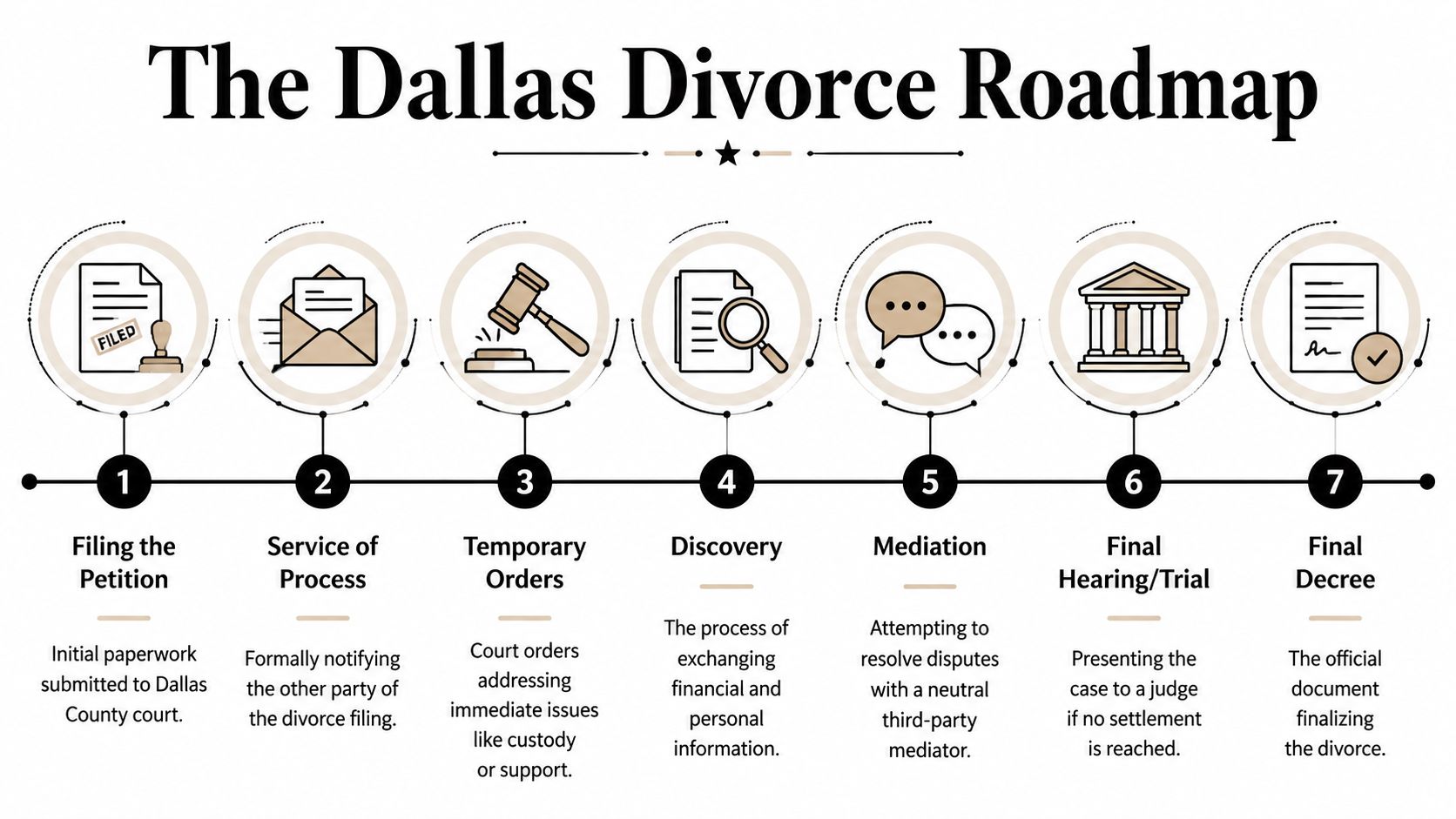
Step one begins with filing
You file an Original Petition for Divorce with the Dallas County District Clerk at the George L. Allen, Sr. Courts Building, 600 Commerce Street, Dallas, TX 75202. The filing fee is approximately $350, and additional service-of-process costs range from $75 to $150, according to this Dallas County divorce filing guide from Divorce Law Texas Dallas. Dallas County assigns divorce cases to one of seven family district courts: the 254th, 255th, 256th, 301st, 302nd, 303rd, or 330th District Court.
That local structure matters. Your case isn't going into a general civil court. It's handled inside a dedicated family law system, which means the judges regularly work with custody disputes, property division, temporary orders, and enforcement issues.
Step two is making sure you filed in the right place
Before filing, Texas requires that one spouse has lived in the state for at least six months and in the filing county for at least 90 days. If you file too early, the court can dismiss the case, and the filing fee is not refunded, as explained in this overview of Texas divorce residency and venue requirements.
Readers often get tripped up in Dallas-Fort Worth moves. A move across the metroplex may feel minor in daily life, but county lines still matter in divorce. That confusion grows when someone moves during the case and assumes the matter can follow them.
Moving from Dallas County to another DFW county during a pending divorce can create jurisdiction questions that generic FAQs often ignore.
If that's your situation, get personalized advice early. Dallas procedure also has practical local details, and this overview of the Dallas divorce court process and procedures is a useful companion.
Step three through seven shape the case
After filing, the other spouse must be served unless they sign a waiver. The respondent then has a deadline to answer, temporary orders may be needed, the parties exchange information in discovery, and many courts expect mediation before trial.
A simple way to think about the case is this:
- Filing the petition so the court opens the case
- Service of process so the other spouse receives formal notice
- Temporary orders for short-term rules about children, bills, or property use
- Discovery so each side can review financial and personal information
- Mediation to try to resolve disputes without trial
- Final hearing or trial if issues remain
- Final decree to make the divorce official
Texas also has no separation requirement before filing. If you're still under the same roof, that doesn't automatically prevent you from moving forward. For that specific issue, see Filing for Divorce While Living Together in Texas, which explains why Texas law doesn't require spouses to live apart before filing.
The waiting period is real, and it has a purpose
Under Texas Family Code § 6.702, a 60-day waiting period begins the day after filing, and no final decree can be entered before that period expires except in limited family violence situations involving a protective order or conviction. That means the shortest possible Texas divorce is 61 days from filing, as explained in this guide to the Texas divorce process from filing to finalization.
Use that time well. Gather financial records. Think through parenting schedules. Decide what you want to keep, what you can compromise on, and what isn't negotiable. The stronger your preparation, the better your choices.
Choosing Your Path Understanding Types of Divorce
Not every divorce follows the same emotional or legal path. Some couples agree on nearly everything. Others disagree about children, money, the home, or whether the marriage should end at all. Knowing the difference helps you choose the right strategy and the right lawyer.
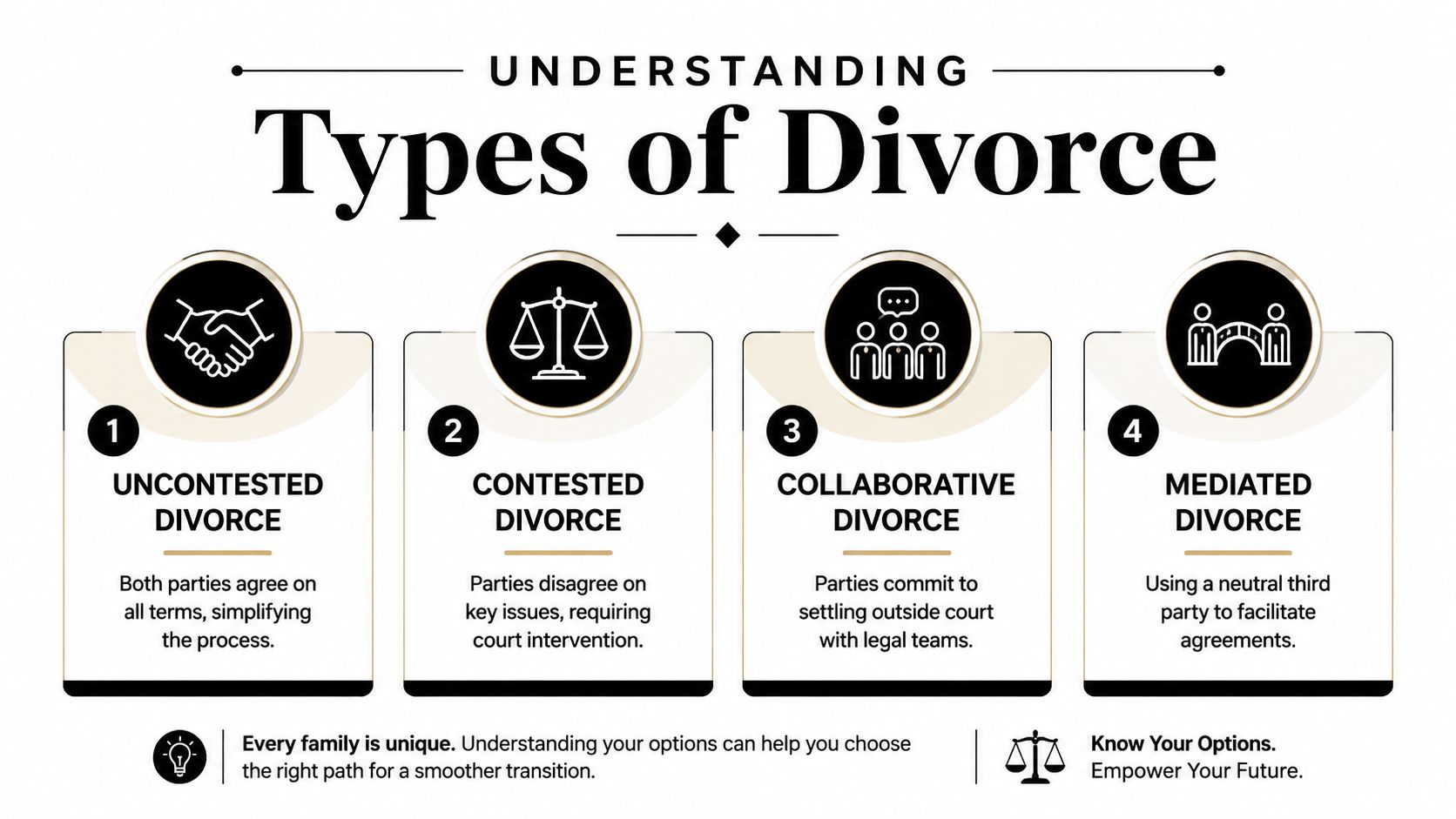
Four common paths
| Divorce path | What it usually means | Good fit when |
|---|---|---|
| Uncontested divorce | You both agree on all major terms | Communication is workable and the issues are straightforward |
| Contested divorce | You disagree on one or more major issues | Property, custody, support, or trust is a major problem |
| Collaborative divorce | Both sides commit to resolving the case outside court with counsel | You want privacy and a problem-solving approach |
| Mediated divorce | A neutral mediator helps you reach agreement | You need structured negotiation but want to avoid trial if possible |
An uncontested divorce is like signing a detailed agreement after a hard conversation. A contested divorce is different. It requires the court to decide at least some issues because the parties can't resolve them on their own.
Time and pressure look different in each path
In Texas, uncontested divorces typically finalize in 2 to 3 months, while contested divorces average 12 to 18 months, and complex cases can last 24 months or longer, according to this Texas divorce timeline guide at Divorce Law checklist for Texas.
That difference affects more than patience. It affects your legal fees, your stress level, how long temporary orders remain in place, and how long children may live with uncertainty.
A faster divorce is not always a better divorce. A better divorce is one that protects your long-term interests without creating avoidable damage.
How to tell which path fits your case
Ask yourself a few honest questions:
- Can you and your spouse exchange information openly? If one of you is hiding income, accounts, or business records, an uncontested path may not be realistic.
- Are parenting discussions civil enough to solve problems? If every conversation becomes a fight, mediation may help, but strong court guidance may also be necessary.
- Do you need a judge to set boundaries now? Cases involving immediate disputes over children, spending, or possession of the home often need temporary orders early.
- Is privacy important because of business ownership or high-value assets? Collaborative work and mediation may give you more control over tone and timing.
Some couples start contested and settle later. Others begin hopefully, then realize the legal or financial issues are too significant for informal agreements. That's normal. The path can change as the facts become clearer.
Protecting What Matters Most Key Divorce Issues
Most divorce stress comes down to three things. Your property, your children, and your future financial stability. Texas law gives a framework for all three, but the details matter, especially in Dallas cases involving professionals, business owners, and parents trying to preserve stability for their kids.
Property division under Texas community property rules
Texas is a community property state. In plain English, property acquired during the marriage is generally presumed to belong to both spouses. That includes more than a checking account or a house. It can include debts, retirement interests, bonus income, and business value built during the marriage.
That doesn't mean every asset gets split down the middle in a simple way. It means the court starts from the idea that marital property belongs to the community estate. Then the parties work through what is separate property, what is community property, and how a fair division should look based on the facts.
A practical first step is to build a clean inventory. List what exists, who controls it, when it was acquired, and what records support your position. People often lose their advantage not because their case is weak, but because their documents are incomplete.
Business owners need to look beyond cash on hand
Dallas entrepreneurs often assume a startup with little current revenue has little divorce value. That assumption can be costly. Under Texas Family Code, the goodwill or unrealized growth of a startup founded during the marriage is often treated as community property. One source reports that 32% of Dallas-area divorce disputes involve business valuation conflicts, which is why this issue deserves early attention in a business-owner divorce, as discussed by Ashmore Law on complex divorce and business valuation in Dallas.
If you own a business, gather formation documents, tax returns, cap tables, investor records, compensation information, and any agreements that affect ownership. If your spouse owns the business, don't assume “it's in their name” ends the conversation. In Texas, title alone doesn't answer the community property question.
Case focus: In a startup divorce, the legal issue may not be what the company would sell for today. The dispute may center on whether growth potential, goodwill, or ownership interests created during the marriage belong to the community estate.
Children and custody decisions
Parents usually ask one question first. “What will happen with my kids?” Texas courts focus on the best interest of the child. That standard shapes conservatorship, possession schedules, decision-making, and child support.
Judges want stability, safety, and workable parenting arrangements. They pay attention to who has handled school routines, medical decisions, daily care, transportation, and communication. They also pay attention to conflict. If one parent uses the children to punish the other, that usually hurts the case.
Helpful related resources often include guidance on child custody, child support, mediation, and enforcement. If you're trying to make smart decisions early, those topics matter because divorce orders often connect directly to future co-parenting conflict.
Spousal maintenance and practical support concerns
Texas does recognize spousal maintenance in some situations, but it is not automatic. Eligibility depends on the facts, and many people confuse temporary support during the case with longer-term support after divorce.
Think practically. If you've been financially dependent, start documenting your monthly needs and your efforts to become self-supporting if that issue may arise. If you may be asked to pay support, gather accurate records of income, expenses, and obligations so negotiations stay tied to reality rather than emotion.
Finding Your Advocate How to Hire a Divorce Lawyer in Dallas
You sit down for a consultation after a sleepless week. You have questions about the house, the children, your paycheck, and how any of this works in Dallas County. The lawyer's job is not merely to quote the law. The lawyer should help you understand what happens next, what the local court process may look like, and how to make careful decisions under pressure.

A good fit matters because divorce cases are part legal strategy and part day-to-day problem solving. In Dallas, that can include understanding local filing practices, temporary orders hearings, mediation expectations, and how different judges want information presented. State law gives the framework. Local procedure affects how that framework works in real life.
Questions worth asking in a consultation
Bring a written list. Stress can blur even basic details, and a checklist keeps the meeting useful.
- How often do you handle cases in Dallas family courts? You want someone who knows the local process, not just the general Texas rules.
- What concerns you most about my case right now? A careful lawyer should identify pressure points early, whether they involve parenting schedules, property records, or communication problems between spouses.
- How do you approach settlement, mediation, and trial? Divorce often moves through several phases. Your attorney should be able to explain where compromise makes sense and where stronger court action may be needed.
- Who will communicate with me day to day? Some clients want direct attorney contact. Others are comfortable with a team approach. Ask now so expectations are clear.
- What documents should I gather first? Financial records, messages, calendars, and account statements can shape the case early.
- How do you handle issues that continue after the decree, such as enforcement or custody modifications? A divorce order is more like a blueprint than a finish line. It needs to work in daily life.
If you want a stronger consultation checklist before meeting with counsel, review these questions to ask a divorce lawyer before hiring them.
Pay attention to fit, not just confidence
Some lawyers speak with great certainty. That can feel reassuring at first. But family law is rarely simple, and an honest attorney should explain risk, not hide it.
Notice how the lawyer answers hard questions. Do they listen before offering solutions? Do they translate legal terms into plain English? Do they explain the likely path of a Dallas divorce case in a way that makes the process feel more organized and less overwhelming? Those signs often tell you more than a polished sales pitch.
Fees matter too. Ask how the retainer works, what services are billed hourly, whether staff time is charged differently, and what events usually increase cost, such as emergency hearings, contested discovery, or trial preparation. Clear billing explanations at the start can prevent conflict later.
One practical option to consider
Some Texas families consider Law Office of Bryan Fagan, PLLC when looking for help with divorce, custody, support, mediation, or enforcement issues. If you speak with that firm, use the same careful standard you would use with any attorney. Ask how your case would be staffed, how strategy decisions are made, and what the first month of work would likely involve.
Good legal help should make the process clearer and easier to handle.
Why Dallas Families Choose The Law Office of Bryan Fagan
People going through divorce usually want the same basic things. They want someone to answer their questions, return their calls, explain the court process clearly, and help them protect what matters most without being treated like a file number.
That's one reason families often look for a firm that combines strategy with education. Divorce is easier to face when you understand what the court is doing and why each step matters. Many clients don't need more alarm. They need structure, calm guidance, and a legal team that can translate complex Texas family law into practical next steps.

What that support looks like in real life
A parent facing custody conflict may need help preparing for temporary orders and building a workable parenting proposal. A business owner may need guidance on records, valuation concerns, and settlement strategy. A spouse with less financial access may need immediate clarity about what documents to gather and how to avoid being pushed into an unfair agreement.
The Law Office of Bryan Fagan, PLLC has built a broad educational library for Texans who want to understand divorce, custody, support, mediation, and enforcement before making major decisions. The firm also offers free consultations, along with in-person and virtual meetings for families across Texas.
Why local knowledge matters
Dallas County is not just “Texas divorce” in the abstract. It has its own filing location, assigned family courts, procedural habits, and practical rhythms. A lawyer who understands how local family cases move can often help you prepare more effectively, whether your case is likely to settle or head toward trial.
For many people, the deciding factor is simple. They want to feel heard, informed, and ready. That combination of empathy and structure can make a painful process feel less chaotic and more manageable.
Your Next Steps and Common Questions Answered
A Dallas divorce often feels most confusing after the first big decision is made. You file, or you get served, and then a practical question hits. What happens if your spouse does nothing? What happens if life changes and you need to move?
Those questions matter because divorce is not only a legal case. It is also about school pickups, lease renewals, work commutes, and keeping your footing while the court process unfolds.
What if my spouse ignores the divorce papers
If your spouse is formally served, Texas gives them until the Monday following 20 days from the date of service to file an answer. If no answer is filed, the court may allow a default judgment, which means the case can continue without that spouse taking part, as explained by Griswold Law Firm in its overview of the Texas divorce process.
Default does not mean automatic.
A judge still needs to see that service was done correctly, the waiting period has passed, and the final papers match what was requested in the original petition. In Dallas family courts, details matter here. A missing return of service, incomplete paperwork, or a decree that asks for more than the petition requested can slow the case down or stop the default from being granted.
What if I move to another DFW county during the divorce
A common surprise for people concerns the 90-day county residency rule. It affects where a case can be filed, and a move during the case can create confusion about venue.
That confusion is easy to understand. Filing location and current address are not always the same thing. A case filed in Dallas County does not automatically shift to another county because one spouse relocates to Collin, Denton, or Tarrant County. Whether a transfer makes sense depends on timing, the stage of the case, and the specific court orders already in place. If a move may happen, get legal advice before changing addresses, signing a new lease, or assuming the case will follow you. Mathur Law Offices discusses divorce issues that can arise in Dallas-area cases.
What to do next
Start with the basics, like packing a bag before a long trip. You do not need everything at once, but you do need the right things first.
- Gather core records such as tax returns, bank statements, pay stubs, debt information, and records related to children, real estate, or a business.
- List your top concerns in plain language. Where will the children live? Who stays in the home? What bills need to be paid now?
- Keep informal agreements in writing and have them reviewed before you rely on them.
- Set up a consultation with a Dallas divorce lawyer who can explain how local court practice and Texas law apply to your facts.
You do not have to solve the whole case today. The next step is enough.
If you are ready to talk through your situation, schedule a free consultation with Law Office of Bryan Fagan, PLLC. A consultation can help you understand your options under Texas law and choose your next step with more clarity.