Skip to content
You may be sitting at your kitchen table, staring at bank statements, school calendars, and a marriage you know isn’t working, while wondering what happens if you make the first move.
That moment matters more than commonly understood. The steps you take before filing can shape your finances, your parenting case, and your peace of mind. If you’re searching for What to Do Before Filing for Divorce in Texas (Step-by-Step Plan), the smartest approach isn’t to rush to the courthouse. It’s to prepare carefully, protect what matters, and file from a position of clarity.
Thinking About Divorce in Texas? Start Here
Divorce can make ordinary decisions feel heavy. Should you move out. Should you tell your spouse. Should you wait. Should you gather records first. Those questions are normal, and they deserve careful answers.
Texas families go through this every day, even if it feels isolating when it’s happening to you. Texas had about 2.7 divorces per 1,000 residents in 2023, down from 3.8 per 1,000 in 2003, according to Texas divorce statistics. That decline is meaningful, but it still means many Texans are trying to protect children, property, and their future at the same time.
The first practical truth is simple. Filing is not the beginning of your divorce strategy. Preparation is. Texas also has a mandatory waiting period after filing, and that window can either help you or hurt you depending on how ready you are before the case starts.
Practical rule: Don’t treat divorce like a single legal event. Treat it like a sequence of decisions, and make the first ones carefully.
A strong pre-filing plan usually focuses on five things:
- Confirming your right to file in a Texas county.
- Organizing your financial records before they become harder to access.
- Protecting assets and credit if you suspect retaliation, waste, or secrecy.
- Preparing for custody discussions if children are involved.
- Choosing the right process so your case doesn’t become more expensive or hostile than it needs to be.
Some people need a calm, paper-driven uncontested case. Others need immediate court protection. The mistake is assuming every divorce starts the same way.
Confirm Your Legal Standing and Timeline
Before you do anything else, make sure Texas is the right place to file, and make sure you understand the clock.

Check residency before you build a filing plan
Under the Texas Family Code, at least one spouse must have lived in Texas for six months before filing, and in the county where the case is filed for 90 days. If those requirements aren’t met, the court may not be able to move your case forward.
If you’re unsure where you can file, review the Texas divorce residency requirement. This is one of those issues that sounds minor until a filing gets delayed or challenged.
Keep simple proof available. Your driver’s license, lease, utility bills, pay records, or other mail may help confirm where you’ve been living.
Understand the waiting period for what it is
Texas requires a 60-day waiting period after filing before a divorce can usually be finalized. In plain English, that means even a straightforward divorce won’t be over the same week you file.
That waiting period frustrates people when they think of it as dead time. It’s more useful to think of it as protected planning time. During that stretch, you may need to verify accounts, negotiate temporary arrangements, exchange documents, address parenting schedules, and prepare orders the judge can sign.
The waiting period doesn’t slow down a prepared case nearly as much as it punishes an unprepared one.
Decide whether timing helps or hurts you
Some people should file promptly. Others should pause long enough to secure records, line up housing, or get legal advice about immediate risks.
Ask yourself these questions:
- Can your spouse cut off access to money? If yes, don’t delay without a protection plan.
- Are the children stable where they are now? If no, temporary orders may matter quickly.
- Do you own a business or complex assets? If yes, organize before positions harden.
- Is there any safety concern at home? If yes, legal timing should follow a safety plan, not emotion.
The right timeline is rarely “as fast as possible.” It’s “as soon as you’re protected enough to proceed wisely.”
Build Your Financial Information File
This is the work people avoid because it feels tedious. It’s also the work that gives your lawyer, the court, and even a mediator a clear picture of what exists, what was earned, what was spent, and what needs protection.
Texas divorce cases depend heavily on financial disclosure. According to guidance on pre-filing financial documentation in Texas divorce cases, complete pre-filing financial disclosure can reduce discovery disputes by up to 60% and shorten resolution timelines by an average of 30 to 45 days. The same source notes that poor preparation during the mandatory waiting period often leads to contested hearings and longer cases.
What to gather before records start disappearing
Start by making copies of what you can access lawfully. Don’t alter records. Don’t hide records. Preserve them.
Here is a practical checklist.
| Document Category | Specific Items to Collect | Why It's Important |
|---|---|---|
| Bank records | Checking, savings, joint account statements, online transaction histories | Shows cash flow, account balances, and unusual transfers |
| Income records | Recent pay stubs, bonus records, commission summaries | Helps establish current earnings and support issues |
| Tax records | Personal and business tax returns, W-2s, 1099s, schedules | Gives a broader picture of income, deductions, and assets |
| Retirement accounts | 401(k), IRA, pension statements, beneficiary pages | Identifies long-term assets and how they were accumulated |
| Investment accounts | Brokerage statements, stock records, cost basis information | Helps trace marital and separate property claims |
| Real estate records | Deeds, mortgage statements, refinancing documents, tax appraisals | Shows ownership, debt, and equity questions |
| Business records | Profit and loss statements, balance sheets, payroll records, operating agreements | Critical if either spouse owns all or part of a business |
| Debt records | Credit card statements, personal loans, vehicle loans, lines of credit | Confirms what is owed and whether debt is marital or separate |
| Insurance records | Life, health, disability, property coverage documents | Helps identify policy values and current coverage |
| Estate planning documents | Wills, trusts, powers of attorney | Flags beneficiary issues and broader planning concerns |
Organize your file like someone will need it fast
A shoebox full of papers is not a strategy. Use folders that make sense at a glance. Many clients do well with four main categories: income, assets, debts, and household expenses. If your finances are more complex, add folders for business interests and separate property claims.
Digital copies matter. Scan paper documents and store them in a secure place you control. If you need ideas for how to keep your essential records safe, use a method that protects both paper originals and password-protected digital backups.
For a more detailed list, review these essential divorce filing documents in Texas.
Focus on what courts and lawyers actually use
Not every paper has equal value. These usually matter first:
- Recent account statements. They show what exists now.
- Tax returns. They often reveal income streams people forget to mention.
- Retirement summaries. These are commonly overlooked and often significant.
- Credit card records. They can expose unusual spending or new debt.
- Property records. They help sort ownership and reimbursement issues.
A complete file doesn’t guarantee a simple divorce. It does prevent avoidable fights over basic facts.
If you’re a business owner, don’t stop at the business checking account. Pull governance documents, loan records, payroll information, and records that show whether personal expenses run through the company. If you’re a high-income professional, include deferred compensation documents, equity awards, and benefit summaries.
Protect Your Assets, Credit, and Personal Safety
Gathering records is passive. Protection is active.
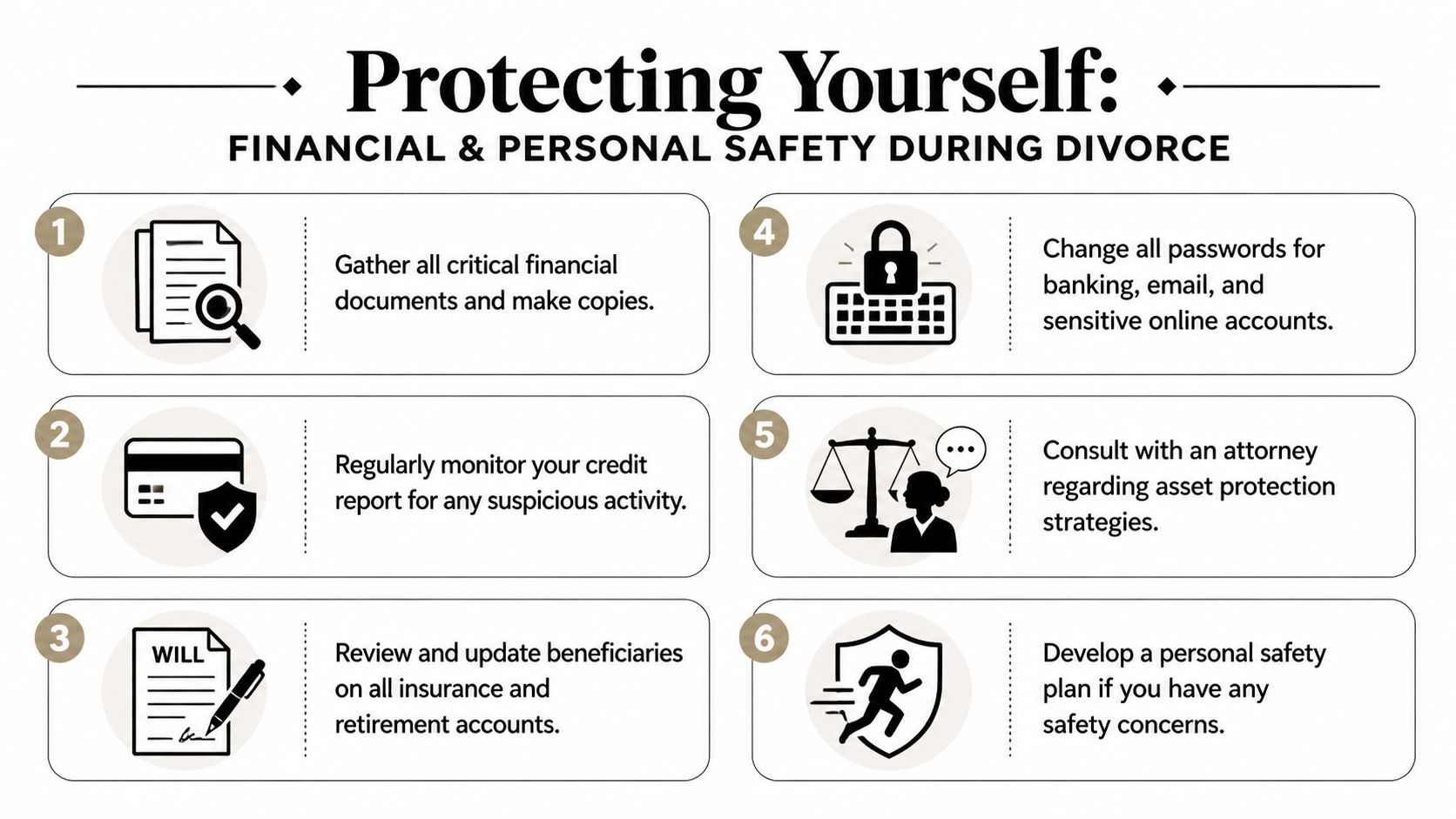
If you’re worried your spouse may drain an account, run up debt, move property, or change the story after learning about a divorce, you need more than a checklist. You need a plan that protects both the marital estate and your ability to function day to day.
Start with financial self-protection
If you still share accounts, monitor them closely. Look for unexplained withdrawals, transfers, cash advances, unusual purchases, or account changes. Save statements regularly so you can compare activity over time.
You should also secure your own financial footing:
- Open an individual account for your paycheck or emergency funds, if appropriate.
- Review your credit report so you know what debts exist in your name.
- Change passwords on personal email, cloud storage, banking apps, and phone accounts you control.
- Preserve account access information for records you can lawfully reach now.
- Track household bills so utilities, insurance, and child-related expenses don’t lapse during conflict.
These steps are not about hiding money. They’re about preventing chaos.
Use court protection when the risk is real
Texas law gives courts tools to stop damage before it spreads. A Temporary Restraining Order, often called a TRO, may be available under Texas Family Code §6.501 to prevent a spouse from dissipating assets before the court can divide them. According to pre-filing divorce guidance discussing TROs and marital waste, contested cases often involve claims of hidden assets or marital waste, and a TRO can freeze or restrict certain actions involving property.
In plain English, a TRO can tell a spouse not to sell, transfer, destroy, hide, or waste marital property while the case gets in front of a judge.
That matters in situations like these:
- A spouse threatens to empty joint accounts
- A spouse has access to business funds and records
- Valuable personal property may disappear
- One party may change insurance or cancel coverage
- Debt is being created out of spite or advantage
For more on this issue, review how to protect assets during divorce in Texas.
If you suspect dissipation, don’t wait for proof perfect enough to satisfy your own anxiety. Get legal advice while the damage may still be preventable.
Don’t overlook personal safety
Some divorces are financially tense. Others are dangerous.
If there has been intimidation, stalking, threats, coercion, or family violence, your plan should include safety first. That may mean speaking with an attorney before telling your spouse you intend to file. It may also mean talking with law enforcement, seeking a protective order, arranging a safe place to stay, or documenting threatening messages and incidents.
Practical steps can include:
- Create a safe communication plan. Use a private email address and a device your spouse can’t monitor.
- Store documents outside the home if you fear confrontation.
- Tell a trusted person where you are and what is happening.
- Document threats carefully. Save texts, voicemails, emails, and photos.
- Ask about protective orders if you’re afraid for your safety or your child’s safety.
You don’t need to minimize your concerns to seem reasonable. Family courts take safety seriously, and you should too.
Prepare for Child Custody and Support Decisions
A parent usually sits in my office worried about one question first. Where will the children be next week, and how do I keep this from turning into chaos?

The right preparation starts before the petition is filed. Child-related decisions take shape early, sometimes within days. If conflict is rising, the same early planning used to protect assets from dissipation should also protect your parenting position. Temporary restraining orders can address financial misconduct, but they can also set the tone for stability, possession, and communication once the case begins.
Build your position around the child’s actual life
Texas courts decide conservatorship, possession, and support based on the best interest of the child. Judges are not looking for the better speech. They are looking for patterns. Who gets the child to school on time? Who schedules the dentist? Who knows the therapist’s name, the allergy medication, the teacher, the bedtime routine?
Start documenting the facts that show how parenting already works:
- School drop-offs and pickups
- Medical appointments
- Therapy or special education involvement
- Extracurricular participation
- Homework help and daily routines
- Communication with teachers and caregivers
A simple parenting log helps. Keep it factual. Dates, tasks, messages, missed exchanges, and school or medical issues matter more than broad statements about who is the better parent.
If your involvement has been limited because of work travel, long shifts, or a prior informal arrangement, do not overstate it. Courts respond better to a realistic plan you can keep than to promises that fall apart in the first month.
Draft a schedule that can survive real life
Texas often uses a Standard Possession Order as a starting point. Many families need something different.
A toddler, a child with special needs, parents who live far apart, or a parent with a rotating schedule may need a custom plan. The strongest proposals answer practical questions before anyone gets to court:
- Where the children sleep on school nights
- How exchanges happen
- Who handles routine and non-routine medical decisions
- How holidays are divided
- How parents share school information and activity updates
- What happens when a parent travels, works overtime, or misses time
Parents who prepare this early usually make better decisions. They stop arguing in general terms and start testing whether a schedule fits the child’s school, health, and daily routine.
Judges tend to trust parents who bring a workable plan and records to support it.
That does not mean agreeing to a bad arrangement to appear cooperative. It means separating valid concerns from emotion and putting the child’s needs first in a form the court can use.
Here’s a helpful overview on issues families often face during this stage:
Get support information organized before numbers are discussed
Child support in Texas usually starts with guideline calculations tied to the paying parent’s net resources. The discussion gets harder when income is irregular, benefits are paid through a business, cash flow is inconsistent, or a child has higher-than-usual needs.
Gather the records that shape support and related expenses:
- Recent pay stubs
- Tax returns
- Health insurance costs for the child
- Childcare expenses
- Proof of recurring medical, educational, or therapeutic costs
- Any reimbursement records between parents
This is also where financial preparation and parenting preparation meet. If one spouse controls the books, delays disclosure, or mixes personal and business spending, support can become harder to calculate correctly. In those cases, organized records and help from Hire CPAs can make a real difference.
If your child has ongoing medical, educational, or therapeutic needs, organize those records now. Courts will not fill in missing details for you. Clear documentation gives your attorney something concrete to present, whether the issue is support, reimbursement, insurance, or a possession schedule built around treatment and school services.
Parents often do better when they come to the first hearing prepared to explain three things clearly. What the child needs, what the current routine looks like, and what plan can hold up under pressure.
Choose Your Divorce Path and Your Professional Team
Not every divorce belongs in a courtroom fight. Some do. Many don’t.
The better question is not “Do I need to be aggressive?” It’s “Which process protects my goals with the least unnecessary damage?”

Compare the main paths
| Divorce Path | Best Fit | Main Advantage | Main Trade-off |
|---|---|---|---|
| Uncontested divorce | Spouses agree on all major issues | Lower conflict and simpler paperwork | Falls apart quickly if one issue remains unresolved |
| Contested divorce | There are serious disputes about children, property, or both | Court can decide issues when negotiation fails | More time, more stress, and more formal process |
| Mediation | Spouses can negotiate with help | Private problem-solving and more control over outcomes | Requires enough trust and disclosure to negotiate meaningfully |
| Collaborative divorce | Both sides want a structured settlement process | Team-based approach can reduce hostility | Not ideal where secrecy, intimidation, or active asset concerns exist |
Match the process to the facts, not your hopes
An uncontested divorce works when both spouses agree and can follow through. It doesn’t work when one spouse says “I’m fine with whatever” but won’t produce records or sign documents.
Mediation can be excellent in the right case, especially when both parties want privacy and practical solutions. It can be a poor fit if one party uses delay, intimidation, or financial fog as a tactic.
Collaborative divorce can help families who want to preserve co-parenting relationships and avoid court. But if there’s a business with disputed income, suspected concealment, or urgent need for restraining orders, a more formal path may be safer.
Build the right team early
Your lawyer’s job is not only to litigate. A good family lawyer helps you choose the right process, identify risk early, and avoid mistakes that are expensive to fix later.
Some cases also need financial support beyond legal advice. If your divorce involves a closely held business, tracing issues, or unusual income patterns, you may need a CPA or forensic accounting help. If you’re evaluating options, this directory of Hire CPAs can help you identify professionals for financial review.
The right team may include:
- A family law attorney for strategy and court protection
- A CPA or forensic accountant for complex financial analysis
- A therapist or counselor to help you stay steady and parent effectively
- A financial planner for post-divorce budgeting and transitions
No one wins by building a bigger team than necessary. But the wrong case handled with too little support can cost far more.
What to Do Next A Clear Plan for Moving Forward
If divorce may be ahead, your next steps should be deliberate.
First, confirm where and when you can file so you’re not building a plan on the wrong timeline. Second, gather and organize your financial records before access becomes harder or disputes begin. Third, protect yourself, which may mean monitoring accounts, securing passwords, preserving evidence, and asking whether court protection is needed. Fourth, if you have children, document your parenting role and think through a workable schedule centered on their needs. Fifth, choose the right process, not the most dramatic one.
The people who do best in divorce are not the ones who feel the least stress. They’re the ones who prepare before conflict controls the pace.
Your first goal is not to “win the divorce.” Your first goal is to enter the process informed, protected, and steady.
If you’re at the point where you need answers specific to your home, your children, your business, or your safety, it’s time to get legal guidance suited to your situation.
If you're considering divorce, a confidential conversation can help you understand your rights and avoid costly early mistakes. The Law Office of Bryan Fagan, PLLC offers free consultations for Texans facing divorce, custody disputes, property division issues, and urgent pre-filing concerns. You can speak with an experienced family law attorney about protecting assets, planning for child custody, and choosing the most effective path forward for your family.