Skip to content
You may be ready to end your marriage, but one basic question can stop everything cold: Can you even file in Texas yet?
That uncertainty is common. You might still be in the same house, staying with family, moving because of work, or trying to protect your children while your spouse has already left. Before the court can address custody, property, support, or mediation, it has to know it has the legal authority to hear your case.
If you're searching for residency requirement divorce texas, the good news is that the rule is usually straightforward once you break it into parts. The challenge is applying it to your real life. That gets harder when one spouse moved away, when military service is involved, or when family violence has forced an urgent change in living arrangements.
Residency questions often come up at the same time as bigger practical concerns. For example, if a home sale is part of your separation planning, a resource on selling your home during divorce in NC can help you think through property logistics in another state context while you sort out Texas filing rules. For the Texas filing sequence itself, this complete guide to the steps to file for divorce in Texas gives a broader roadmap.
Starting Your Divorce Journey in Texas
The first filing question isn't whether your divorce will be contested or uncontested. It isn't whether your spouse agrees. It isn't even how property will be divided.
The first question is whether a Texas court can take your case.
That matters because a divorce starts with jurisdiction. If the court doesn't have it, your petition can stall before it ever reaches the issues you care about most. People often assume that living in Texas now is enough. Sometimes it is. Sometimes it isn't.
Why this issue matters so early
When you're under stress, it's easy to focus on the emotional emergency and miss the procedural one. You may want quick temporary orders about the children. You may need direction about bills, access to a business account, or who stays in the home. But if residency isn't handled correctly, all of that gets harder.
Think of residency as the courthouse gate. Until you meet the legal entry rules, the court may not move your case forward.
Practical rule: Before you spend energy preparing your divorce petition, confirm your filing dates, your county, and whether any exception applies to your situation.
The confusion most people run into
Readers usually get stuck on one of these points:
- You recently moved: You know you're in Texas now, but you're not sure whether you've been here long enough.
- Your spouse moved first: You don't know whether you can still file here if the other spouse left the state.
- You live in one county and your spouse lives in another: You're unsure which courthouse is proper.
- Your situation is urgent: Family violence, relocation, or military duty has disrupted the normal timeline.
The rest of this guide is built to answer those questions in plain language. You'll see the basic rule, the county filing issue, the special exceptions, the proof the court usually wants, and the risks of filing too early.
The Foundation of Texas Divorce Residency Rules
Texas divorce residency rules are built on a simple two-part test. Under Texas Family Code Section 6.301, at least one spouse must have lived in Texas for the preceding six months and in the county of filing for the preceding 90 days. That rule is explained here in plain language by WomensLaw's summary of Texas divorce residency requirements.
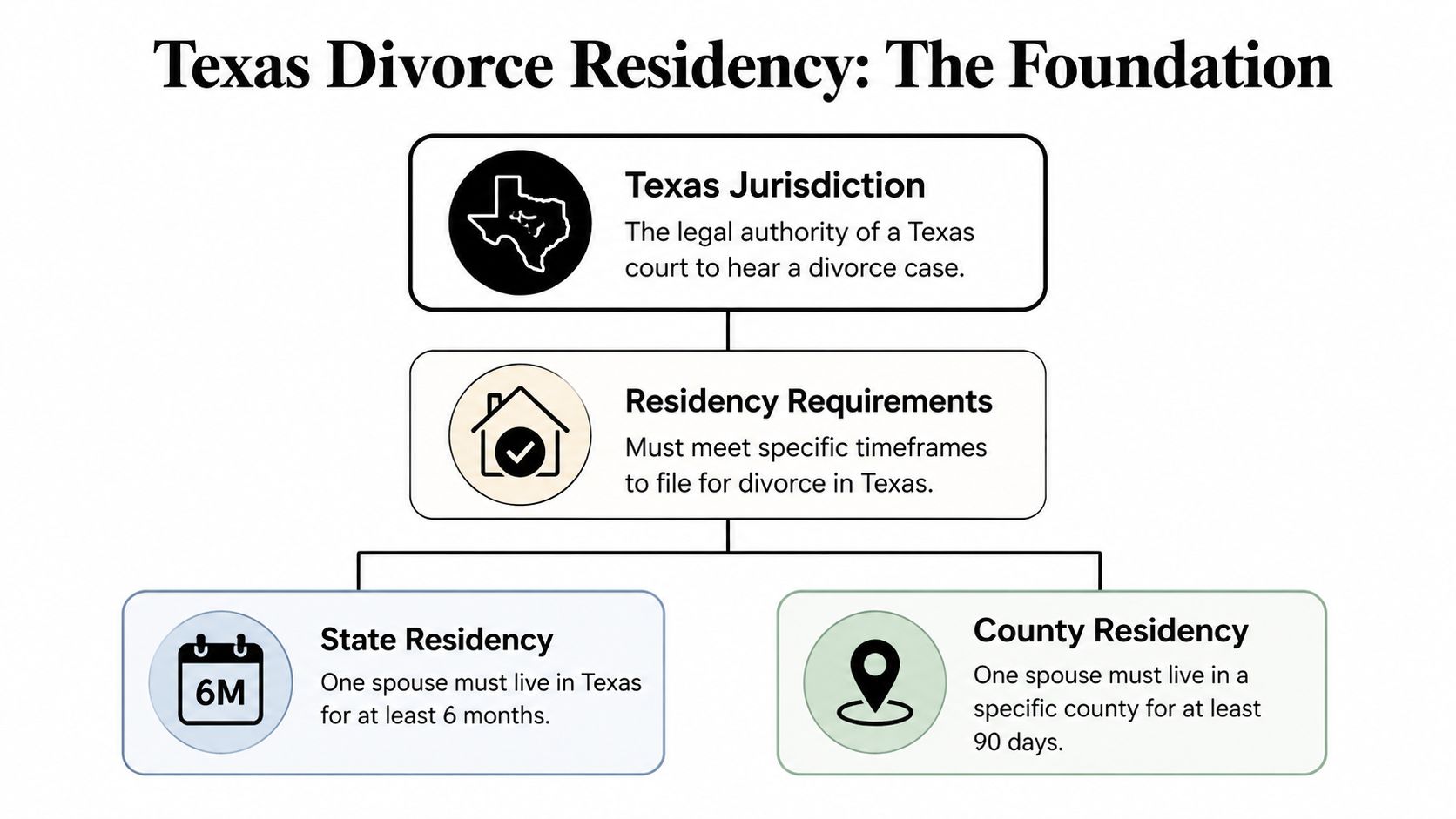
The two clocks you need to check
A lot of people think there is only one residency deadline. There are two.
| Requirement | What it means in plain English |
|---|---|
| Six-month state residency | At least one spouse must have lived in Texas for the six months before filing |
| Ninety-day county residency | At least one spouse must have lived in the county where the case is filed for the 90 days before filing |
These clocks matter at the same time. Meeting one but not the other can still create a problem.
Why Texas has both rules
A house needs both land and a foundation. A divorce case is similar. The state residency rule ties your case to Texas. The county residency rule ties your case to a specific local court.
Courts use those requirements to make sure the case belongs in Texas and belongs in that county. It also discourages forum shopping, where someone tries to file in a place that seems more convenient or more favorable without a real connection to it.
At least one spouse must qualify
Many people feel relief that only one spouse has to meet the residency requirement.
That means if your spouse meets the Texas and county timeline, the case may still be filed in that county even if you personally moved away. This can matter a lot after separation, especially when one spouse leaves quickly for work, family support, or safety.
A Texas divorce does not require both spouses to satisfy the residency timeline. One qualifying spouse is enough to open the courthouse door.
Domicile versus being physically present
People often use "resident" and "living somewhere" as if they mean the same thing. In family law, they can overlap, but they are not always identical.
Physical presence means you are there.
Domicile usually points to the place you treat as your true home.
That difference matters in close cases. If you are traveling for work, staying temporarily with relatives, or splitting time between states, a court may look at the full picture. Where do you receive mail? Where is your driver's license? Where do you vote? Where do you intend to stay?
A simple example
Suppose your family lived in Travis County. You and your spouse separated. Your spouse stayed in Austin. You moved to Oklahoma to stay with family for a while.
If your spouse has remained in Texas and in Travis County long enough to satisfy the legal timeline, the case may still be filed there. Your move does not automatically block the divorce from being filed in Texas.
What this rule does not decide
Residency only answers whether Texas and a particular county can hear the divorce. It does not resolve:
- Child custody details
- Property division
- Whether spousal maintenance will be requested
- Whether the case should settle in mediation
- How business interests or retirement assets will be handled
Those issues come later. But they only come later if the filing starts in the right place.
Choosing the Right Courthouse and County Venue
Once you know the case belongs in Texas, the next question is practical: Which county courthouse should handle it? This is the venue question.

Venue is not just paperwork. It affects where hearings happen, where your attorney appears, and how quickly an error can slow your case down. If your spouse is challenging more than venue and is also raising jurisdiction arguments, this explanation of a Texas divorce special appearance and personal jurisdiction helps show how those issues can overlap.
Venue means the right local court
Think of jurisdiction as the court's power. Think of venue as the correct stage where the case should be performed.
You may have more than one possible county in some situations. But that doesn't mean every county is available. The county must connect to the residency rule discussed above.
Common county scenarios
Here are a few examples that tend to cause confusion:
- You live in Harris County, your spouse lives in Fort Bend County: A lawyer will usually look at which spouse satisfies the county timeline and whether filing in one county is proper under the facts.
- You moved recently within Texas: You may satisfy the Texas rule but not yet satisfy the new county rule.
- Your spouse moved out of state: A Texas county can still be proper if the Texas-based spouse qualifies there.
Why filing in the wrong county causes trouble
If a divorce is filed in the wrong place, the other side may raise a plea in abatement. That doesn't mean the divorce disappears forever, but it can stop progress while the court deals with the filing defect.
The result is frustration at the exact time most families need movement. Temporary orders may be delayed. Negotiations can lose momentum. A simple filing mistake can become a strategic fight.
County choice is not a technical side issue. It can affect timing, cost, stress, and your ability to get before a judge quickly.
A short video can help if you prefer to hear these ideas explained aloud.
How to choose carefully
A good venue analysis usually includes these questions:
- Where has at least one spouse resided recently?
- How long has that spouse lived in that county?
- Did either spouse move shortly before filing?
- Will the other spouse challenge venue or jurisdiction?
- Are there urgent issues involving children, support, or protection orders?
If children are involved, county choice can also affect where emergency or temporary requests are heard first. If substantial property is involved, especially a business or high-value estate, starting in the correct court helps avoid early procedural fights that distract from the core financial issues.
Navigating Special Circumstances and Exceptions
A common question comes up right after a sudden move, a deployment order, or a separation that crosses state lines. "Do I still qualify to file in Texas, or do I have to start over somewhere else?"
For some families, the residency rules work less like a straight measuring tape and more like a timeline the court reads in context. Military service, safety-related moves, and split-household situations can change how the dates are counted and what proof matters most.

Military families and Texas residency
Military families often worry that an assignment outside Texas breaks the residency timeline. Texas law can protect against that result. Under Texas Family Code § 6.303, time spent away from Texas because of military service may still count toward the residency requirement if Texas remains the service member's home state for filing purposes.
That exception helps, but courts still need a clear story. A judge usually wants to see why the absence happened, how it relates to military duty, and what ties still connect the family to Texas.
In practical terms, these cases often turn on records such as:
- Military orders showing deployment, transfer, or training
- Housing records tied to Texas, such as a lease, mortgage, or base housing history
- Texas identification records if they support the timeline
- Sworn statements explaining that the move was duty-related and not a permanent change of home
- Spouse or family records showing where the household was based before the assignment
A simple way to think about it is this. Physical location and legal residence are not always the same thing for military families. A service member may sleep in another state or another country for months, while Texas still counts as home under the statute.
A practical military example
Suppose one spouse was stationed in San Antonio, then sent overseas, while the other spouse returned to stay with family in another county. The question is not only, "Where are they living today?" The better question is, "What does the paper trail show about their Texas connection during the required period?"
If the orders explain the absence and the records show a continuing Texas base, filing may still be possible here. If the documents are scattered or the dates conflict, the case can face avoidable objections.
Families dealing with that kind of split-residence issue often ask whether one spouse living in Texas is enough. This guide on filing for divorce in Texas when only one spouse lives here explains that question in more detail.
Family violence and urgent filing concerns
Family violence cases raise a different problem. The law's timing rules still matter, but safety can change how a case must be handled.
A person escaping abuse may leave a home, county, or city with little warning. That move should not be treated like an ordinary relocation planned months in advance. Courts understand that survivors may need quick action on protection, temporary custody, support, or use of the home while the residency question is being addressed carefully.
In these cases, the most helpful first step is often to build a short, organized record of what happened and when. That may include:
- A sworn affidavit describing the violence or threat of harm
- Police reports or protective order records, if available
- Medical records, photos, or messages that support the timeline
- Proof of the prior residence and the date the survivor had to leave
- Information about children if immediate custody or safety orders are needed
The key point is practical. A survivor's sudden move does not automatically erase access to the Texas courts. But the exception works best when the facts are specific, dated, and easy for the judge to follow.
Privacy concerns are real
Many survivors hesitate because they do not want a current address placed in public court papers. That concern is reasonable.
Texas offers tools that can help protect location information in the right case, including confidentiality protections for some survivors. If address privacy is part of the problem, it should be addressed at the start of the filing strategy, not as an afterthought after papers are filed.
Use exceptions carefully
Exceptions are not shortcuts. They are legal rules for unusual situations, and they still require proof.
That is why special-circumstance cases benefit from a careful review of dates, locations, and documents before filing. The goal is to present the court with a timeline that makes sense on paper, not just in conversation.
The Law Office of Bryan Fagan, PLLC handles Texas family law matters including divorce, custody, mediation, protective orders, and military-related family law questions.
How to Prove Your Texas Residency to the Court
You may know you qualify to file in Texas and still worry about one practical question. How do you show that to a judge in a way that is clear, calm, and hard to dispute?

The court is usually looking for a simple timeline. Where did you live, when did you live there, and what papers back that up? Residency proof works a lot like putting together a dated trail of breadcrumbs. Each document may seem small by itself, but together they show the court that your filing belongs here.
Build a timeline, not just a stack of papers
Start by listing the months that matter for the Texas and county residency rules. Then match each month to something that shows your address. A judge does not need every piece of mail you ever received. A judge needs enough reliable records to see a steady pattern.
A paper folder works. A phone folder or cloud folder works too. What matters is that your records are easy to follow.
Documents that usually help
- Texas driver's license or state ID: Helps show your connection to Texas and may support your address history.
- Utility bills: Good evidence because they are dated and tied to a home.
- Lease, mortgage statement, or closing papers: Useful for showing where you lived.
- Voter registration record: Can support the claim that Texas is your home state.
- Pay stubs, school records, or official government mail: These can fill gaps if bills or housing records are missing.
- Affidavit: A sworn statement can explain details the documents do not show on their own.
Why an affidavit matters
An affidavit is your chance to explain the timeline in plain language. Documents show dates and addresses. An affidavit connects those facts so the court can understand the full story.
That matters most when life has not been neat or predictable.
| Situation | How an affidavit can help |
|---|---|
| Recent move | Explains the move date and where you lived before and after |
| Split time between homes | Clarifies which home was your actual residence |
| Military service | Explains duty assignments, temporary absences, and your Texas home base |
| Missing records | Fills in gaps and identifies other proof that supports the timeline |
Military families often need this extra explanation. If service took you outside Texas for a period of time, the court may still be able to follow your Texas residency if your records show Texas remained your home base. The goal is to make temporary absence look temporary on paper, not just in conversation.
Keep your proof consistent
Residency challenges often start with small conflicts. Your petition lists one county. Your license shows another. Your lease starts later than your claimed move-in date. None of those issues automatically ruin a case, but each one invites questions.
Review your documents before filing. Check addresses, dates, county names, and spelling. If something does not match, add an explanation early instead of waiting for the other side to point it out.
The strongest residency proof is usually simple, dated, and consistent.
If your situation involves a recent relocation, military orders, or safety-related gaps in records, that does not mean you cannot prove residency. It means you should prepare your evidence with more care. A clear timeline, a few solid documents, and a well-written affidavit often do more for your case than a thick pile of disorganized paperwork.
Consequences of Filing Without Meeting Residency Rules
Filing too early can cost more than time. It can disrupt the entire divorce strategy.
The most immediate problem is that the other side can challenge your filing. If the court agrees, the case may be paused or dismissed. That means more paperwork, more delay, and more stress while major issues remain unresolved.
The practical fallout
When a residency mistake stops a case, families often feel the impact in very ordinary ways:
- Temporary orders may be delayed: That can affect parenting schedules, bill payment, use of the home, or access to accounts.
- Settlement discussions may stall: People are less likely to negotiate seriously when the filing itself is under attack.
- Costs can rise: Refiling, attending added hearings, and correcting procedural defects can make the process more expensive.
The verified guidance on Texas residency rules notes that failure to meet the threshold often results in a plea in abatement, which pauses proceedings until compliance and can increase costs because of refiling or additional hearings.
Why this matters for parents and property issues
If children are involved, delay can be especially hard. You may need court direction on possession schedules, school decisions, or temporary support. If a business, retirement accounts, or significant property is involved, delay can also complicate document gathering and financial planning.
Mediation usually works best when the case is on stable procedural footing. If the filing itself is vulnerable, the focus shifts away from solutions and toward procedural defense.
The smarter approach
The safest approach is simple. Confirm your dates before you file. Confirm the county before you file. Confirm whether an exception applies before you file.
That doesn't mean every residency question requires a court fight. Many can be handled with careful review and solid documentation. But a problem found before filing is far easier to solve than a problem discovered after the other side objects.
What to Do Next Your Practical Steps for Filing
By this point, the path should feel more manageable. Texas residency rules can look intimidating at first, but they usually become clearer when you match the law to your actual timeline and documents.
Your next-step checklist
- Write out your dates. List where you and your spouse have lived, by month, for the period leading up to filing.
- Identify the likely county. Focus on the county that best fits the filing rule and your supporting records.
- Gather your documents. Pull together identification, utility bills, leases, and any other records that support your timeline.
- Check for special circumstances. Military duty, an out-of-state spouse, or family violence may change the analysis.
- Think beyond filing. If children, a business, real estate, or substantial assets are involved, your filing strategy should fit your larger divorce goals.
- Prepare for the next stages. After filing comes service, temporary orders if needed, discovery, mediation in many cases, and then final orders or a final decree.
Key Takeaway
The phrase residency requirement divorce texas sounds narrow, but it affects everything that follows. If you start in the right court, with the right county, and with the right proof, you give your case a stronger start.
If you're unsure, ask before filing. That one decision can save weeks of stress and help you move toward custody, support, mediation, and property resolution with more confidence.
Frequently Asked Questions About Texas Divorce Residency
What if my spouse moves out of state after we separate
You may still be able to file in Texas if the residency rule is satisfied through the spouse who remains connected to Texas. The key issue is whether at least one spouse meets the legal filing requirement in Texas and in the proper county.
Does my immigration status affect my ability to file for divorce in Texas
The Texas residency rules apply without distinctions based on U.S. citizenship or immigration status. The focus is residency under Texas family law, not immigration classification.
Can we file in a county where neither of us currently lives just because we own property there
Usually, no. Property ownership in a county is not the same as meeting the county residency requirement for divorce filing. The court will look at residence, not just real estate ownership.
What is the 60-day waiting period, and is it the same as residency
No. They are different concepts. Residency addresses whether you can file in Texas and in a particular county. The waiting period concerns how soon a divorce may be finalized after filing. Those are separate timing rules.
Do we have to live separately before filing for divorce in Texas
No. Texas does not require spouses to live separately before filing for divorce. The filing question is about residency and jurisdiction, not whether you already have separate homes.
If we have children, does residency affect custody too
It can. Divorce jurisdiction and custody-related issues can overlap, especially when parents live in different places. That is one reason residency and county analysis should be done carefully at the start.
If you're trying to figure out where you can file, whether an exception applies, or how to protect your children and property while your case gets started, a conversation with an attorney can bring real clarity. The attorneys at Law Office of Bryan Fagan, PLLC help Texas families work through divorce, custody, mediation, support, enforcement, military divorce, and protective-order issues with practical guidance suited to the facts of your case. Schedule a free consultation to talk through your residency timeline, your filing options, and your next step.