Skip to content
When your marriage is ending, it's hard to know whether hiring a lawyer is smart protection or just one more expense you can't afford.
A lot of Texans start in the same place. You want the process over. You want to protect your kids, your money, and your peace. You also don't want to spend thousands of dollars if your divorce could be handled another way.
That tension is real. So is the risk.
The Question Every Texan Asks Before Divorce
You are sitting at the kitchen table late at night, looking at court forms on one screen and attorney fees on the other, trying to answer one question. Do I need a divorce lawyer, or can I handle this myself?
In Texas, the honest answer depends on risk.
Some divorces are straightforward enough for limited help or a do-it-yourself approach. Others look simple at first and turn expensive fast. I have seen cases go off track over one retirement account, one disputed pickup schedule, one badly written decree, or one spouse who agreed verbally and changed position at the hearing.
Texas lets you file without a lawyer. That is called pro se representation. For the right couple, that can work. If you both agree on all terms, have little property to divide, no dispute involving the children, and enough patience to follow court rules and finish the paperwork correctly, full representation may be more than you need.
But this is not a basic yes-or-no decision. It is a risk assessment.
The safer question is: What level of legal support fits the risk in my case?
That question matters because the danger in divorce is rarely the filing fee. The danger is signing orders you do not understand, overlooking assets or debts, accepting parenting terms that create future conflict, or walking into court with documents a judge will not approve. Those mistakes can cost far more than early legal advice.
Texas procedure also matters more than many people expect. A divorce usually starts with an Original Petition for Divorce. Then the other spouse is served or signs a waiver, temporary issues may need attention, financial information is exchanged, settlement terms are negotiated, and the case ends with a Final Decree of Divorce signed by the court. On top of that, Texas law controls how courts handle community property, conservatorship, possession schedules, child support, and whether your final orders can be enforced later.
The key is matching the level of help to the level of exposure. Low conflict, low asset, full agreement cases carry one kind of risk. Cases involving children, a house, retirement funds, uneven financial knowledge, safety concerns, or a spouse who already hired counsel carry another.
Choose based on what could go wrong in your case, not just what you hope will happen.
The Four Paths to Divorce in Texas A Comparison
A spouse says, “We already agree on everything. We can do this ourselves.” That may be true. It may also be true right up until someone sees the retirement account balance, asks for a different possession schedule, or realizes the decree does not say who keeps the debt.
Those are different risk levels. The right path depends less on optimism and more on what could go wrong if the process slips.
| Approach | Best For | Estimated Cost | Your Level of Control | Requires Full Agreement? |
|---|---|---|---|---|
| Pro Se (DIY) | Couples with a short marriage, simple property, no children, and real agreement on every term | Usually the lowest upfront cost. You still pay filing fees, and mistakes can add delay, refiling costs, or later cleanup | High control, high responsibility | Yes, in practical terms |
| Mediation | Spouses who can still negotiate and want help reaching terms | Moderate. Cost depends on the number of sessions and whether lawyers review the result | High, because you help shape the agreement | No at the start, but yes if you want settlement |
| Collaborative Divorce | Spouses who want a private, structured settlement process with both lawyers involved | Higher than mediation alone because both sides have counsel and multiple meetings are common | High, with legal guidance throughout | No at the start, but both sides must stay committed to settlement |
| Full Legal Representation | Cases involving children, contested property, business interests, retirement issues, hidden information, safety concerns, or a spouse who already has counsel | Usually the highest upfront cost, but often the safest choice when the downside risk is serious | Lower on day-to-day paperwork, higher on protection and strategy | No |
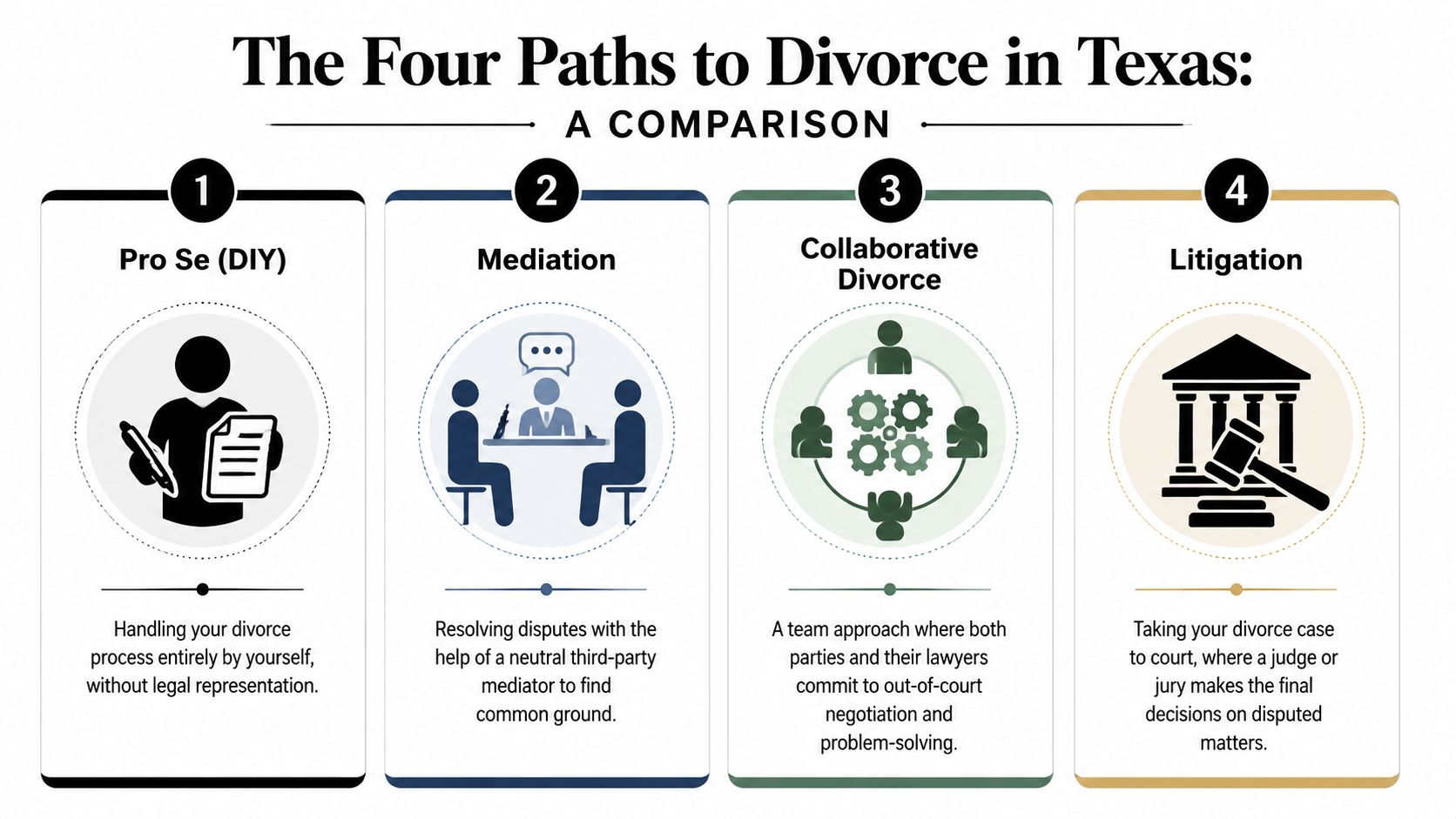
Pro se divorce
This is the do-it-yourself route. You prepare the petition, track service or waiver issues, draft the final decree, and make sure the paperwork matches what the court will sign.
It can work in a narrow group of cases. Short marriage. No kids. No house. No retirement division. No argument about debt. No concern that one spouse knows more than the other.
Texas allows this path, and some uncontested cases do finish relatively quickly if the documents are correct and both sides stay in agreement, as explained in this guide to Texas uncontested divorce timing and options.
The risk is not usually filing the case. The risk is drafting orders that leave gaps, create tax problems, fail to divide accounts correctly, or are too vague to enforce later.
Mediation
Mediation uses a neutral third party to help both spouses reach an agreement. The mediator does not represent either of you. The mediator also does not protect your individual interests.
This path makes sense when communication is strained but still workable. It is often a good middle option for couples who need help getting unstuck on parenting time, support, the house, or debt allocation.
A fair warning. Mediation is only as good as the information on the table and the judgment each person brings into the room. If one spouse is controlling, hiding money, or pushing for a rushed deal, mediation alone may not protect the weaker side.
Collaborative divorce
Collaborative divorce is a settlement process with more structure. Each spouse has a lawyer trained for that process, and everyone agrees to work the case toward resolution outside court.
For the right couple, it can reduce public conflict and keep discussions focused. It often appeals to parents, business owners, and professionals who want a more orderly process than informal negotiation.
It also requires a real commitment from both spouses. If one person uses the process to delay, avoid disclosure, or gain an advantage, costs can rise without solving the core problem.
Full legal representation
Full representation gives you the highest level of protection. Your lawyer handles filings, deadlines, negotiation, evidence, hearing preparation, and the final orders.
This is often the right call when the facts are uneven or the potential impact is substantial. Children change the analysis. So do retirement accounts, real estate, separate property claims, a family business, reimbursement issues, domestic violence, or a spouse who is already treating the case like a fight.
If you are trying to choose among these four paths, ask a simple question: if this goes badly, what is the damage? If the honest answer is “not much,” limited help may be enough. If the honest answer is “my time with my kids, my financial stability, or my safety,” choose more protection early.
What a Texas Divorce Lawyer Actually Does for You
A lot of people think a divorce lawyer only matters if your case goes to trial. That's not how real cases work.
Most of the value happens long before a judge hears anything.

Building a strategy before the case starts controlling you
Texas divorce law gives courts power over property division, parenting orders, support, and temporary relief. A good lawyer doesn't just react. They map out where you are, what matters most to you, and what needs to happen first.
Sometimes the immediate priority is getting temporary orders about the house, the children, or who pays what while the divorce is pending. Sometimes it's preserving financial records before they disappear. Sometimes it's slowing things down so you don't sign a bad agreement just to end the stress.
Investigating money and property
Texas is a community property state. In plain English, that means property acquired during the marriage is generally part of the marital estate, while separate property may include assets owned before marriage or received by gift or inheritance. Those categories sound simple until bank accounts are mixed, business records are incomplete, or retirement funds grew during the marriage.
A lawyer knows how to use discovery, which is the formal process for requesting documents, statements, records, and sworn answers. That matters if your spouse controls the books, runs a business, or is not being candid.
A divorce file is often a paper trail problem before it becomes a courtroom problem.
Negotiating from a position of legal strength
Negotiation isn't just conversation. It's influence derived from facts, legal standards, and draftable terms.
If you agree to divide a retirement account, somebody still has to make sure the decree says it correctly. If you agree on child custody, the language still has to be specific enough to enforce. If you agree to sell a house, the order must say who pays the mortgage, who chooses the realtor, how repairs are handled, and what happens if the sale stalls.
Preventing procedural mistakes
Texas courts expect accurate filings, proper notice, complete orders, and compliance with local procedure. Missing something small can create a large problem later.
A lawyer keeps the case moving through the right sequence:
- File the petition correctly so the court has the case in the right form.
- Address service and responses so no one loses time fixing a technical problem.
- Handle temporary issues if money, parenting, or possession of property needs immediate rules.
- Draft settlement language that matches what you agreed to.
- Get a final decree signed that can be enforced later if necessary.
Acting as a buffer
This part gets overlooked. Divorce pulls people into arguments they would never choose on a calm day.
Your lawyer becomes the point of contact for demands, pressure, and posturing. That distance helps you make decisions instead of emotional reactions. For many clients, that alone changes the quality of the process.
When a Lawyer Becomes Non-Negotiable High-Stakes Scenarios
Some divorces are manageable without full representation. Some are not. If your case falls into one of the categories below, self-representation stops being a money-saving idea and starts becoming a high-risk gamble.

Child custody or child support is disputed
Under the Texas Family Code, courts focus on the best interest of the child when deciding conservatorship, possession, and support. That sounds straightforward until complex issues show up: school schedules, exchange times, medical decisions, travel, extracurriculars, and one parent claiming the other is unreliable.
Pro se cases frequently break down. Texas divorce performance metrics reported in this review of pro se divorce outcomes in Texas state that pro se filers face a 55% loss rate in contested matters involving child custody or support, and attorney-represented parties secure 15% to 25% higher child support awards.
If the other parent is already framing the facts in a way that hurts you, don't walk into that alone.
A business, retirement account, or complicated asset is involved
Texas Family Code property rules divide community property in a manner the court considers just and right. The problem is that many assets aren't easy to classify or value.
A family business can involve goodwill, debt, income questions, and records that only one spouse controls. Retirement accounts may require specialized language to divide correctly. Separate property claims can fail if funds were mixed carelessly over time.
When the asset list includes anything beyond ordinary checking accounts and household items, a lawyer becomes protection against an unfair or incomplete division.
Bottom line: Complex property isn't dangerous because it looks impressive. It's dangerous because one drafting mistake can change ownership, control, or future income.
There is domestic violence, intimidation, or controlling behavior
If you're afraid of your spouse, or if your spouse has used threats, stalking, coercion, or violence, your case isn't a paperwork project. It's a safety issue.
The same Texas pro se divorce metrics should push you to take this seriously. The underlying data discussed earlier shows that in domestic violence scenarios, protective orders filed by attorneys are granted 92% of the time, compared to 65% for pro se filers, as previously noted in the section above. In plain terms, representation can matter at the exact moment you need the court to act.
Fear changes how people negotiate. Control changes what “agreement” really means. Don't mistake silence for consent.
Your spouse already hired a lawyer
This is one of the clearest tipping points.
Even if your spouse's lawyer is polite, that lawyer represents your spouse's interests, not yours. They know the filing requirements, drafting standards, negotiation pressure points, and how to create a record that supports their client.
If one side has counsel and the other doesn't, the imbalance grows quickly. The issue isn't intelligence. It's position, access, and legal tools.
Military service or interstate issues are involved
Military divorces and cases with interstate custody questions create extra layers around residency, notice, scheduling, and jurisdiction. The Texas Family Code often intersects with federal rules or other states' laws in ways that aren't obvious from a court form.
If one spouse serves in the military, moves often, or lives outside Texas, don't assume a standard online packet will cover what the court needs. Jurisdiction mistakes can derail a case before the merits are even addressed.
The True Cost of Divorce With and Without an Attorney
You may be staring at a filing fee of a few hundred dollars and a retainer that feels hard to justify. Then six months later, you are paying far more to fix a decree that never clearly divided retirement, did not protect you from joint debt, or left parenting terms too vague to enforce. That is the actual cost question.

In Texas, the price gap between DIY and lawyer-led divorce is real. Filing on your own may only require court costs, while attorney fees can rise quickly as conflict, children, and property issues increase. Our firm's breakdown of Texas divorce lawyer costs explains that range and examines outside reporting on how much more expensive these cases often become when children are involved.
That does not mean everyone should hire full representation. It means you should measure cost against risk.
A low-conflict divorce with no children, modest property, and full financial transparency can often be handled with limited help or careful document review. A divorce involving a house, retirement accounts, a family business, disputed debt, or a spouse who changes positions every week carries a different kind of price tag. In those cases, the legal fee is often smaller than the cost of an avoidable mistake.
Here is where people get burned.
A decree can say each spouse will pay certain debts, but the creditor is not bound by your divorce order if the account is joint. If your spouse stops paying, the lender may still come after you. The same problem shows up with retirement plans. If the decree language is incomplete, you may win a share on paper and still spend time and money later trying to collect it. Parenting terms create their own version of the same problem. If pickup times, holiday schedules, or decision-making rights are vague, enforcement gets harder and conflict usually gets worse.
Divorce also affects life after court. If missed payments, refinances, or joint accounts are part of your case, review related credit issues such as analyzing derogatory marks for lenders, especially if you plan to rent, buy, or borrow soon after the divorce.
The practical comparison is simple. Upfront savings matter. So does downstream exposure.
I tell clients to ask one question before they decide what level of legal help to buy: If this order goes wrong, how expensive will it be to fix? If the answer is “annoying but manageable,” limited help may be enough. If the answer is “it could affect my kids, home, income, retirement, or credit,” the cheaper path may be the one that costs more.
What to Do Next A Clear Plan for Your Decision
You don't need to solve your entire divorce today. You do need to decide your next move carefully.
Start with a blunt self-check. Are you dealing with full agreement, or just temporary calm? Is your spouse transparent about money? Are the children's issues already turning personal? Are you intimidated, rushed, or afraid to ask questions? If any answer gives you pause, treat that as useful information.
Use a simple risk filter
Ask yourself these five questions:
- Do you fully agree on every issue? Property, debt, parenting, support, and the wording of the final deal all count.
- Are your finances easy to understand? A house, business, retirement account, bonus structure, or disputed debt changes the risk.
- Is there any power imbalance? That includes fear, pressure, manipulation, or one spouse controlling the information.
- Has your spouse hired counsel? If yes, your risk level rises immediately.
- Will the order need to be enforced later? Parenting plans and financial obligations must be clear enough for a court to enforce.
If your answers point to low conflict and low complexity, limited legal help may be enough.
Consider limited-scope help if your case is borderline
You don't always have to choose between doing everything yourself and hiring full representation. In some cases, the middle ground makes sense.
You may want a lawyer to:
- Review your settlement terms before you sign.
- Draft or revise the final decree so it says exactly what you intended.
- Advise on custody or support language if children are involved.
- Flag separate versus community property issues before assets are divided.
- Prepare you for the prove-up hearing so the final step goes smoothly.
That kind of targeted help can reduce risk without committing you to full litigation.
Get a professional opinion before you commit to a path
A consultation isn't a promise to hire anyone. It's due diligence.
Bring your questions. Bring a rough list of assets and debts. Bring any paperwork your spouse has already sent. A good consultation should tell you what the court is likely to care about, where the danger points are, and whether your case looks safe for DIY, better suited for limited help, or in clear need of full representation.
What to do next: Choose your level of legal support based on risk, not stress, guilt, or your spouse's opinion of what should be “easy.”
The right decision is the one that protects your children, your property, your enforceable rights, and your ability to move forward without reopening the fight later.
If you're weighing whether to handle your divorce alone or get legal support, schedule a free consultation with Law Office of Bryan Fagan, PLLC. You can talk through your specific facts, understand your rights under Texas law, and get a clear recommendation about whether your case is safe for DIY, better suited for limited-scope help, or needs full representation.