 Skip to content
You may be lying awake at night, replaying the same question over and over: if you leave, how do you do it without making everything worse?
Divorce planning in Texas isn't about playing games or trying to outmaneuver your spouse. It's about protecting your safety, your children, your finances, and your ability to think clearly when emotions are high. If you're considering divorce, the most effective move is usually not a dramatic one. It's a quiet, organized, legally sound plan.
Texas adds an important layer to that planning. Because Texas treats most property acquired during marriage as community property, the choices you make before filing can affect how a court views your conduct later. That means good planning helps. Rash moves often hurt.
Thinking About Divorce is Overwhelming But a Plan Brings Power
When people first think about leaving a marriage, they often focus on the final conversation, the filing date, or where they'll live next. Those questions matter, but they aren't the first layer of strategy. The first layer is control. You need control over information, timing, and your next practical steps.
A smart exit strategy reduces chaos. It gives you a way to make decisions while you're still thinking rather than reacting. That matters in any divorce, but it matters even more in Texas because property issues can become complicated quickly.
Why Texas planning is different
Under Texas law, property acquired during the marriage is generally presumed to be community property, and some pre-divorce financial moves can create legal risk if they look like fraudulent transfer or asset dissipation under Texas community property guidance and pre-divorce planning risks. In plain English, that means you shouldn't assume you can clean out accounts, move money around, retitle property, or make unusual transactions without consequences.
That is where many online divorce checklists fall short. They tell you to gather papers and make a budget, but they don't explain how your timing can affect a Texas property case. A move that feels protective to you may be framed by the other side as concealment, waste, or bad faith.
Practical rule: Prepare quietly, document carefully, and avoid major financial changes until you've received case-specific legal advice.
What works and what usually doesn't
Some pre-divorce habits help almost every client:
- Build a record: Start organizing account statements, debt records, insurance information, and household expenses.
- Track facts, not feelings: Keep notes about finances, parenting, and major events. Details matter later.
- Think in phases: Pre-filing, temporary orders, negotiation, and final decree each require different decisions.
Other moves often backfire:
- Confronting too early: Telling your spouse before you've planned can lead to conflict, missing documents, or financial disruption.
- Making symbolic gestures: Moving out suddenly, emptying a joint account, or canceling cards out of anger can damage your position.
- Treating divorce as one event: It's a process. Some parts move fast. Others take patience.
The right mindset
Planning your exit doesn't mean you've failed. It means you're taking responsibility for what comes next. If children are involved, planning helps you create stability. If you own a business, have investments, or share substantial debt, planning helps you avoid expensive mistakes. If your spouse is unpredictable, planning helps you protect yourself.
Texas divorce rates have declined over time, with the state reported at about 1.4 to 1.9 divorces per 1,000 population and below the national average of around 2.5 per 1,000, according to Texas divorce statistics summarized with CDC trend references. That doesn't make your situation less serious. It just means that even in a state where divorce has become less common, the people who do face it still need a solid plan.
Assess Your Safety and Emotional Readiness First
Before you collect financial records or compare attorneys, ask a harder question. Are you safe, and are you emotionally ready to follow through?

People often underestimate how much fear, guilt, trauma, or pressure affects decision-making. That's not weakness. It's human. But it can lead to agreements you regret, inconsistent boundaries, or false starts that make the next attempt harder. As noted in this discussion of emotional readiness in exit planning, clients who haven't addressed emotional readiness often make settlement concessions they later regret or end up in longer conflict.
Safety comes before strategy
If your spouse is controlling, threatening, abusive, or volatile, your first plan isn't a divorce plan. It's a safety plan.
Consider these steps:
- Protect communication: Use a private email address, a new password system, and devices your spouse can't access if possible.
- Secure essentials: Keep identification, medication, keys, children's documents, and a small set of necessary items where you can access them quickly.
- Choose safe contacts: Tell one or two trusted people what's happening. Pick people who will stay calm and keep your confidence.
- Know your legal tools: If you're dealing with threats or abuse, learn how a protective order during divorce in Texas may fit into your plan.
If you feel physically unsafe, don't make your announcement first and your plan second.
Emotional readiness isn't the same as unhappiness
You can know the marriage is damaged and still not be ready to leave. Readiness usually looks more grounded than dramatic. You stop hoping one more argument will fix everything. You begin thinking in practical terms. You can tolerate short-term discomfort because you're focused on long-term stability.
Signs you may need more emotional support before filing include:
- You keep reversing course: You decide to leave, then retreat every time conflict rises.
- You can't think past the next conversation: All your energy goes into managing your spouse's reaction.
- You feel pressure to give away too much just to end it: That can show up in parenting decisions, money issues, or living arrangements.
- You don't have any private support system: Isolation makes people more vulnerable to manipulation.
Build support before the legal fight starts
You don't need a huge team. You need a stable one.
A strong support circle may include a therapist, a faith leader, one reliable family member, one practical friend, and eventually your attorney. The point isn't to create a crowd. It's to create enough structure that you aren't making major decisions alone at your worst moment.
One useful exercise is to write down three separate lists: what you're afraid of, what you know, and what you need before you can act. That simple distinction helps many people separate panic from planning.
Your Texas Divorce Financial Checklist
Money anxiety drives many bad divorce decisions. The antidote is not guessing. It's documentation.
Texas is a community property state, so your financial picture matters early and in detail. A strong pre-divorce financial file helps your attorney identify what exists, what may be separate property, what debts need attention, and whether anything appears to be missing. According to Texas pre-filing guidance on financial inventory and affidavits, a careful exit strategy includes gathering 24 to 36 months of bank statements, retirement account information needed for possible QDRO work, and investment records. The same guidance notes that clients who prepare a pre-filed financial affidavit often settle up to 70% faster.
Start with a paper trail
Don't rely on online access alone. Logins change. Statements disappear. Shared passwords get reset.
Collect records for checking, savings, credit cards, personal loans, mortgages, auto loans, tax returns, retirement plans, brokerage accounts, and insurance. If one spouse owns a business, collect business tax returns, profit and loss statements, payroll reports, and ownership documents too.
For a deeper companion guide, review this financial divorce checklist for Texas preparation.
| Document Category | Specific Items to Collect (Last 2-3 Years) | Why It's Important in Texas |
|---|---|---|
| Banking | Checking and savings statements, deposit records, online account summaries | Helps trace community funds, unusual withdrawals, and spending patterns |
| Debt | Credit card statements, loan agreements, mortgage statements, vehicle financing | Shows which obligations exist and who has been paying them |
| Income | Pay stubs, tax returns, bonus records, business distributions | Helps evaluate cash flow, support issues, and spending capacity |
| Retirement and investments | 401(k) statements, IRA records, pension information, brokerage statements | Identifies accounts that may require division and specialized orders |
| Real property | Deeds, closing documents, refinance records, property tax notices | Helps determine ownership, equity, and possible separate property claims |
| Business records | Formation documents, tax filings, balance sheets, contracts | Important when a business interest may be valued or divided |
| Insurance and benefits | Health, life, auto, home, disability policies | Clarifies coverage, beneficiaries, and replacement needs after separation |
| Household expenses | Utility bills, tuition, child expenses, subscriptions, recurring payments | Supports a realistic post-divorce budget and temporary orders planning |
Know your monthly reality
Many spouses know income in a general way but don't know cash flow in a practical way. Before filing, build a working budget. Use a spreadsheet, a secure notes app, or budgeting templates. The tool matters less than accuracy.
List what comes in and what goes out. Include housing, food, gas, insurance, debt payments, childcare, school costs, activities, subscriptions, and medical expenses. If you're planning to live separately, estimate what those same categories will look like in two households instead of one.
This video offers useful context on preparing for divorce in Texas:
Financial moves that help versus moves that hurt
Good financial preparation usually includes:
- Opening your own account: A separate account in your own name can help you receive income and pay your own expenses.
- Establishing personal credit: If everything is joint, you may need an individual credit card to begin building independent credit history.
- Saving records in a secure place: Use secure cloud storage with two-factor authentication or another private storage method.
Risky financial conduct usually includes:
- Large unexplained transfers: These can look like concealment or waste.
- Running up joint debt: Courts and opposing counsel will notice timing and intent.
- Selling property without advice: That can create tracing problems and legal disputes you didn't need.
Organized records give your lawyer options. Missing records give the other side arguments.
Planning for Child Custody and Support
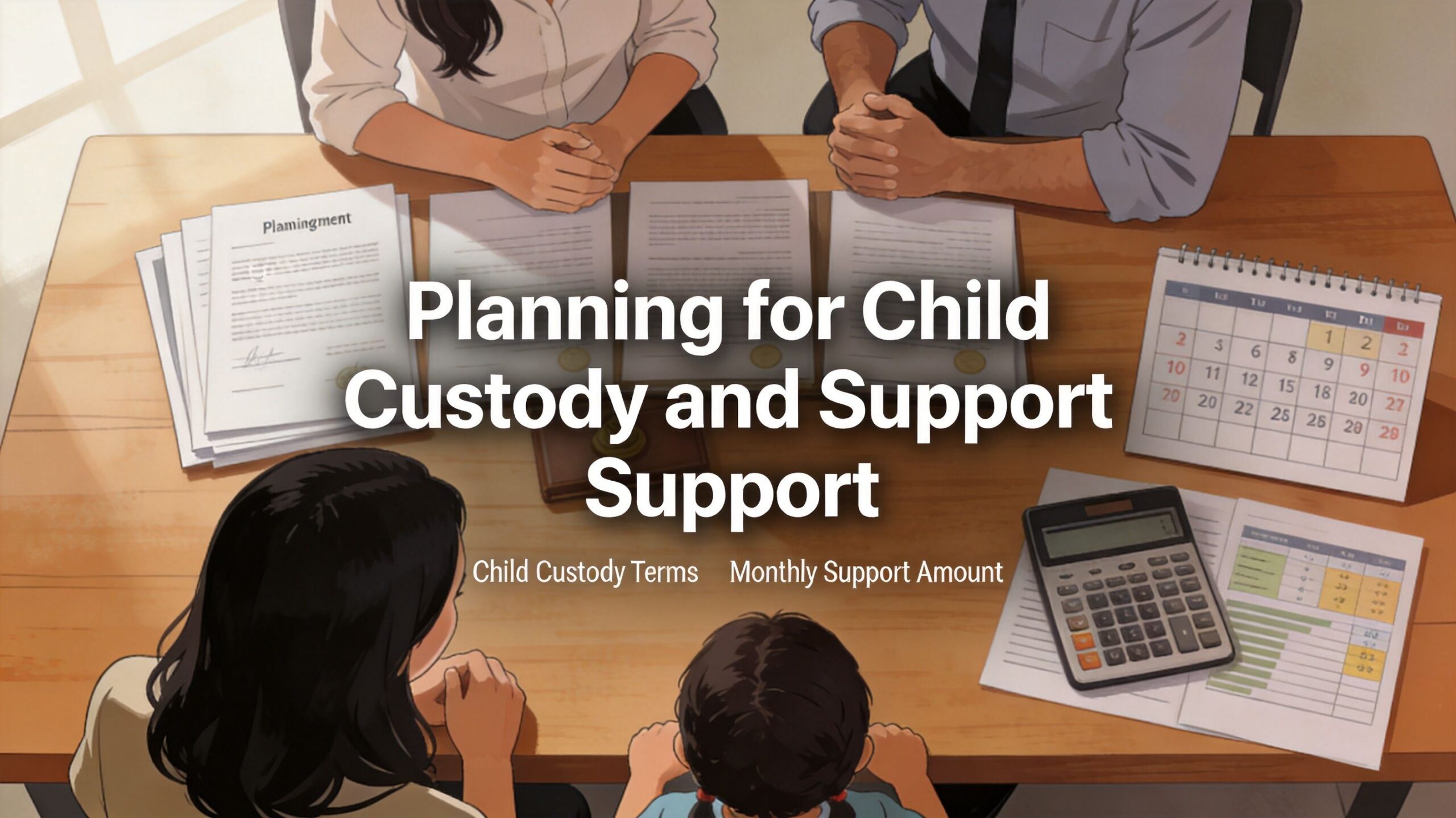
If you have children, your exit strategy can't focus only on property. It has to address routines, school, medical care, communication, and what your children will experience in the first days and weeks after separation.
Texas courts decide conservatorship and possession issues based on the best interest of the child. That standard sounds broad because it is broad. Judges look at stability, involvement, safety, communication, and each parent's ability to meet the child's needs. In many cases, a Standard Possession Order becomes a starting point for possession and access, though some families need a different arrangement.
Start documenting your parenting life
You don't need to create a glossy presentation of yourself as a parent. You need a credible record of ordinary involvement.
Keep a simple parenting journal that tracks:
- School responsibilities: Drop-offs, pickups, parent conferences, homework help, school emails.
- Medical involvement: Doctor visits, prescriptions, therapy appointments, dental care.
- Daily care: Meals, bedtime, bathing, transportation, and after-school supervision.
- Activities and emotional support: Coaching, practices, performances, reading time, and problem-solving moments.
Those details help because they show how your family functions. If you later negotiate a parenting schedule or attend mediation, that record gives your attorney concrete facts instead of broad claims.
Build a child-centered proposal
A useful parenting proposal answers practical questions before a court asks them.
Think through issues like these:
- Where will the child sleep on school nights
- How will exchanges happen
- Who handles transportation
- How will you share school and medical information
- What happens during holidays and summer
- How will you communicate without putting the child in the middle
If you need a framework, this Texas parenting plan template can help you organize your thinking.
Children do better when parents reduce surprises, keep adult conflict away from them, and create routines they can count on.
Understand support before emotions take over
Child support disputes often become emotional because people confuse support with control or fairness. In reality, support is part of building a workable plan for the child's needs. Before filing, gather records that show health insurance costs, childcare expenses, and each parent's role in day-to-day spending.
Also be careful about what you say to your children before a plan is in place. Promises about where they'll live, what school they'll attend, or how often they'll see the other parent can create confusion and later conflict. Calm, age-appropriate consistency matters more than trying to win your child's loyalty.
Understanding the Legal Path to Divorce in Texas
The legal process feels less intimidating once you understand the order of events. In Texas, a divorce starts with an Original Petition for Divorce, followed by service or waiver, temporary planning if needed, exchange of information, negotiation, mediation in many cases, and then final orders.
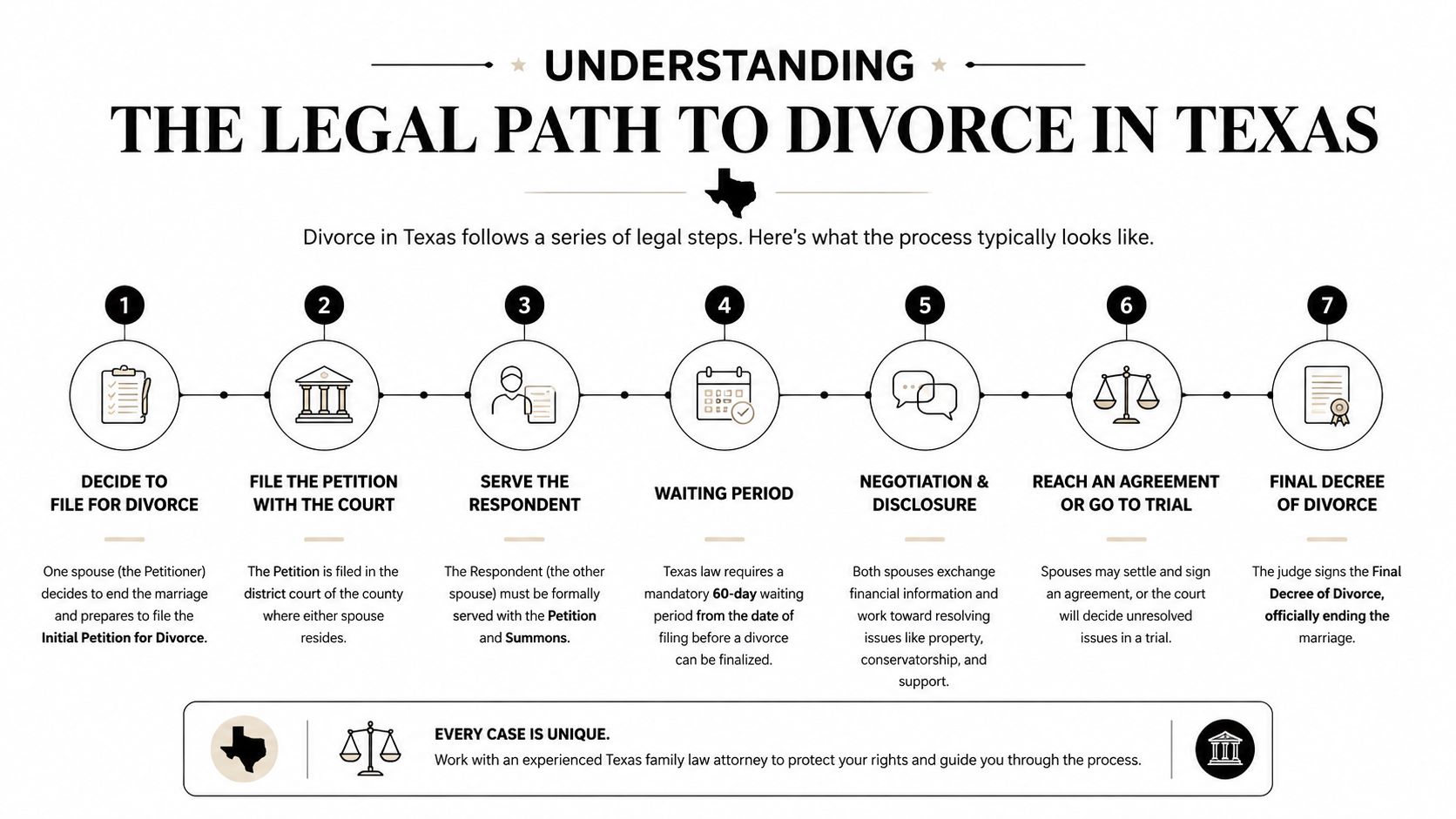
One of the first timeline issues to understand is the waiting period. Texas requires a 60-day waiting period before a divorce can be finalized, and contested cases involving significant assets or custody disputes can last 12 to 18 months, as discussed in this Texas divorce timing overview. That difference matters. A case may begin quickly and still take a long time to resolve if the conflict level is high.
What happens early in the case
The first phase often shapes the rest of the case. In this phase, preparation pays off.
Early issues often include:
Filing and service
One spouse files the petition. The other spouse is formally served unless service is waived properly.Temporary orders
These orders can address who stays in the home, who pays which bills, where the children stay, temporary support, and rules about conduct while the case is pending.Initial disclosures and document exchange
Each side begins sharing information about finances, property, and sometimes parenting issues.
Temporary orders deserve special attention. If you wait too long to address possession of the home, access to funds, parenting schedules, or bill payment, you may spend months operating under confusion or pressure. Temporary orders don't decide everything forever, but they can stabilize the situation and set expectations.
Mediation, negotiation, and trial risk
Most Texas divorces won't end in a full trial. Many resolve through negotiated agreements or mediation. Mediation can be especially effective when both spouses need structure, privacy, and a realistic path to compromise.
That said, mediation works best when you've done your homework. If you show up without records, without a budget, and without a clear sense of your priorities, you'll be negotiating from stress instead of strategy.
A few questions to ask any attorney during a private consultation:
- How do you handle temporary orders in cases like mine
- What documents should I gather before filing
- How do you approach custody disputes or business valuation issues
- When do you recommend mediation
- What actions should I avoid right now
Plain-English Texas Family Code points to know
Some provisions matter early even if you never read the statute yourself:
- Texas Family Code §§ 3.001 to 3.003 deal with separate and community property concepts.
- Texas Family Code § 3.006 matters when pre-divorce transfers or financial maneuvers raise concerns.
- Texas Family Code provisions on temporary orders and conservatorship guide how courts create short-term structure while the case is pending.
You don't need to become your own lawyer. You do need to understand that Texas procedure rewards preparation and punishes impulsive decisions.
Key Takeaways and Taking Control of Your Future
By the time you're seriously considering divorce, you've probably spent a long time managing uncertainty. The value of an exit strategy is that it turns uncertainty into tasks. Not easy tasks, but clear ones.
The strongest plans usually share the same features. They start with safety. They protect privacy. They gather financial records before conflict escalates. They take parenting seriously from the beginning. And they avoid impulsive moves that create legal problems later.
What to do next
If you're preparing for divorce in Texas, focus on these priorities first:
- Protect yourself: If there's any concern about abuse, threats, coercion, or stalking, put safety planning first.
- Collect records discreetly: Financial statements, debt records, tax returns, insurance information, and children's records should be accessible before filing.
- Create a working budget: You need to know what life costs now and what it may cost after separation.
- Document parenting involvement: Keep a calm, factual record of your daily role with your children.
- Get legal advice before major moves: Don't move out, transfer property, empty accounts, or make major promises without advice tied to your facts.
What people regret most
People rarely regret being too organized. They often regret acting from panic.
Common regrets include telling a spouse too early without a plan, assuming verbal promises will hold, underestimating how important documents can disappear, and using money to send emotional messages. Those decisions can affect property division, custody negotiations, and settlement advantage.
A divorce strategy should help you leave with dignity and stability, not just speed.
You don't need to solve everything at once
Many clients think they need a full life map before they can take the first legal step. That's usually not true. You need enough structure to protect yourself and enough information to make the next smart decision.
That may mean consulting an attorney before anyone else knows. It may mean delaying the filing while you gather records and build support. It may mean prioritizing temporary orders because the immediate issue is access to your children or control of household finances. Strategy depends on facts.
The important point is this: if you're careful now, you can avoid a lot of preventable damage later. Texas divorce law gives you a framework. Good preparation helps you use that framework to protect your future rather than react to a crisis someone else creates.
If you're considering divorce and need a confidential plan specific to your situation, the Law Office of Bryan Fagan, PLLC can help you understand your rights, protect your children, and prepare for the financial and legal steps ahead. Schedule a free consultation to talk through your options with a Texas family law team that handles divorce, custody, property division, mediation, enforcement, military divorce, and high-asset cases with clarity and compassion.


