 Skip to content
The moment you're handed divorce papers can feel unreal. One minute you're going through a normal day, and the next you're staring at legal documents that seem to change everything.
If your spouse filed first, you're not powerless, and you're not already behind. In Texas, being the respondent means you need to act quickly, understand what the papers say, and make smart decisions early. That's how you protect your time with your children, your finances, and your position in the case.
Receiving Divorce Papers Your First Reactions and Next Steps
Being served often brings shock first, then anger, fear, or confusion. That reaction is normal. What matters now is what you do in the next few days.

You should know that this happens to many people. Nearly 70% of all divorces in the United States are initiated by women, according to research discussed by the American Sociological Association and summarized in this breakdown of who is more likely to initiate divorce. If you're a man who has been served, your situation is far from unusual. If you're a woman who has been served, it shows that divorce filing doesn't follow one simple pattern.
What to do in the first 24 hours
Start with control, not reaction.
- Read everything carefully. Don't rely on what your spouse told you the papers mean.
- Look for the court information. The county, cause number, and filing date matter.
- Set the papers aside somewhere safe. Don't throw them away, mark them up, or leave them where children can see them.
- Avoid a confrontation. A heated exchange rarely helps and can become evidence later.
You don't need to solve your whole divorce today. You do need to stop the panic and start the response.
What being served actually means for you
A divorce case has now been opened in a Texas court. Your spouse is asking the court for specific relief. That may include ending the marriage, dividing property, setting custody terms, establishing child support, or addressing temporary arrangements while the case is pending.
This is the point where many people make one of two mistakes. They either freeze and do nothing, or they fight emotionally instead of strategically. Neither works.
A measured response works better. You review the paperwork. You identify deadlines. You gather records. You decide what temporary protections you need. Then you file the right response on time.
What Is a Divorce Petition and What Does It Mean to Be Served
The main document you received is usually the Original Petition for Divorce. Think of it as your spouse's opening request to the court. It tells the judge that a divorce has been filed and outlines what your spouse is asking for.
What the petition usually contains
Most divorce petitions in Texas include several basic parts:
- Jurisdiction and residence allegations. These tell the court why a Texas court can hear the case.
- Grounds for divorce. Many Texas divorces are filed on no-fault grounds.
- Children of the marriage. If you have children, the petition may ask for conservatorship, possession, and support orders.
- Property and debt requests. The petition may ask for a particular division of the marital estate.
- Temporary relief. In some cases, the filing asks for short-term court orders while the divorce is pending.
The petition may sound broad. That's common. It doesn't mean the court has already agreed with everything in it.
What service means in plain English
Service of process is the formal delivery of the lawsuit to you. Texas requires proper notice before the court can move forward against you. You may be served by a constable, sheriff, process server, or, in some situations, by waiver if you choose to sign one after legal review.
Service matters because it starts your response timeline. It also means this is no longer a private marital dispute. It's an active court case.
Why the emotional impact is real
People often feel blindsided even when the marriage has been under strain for a long time. That emotional hit is one reason fast legal guidance helps so much. Respondents report higher initial anxiety, with 65% reporting elevated stress compared to 42% for petitioners, and respondents who consult an attorney within the first week report 30% better emotional outcomes, according to this discussion of the emotional impact of being the responding spouse.
Practical rule: The more clearly you understand the papers, the less control fear has over you.
What not to assume from the paperwork
Don't assume that being served means your spouse will get the house, the children, or the final word. Don't assume every sentence in the petition is true, fair, or final. And don't assume that signing something quickly will make the case easier.
You need to understand what was filed before you decide how to respond. That's especially true if you're a parent, own a business, receive bonuses or commissions, or have retirement accounts, real estate, or separate property claims.
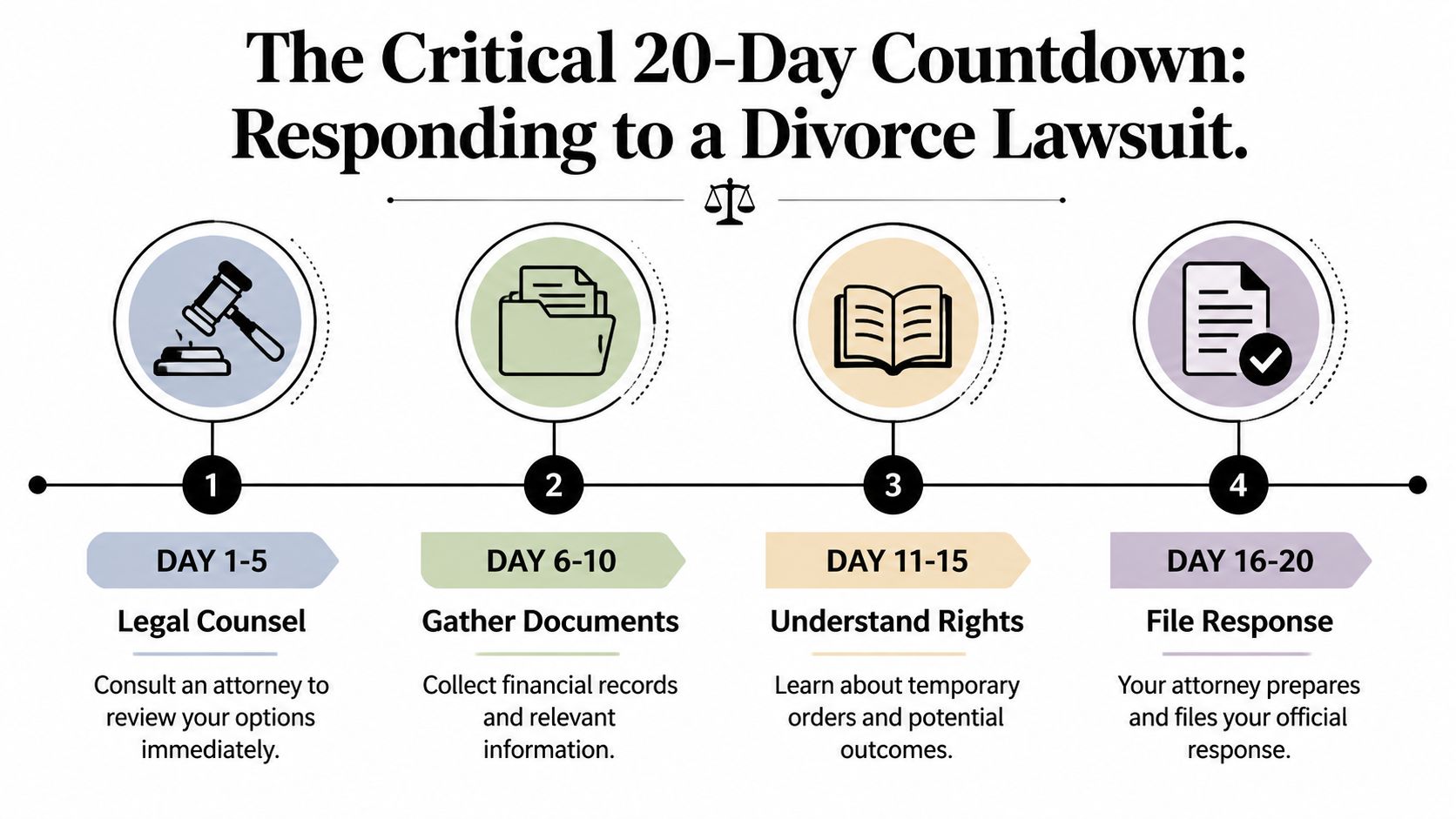
The Critical 20-Day Countdown How to Respond to the Lawsuit
Texas doesn't give you endless time to figure this out. Once you've been served, the response deadline matters immediately.
In Texas, delaying your response to a divorce petition can lead to a default judgment. The state's statutory response period is typically 20 days plus the weekend until the following Monday. Missing this deadline means the court can grant your spouse's requests without hearing your side, as explained in this discussion of divorce timing and response deadlines in Texas.
Your first filing options
The most common first response is an Answer. This tells the court that you've appeared in the case and that your spouse can't move forward by default without notifying you.
In many cases, you should also file a Counter-Petition. That document lets you ask the court for your own relief instead of only reacting to what your spouse requested.
Here's the practical difference:
| Filing | What it does | Why it matters |
|---|---|---|
| Answer | Enters your appearance in the case | Helps prevent a default judgment |
| Counter-Petition | States what you want from the divorce | Puts your requests before the court too |
What works and what doesn't
Some responses help. Some create bigger problems.
- Works well. Calendaring the deadline the same day you're served.
- Works well. Bringing the petition and any attached orders to a lawyer quickly.
- Works well. Starting a document file with bank records, pay stubs, tax returns, and insurance information.
- Doesn't work. Ignoring the papers because you think the case can't move without your agreement.
- Doesn't work. Relying on a verbal promise from your spouse that “nothing will happen.”
- Doesn't work. Waiting until the deadline week to get advice.
If you want a fuller explanation of the filing process, this guide on how to respond to a divorce petition can help you understand the mechanics.
A simple countdown plan
You don't need a perfect plan on day one. You need a steady one.
- Mark the deadline immediately. Use your phone calendar and a written backup.
- Call counsel early. The sooner you do this, the more options you preserve.
- Gather the core records. Income, debts, account statements, deeds, titles, and child-related records.
- Identify urgent issues. Who is staying in the home, who is paying bills, and whether a parenting schedule is already breaking down.
- File before the deadline. Not on it if you can avoid it.
Missing the response deadline turns a stressful case into an avoidable emergency.
Protecting Your Family and Finances with Temporary Orders
The first serious fear many people have is immediate. Can your spouse drain accounts, cut you off financially, or change the children's routine before you have a chance to respond?
Texas law gives the court tools to stabilize the situation.

What temporary restraints do
When your spouse files first, they become the petitioner, and in Texas, the filing can trigger immediate temporary court orders under Texas Family Code §6.501. Those orders restrict both parties from dissipating marital assets, as described in this overview of whether filing first matters.
In plain English, that usually means you should be very careful about:
- Selling or transferring property
- Hiding or moving money
- Changing insurance or beneficiaries without advice
- Running up unusual debt
- Taking actions that disrupt the children's stability
That protection cuts both ways. It limits what your spouse can do too.
Temporary orders are not just defensive
Many respondents lose momentum at this stage. They think their only job is to answer the lawsuit. In reality, this is often the point where you ask the court for structure.
Temporary orders can address practical issues such as:
- who stays in the marital home
- temporary parenting time
- decision-making for the children
- child support
- temporary spousal support, if appropriate
- responsibility for mortgage, rent, utilities, or other key bills
- use of vehicles
- restrictions on property transfers
If your spouse filed first, you can still ask for your own relief. A timely request for temporary orders often neutralizes the idea that the petitioner controls the early part of the case.
For more detail on that process, review this explanation of a temporary orders hearing in a Texas divorce.
Parents, business owners, and high-asset spouses need a tighter plan
If children are involved, temporary orders often shape daily life long before the final decree. Courts pay close attention to which parent is meeting the children's needs consistently, keeping routines stable, and following court instructions.
If you own a business or manage substantial assets, early discipline matters even more. You may need to preserve company records, identify separate versus community property issues, and avoid transactions that could later be questioned. Good records and calm decision-making usually help more than dramatic financial moves.
This video gives a helpful overview of the filing-first question in Texas and why early strategy matters:
What judges look for early
Judges often want stability, transparency, and common sense. If one parent is escalating conflict, withholding information, or making sudden financial moves, that can hurt credibility.
If you're the respondent, your best early posture is usually simple. Follow the rules. Preserve records. Keep parenting steady. Ask the court for specific temporary relief when you need it.
Does Filing First Create an Unfair Advantage in Texas
Many individuals who have just been served ask the same question. Did my spouse beat me to the courthouse and gain a real edge?
The honest answer is yes, but only in limited ways. The filing spouse may gain some procedural advantages. That does not mean they win the important issues.

The advantages that are real
The petitioner in a contested case may get to speak first and last at trial. That can create a rhetorical advantage. The filing spouse may also choose the venue if more than one proper county is available.
Those are real tactical points. But they're not the same as a legal presumption.
Why the outcome still turns on facts
The petitioner in a divorce gets to present arguments first and last in a contested trial, giving them a rhetorical advantage. However, this does not alter the final outcome. In Texas, community property is divided equitably, and custody is determined by the child's best interest. By filing a timely Answer and Counter-Petition, a respondent can neutralize any perceived procedural edge and ensure the case is heard on its merits, as explained in this discussion of the effects of filing first in divorce litigation.
Texas courts don't decide conservatorship based on who filed first. Under Texas Family Code §153.002, the controlling standard is the best interest of the child. Property division is also not a prize for winning the race to file. Texas courts look for a division that is just and right under the circumstances.
Filing order can affect posture. It doesn't decide parenting quality, credibility, or what property character can be proved.
How respondents level the field
You level the field through preparation, not outrage.
A strong response often includes:
- A timely Answer and Counter-Petition
- A clean property inventory
- Organized financial records
- A practical parenting proposal
- Requests for temporary orders when needed
If property division is going to be disputed, one of the most useful early tasks is building a detailed inventory of what exists and where it is. A practical resource on how to catalog your personal property can help you start documenting household items and valuables in a way that becomes useful during the divorce process.
If you want a broader look at this issue from a Texas perspective, this article on whether it is best to file for divorce first adds context.
When filing order matters more
Some cases are more sensitive to early positioning than others. That includes disputes involving children, a family business, professional practices, separate property claims, real estate, restricted stock, or military benefits. In those cases, the filing spouse may arrive more prepared.
That still doesn't make the case unwinnable for the respondent. It means your response has to be organized, informed, and prompt.
Answering Your Urgent Questions About Being Served
You may still have a few questions that keep looping in your mind at night. These are the ones clients ask most often.
Does being the respondent make me look like the bad guy
No. Courts understand that one person files and the other responds. That label doesn't say anything about who was a better spouse, who was a better parent, or who should receive a better outcome.
Judges look for evidence, credibility, and follow-through. If you act reasonably and meet your responsibilities, being served first won't define your case.
Can I refuse to sign anything
You can refuse to sign documents you don't understand or don't agree with. In many situations, that's the safer choice until you've had legal advice.
What you can't do is treat refusal to sign as a way to stop the divorce. Your spouse doesn't need your permission to file a divorce case in Texas.
Can I ignore the papers if I think reconciliation is possible
No. You can still explore counseling or settlement discussions, but the lawsuit itself needs a response. Ignoring service creates risk without creating an advantage.
If reconciliation is possible, protecting your legal position still makes sense. If reconciliation fails, you won't be scrambling to undo avoidable damage.
Am I at a disadvantage in a custody fight because I was served
Not because you were served. Custody decisions turn on the child's best interest, daily caregiving history, each parent's judgment, and the ability to provide a stable routine.
What can create a disadvantage is waiting too long to propose a workable parenting plan or failing to address immediate problems through temporary orders.
Does the person who filed first get everything they asked for
No. A petition is a request, not a result. Courts do not automatically rubber-stamp one spouse's wish list because that spouse filed first.
Should I talk directly with my spouse about the case
Only with caution. Routine communication about the children or household needs may be necessary. Legal arguments, threats, and emotional text exchanges usually make things worse.
If communication is tense, keep it brief, respectful, and focused on practical matters. Save legal strategy for your lawyer.
Your Action Plan Regaining Control of Your Divorce
You don't need to know every answer today. You do need to take the next right steps.
What to do next
- Take a breath and slow the moment down. Panic leads to mistakes.
- Read every page you were served. Look for requests about children, property, and temporary restraints.
- Calendar your response deadline right away. Treat it as fixed until a lawyer tells you otherwise.
- Start gathering records. Focus on tax returns, pay stubs, bank statements, retirement accounts, insurance, debt information, deeds, titles, and business records if applicable.
- Protect your communication. Don't argue about the case by text, email, or social media.
- Think about immediate needs. Housing, parenting schedules, bill payment, and access to accounts often need early attention.
- Prepare for temporary orders if necessary. That's often where stability begins.
- Get legal advice quickly. Early advice helps you avoid reactive decisions that are hard to unwind.
Key takeaway
What Happens If Your Spouse Files for Divorce First? In Texas, it means the case has started and the clock is running. It does not mean you've lost control.
A calm, timely response can protect your rights, stabilize your home life, and put you in a strong position for negotiation, mediation, or trial. If you're a parent, a business owner, or someone with substantial assets, that early response matters even more.
If you've been served with divorce papers, you don't have to sort through the fear and confusion alone. The Law Office of Bryan Fagan, PLLC helps Texans understand what the petition means, file the right response, seek temporary orders, and build a strategy for custody, property division, support, mediation, and final orders. Schedule a free consultation to talk through your situation and take the next step with clear legal guidance.


