Skip to content
You may be sitting at your kitchen table right now, knowing the marriage is over but not yet ready for your spouse to know that you've decided to file.
The window between your decision and formal service matters more than is often realized. In Texas, the steps you take before your spouse is officially notified can protect your safety, preserve financial records, strengthen your custody position, and prevent avoidable mistakes that cost time and money later.
The Strategic Pause Before You File for Divorce
The urge to move fast is understandable. When you've finally made up your mind, delay can feel unbearable. But a short, deliberate pause often gives you something more valuable than speed. It gives you control.
Many people focus on the question of whether it helps to file first. That can matter, and this discussion of whether it's best to file for divorce first is worth reading. But filing first and preparing first are not the same thing. Preparation is what keeps you from walking into the process blind.
Texas divorce cases usually turn on a few practical issues: safety, parenting, property, debt, and proof. If you begin without records, without a plan, and without thinking through how your spouse may react, you start in a defensive position. If you prepare first, you're far more likely to make calm decisions instead of emergency decisions.
What this pause should accomplish
Before papers are served, you want to:
- Protect your physical safety if conflict could escalate
- Secure access to information that may become harder to get later
- Separate enough financially to keep paying for daily life and legal help
- Document your role as a parent if children are involved
- Choose the right service method so the case starts correctly
The strongest pre-divorce strategy is usually the least dramatic one. Quiet preparation beats reactive damage control.
This isn't about hiding assets, punishing your spouse, or creating conflict. It's about entering a difficult legal process with your footing under you.
Secure Your Personal Safety First
If you're worried that your spouse may become threatening, violent, controlling, or unpredictable after learning about the divorce, safety comes before every other concern.
That includes your physical safety, your children's safety, and your digital safety. A surprising number of people protect documents but forget passwords, phones, location sharing, and shared cloud accounts. Those gaps can expose your plans immediately.

Start with a private safety plan
A basic safety plan should be practical, not theoretical. Ask yourself where you would go tonight if you had to leave quickly, who could help you, and what you would need in the first day or two.
Your checklist may include:
- A safe place to stay with a trusted friend, relative, or secure location
- Essential documents such as identification, insurance cards, medication lists, and keys
- Private communication channels through a personal email address and updated passwords
- A charged phone and backup access if you think your current device is monitored
- School and childcare planning so you know how your children would be picked up and cared for
If you share devices, tablets, or family accounts, assume your activity may be visible. Change passwords from a device your spouse can't access. Review account recovery settings. Turn off location sharing where appropriate.
Know when a protective order may be the right step
Texas law allows a person to seek a protective order before divorce papers are served. That matters because some situations don't allow you to wait for the regular pace of a divorce case.
Under Texas Family Code §81.001, the process can begin with a temporary ex parte order and may lead to a final order that becomes important evidence later. Texas courts issued an estimated 162,497 protective orders from 2021 through 2023, which shows how widely this tool is used in practice, especially when safety and child protection are on the line, according to this explanation of protective orders during divorce in Texas.
A protective order can do more than tell someone to stay away. In a divorce involving children, it can affect possession and access if the court finds family violence.
Practical rule: If you're afraid of what will happen when your spouse learns about the divorce, talk to a lawyer about safety planning before you talk to your spouse.
If immediate court protection may be needed, review how a temporary restraining order can work in a Texas family law case. The right remedy depends on the facts, and not every dangerous situation is handled the same way.
What does not work
Some choices feel protective in the moment but create bigger problems:
| Approach | Why it often backfires |
|---|---|
| Announcing the divorce in anger | It can trigger the exact reaction you were trying to avoid |
| Relying on verbal promises | There's no paper trail if behavior changes fast |
| Using shared email or shared cloud storage | Your spouse may see your plans, documents, or lawyer communications |
If safety is a real concern, your first move shouldn't be confrontation. It should be structure.
Build Your Financial Fortress Before Filing
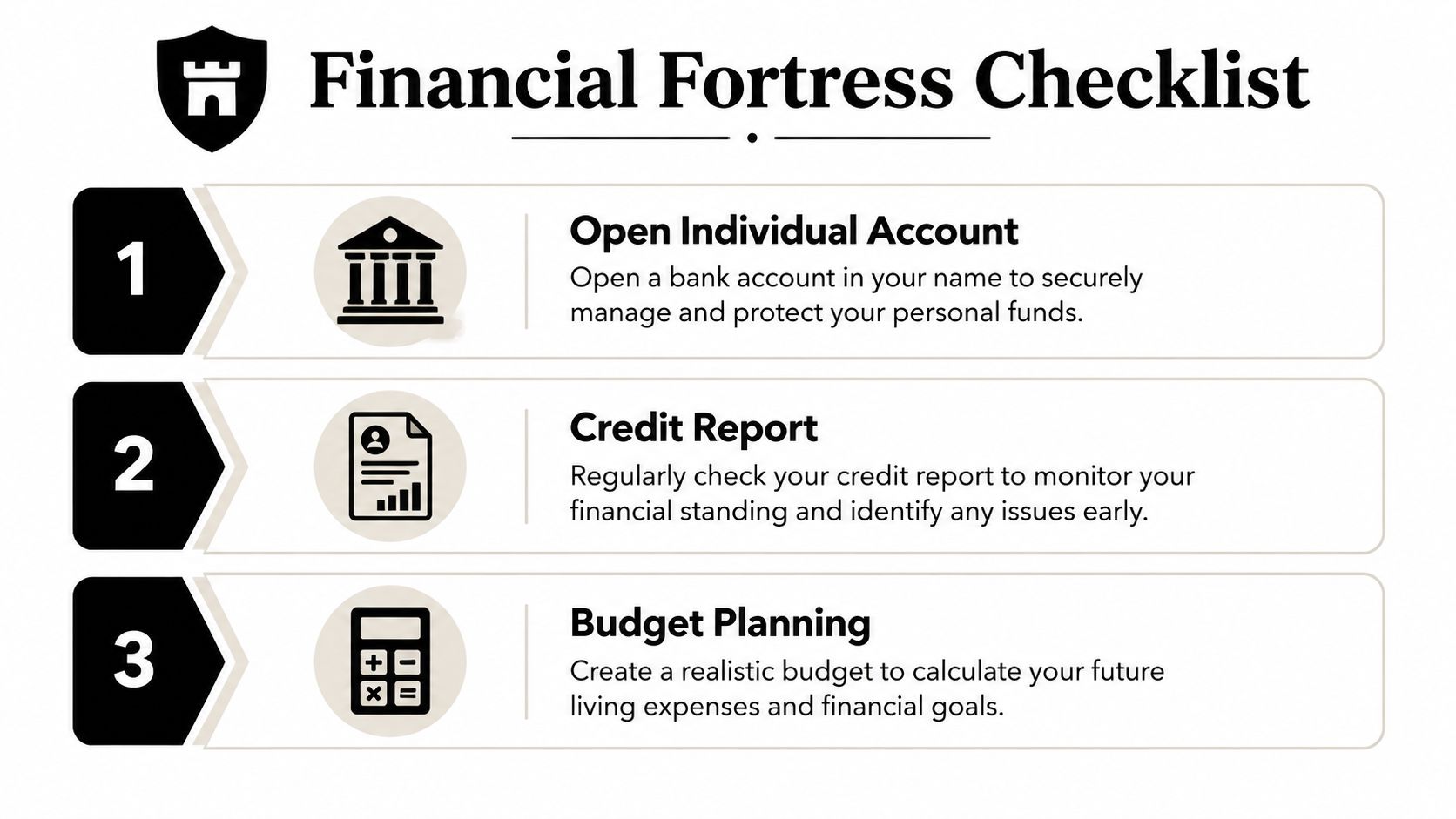
The week before service often gives you the clearest access to the financial truth of your marriage. After your spouse learns a divorce is coming, account access may change, passwords may change, and ordinary spending can suddenly become hard to explain. Pre-filing financial preparation is about setting up your records, your cash access, and your paper trail before that shift happens.
For many clients, this is the part of How to Protect Yourself Before Serving Divorce Papers in Texas that lowers fear fast. Preparation prevents expensive surprises.
Gather the record before the conflict starts
Before serving divorce papers, get your own copy of the financial record. That usually means opening a separate personal bank account and collecting at least 12 months of statements, tax records, retirement account records, and property documents, as outlined in this Texas divorce preparation guide.
Build a file that shows how money moved during the marriage. Include:
- Cash flow records such as bank statements, direct deposits, and account histories
- Retirement and investment records for 401(k), IRA, pension, and brokerage accounts
- Real property documents including deeds, mortgage records, and loan balances
- Debt records such as credit card statements and other liabilities
- Insurance and benefit information that may affect support, coverage, or property issues
Texas is a community property state. Property acquired during marriage is generally presumed to be part of the marital estate. Separate property claims often succeed or fail on documentation. If you cannot trace an asset, arguing about it later gets much harder.
Get readable copies. Save them somewhere your spouse cannot access. Label them well enough that your lawyer can use them quickly.
Open a separate account carefully
A separate account can protect your ability to pay for housing, groceries, transportation, and legal advice once the case begins. It can also create problems if it looks like you were trying to hide funds. The difference is usually documentation and restraint.
Keep the goal narrow. Set up an account for your paycheck, ordinary living expenses, and attorney's fees if needed. If you move money, record the amount, date, source, and reason. Save screenshots showing balances before and after the transfer.
Here is the practical trade-off:
| Move | Usually smart | Usually risky |
|---|---|---|
| Open a personal checking account | Yes, if records are clear | No issue if fully documented |
| Get an individual credit card | Often helpful for independent credit | Risk rises if used recklessly |
| Move money without notes or records | No | Can look like concealment |
| Sell property quickly before filing | Usually not | Can create major legal problems |
Clients sometimes ask whether they should empty a joint account before filing. In most cases, that creates more heat than protection. A measured transfer with a clear paper trail is easier to defend than a sudden withdrawal that leaves the other spouse without access to household funds.
Budget for the first ninety days, not the whole divorce
Early pressure points matter more than perfect long-term forecasting. Focus first on the next two to three months. Can you cover rent or mortgage, utilities, food, fuel, child-related expenses, medication, insurance, and a retainer if one is required?
If cash will be tight, identify options before you are under pressure to act fast. If valuables may need to be sold for liquidity, review resources on comparing gold buyers and pawn shops so you understand the trade-off between speed and value. A rushed sale usually produces the worst number.
A short video can also help you think through the financial side before you act.
Plan for records you may not control later
Even with good preparation, some records stay out of reach until the case is filed. Business documents, third-party bank records, payroll information, and account histories held by someone else may require formal discovery. It helps to know in advance how a subpoena in a Texas divorce case can be used to obtain financial records if voluntary disclosure stops after service.
That matters even more for business owners, people with irregular income, and spouses dealing with high-value assets. Texas divorce filings are generally public, but privacy tools may help limit unnecessary exposure of sensitive financial information, including motions to seal and litigation protective orders, as discussed in this overview of privacy protections in Texas divorce.
The Law Office of Bryan Fagan, PLLC handles Texas divorce, custody, and property-division matters, including cases involving businesses and significant estates.
Gather Key Evidence and Uncover Hidden Assets
A divorce case is built on evidence, not assumptions.
If your spouse has been dishonest, manipulative, or financially secretive, you need more than a feeling that something is off. You need organized information that can later support requests for records, temporary orders, mediation positions, or trial evidence.

Think in terms of proof, not outrage
Start by preserving information that may later matter:
- Messages and emails that show threats, admissions, financial promises, or parenting problems
- A witness list of people who have seen relevant conduct firsthand
- A timeline that notes major events, account changes, separations, and incidents involving the children
- Photos or records tied to property, damage, spending, or living conditions
Don't alter messages. Don't crop out context. Don't “clean up” a screenshot. Courts care about reliability, and your lawyer needs the full picture.
Save evidence in a location your spouse can't access, and keep it in its original form whenever possible.
Hidden assets are not just offshore accounts
A growing trend in Texas divorce involves concealed digital assets such as cryptocurrency that don't appear on ordinary bank statements. Texas law requires full financial disclosure, but the pre-filing period is often your best chance to spot red flags and review digital payment platforms before a spouse changes passwords, moves money, or deletes evidence, as noted in this discussion of hidden assets before filing in Texas.
Red flags may include:
- Transfers to payment apps you rarely used as a couple
- Exchange names or wallet references in email confirmations or tax documents
- Cash-heavy business activity that doesn't match reported household income
- Missing statements or sudden paperless changes on financial accounts
If you're dealing with a business, consulting income, or a spouse who knows how to move money, a forensic review can be valuable. For a plain-English overview of that process, see Lighthouse Consultants on divorce forensic accounting.
When legal discovery comes later
Pre-filing evidence collection doesn't replace formal discovery. It helps your lawyer know where to aim. If the case later requires records from banks, employers, or third parties, legal tools such as a subpoena in a Texas divorce may become important.
What doesn't work is waiting and hoping everything will appear voluntarily. In high-conflict cases, the spouse with better information often starts with the advantage.
Protect Your Role as a Parent
If you have children, the court will focus on their best interest. That phrase appears often in Texas family law, but in practice it comes down to something more concrete. Which parent is showing stability, judgment, involvement, and a willingness to put the child ahead of the conflict?
Your conduct before filing can answer that question long before the judge hears your case.

Stability matters more than speeches
Parents sometimes think custody cases are won by dramatic accusations. Usually, they're built on patterns.
If you want to protect your role as a parent before service, focus on daily life:
- Be present for routines like school drop-offs, homework, meals, bedtime, and activities
- Track your involvement with a simple calendar of pickups, appointments, and caregiving tasks
- Stay child-focused in communication instead of using the children to deliver adult messages
- Keep the home steady so the children experience predictability, not chaos
A judge can do more with a clean, credible record of your parenting than with a long list of emotional complaints.
What to document now
You don't need a complicated system. A notebook, spreadsheet, or secure app can work if it's consistent.
Keep notes on:
| Parenting area | Useful examples |
|---|---|
| Education | school meetings, homework help, teacher communication |
| Health | doctor visits, medications, therapy, special needs support |
| Daily care | meals, bathing, bedtime, transportation |
| Activities | sports, lessons, church, social events |
| Concerns | missed pickups, unsafe behavior, intoxication, inappropriate conflict around the children |
Children do best when one parent doesn't recruit them into the divorce. Judges notice that too.
Avoid moves that create custody problems
Some decisions feel practical in the short term but can complicate custody arguments later.
Be cautious about:
- Moving out abruptly without a clear parenting arrangement, especially if it reduces your day-to-day contact
- Talking badly about the other parent in front of the children or through text the children may see
- Using social media as a pressure tactic during a family crisis
- Withholding the children out of anger unless there is a true safety issue and legal guidance supports it
If family violence or child safety is a factor, that changes the analysis. But in a standard custody dispute, the parent who stays calm, keeps routines intact, and acts responsibly usually presents the stronger case.
You may also want to read more about related issues such as child custody in Texas, child support, mediation, and enforcement actions.
Choose the Right Method for Serving Divorce Papers
Serving divorce papers is the moment the legal clock starts. It's also one of the easiest places to make a preventable mistake.
Under Texas Rule of Civil Procedure 106, you cannot serve divorce papers on your own spouse. Service must be completed by a constable, sheriff, or private process server, as explained in TexasLawHelp's guidance on serving initial divorce papers. If service is done incorrectly, it can invalidate the service and force you to start over.
Your main options
In most Texas divorce cases, the practical choices are:
Personal service
An authorized server personally delivers the papers to your spouse. This is usually the safer route in contested or high-conflict cases because it creates a clear record of notice.Waiver of service
Your spouse signs a formal waiver, usually before a notary, acknowledging receipt and waiving formal service. This can work well when the divorce is expected to be cooperative and both sides are communicating calmly.
Which one works better
There isn't one best method for every case.
| Method | Best fit | Main trade-off |
|---|---|---|
| Personal service | Conflict, avoidance concerns, uncertain cooperation | Can increase tension |
| Waiver of service | Uncontested or relatively civil cases | Relies on your spouse's cooperation |
If you expect your spouse to evade service, deny receipt, or use delay as a tactic, formal service is usually the cleaner path. If the two of you are already discussing terms respectfully, a waiver may save time and reduce friction.
Don't improvise this step
People sometimes try to hand papers over during an argument, leave them on a table, or send them themselves. That may feel efficient. It isn't legally reliable.
The same goes for careless timing. Service at work, at a child's event, or in a highly emotional setting can inflame a case before it begins. The legal method should be correct, and the delivery should be strategically chosen.
What to Do Next A Pre-Divorce Protection Checklist
You are sitting on information your spouse has not seen yet. Account records, school calendars, text messages, insurance details, passwords, and a clear picture of what the children need each week. Once service happens, access can tighten fast and emotions can drive bad decisions. The goal in this window is to get organized before the pressure spikes.
Careful pre-filing work often saves money, prevents avoidable mistakes, and gives your lawyer better options at the start of the case. It also helps you respond from a position of stability instead of scrambling after your spouse is notified.
Your pre-divorce checklist
Before serving papers, confirm that these items are handled:
Safety first
Make a private safety plan. Change passwords, secure your phone and email, and get legal help quickly if there has been intimidation, stalking, threats, or family violence.Financial access
Set up an account in your own name, copy financial records, and map out how you will cover housing, food, transportation, and child-related costs in the first few months.Evidence preservation
Save statements, screenshots, emails, and photographs in their original form. Store them somewhere your spouse cannot reach or delete.Parenting record
Keep the children's routine as steady as possible. Track school pickups, medical appointments, extracurricular involvement, and the day-to-day care you provide.Service strategy
Decide on the service method with your lawyer before filing. The right choice depends on your spouse's temperament, the level of conflict, and whether cooperation is realistic.
One more point matters. Do not tip your hand too early. A sudden confrontation, a vague threat to file, or a rushed demand for documents can give your spouse time to move money, delete messages, or create unnecessary conflict before protections are in place.
This period before service can shape the entire case. A solid plan helps you protect your finances, your children, and your peace of mind from day one.
If you're ready to protect yourself before filing, Law Office of Bryan Fagan, PLLC can help you assess safety concerns, prepare financial documentation, evaluate custody issues, and choose the right strategy for serving divorce papers in Texas. You don't have to guess your way through this. Schedule a free consultation and get a plan built around your circumstances, your children, and your future.