Skip to content
Getting divorced can feel like you’re trying to navigate a storm without a compass. The future feels uncertain, and the path forward is anything but clear. For many Texas families, divorce mediation offers a calmer, more controlled alternative to fighting it out in a public courtroom, giving you a private and efficient way to find solutions. It's a process built on collaboration, designed to keep conflict low and put you in the driver's seat.
Understanding Divorce Mediation In Texas
When you're looking at the end of your marriage, the thought of a long, drawn-out court battle can be completely overwhelming. Divorce mediation in Texas carves out a structured, confidential path that helps you avoid the high costs and sheer uncertainty of litigation. It’s a process where you and your spouse sit down with a neutral professional—the mediator—to hash out and resolve all the issues tied to your divorce.
Think of the mediator as a skilled guide or facilitator. Their job isn’t to pick sides or tell you what to do. Instead, they keep the conversation on track, help you and your spouse communicate without falling into old patterns, and explore creative solutions that a judge might not even be able to order from the bench. The whole point is to help you both arrive at an agreement you can live with on everything from dividing your property to figuring out a parenting plan.
Why Texas Courts Encourage Mediation
Here in Texas, the family court system is a big believer in settling disputes outside of the courtroom. In fact, under the Texas Family Code, most judges will actually require you and your spouse to try mediation before they’ll even consider letting your case go to a final trial. This isn't just a suggestion; it's a requirement that reflects a core belief in our legal system: that you and your spouse are in the best position to make decisions for your own family.
This focus on alternative dispute resolution isn't just about clearing crowded court dockets—it’s about fostering better, more durable outcomes for families. It's interesting to note that this emphasis on resolution methods like mediation may even be contributing to broader social trends. Over the last several decades, Texas has seen its divorce rate steadily decline, dropping from 5.5 divorces per 1,000 residents in 1990 to between 1.4 and 2.7 in recent years. You can explore more data on divorce rates in Texas to see this trend for yourself.
The Power of A Mediated Settlement Agreement
The entire mediation process is designed to lead to one single, crucial document: the Mediated Settlement Agreement (MSA). This is the written contract that lays out every single term you and your spouse have agreed on. Once both of you sign that MSA, it becomes an incredibly powerful legal document.
According to the Texas Family Code, a signed Mediated Settlement Agreement is binding and irrevocable. This is huge. It means that once your signatures are on that paper, neither you nor your spouse can simply change your mind and back out of the deal.
This finality brings a real sense of security and closure. From there, your attorneys will take the MSA and use it to draft the Final Decree of Divorce. The judge signs off on that decree, and your divorce is official. By creating your own agreement, you keep control over the outcome and make sure the final terms are something you both chose, rather than leaving life-altering decisions up to a stranger in a black robe.
The Texas Divorce Mediation Process: A Step-by-Step Breakdown
The thought of walking into divorce mediation can be nerve-wracking. It often feels like you're stepping into the unknown, with no clear map of what's ahead. But the Texas divorce mediation process is actually very structured and predictable, designed to take you from conflict to a concrete, final agreement.
This simple visualization shows how mediation acts as a bridge, guiding you from the initial turmoil of your divorce to the stability of a final settlement.
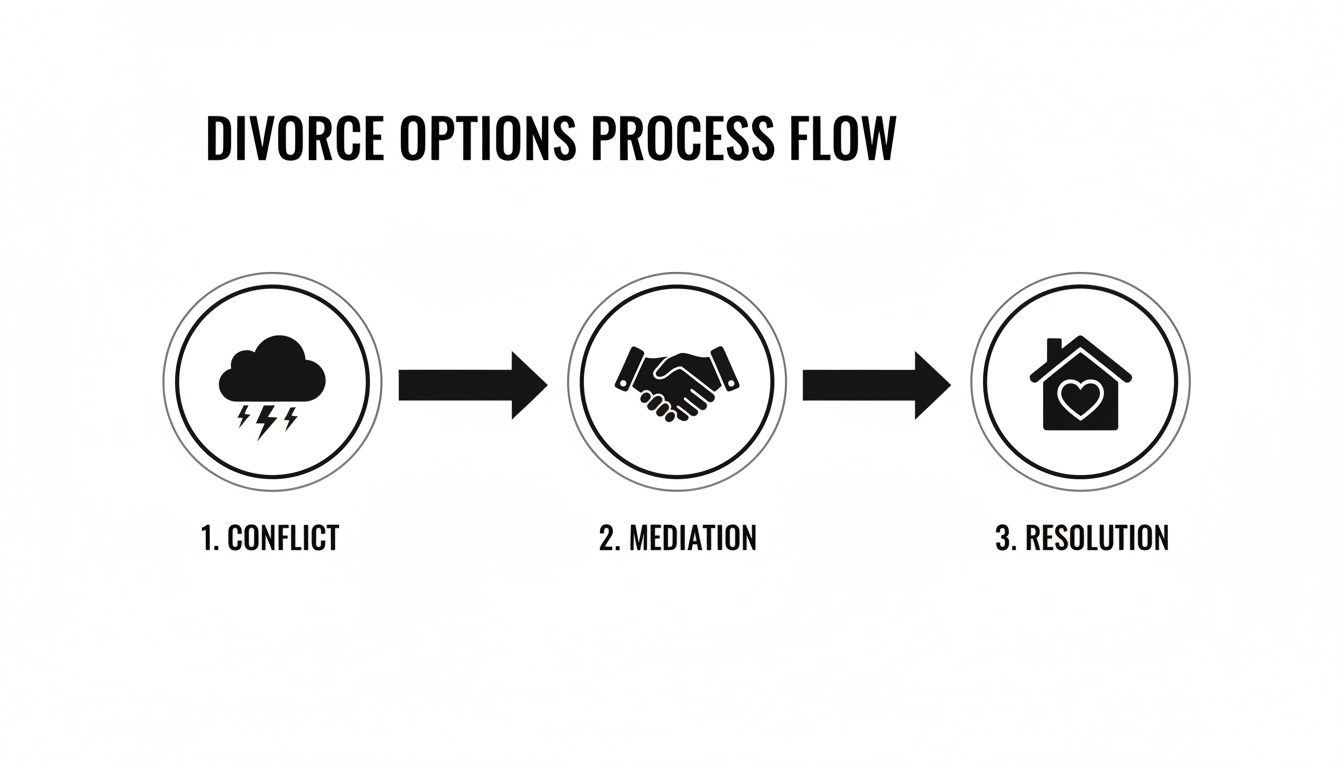
This is exactly what mediation is designed to do: steer you through the storm and toward a peaceful, agreed-upon outcome for your family.
Step 1: Selecting Your Mediator
The first step is for you and your spouse, usually through your attorneys, to agree on a neutral third party—the mediator. This person’s job isn't to take sides or make decisions for you; their role is to facilitate the negotiation.
It’s essential to pick someone both of you trust to be impartial. Most mediators are seasoned family law attorneys themselves, so they understand the legal landscape inside and out. This initial collaboration helps set a cooperative tone for the entire process.
Step 2: The Opening Session
Once you have a mediator, the session is scheduled. In Texas, most mediations are booked for either a half-day (four hours) or a full day (eight hours). The day starts with an opening statement from the mediator, where they'll lay out the ground rules: everything is confidential, they are a neutral party, and the end goal is to sign a Mediated Settlement Agreement (MSA).
Typically, you and your attorney will be in one room, and your spouse and their attorney will be in another. This setup is standard practice. It allows you to have frank, strategic conversations with your lawyer without any direct confrontation with your spouse. After this brief introduction, the real work begins.
Step 3: The Caucus and Negotiation Phase
This is where the magic happens. The mediator will start moving back and forth between the two rooms in a process we call "caucusing." In these private meetings, the mediator will listen to your side—your proposals, your biggest concerns, and what you’re willing to give on.
They then carry offers and counter-offers between the rooms, working to find common ground. Think of the mediator as a shuttle diplomat. They absorb the emotion and translate each side's position into practical terms, helping you both see the strengths and weaknesses of your arguments. This back-and-forth continues for all issues, from the division of your property to the nitty-gritty details of a parenting plan, until you reach a middle ground.
Step 4: Reaching An Agreement
If the negotiations are successful and you’ve found a resolution for all outstanding issues, the mediator will draft the Mediated Settlement Agreement. This document is the culmination of all the day's hard work.
Under Section 153.0071 of the Texas Family Code, a signed MSA is binding and cannot be revoked. Once you and your spouse sign on the dotted line, you are legally committed to the terms. This provides a powerful and final resolution.
Before you sign anything, your attorney will review the MSA with a fine-tooth comb to ensure it accurately reflects what you agreed to and fully protects your interests. Once signed by everyone, this document gets filed with the court, and your attorneys will use it to prepare the Final Decree of Divorce for the judge to sign.
Resolving Key Issues In Your Divorce Mediation
Walking into a mediation session can feel like trying to assemble a puzzle without the box top. All the pieces of your post-divorce life are on the table, and it's your job to fit them together. This is where the big decisions get made. In a Texas divorce mediation, you and your spouse have the power to solve this puzzle together, focusing on three main areas: your property, your children, and your finances.

Dividing Your Marital Estate
Texas is a community property state. This is a legal term that basically means almost everything you and your spouse acquired from your wedding day until the day you divorce belongs to both of you—no matter whose name is on the account or title.
The goal in mediation is to reach a "just and right" division of this community estate. Notice the wording there. It doesn’t say a perfect 50/50 split. It’s about fairness and finding a practical solution that makes sense for your unique situation.
This is where mediation really shines. It gives you the flexibility to get creative in ways a courtroom simply can't. For instance, one spouse might keep the family home, and in exchange, the other gets a larger portion of the retirement funds. These kinds of tailored trade-offs are tough for a judge to order but are common ground in mediation. To get a better handle on this, you can learn more about https://texasdivorcelawyer.us/texas-divorce-property-division/ in our complete guide.
Crafting A Parenting Plan for Your Children
For most parents, nothing matters more than the kids. Mediation offers a confidential, low-conflict space to build a detailed parenting plan that puts their well-being at the forefront. This is where you’ll hash out the critical issues that will shape how you co-parent for years to come.
Successfully navigating these sensitive topics often comes down to communication. Brushing up on effective communication strategies can make all the difference in reaching a peaceful resolution.
Addressing Financial Support
Beyond child support, spousal support is another common topic. In Texas courtrooms, this is legally known as spousal maintenance, and it’s notoriously difficult to get a judge to award it.
But in mediation, you have more freedom. You and your spouse can agree to temporary support—often called contractual alimony—to help one person get back on their feet financially. This is a huge advantage of settling your divorce out of court.
It's also helpful to understand the broader context. Research indicates that women initiate divorce in roughly 69% of cases. While family law is shifting toward shared parenting, historical trends still sometimes influence perspectives on custody and support. Knowing this can help both sides approach the table with a little more empathy and work toward a truly equitable outcome.
During mediation, you'll tackle the big questions head-on. The table below breaks down the most common issues you'll discuss, helping you organize your thoughts and prepare for a productive conversation.
Common Issues Addressed In Texas Mediation
This table outlines the primary topics negotiated during divorce mediation and the typical goals for each, helping you prepare for the discussion.
| Issue Area | What Is Decided | Primary Goal |
|---|---|---|
| Property Division | How to divide assets (home, cars, bank accounts) and debts (mortgages, credit cards) acquired during the marriage. | Achieve a "just and right" division of the community estate that both parties agree is fair and equitable. |
| Conservatorship | The rights and responsibilities of each parent, including who makes decisions about education, medical care, etc. | Establish a Joint Managing Conservatorship where both parents share decision-making responsibilities. |
| Possession Order | The specific schedule of when the children will be with each parent (visitation), including holidays and summer breaks. | Create a practical and consistent schedule, like the Standard Possession Order, or a custom one that fits the family's needs. |
| Child Support | The amount of financial support one parent pays to the other for the children's expenses, based on Texas guidelines. | Ensure the children's financial needs are met by calculating support accurately and addressing health insurance. |
| Spousal Support | Whether one spouse will provide temporary financial support to the other after the divorce (contractual alimony). | Provide a financial bridge for one spouse to become self-sufficient, negotiated by agreement rather than by court order. |
Each of these issues represents a major building block for your new life. Resolving them collaboratively in mediation keeps you in control and helps you build a stable foundation for the future.
How Mediation Saves You Time And Money
The idea of divorce often conjures images of long, draining court battles that chew through your savings and your peace of mind. Many people assume a fight is inevitable, but there's a much smarter, more efficient path forward. In Texas, divorce mediation is specifically designed to help you avoid the spiraling costs of litigation and keep your hard-earned assets for your new life.
Choosing mediation is really an investment in your own financial future. When you and your spouse work together to find common ground, you sidestep the massive expenses that come with a traditional courtroom fight, where every single disagreement can add thousands to your legal bill.
Comparing The Costs: Litigation Versus Mediation
The difference in cost between a litigated divorce and a mediated one can be staggering. Think about it: in a courtroom battle, you and your spouse are each paying attorneys for every single action. Every phone call, every email, every motion filed with the court, and every hour spent preparing for a hearing. Those hours add up faster than you can imagine, slowly turning your marital estate into a slush fund for legal fees.
Mediation, on the other hand, is a much more focused process. While you'll still have your attorney's guidance, the main shared expense is the mediator's fee, which in Texas is typically split 50/50. A full-day mediation might cost a few thousand dollars in total, but it has the power to resolve your entire case in a single day—a feat that could take months, or even years, in court.
The Financial Reality of a Contested Divorce
The numbers really do speak for themselves. According to 2023 statistics, a contested divorce in Texas without children can easily cost an average of $15,600 in legal and court fees. If you have children, that figure jumps to a shocking $23,500. These aren't small numbers; they represent retirement funds, college savings, and the down payment on your next home.
By resolving your case efficiently through mediation, you're not just settling a legal dispute—you're actively protecting your family’s financial future. Instead of watching your savings get depleted to fuel a prolonged conflict, you can preserve those assets for what truly matters. Our attorneys have written extensively about how mediation is a more cost-effective choice for Texas couples.
Mediation isn’t just about saving money; it’s about making smarter financial decisions for your family’s future. It allows you to control the outcome and the cost, ensuring that your assets are divided between you and your spouse, not spent on attorneys and court fees.
How To Prepare For A Successful Mediation
Walking into your mediation session unprepared is a lot like trying to sail a ship without a map or a compass. You’ll feel lost, overwhelmed, and at the mercy of the currents. But solid preparation is the single most important factor for a successful Texas divorce mediation, turning what feels like a chaotic process into a manageable one.
When you have a clear plan, you enter the room with the clarity and confidence needed to secure a fair and lasting agreement.

Gathering Your Essential Documents
You can't negotiate what you can't see. The very first step is to work with your attorney to create a complete and transparent financial picture of your marital estate. This means gathering and organizing every relevant document.
This isn't just busywork; it's about building the factual foundation for every single proposal you make. Having this information at your fingertips prevents frustrating delays and shows everyone in the room that you’re negotiating in good faith.
A thorough approach to your paperwork empowers you and your attorney to build a strong, fact-based case. We’ve put together a detailed guide on how to prepare for your divorce mediation that takes an even deeper dive into this critical step.
Defining Your Goals And Priorities
Before you can negotiate, you have to know what you’re fighting for. Take some quiet time to think deeply about what you want your life to look like after the divorce is final. What is most important to you, really?
- Needs vs. Wants: Grab a piece of paper and create two columns. In one, list your absolute must-haves—the non-negotiables, like keeping the family home for the children's stability. In the other, list your wants—items you'd like to have but are willing to be flexible on, like a specific piece of art or furniture.
- Best and Worst-Case Scenarios: Mentally walk through the best possible outcome you can realistically achieve. Then, do the same for the minimum acceptable outcome—your bottom line. This exercise is incredibly helpful for establishing a clear negotiating range before the pressure is on.
Going through this process helps you and your attorney develop a focused, coherent strategy. Knowing your bottom line prevents you from accepting a poor deal out of sheer exhaustion or giving up on something truly essential to your future.
The goal of mediation is not to "win" a fight, but to solve a problem. Adopting a mindset focused on finding workable solutions, rather than placing blame for past events, is the key to a productive session and a durable agreement.
Adopting A Solution-Focused Mindset
Finally, your mindset on the day of mediation matters more than you might think. These sessions can be long, emotionally draining days. How you approach them can make all the difference.
Commit to staying as calm and future-focused as possible. Listen to the mediator's guidance—they're the neutral third party there to help you find common ground. Rely on your attorney for sound legal advice, and try to be open to creative solutions you may not have considered before.
Remember, you are there to build a bridge to your new beginning, not to re-live past conflicts and arguments. This forward-looking perspective is your greatest asset in the room.
Common Questions About Texas Divorce Mediation
Going through a divorce brings up a ton of questions, and it’s completely normal to feel a bit lost about what’s next. We've put together some clear, no-nonsense answers to the questions we hear most often from our clients about divorce mediation in Texas. Our goal is to give you the practical info you need to feel more prepared and in control of the path forward.
What Happens If We Don't Settle Everything in Mediation?
This is probably the number one worry people have walking into mediation. If you and your spouse can't resolve every single issue during the session, the case is simply considered "unsettled." It’s not a failure by any means; for some couples, it’s just part of the journey.
If that happens, your case continues moving toward a final trial, where a judge will make the final calls. But here's the good news: even a partially successful mediation is incredibly valuable. Any issues you did manage to agree on can be locked in, which narrows down what’s left for a judge to decide. That almost always saves you a significant amount of time, money, and stress.
Can I Be Forced to Sign an Agreement I Don’t Like?
Absolutely not. Mediation is a completely voluntary negotiation. The mediator is there to guide the conversation and help you find common ground—not to twist your arm or push you into a deal you're not comfortable with.
You’ll have your own attorney right there with you to give you advice and make sure any potential agreement is fair and protects your interests. In the end, you and you alone have the final say on whether to sign the Mediated Settlement Agreement. You will never be forced to accept terms you do not agree with.
Is Mediation a Good Idea for High-Conflict or High-Asset Cases?
Yes. In fact, for these tough situations, mediation is often the best option available.
- For high-conflict divorces: The controlled, private environment of mediation can really lower the temperature. A neutral mediator keeps the conversation on track, and with attorneys present, communication is managed carefully. This prevents direct arguments and keeps the focus on finding solutions, not rehashing old fights.
- For high-asset divorces: Mediation gives you the privacy and flexibility needed to sort out complex finances, business valuations, and other unique assets. Court filings are public records, but what happens in mediation stays in mediation. It also opens the door to creative financial solutions that a judge simply might not be able to order in a courtroom.
How Long Does a Typical Mediation Session Last?
Here in Texas, most divorce mediations are blocked out for either a half-day (four hours) or a full day (eight hours). The complexity of your situation really dictates how much time you’ll need.
A straightforward case with only a few disagreements might wrap up in a half-day session. But more complicated divorces, especially those involving businesses, extensive assets, or contentious custody disputes, often need a full day to work through everything properly. Your attorney will help you figure out the right amount of time to schedule so you don't feel rushed.
What to Do Next: Your Path Forward
Getting a handle on how Texas divorce mediation works is the first step toward a more peaceful resolution. But understanding the process is one thing; taking decisive action is what truly shapes your future.
You've seen how this process puts you in the driver's seat, saves money, protects your kids from courtroom drama, and keeps your family's private life out of the public record. This is a journey you can succeed at, but you shouldn't walk it alone. Having the right lawyer in your corner ensures your rights are protected and that the final agreement is fair, solid, and will hold up in court.
Key Takeaways
Let’s quickly recap the powerful advantages of choosing mediation for your divorce in Texas:
- You Keep Control: Instead of a judge who doesn't know you making life-altering decisions, mediation empowers you and your spouse to craft custom solutions that truly fit your family's needs.
- It Is Cost-Effective: By steering clear of a long and bitter court battle, you get to keep your marital assets for your future, not sink them into endless legal fees.
- It Protects Your Children: Mediation helps build a cooperative co-parenting relationship right from the start, shielding your children from the emotional fallout of a high-conflict divorce.
- Your Privacy Is Guaranteed: Court records are public. Mediation, on the other hand, is a completely confidential process, protecting your family’s dignity and privacy.
The road ahead might feel foggy, but you don't have to figure it out by yourself. The experienced and compassionate attorneys at The Law Office of Bryan Fagan, PLLC, are here to guide you through every stage, from preparing for your session to finalizing your divorce decree.
Your family's well-being is our top priority. We blend empathetic guidance with sharp legal strategy to help you navigate this transition with confidence. We encourage you to take the next step by scheduling a free, no-obligation consultation with our team. We'll listen to your story, answer your questions, and give you clear, honest advice on how we can protect your family, your finances, and your future. Don't wait to get the help you deserve. Contact us today at https://texasdivorcelawyer.us.