Skip to content
Walking into divorce mediation can feel overwhelming, but preparation turns that anxiety into confidence.
This isn't about gearing up for a fight; it’s about shifting your mindset toward collaboration, organizing your essential documents, and knowing what you want before you sit down at the table. When you take control of the process, you gain clarity and set the stage for a better outcome for you and your family.
Your First Step Toward a Successful Mediation
Let's be clear: divorce mediation in Texas is almost always a better road to take than a drawn-out, expensive courtroom battle. The Texas Family Code defines mediation as a confidential process where a neutral, third-party mediator helps you and your spouse negotiate your own settlement. A mediator isn't a judge—they don't make decisions for you. Instead, they guide the conversation, helping you find common ground on critical issues like property division, child custody, and support.
This approach has major advantages for you:
- You control the outcome: You and your spouse, not a judge who doesn't know your family, make the final calls.
- It's cost-effective: Mediation almost always costs significantly less than going to trial and racking up legal fees.
- Your privacy is protected: What's said in mediation stays in mediation. Your personal and financial life remains out of the public court record.
Getting ready for mediation isn’t about winning. It’s about thoughtfully building a stable, workable future for yourself and your children. Understanding how it works lets you move forward with a clear head and a solid plan. The goal is to create a lasting agreement that works for everyone, and that starts with good preparation.
Your Mediation Preparation Checklist
Here's a quick look at the core actions needed for effective divorce mediation preparation, which we'll cover in detail below.
| Preparation Pillar | What This Achieves |
|---|---|
| Mindset & Goals | Shifts focus from conflict to problem-solving and defines your non-negotiables. |
| Financial Documentation | Creates a clear, fact-based picture of the marital estate for fair division. |
| Legal Understanding | Equips you with knowledge of Texas law to ensure your agreement is fair and valid. |
| Communication Strategy | Helps you stay calm, focused, and productive during negotiations. |
Each of these pillars is a building block for a successful mediation. Overlooking any one of them can weaken your position and lead to a less-than-ideal agreement.
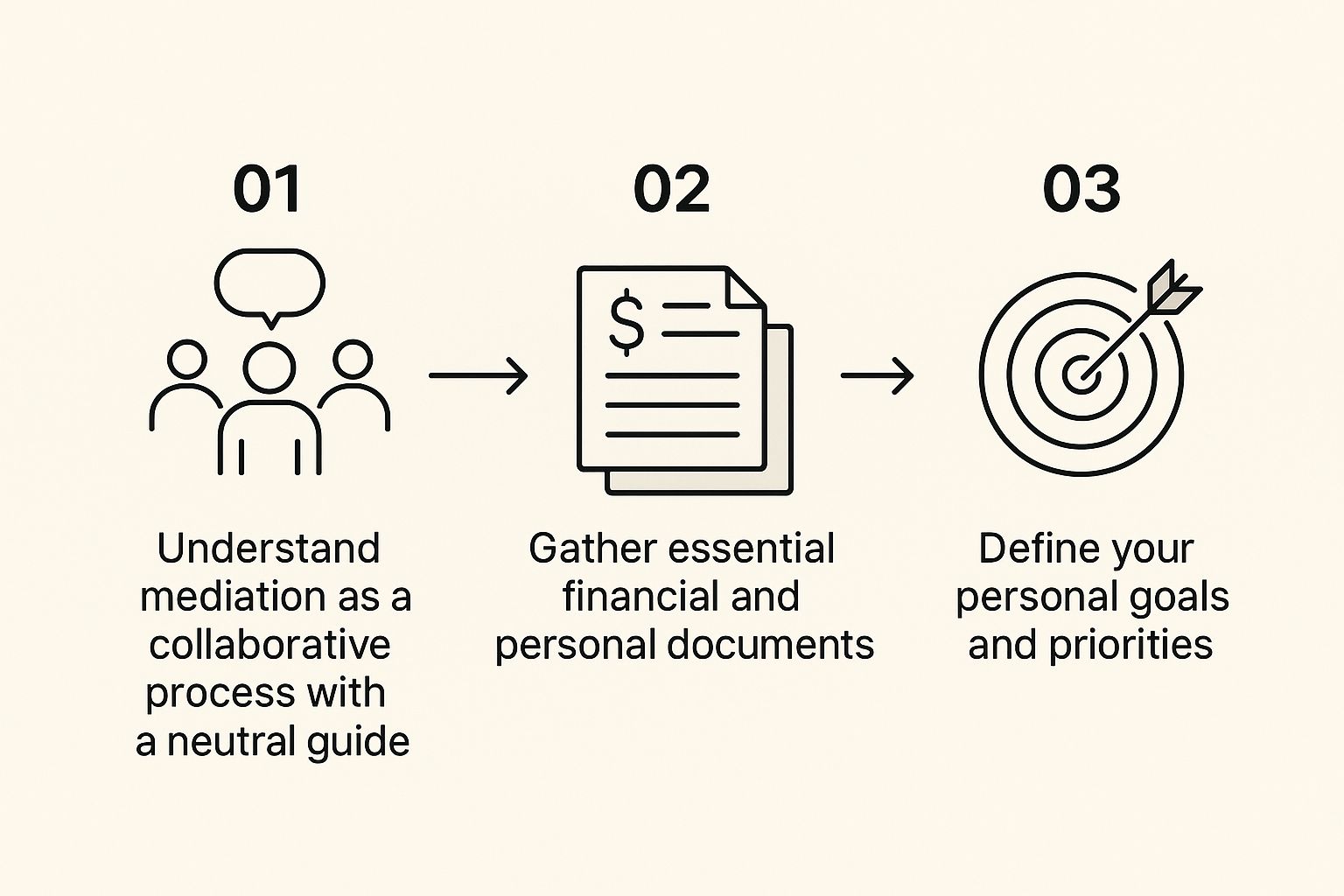
As the infographic shows, success starts with understanding mediation’s collaborative nature. From there, it's about organized document gathering and setting clear goals for your future.
Remember, the mediator is a neutral guide, not an advocate for either side. Their job is to help both of you find a resolution. You can learn more about the specific role of mediation in resolving legal divorce matters in our detailed guide. Approaching this process with the right expectations is your most powerful first step.
Gathering Your Financial and Personal Documents
Walking into mediation without your financial documents in order is like trying to build a house without a blueprint. A successful, fair agreement depends entirely on having complete and transparent information from both sides.
Gathering your paperwork isn’t just about making a list; it’s about creating a clear, factual picture of your marital estate. This allows you to negotiate from a position of confidence, not guesswork. Under the Texas Family Code, this full disclosure is non-negotiable. It's the foundation for creating a fair and equitable division of community property.

Your Financial Document Checklist
Organizing your finances is the most time-consuming part of this process, but it's also the most critical. Start with dedicated folders for each category and collect the most recent statements you can find.
- Proof of Income: Gather your last three months of pay stubs and your W-2s. You'll also want your federal income tax returns for the past two to three years. If you're a business owner, this means getting profit and loss statements, balance sheets, and business tax returns for that same period.
- Bank and Investment Accounts: You'll need statements from the past year for all accounts—checking, savings, money market, etc.—whether they're held jointly or separately. Don't forget statements for any brokerage accounts, stocks, bonds, or mutual funds.
- Retirement and Pension Plans: The most recent statements for any 401(k)s, IRAs, pensions, or other retirement vehicles are essential. Make sure you have them for both yourself and your spouse.
- Property and Debts: Find the deeds to any real estate, recent mortgage statements, and vehicle titles. On the debt side, pull together recent statements for all credit cards, car loans, student loans, and any personal loans.
As you're getting these documents together, it's smart to understand your options for big-ticket items like the family home. Researching topics like how to transfer a mortgage after divorce can give you practical solutions to bring to the negotiation table.
Documents for Child-Related Issues
When children are involved, your preparation must go beyond finances. The mediator needs information to help you and your spouse craft a parenting plan that serves the "Best Interest of the Child"—a core principle that drives every decision in Texas family law.
Having detailed records for your children’s expenses and schedules provides a factual basis for discussing child support and custody. It prevents disagreements based on fuzzy memories or assumptions.
Make sure you collect records related to:
- Healthcare Costs: Gather statements that show the monthly health, dental, and vision insurance premiums you pay for your children. Also, find records of any out-of-pocket medical expenses.
- Childcare and Education: Collect receipts or statements for daycare, after-school programs, and any private school tuition.
- Extracurricular Activities: Document the costs for sports, music lessons, summer camps, or any other regular activities your kids participate in.
This level of organization does more than just prepare you. It sends a clear signal that you are serious about finding a fair resolution.
Defining Your Goals and Understanding Priorities
Mediation is your chance to actively design your future, not just passively divide up your past. Before you step into that room, one of the most powerful things you can do is take time for honest self-reflection. This isn't just about making a list; it's about getting to the heart of what truly matters for your life after the divorce is final.
Going in with a clear head empowers you to negotiate from a place of strength and purpose, not just raw emotion. When you know your destination, it's easier to navigate the journey.

Separating Your Needs From Your Wants
The first step in mapping out your goals is to create two distinct categories: your absolute needs and your wants. This exercise brings incredible clarity to the negotiation table.
- Needs are your non-negotiables. These are the essential foundations for your stability and your children's well-being. A need might be securing enough financial support to stay in your home or getting a custody schedule that allows you to remain a primary caregiver.
- Wants are the items you’d like to have but could ultimately live without. Maybe that's a specific piece of furniture, a vehicle, or season tickets. Knowing where you can be flexible gives you valuable bargaining chips to trade for the things you truly need.
This distinction is crucial. It helps you focus your energy on the outcomes that will have the most significant long-term impact on your family's future, instead of getting bogged down in small, emotionally charged battles.
Clarifying Your Goals for Key Issues
Once you've separated your needs and wants, you can build a clearer vision for the major areas of your divorce. Spend some time thinking through these prompts to help solidify your position:
- Child Custody and Visitation: What does an ideal co-parenting week look like? Map it out. Consider school schedules, extracurriculars, and holidays. Under the Texas Family Code, all custody decisions must be in the "Best Interest of the Child," so you’ll want to frame your desired schedule around their stability and happiness.
- Property Division: What’s the goal for the family home? Do you want to sell it and split the proceeds, or does one of you hope to buy the other out? What about retirement accounts, investments, or a family business? Get specific.
- Financial Future: What will it take for you to feel financially secure in one, five, and ten years? This forces you to think strategically about things like spousal support and asset division, not just about getting by next month.
Having a clear vision for your post-divorce life is the foundation of a successful mediation strategy. It transforms the process from a reactive argument about the past into a proactive discussion about building two separate, stable futures.
The effectiveness of mediation can hinge on this kind of personal preparation. Studies show that while mediation is mandated in some countries, settlement rates can be lower than in places like the U.S., where the collaborative process itself is often seen as a win. This highlights how important your own clear goals are in the Texas system. You can read more about these global differences in this comparative study.
Doing this groundwork allows you to walk into mediation ready to build a sustainable, fair agreement that will serve your family for years to come.
Working With Your Attorney to Build a Strategy
You do not have to walk into mediation alone. In fact, you shouldn't. Your attorney isn't just a legal advisor; they are your most important strategic partner in this entire process.
Working closely with your lawyer before you sit down at the mediation table is what turns a potentially intimidating event into a well-planned negotiation. Their job is to give you a much-needed reality check, champion your best interests, and make sure any agreement you sign is fair, enforceable, and legally sound.
First, your attorney will analyze all those financial documents you've gathered. They will explain what the Texas Family Code says about community property versus separate property, giving you a clear-eyed view of what a judge would likely do if your case ended up in a courtroom. This insight is powerful—it sets a realistic baseline for your negotiations and keeps your expectations grounded.
From Legal Theory to Practical Strategy
An experienced family law attorney does more than just quote the law. They help you build a concrete game plan for the negotiation room, which often means role-playing different scenarios and discussing where you might be willing to compromise.
This strategic planning boils down to a few key actions:
- Defining Your Best and Worst-Case Scenarios: Your lawyer will help you map out the best possible outcome you can realistically hope for and, just as importantly, the absolute minimum you're willing to accept. This gives you firm boundaries.
- Anticipating Your Spouse's Position: A seasoned attorney has seen many situations like yours. They can use that experience to predict your spouse’s likely arguments and help you prepare smart, effective counter-offers.
- Framing Your Custody Goals: When children are involved, your attorney will help you frame your ideal parenting plan around the "Best Interest of the Child" standard, because that's the only lens a Texas court will use.
This prep work is often what separates a successful mediation from a failed one. It's no surprise that mediation success rates are often high—some reports show between 50% and over 80% of cases reaching a full agreement. That success almost always comes down to how well-prepared both sides are. A European Parliament study on international divorce432732_EN.pdf) even shows how different legal systems impact outcomes, which underscores how vital it is to have an expert who knows Texas law inside and out.
Your attorney is your advocate and your advisor. They handle the legal details so you can focus on making clear-headed decisions for your future.
With a solid strategy, you can walk into that room and negotiate with confidence. Your lawyer is right there with you, making sure the final Mediated Settlement Agreement protects your rights and reflects the hard work you both put in. Understanding how a Fort Worth family lawyer can help you with divorce mediation is one of the most important steps you can take.
Mastering Communication and Negotiation Tactics
How you talk—and how you listen—in the mediation room will directly shape the final outcome. Your preparation isn't just about gathering documents; it's about having a plan for how you'll handle yourself, especially when conversations get tough.
This isn't about winning arguments. It's about behaving in a way that encourages agreement, not more conflict. The goal is to stay calm, focused, and effective, even when emotions are high. Thinking of it like a business meeting—with a professional, level-headed demeanor—is your greatest asset.

Adopt a Solution-Focused Mindset
The single most powerful shift you can make is to stop looking backward and start looking forward. Mediation is not the place to rehash old fights or point fingers. That only makes the other person defensive and brings progress to a halt.
Instead, you need to steer the conversation toward future solutions. A few simple communication shifts can make all the difference.
- Use "I" Statements: Frame your needs from your own perspective, without blaming your spouse. Instead of saying, "You never think about the kids' schedules," try, "I'm concerned about making sure the kids have a consistent routine during the school week." One is an accusation; the other is a statement of a problem to be solved.
- Practice Active Listening: Don't just wait for your turn to talk. Genuinely listen to what your spouse is saying. You can show you're hearing them by saying, "So what I hear you saying is that you're worried about…" This doesn't mean you agree, but it shows respect and lowers the tension in the room.
This forward-thinking approach is incredibly effective. In countries like Finland and the UK, around 70% of family cases are successfully resolved through mediation. Those high success rates are almost always credited to well-prepared participants who come in ready to find common ground. You can learn more about how different legal systems achieve successful mediation outcomes in family disputes.
Know When to Hold Firm and When to Bend
Good negotiation is a balance between standing your ground on what truly matters and being flexible enough to get a deal done. You've already done the hard work of figuring out your "needs" versus your "wants," and now is when you put that knowledge into action.
Be ready to think outside the box. Sometimes the best solutions are the ones neither of you saw coming, but they manage to meet both of your core needs in an unexpected way.
Taking a break when emotions are running high is not a sign of weakness—it's a sign of strength and strategic thinking. If you feel yourself getting angry or overwhelmed, ask the mediator for a few minutes. Step away, clear your head, and come back ready to focus.
Ultimately, mastering these tactics is about mastering yourself. When you stay composed and solution-oriented, you empower yourself to negotiate from a position of strength and build a fair, lasting agreement for your family's future.
What to Do Next: From Agreement to Final Decree
The feeling of relief after a successful mediation is incredible. You've navigated tough conversations and found common ground. But before you can officially close this chapter, a few critical legal steps are needed to turn those agreements into a rock-solid, enforceable court order.
The Final Steps in the Divorce Process
If you settled everything, your attorney will draft a Mediated Settlement Agreement (MSA). This document puts every detail you and your spouse agreed upon into legal language. It is incredibly important.
Once you and your spouse sign the MSA, it becomes irrevocable under the Texas Family Code. This means neither of you can just wake up the next day and change your mind. Your decisions are now locked in.
With the signed MSA in hand, your attorney will then draft the Final Decree of Divorce. This is the official document that the judge will sign, incorporating all the terms from your MSA. Once the judge signs it, your divorce is legally final, completing the step-by-step process from filing to decree.
Key Takeaway
You’ve done the hard work of taking control of your future through mediation. Now, you need an experienced attorney to ensure that agreement is finalized perfectly and protects your interests. The team at The Law Office of Bryan Fagan, PLLC, can review your agreement and guide you through these last crucial steps to secure your family’s future with confidence.
Common Questions About Divorce Mediation in Texas
It’s completely normal to feel uncertain heading into divorce mediation. Knowing what to expect can make a world of difference, helping you walk into that room with confidence instead of anxiety. Let's go through a few of the most common questions we hear from clients in your exact situation.
What Happens If We Don’t Reach an Agreement in Mediation?
First, don't panic. If you can’t resolve every single issue in mediation, your case simply continues toward a potential trial. But that doesn’t mean the mediation was a waste.
Any agreements you do make can be written down, which narrows the list of disputed issues a judge will eventually have to decide. This alone saves you a significant amount of time and money. Plus, you’ll leave with a much clearer understanding of your spouse’s bottom-line positions, which is invaluable for trial preparation.
Is a Mediation Agreement Legally Binding?
Yes, without a doubt. In Texas, once both parties and their attorneys sign a Mediated Settlement Agreement (MSA), it becomes irrevocable under the Texas Family Code.
This means neither of you can simply change your mind. It’s a done deal. Your attorney will then take that signed MSA and use it to draft the Final Decree of Divorce for the judge to sign, turning your agreement into an official, enforceable court order.
A signed Mediated Settlement Agreement is a powerful legal document. It provides finality and ensures that the decisions you made collaboratively are locked in, allowing you to move forward with certainty.
Can I Bring Someone Else to Mediation for Support?
Generally, no. Divorce mediation in Texas is a confidential process, strictly limited to the spouses and their respective attorneys.
This privacy is by design. It creates a safe, controlled environment where you and your spouse can negotiate openly without the pressure or influence of a new partner, parent, or friend in the room. Keeping it to the core parties is essential for reaching a genuine resolution.
One key task to handle after your agreement is finalized is sorting out benefits. A divorce is usually considered a qualifying life event, which opens a Special Enrollment Period for health insurance. Understanding what constitutes a qualifying event for health insurance is critical for making sure you and your children get new coverage without a gap.
You've done the hard work to prepare for a successful mediation. Now it's time to ensure your agreement is finalized correctly and your future is secure. The team at The Law Office of Bryan Fagan, PLLC is here to provide the compassionate, expert guidance you need. Schedule a free, confidential consultation with our experienced attorneys today to discuss your next steps.