Skip to content
You check the calendar, the payment date passes, and nothing hits your account. Then you wait a few more days, send a text, get a vague excuse, and realize the divorce decree didn’t end the financial stress after all.
When that happens, many people feel stuck. You may be trying to cover rent, utilities, insurance, or the costs of rebuilding life after divorce while your former spouse acts like the support order is optional. It isn’t.
In Texas, a valid support order is a court order, and courts expect compliance. Spousal support enforcement texas cases often turn on one simple question: is the problem a payment delay that can be corrected quickly, or a pattern of nonpayment that needs court intervention? The answer shapes everything from the evidence you gather to the remedy you ask the judge to use.
The good news is that enforcement is not guesswork. There are specific procedures, specific remedies, and specific ways to pressure a nonpaying ex-spouse to comply. The harder truth is that some methods work far better than others depending on how your former spouse earns money, what assets they control, and whether they are openly defiant or evasive.
Your Ex-Spouse Is Not Paying Support What Now?
A common scenario goes like this. Your divorce is final. The decree says support is due on a certain date each month. The first month arrives, then the second, and your former spouse starts sending messages like “I’m waiting on a client payment” or “I’ll catch up next month.”
At first, you may try to keep things civil. That instinct makes sense, especially if you’re also co-parenting or trying to avoid another fight. But missed support usually gets worse when there’s no immediate response.
Your first move should be practical, not emotional. Pull your decree, confirm the payment terms, and start a clean record of every missed or partial payment. Save screenshots, bank records, emails, and texts. If you end up filing a motion to enforce in Texas, details matter.
Practical rule: Treat every missed payment like evidence, not just a frustration.
That means writing down the due date, what was paid if anything, how it was supposed to be paid, and any explanation your ex gave. You don’t need a dramatic confrontation. You need a paper trail.
Some cases can still be fixed with a formal demand through counsel. Others need immediate filing, especially when the missed payments are stacking up or your former spouse is moving money around. The key is to act before the nonpayment becomes the new normal. A Texas judge can enforce a decree, but your case gets stronger when your records are organized and your response is prompt.
Understanding Your Rights Under Texas Spousal Support Law
Before you enforce anything, you need to know what kind of support you have. In Texas, that distinction changes the remedies available to you.

Court-ordered maintenance and contractual alimony are not the same
Court-ordered spousal maintenance comes from the Texas Family Code. A judge orders it because the legal requirements were met. That matters because court-ordered maintenance can be enforced with stronger tools, including contempt.
Contractual alimony is different. It comes from an agreement between spouses, usually included in the divorce settlement. Even when it appears in the decree, it may function more like a contract than a statutory support obligation. In many cases, that means enforcement is more limited. You may be pursuing damages or specific performance rather than contempt.
If you aren’t sure which one your decree created, don’t assume. Read the exact language. A single paragraph in the decree often determines whether the court can jail a nonpaying ex-spouse for willful noncompliance or whether you’re limited to contract-style remedies.
Texas keeps spousal maintenance narrow
Texas does not treat spousal maintenance as open-ended support. Under Texas law, payments are capped at the lower of $5,000 per month or 20% of the paying spouse’s average monthly gross income, and eligibility often requires a marriage of at least 10 years when the receiving spouse cannot meet minimum reasonable needs, as outlined in this discussion of Texas alimony limits.
That limited structure affects enforcement strategy in two ways. First, it means many decrees are tightly drafted and specific about amount and duration. Second, it means you need to know whether the order is still active and exactly what was required each month.
If you’re trying to understand what the original support number may have been based on, a tool like this spousal support calculator can help you frame questions for your attorney, though the decree itself controls.
What the Family Code requires
At a practical level, most enforcement disputes start with these questions:
- Was the order clear enough to enforce? The payment amount, due date, and duration should be specific.
- Was your ex-spouse eligible to ask for modification instead of just stopping payment? If circumstances changed, the paying spouse needed to go back to court.
- Did the support arise under the statute or by agreement? That answer changes the means of enforcement.
The decree is not a suggestion. It is the roadmap for what the judge can enforce.
Why this foundation matters
Clients often want to jump straight to punishment. Sometimes that’s appropriate. But the stronger approach is to identify the legal character of the obligation first. A clean enforcement case begins with the text of the decree, the statutory basis for the obligation, and a precise accounting of what went unpaid.
That groundwork does more than prepare a filing. It keeps you from spending time and money on the wrong remedy. In spousal support enforcement texas cases, the fastest path is often the one built on the most careful reading of the original order.
Powerful Enforcement Remedies Available in Texas Courts
Texas courts use a tiered system for enforcement. For W-2 employees, wage garnishment has a compliance rate exceeding 95%, and when that isn’t enough, courts can escalate to property liens or contempt proceedings that may include jail time if ability to pay is proven, as described in this overview of Texas spousal support calculations and enforcement tools.
That sounds simple on paper. In practice, each remedy solves a different problem.
Wage withholding works best when income is regular
If your former spouse has a standard paycheck, wage withholding is usually the cleanest option. The court orders the employer to deduct the amount directly. This avoids the monthly argument over whether your ex will pay voluntarily.
This remedy works because it removes choice from the process. If the employer is withholding correctly, the support gets paid before the money reaches your ex-spouse’s bank account.
It is less effective when the payor changes jobs often, works for cash, controls payroll through a business, or classifies earnings in a way that avoids a normal paycheck.
Liens put pressure on property and business assets
A lien can attach to real or personal property and prevent sale or refinancing until the obligation is addressed. This tool is useful when your former spouse has equity in a house, valuable vehicles, or other assets but keeps claiming there is “no money” available for support.
Liens don’t always create immediate cash flow. What they do create is pressure. They interfere with access to property value, which often forces negotiation or payment.
When a payor has a business interest, the strategy can become more technical. A lien may not solve every problem, but it can block transactions your ex hoped to complete discreetly.
Contempt is the strongest remedy, but not automatic
A motion for contempt asks the court to punish willful nonpayment. This is the remedy people talk about most, but it requires proof. The judge must be persuaded that your former spouse had the present ability to pay and chose not to.
If the court finds willful noncompliance, penalties can be severe. But contempt is not a shortcut for every missed payment. A poorly prepared contempt case can fail if the evidence doesn’t show ability to pay.
Client warning: Judges take contempt seriously, and they expect your evidence to be exact. Sloppy records can weaken a strong claim.
Other collection pressure may be appropriate
Depending on the facts, enforcement may also involve seeking judgment for arrears, pursuing asset seizure, or tracing accounts where funds moved after payments stopped. These remedies often work alongside withholding, liens, or contempt rather than replacing them.
The goal is not to use every tool at once. The goal is to pick the tool that matches your ex-spouse’s actual income pattern and assets.
Comparing Spousal Support Enforcement Remedies in Texas
| Remedy | Best For | Key Feature |
|---|---|---|
| Wage withholding | Spouses with regular W-2 income | Automatic deduction from paycheck |
| Property lien | Spouses with real estate, vehicles, or valuable property | Restricts sale or refinance until debt is addressed |
| Contempt motion | Willful nonpayment with proof of ability to pay | Can lead to court sanctions, including jail time |
| Asset seizure or collection action | Cases involving reachable non-exempt assets | Targets money or property outside payroll |
| Enforcement judgment | Ongoing arrears that need formal liquidation | Converts unpaid support into a collectible judgment |
What works and what doesn’t
Some clients assume the strongest-sounding remedy is always the best one. Usually it isn’t.
A W-2 employee with stable employment often responds fastest to withholding. A business owner who manipulates cash flow may ignore withholding entirely, making liens, accounting review, and contempt more useful. A payor with assets but no obvious salary may need pressure on property, not payroll.
What usually doesn’t work is repeated informal requests without consequences. Another weak approach is filing too broadly, asking for every remedy possible without tying each request to facts the judge can act on.
Strategic sequencing matters
A smart enforcement plan often looks like this:
- Audit the order and payment history. Confirm exactly what is owed.
- Identify income source. W-2, self-employed, commissions, business distributions, rental income, or mixed sources.
- Match the remedy to the problem. Withholding for payroll cases. Liens and tracing for asset-based cases. Contempt for provable defiance.
- Prepare for collection, not just a hearing. Winning an order matters less if there’s no practical path to payment.
The most effective enforcement case is built around collectability. A good order on paper helps. A targeted order that reaches actual income and actual assets helps more.
Enforcing Support Against Self-Employed and High-Asset Spouses
The hardest cases usually involve a former spouse who doesn’t draw a normal paycheck. They may own a company, operate as a contractor, collect rent, receive irregular distributions, or hold wealth in forms that don’t show up in a basic payroll search.
That is where routine wage withholding starts to break down.
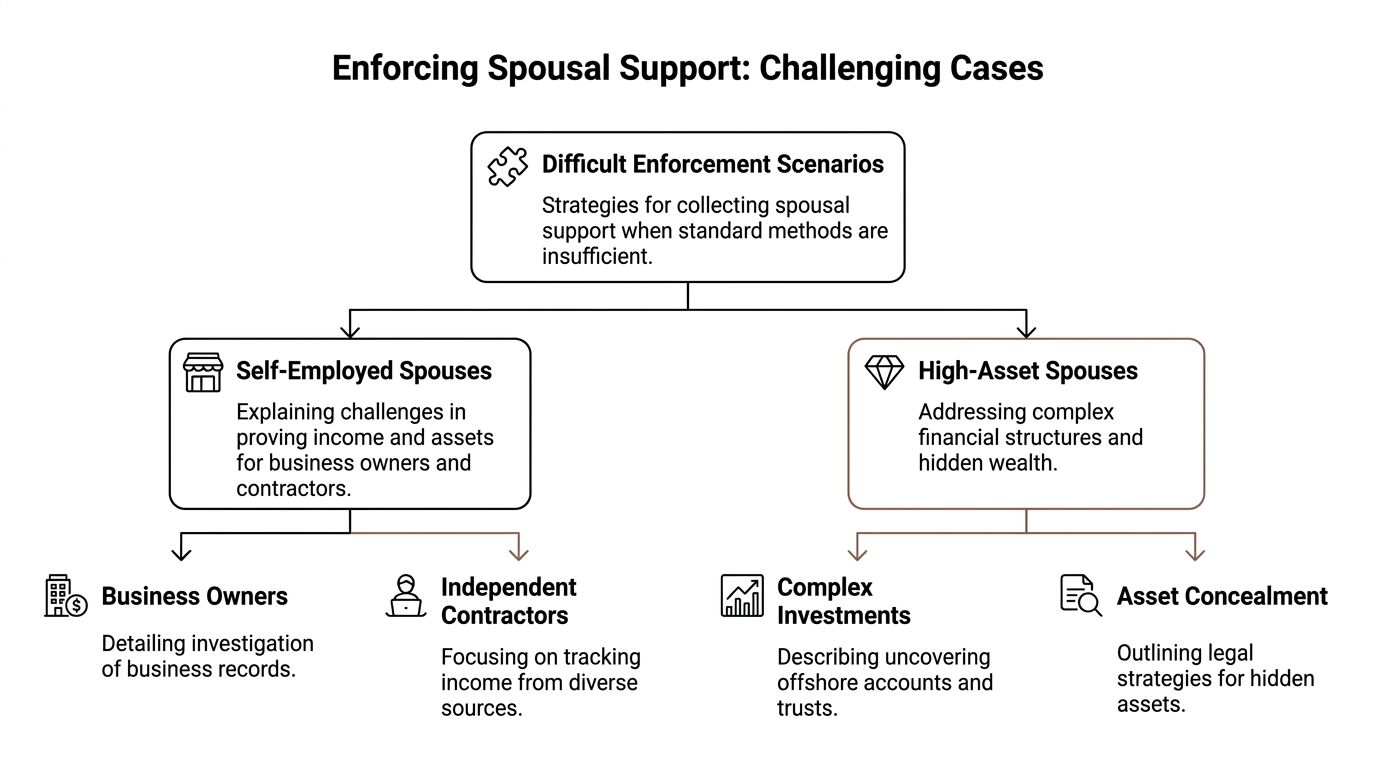
Over 20% of spousal support enforcement cases in Texas involve irregular income sources, which makes traditional wage withholding less reliable. In those cases, advanced methods like appointing a business receiver may be necessary through specialized motions under Texas Family Code § 8.101, as explained in this discussion of Texas spousal support enforcement challenges.
Why self-employed payors are different
A self-employed ex-spouse can make enforcement difficult in several ways. Income may come in unevenly. Business and personal spending may overlap. Tax returns may understate available cash. A person who controls the books can also control what appears easy to prove.
That doesn’t mean support is uncollectible. It means the case must shift from “where is the paycheck” to “where is the money flowing.”
Tracing income through the business
When a payor owns a company, business records become central. Bank statements, profit and loss reports, general ledgers, merchant processor records, and loan applications can tell a different story than a bare claim of “the business is down.”
A forensic accountant can be useful when the records are dense or suspicious. That professional may help identify owner benefits paid through the company, unusual transfers, hidden distributions, or spending that looks personal rather than business-related.
If you suspect your former spouse is disguising money through entities or delayed distributions, issues related to hidden assets in a Texas divorce often overlap with post-divorce enforcement.
Business owners rarely hide money in one dramatic move. More often, they spread it across ordinary-looking transactions.
Receivership and control-based remedies
In difficult cases, the court can consider stronger remedies aimed at control rather than simple collection. One of the most important is a receiver. A receiver may be appointed to take temporary control over certain business-related funds or assets so support can be paid.
This is not a routine request. It requires a focused motion, a clear factual basis, and a judge willing to use a stronger remedy because softer ones failed or were unlikely to work. But when a payor uses a business structure as a shield, a receiver can cut through that shield.
This approach tends to be most useful when:
- The business is active but support is unpaid
- The payor controls the timing of distributions
- Records suggest money is moving somewhere, just not to you
- Prior orders have been ignored
Cryptocurrency and digital assets
Some high-asset cases now involve digital holdings. If your former spouse has used cryptocurrency, the old assumption that enforcement stops at bank accounts is no longer safe.
Digital assets create two problems. First, they are easier to move quickly. Second, many family law orders were drafted before anyone focused on wallet disclosures, exchange records, or blockchain tracing. That means enforcement may require broader discovery, targeted document requests, and a sharper understanding of how the asset is held.
If there is credible evidence that support arrears coincide with crypto transactions, your attorney may need to pursue exchange records, wallet history, and conversion activity. The legal work is still rooted in the decree and the Family Code. The facts just require a more modern paper trail.
Practical trade-offs in high-asset enforcement
Advanced enforcement is powerful, but it is not cheap. Forensic review, subpoenas, business valuation support, and receiver requests all add complexity. That doesn’t mean you shouldn’t pursue them. It means the amount owed, the available assets, and the payor’s history should justify the cost.
A disciplined approach often looks like this:
- Start with what can be verified quickly. Known accounts, visible assets, public filings, and payment history.
- Escalate when simple remedies fail. Don’t spend heavily on a receiver motion if a direct withholding order will solve the case.
- Use pressure points, not anger. The right subpoena or lien often changes behavior faster than a dramatic hearing request.
- Think beyond salary. Owners may live on draws, reimbursements, retained earnings, or asset sales rather than payroll.
The central question is not whether your ex says they are broke. The central question is whether the financial record supports that claim. In self-employed and high-asset spousal support enforcement texas cases, that distinction decides everything.
Navigating the Spousal Support Enforcement Court Process
Once it’s clear informal efforts won’t fix the problem, the case moves into court procedure. That process feels intimidating for many people, but it becomes much more manageable when you break it into steps.

Start with a clean evidence file
Before anything is filed, gather the documents that prove both the order and the nonpayment. Courts expect precision.
Your enforcement file should usually include:
- The final decree or support order showing the exact obligation
- A payment ledger listing due dates, amounts due, amounts received, and missed balances
- Bank records showing what did or didn’t arrive
- Texts, emails, or messages where your former spouse discusses payment
- Employment or business information if available
- Any prior enforcement or modification filings involving the same order
If contempt may be part of the case, details become even more important. Dates, amounts, and method of payment cannot be left vague.
Filing the motion
The usual pleading is a Motion for Enforcement, sometimes paired with requests for contempt, arrears, attorney’s fees, or additional relief depending on the case. Your attorney drafts the motion to identify the violated order, specify each instance of noncompliance, and ask the court for targeted remedies.
If the facts support contempt, strict drafting matters. The alleged violations must be stated clearly enough that the responding party knows exactly what conduct is at issue.
Some people wait too long to file because they hope their ex will “turn it around.” Delay often makes the accounting messier and gives the payor more room to claim confusion.
Service and notice matter
After filing, the other side must be properly served or otherwise given notice in the manner required for the relief requested. This is not just a formality. If service is defective, a strong case can be postponed or limited.
When contempt is requested, the court may require additional notice procedures because personal liberty is potentially at stake.
Best practice: Build your case as if every line item will be challenged. Judges often focus on the details first.
What happens before the hearing
Many enforcement matters involve some exchange of records before the hearing. Your attorney may request payroll records, bank statements, business documents, or other financial material. In some cases, settlement discussions happen once the motion is filed and the payor realizes there will be a court date.
You may also need to prepare an updated arrears calculation and organize exhibits in hearing-ready form.
For a practical overview of this stage, many clients find it helpful to read about how to file contempt of court in Texas family law cases.
A short explainer can also help you visualize how enforcement hearings are framed:
The hearing itself
At the hearing, the judge usually wants to know four things quickly:
- What did the order require
- What was not paid
- What proof supports the nonpayment
- What remedy are you asking the court to impose
If contempt is requested, the court will also examine whether the nonpayment was willful and whether the payor had the ability to comply. Expect the other side to argue hardship, confusion, or changed circumstances.
Bring organized records. Judges appreciate concise, well-supported presentations more than emotional narratives.
Attorney’s fees and realistic expectations
You can often ask the court to order the nonpaying spouse to pay attorney’s fees tied to enforcement. That does not mean the request will always be granted in full, but it is an important part of the relief to consider.
As for timing, enforcement moves on the court’s calendar, not yours. Some matters resolve quickly after service because the pressure works. Others take longer if discovery is needed, records are disputed, or the payor has a complex financial setup.
The practical lesson is simple. Prepare for a process, not a single dramatic court date. Good enforcement cases are built document by document, hearing by hearing, until the order has teeth again.
Anticipating and Overcoming Common Defenses to Enforcement
Most nonpaying spouses don’t walk into court and admit they ignored the order because they felt like it. They usually offer a defense that sounds reasonable on the surface.
The key issue is whether the defense shows a true inability to pay or just a refusal to comply.
I lost my job
Job loss is the most common explanation. Sometimes it is legitimate. Sometimes it is selective storytelling.
If your former spouse lost a job but quickly took a similar role, started consulting, or continued spending freely, the defense weakens. The court will look at the full picture, not just the phrase “I got laid off.”
You and your attorney may need to gather evidence such as recent employment updates, LinkedIn changes, business launches, travel, major purchases, or banking activity that contradicts the hardship claim.
My business is failing
Business owners often rely on this defense because business income is harder to read from the outside. But a struggling business does not automatically mean inability to pay. The court can still examine whether the owner took distributions, paid personal expenses through the company, delayed income, or protected assets while support went unpaid.
That is why raw tax language is not enough. Actual cash flow matters.
A bad month in business is not the same as legal inability to comply with a court order.
I couldn’t afford it
This defense sounds broad because it is broad. Courts generally need more than a statement of financial pressure, especially in a contempt setting. The question is not whether paying support was inconvenient. The question is whether payment was within the person’s present ability and was still withheld.
Practical counter-evidence can include:
- Lifestyle proof such as vacations, vehicle upgrades, or discretionary spending
- Public records showing property transactions or new business filings
- Account activity revealing transfers to savings, investments, or other accounts
- Communication history where your ex acknowledges the obligation but delays payment anyway
I thought we had an agreement
This defense appears often when former spouses made informal side deals. One person says, “I agreed to let the payment slide for a while.” The other says, “I was just trying to be cooperative.”
Unless the court signed a modification, informal arrangements are dangerous. Private understandings may complicate the facts, but they do not automatically erase a court order. This is one reason written records matter so much.
The best response is preparation
You do not beat common defenses with outrage. You beat them with documentation.
That means comparing the excuse to the financial record, the communication trail, and the decree itself. If the other side claims inability, ask what documents prove it. If they claim confusion, show the language of the order. If they claim hardship, test whether their spending matches that story.
The stronger your records, the harder it is for a vague excuse to survive judicial scrutiny.
Your Next Steps for Spousal Support Enforcement in Texas
If support has stopped, waiting rarely improves the situation. Action does.
The first step is to organize your documents and calculate what is owed under the decree. Keep that accounting current. If payments are partial, note partial payments. If nothing has been paid, note each missed due date separately.
What to do next
- Pull the signed order and read the exact payment terms
- Create a payment history with dates, amounts due, amounts paid, and balances
- Preserve all communication with your former spouse about support
- Identify how your ex earns money because enforcement strategy depends on income source
- Stop relying on informal promises if a pattern of nonpayment has started
- Get legal advice early if your ex is self-employed, owns a business, or may be moving assets
If you’re looking for practical court information in major Texas markets, your local district clerk and county court websites in Houston, Dallas, Austin, and San Antonio can help with filing logistics and local procedures. Legal aid organizations may also provide guidance in limited circumstances, especially when access to counsel is a barrier.
Key takeaway: The order only protects you if you enforce it.
Spousal support enforcement texas cases are often won by the person who gets organized first, moves before records disappear, and asks the court for remedies that fit the actual financial picture. If your former spouse has a simple paycheck, enforcement may be straightforward. If they control a business, hide income, or deal in nontraditional assets, the case becomes more strategic, not impossible.
Take the missed payment seriously. Then take the next step.
If you need help turning a court order into actual payment, the Law Office of Bryan Fagan, PLLC can help you evaluate your options and build an enforcement strategy that fits your case. Whether your former spouse is a salaried employee, a business owner, or someone with complex assets, the firm can help you pursue practical remedies with clarity and urgency. Schedule a free consultation to discuss your decree, your payment history, and the fastest path toward enforcing your rights.