Skip to content
The fear of not being able to support yourself after divorce can keep you up at night.
If you’re searching for permanent spousal maintenance texas, you’re probably asking a very human question. Will I have enough to live on when this is over? Texas law answers that question in a more limited, practical way than many people expect.
The law usually does not create a lifetime stream of payments after divorce. Instead, it creates a structured path that may help one spouse stabilize, regroup, and work toward independence. That distinction matters because it changes how you prepare, negotiate, and plan.
If you’re the spouse who may need support, clarity helps you build a better case. If you may be asked to pay, clarity helps you set realistic boundaries and protect your future. Either way, the goal is the same. You need to understand what Texas courts do, not what people casually call “alimony.”
Facing Divorce and Worried About Your Financial Future?
Divorce can make even steady, capable people feel financially exposed.
Maybe you left work years ago to raise children. Maybe your spouse handled most of the income. Maybe you own a business together and don’t yet know what your cash flow will look like after property is divided. These are the moments when people start searching for answers about ongoing support.
A lot of readers come in expecting a yes-or-no answer. Either Texas gives permanent support or it doesn’t. A more complete understanding is that Texas has a system for spousal maintenance, and that system is built around transition.
Why that distinction matters
The word “permanent” sounds comforting to one spouse and alarming to the other. But it also creates confusion.
Texas courts focus on whether support is needed so a spouse can meet minimum reasonable needs and move toward self-support. In plain English, that means basic living expenses, not a guarantee that life after divorce will look exactly like life during marriage.
That approach can feel frustrating at first. It can also be helpful because it gives you a planning framework.
- If you may need support, you should start gathering proof of your actual monthly needs, your income, and any barrier to earning more.
- If you may pay support, you should start documenting income, expenses, and any reason the other spouse can work or has enough property to meet basic needs.
- If children are involved, remember that custody, child support, and maintenance often interact in practical ways, especially when one parent has most of the caregiving duties.
A strong maintenance case usually starts with a simple question. What does it actually cost you to cover basic life after the divorce is final?
Texas divorce procedure also matters. Requests for maintenance are raised during the divorce case itself, alongside issues like property division, temporary support, parenting arrangements, and mediation. The earlier you understand the rules, the more options you usually have.
The Myth of Lifelong Alimony in Texas
People use the phrase permanent spousal maintenance texas all the time. Texas law doesn’t treat it that way.

Texas law rejects traditional lifetime alimony and instead limits court-ordered support to the shortest reasonable period needed for self-sufficiency. One summary of aggregated Texas cases also states that denial rates often exceed 70% in contested maintenance cases without proven disability because the evidentiary burden is demanding, as explained in this Texas spousal maintenance overview.
Think of maintenance as a runway, not a pension
The better image is a financial runway.
A runway gives a plane enough distance to lift off. It is not the destination. Texas uses maintenance in much the same way. The court may provide support for a period of time so the receiving spouse can stabilize, find work, build skills, or adjust after a long marriage.
That policy affects nearly every maintenance case. Courts look for proof that the spouse asking for support needs a real transition period, not an open-ended arrangement.
If you want a basic legal primer on the terminology, this explanation of what is alimony in Texas helps sort out the difference between everyday language and what Texas courts order.
Why courts are strict
Texas judges don’t start from the assumption that one former spouse should fund the other indefinitely. They start from the idea that both parties should become financially independent if possible.
That doesn’t mean courts are cold. It means they are looking for facts.
A judge will want to know things like:
- Can the requesting spouse work now
- If not now, what is the realistic path to employment
- What property will each spouse receive in the divorce
- What basic expenses must be covered after the case ends
- Are there unusual barriers, such as disability or full-time care of a disabled child
That last point is where many people get confused. Texas is strict, but it isn’t blind to hardship. In rare cases involving disability or permanent incapacity, support may continue longer because the receiving spouse cannot become self-supporting in the usual way.
Here’s a helpful video that breaks down how Texas approaches alimony and maintenance in real life.
What this means for your strategy
If you’re seeking maintenance, don’t frame your case around the idea that you “deserve” lifelong support. Frame it around facts showing why you need a defined transition period and what stands in the way of immediate self-support.
If you may be paying maintenance, don’t assume the court will automatically deny it. The stronger approach is to focus on evidence about the other spouse’s earning ability, available property, and actual minimum needs.
Courts tend to reward preparation. Budgets, work history, medical records, and property details usually matter more than emotion-driven arguments.
Three Paths to Eligibility for Spousal Maintenance
A lot of spouses walk into this stage of the case with the same fear. If Texas does not do lifelong alimony the way some states do, does that mean there is no help at all?
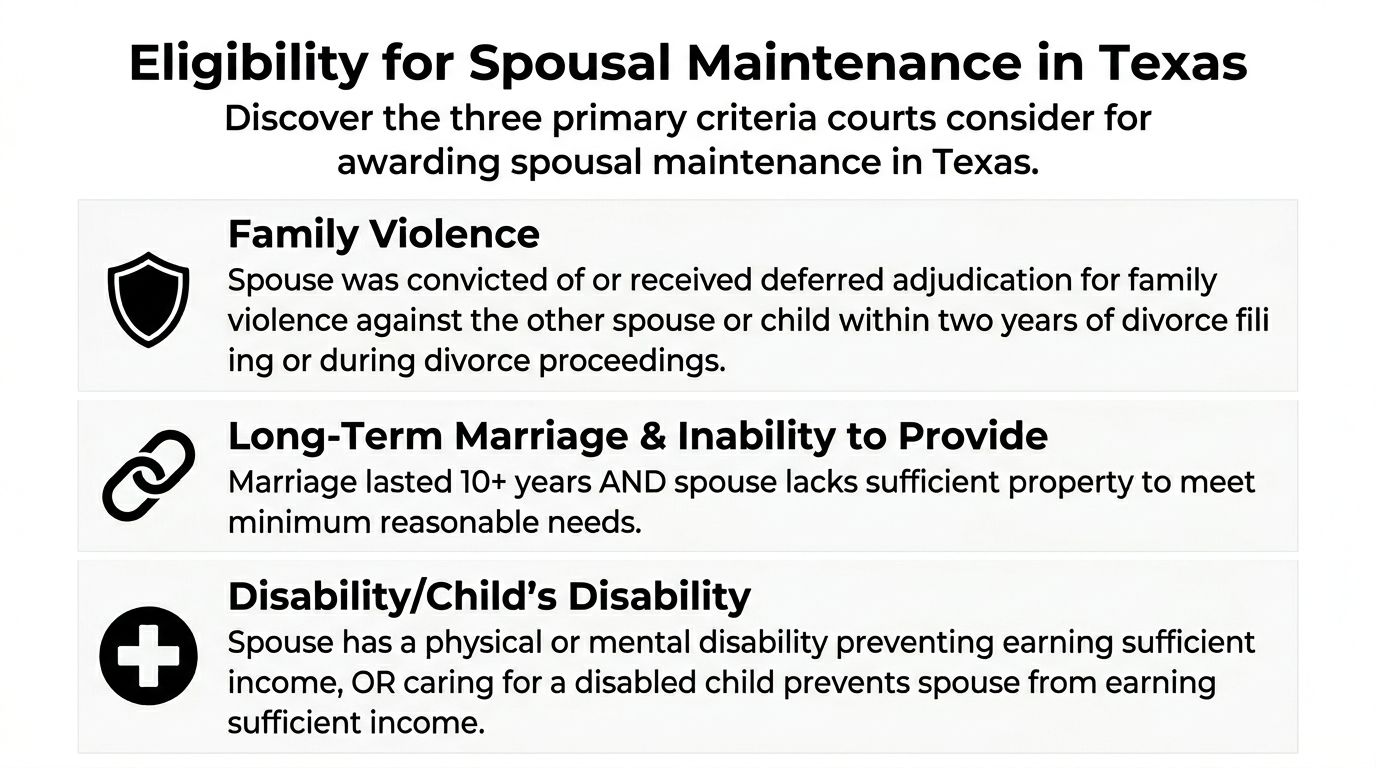
Usually, no. Texas does allow spousal maintenance in limited situations, but the law treats it as a short runway toward stability, not an open-ended promise. Before the court ever decides amount or duration, the first question is whether you fit into one of the legal paths to eligibility.
If you want a fuller explanation of the legal test, this guide on how to qualify for spousal support in Texas is a helpful companion.
Path one. Long marriage plus inability to meet minimum reasonable needs
This is the path people hear about most often.
If the marriage lasted at least 10 years, a court may consider maintenance if the spouse asking for support cannot meet minimum reasonable needs after the divorce. That phrase is narrower than many people expect. It usually refers to core monthly living expenses such as housing, food, utilities, transportation, medical care, and insurance.
The court is not trying to recreate the marital lifestyle forever. It is asking a more basic question. After the property is divided, can this person cover ordinary necessities while getting back on their feet?
That distinction matters in negotiation. A request tied to a realistic budget, a work history gap, and a concrete retraining plan is often stronger than a request framed around keeping the same lifestyle as before divorce. In Texas, the stronger strategy is to show why temporary support creates a workable transition.
Path two. Family violence can remove the 10 year hurdle
Family violence changes the eligibility analysis.
Under the Texas Family Code, a spouse may qualify for maintenance without meeting the usual 10 year marriage threshold if the other spouse was convicted of family violence or received deferred adjudication for family violence against the spouse or the couple’s child within the required time period tied to the divorce case. You can review the statutory framework in Texas Family Code Chapter 8 on spousal maintenance.
This rule reflects a practical reality. Abuse can interrupt employment, cut off access to money, and make safe housing and planning much harder. A person leaving an abusive marriage may need support because the path to independence was disrupted, not because the law is promising long-term financial dependence.
If family violence is part of your case, gather proof early. Criminal records, deferred adjudication paperwork, police reports, protective order records, and evidence showing how the abuse affected your work or housing can all matter.
Path three. Disability of the spouse or a child
This path often gets overlooked, but it is one of the clearest examples of how Texas treats maintenance as a response to real barriers to self-support.
A spouse may qualify if a physical or mental disability prevents that spouse from earning enough to meet minimum reasonable needs. A spouse may also qualify if caring for a disabled child of the marriage keeps that spouse from earning sufficient income outside the home.
These cases usually turn on specifics. General statements such as “I cannot work much” rarely carry enough weight by themselves. Medical records, physician opinions, treatment history, school or care plans for the child, and testimony about daily care demands help the court connect the legal standard to real life.
What “minimum reasonable needs” actually means
This is the phrase that causes the most confusion.
Courts usually examine whether the requesting spouse can cover basic living expenses after considering income, available property, and realistic earning ability. In other words, the judge is looking at the gap between what you reasonably need each month and what you can produce on your own after divorce.
That is why maintenance cases are often won or lost on details. A clean monthly budget, recent pay information, evidence of job searches, and proof of barriers to employment give the court something concrete to work with.
For higher asset cases, the analysis can get more strategic. A spouse may have valuable property on paper but very little cash flow. Another spouse may have business income that rises and falls. In that setting, maintenance is often negotiated as one part of a broader transition plan, with property division and short-term support working together to create a predictable path forward for both sides.
The key is to present eligibility as a practical need for temporary stability. Texas courts respond better to a clear plan for independence than to a vague request for indefinite support.
Calculating Maintenance Amounts and Duration
A common turning point in a Texas divorce comes when someone asks, “Am I going to be paying this forever?” In Texas, court-ordered maintenance is usually built as a short runway, not a lifetime pension. That framing matters, because it changes how you prepare, negotiate, and set expectations from the start.
Texas law puts a firm ceiling on monthly maintenance. The court cannot order more than the lesser of $5,000 per month or 20% of the paying spouse’s average monthly gross income. If you want a practical explanation of the formula, this guide on how much alimony is paid in Texas breaks down the cap in plain language.
The cap sets the outer boundary
The cap is only the top edge of the range. It does not mean the court will award that amount.
Judges usually start with a more practical question. What amount, if any, helps the receiving spouse meet minimum reasonable needs while working toward independence? That is why maintenance often works less like a permanent entitlement and more like temporary scaffolding. It supports someone while they rebuild earning power, finish training, adjust housing, or stabilize after a long marriage.
Courts can weigh many facts when setting the amount, including earning ability, property received in the divorce, employment history, education, age, health, and whether the paying spouse can still cover personal living expenses after making support payments.
A simple example
Suppose the paying spouse earns $15,000 gross per month. Twenty percent of that figure is $3,000, so the legal cap would be $3,000, not $5,000, under the statutory limit summarized in this guide on Texas spousal maintenance calculations.
But that still does not answer what the court will order.
If the spouse requesting maintenance can cover part of basic expenses through current work, near-term employment, or income-producing property received in the divorce, the number may be lower. In practice, the primary dispute is often about the gap. What does this person reasonably need each month, and what can they realistically produce on their own within a defined period?
Duration usually follows a strict timeline
Texas also limits how long maintenance can last in many cases. Those limits are one of the clearest signs that the law is trying to create a predictable transition period rather than open-ended support.
| Length of Marriage | Maximum Duration of Maintenance |
|---|---|
| 10 to 20 years | 5 years |
| 20 to 30 years | 7 years |
| 30 years or more | 10 years |
As noted earlier, disability-based cases can be treated differently, and support may continue longer if the legal standard remains met.
The word that matters most in the table is maximum. Courts are generally directed to order maintenance for the shortest reasonable period that allows the receiving spouse to earn enough to meet minimum reasonable needs, unless a serious obstacle changes that timeline. Examples include a disabling condition or ongoing care duties for a disabled child.
That is the strategic point many spouses miss. The duration rules can help both sides settle. A spouse requesting support can present a concrete plan tied to retraining, housing, or reentry into the workforce. A spouse opposing a larger award can argue for a shorter, targeted period because the law already favors transition over permanence.
The facts that push the result up or down
Two couples can have similar incomes and still receive very different maintenance outcomes because the court looks at daily reality, not just the headline numbers.
A judge may focus on:
- Recent work history: A spouse who left the workforce last year is different from someone who has been out of it for fifteen years.
- Training needs: A short certificate program may support a shorter award than a full return to school.
- Health limitations: Medical restrictions can affect both earning capacity and the time needed to become self-supporting.
- Property division: A larger share of liquid or income-producing assets may reduce the need for maintenance.
- Fault and surrounding circumstances: The court can consider the broader facts of the marriage as part of the analysis.
Why contested cases often turn into proof battles
Once amount and duration are in dispute, the case often becomes less about emotion and more about evidence.
A vocational expert may prepare an employability report showing what jobs are realistically available, what they pay, and how long it should take the requesting spouse to qualify for them. That kind of evidence can be especially important in long marriages, professional households, and cases where one spouse says work is not realistic while the other says work is available right now.
Business-owner cases add another layer. Tax returns may show income one way, cash flow may look different month to month, and bonuses, commissions, or deductions can blur the picture. In those cases, organized financial records and a realistic transition plan often carry more weight than broad arguments about fairness.
The strongest maintenance request usually has two parts. A credible monthly budget and a specific path to self-sufficiency.
The strongest defense usually uses the same framework. It tests whether the budget is reasonable, whether assets offset the need, and whether the runway being requested is longer or wider than Texas law supports.
The Process for Requesting and Contesting Maintenance
Even a strong legal claim can fall apart if you don’t present it the right way in court.
Texas maintenance issues are usually addressed during the divorce itself. That means your request, or your opposition, has to fit into the larger divorce process that includes filing, service, temporary orders, discovery, negotiation, mediation, and the final decree.

Temporary support during the divorce is different from post-divorce maintenance. Court-ordered post-divorce maintenance is capped at the lesser of $5,000 per month or 20% of average monthly gross income, but temporary spousal support during the case does not have that same statutory cap, as summarized in this explanation of Texas alimony and temporary support.
Step one plead for the relief you want
The divorce starts with filing.
If you want maintenance, that request should be included in the divorce pleadings. If you think your spouse may ask for it and you plan to contest it, your response should be built with that possibility in mind from the start.
This early stage matters because it shapes what evidence you gather later.
Step two deal with immediate stability
Many families can’t wait until the final decree to address bills.
Temporary orders may address who stays in the house, who pays what, how children are cared for, and whether temporary support is needed while the case is pending. These early rulings often influence settlement discussions because they show the court what financial arrangement is workable in the short term.
For parents, temporary orders can also affect custody schedules and child support. Those issues often influence whether one spouse can return to work quickly or needs a more gradual transition.
Step three exchange financial evidence
Here, maintenance cases are won or lost.
During discovery, parties usually gather and exchange documents such as pay records, tax returns, bank statements, retirement information, debt records, and business records if a company is involved. The spouse requesting maintenance may also need to produce a detailed monthly budget, job history, medical records, or evidence related to caregiving duties.
If you’re contesting maintenance, discovery is your chance to test the other side’s claims.
- Look at income sources: Salary is only part of the picture in some cases.
- Check property and liquidity: Assets awarded in the divorce may affect need.
- Evaluate work capacity: Education, prior employment, and transferable skills all matter.
- Review spending habits: Courts focus on basics, not unlimited discretionary expenses.
Step four use mediation strategically
Many Texas divorces settle in mediation rather than at a full trial.
That can be especially useful in maintenance disputes because mediation gives both sides room to trade terms. One spouse may agree to a different property split in exchange for lower monthly maintenance. In another case, the parties may structure support by agreement to reduce conflict and create predictability.
Mediation is often where the “runway” idea becomes practical. Instead of fighting over labels, the parties can negotiate how long support should last, what amount makes sense, and how it fits with the rest of the divorce settlement.
Step five present the issue to the judge if needed
If settlement doesn’t happen, the judge decides.
At a final hearing or trial, the court reviews testimony, documents, budgets, and any expert evidence. The judge then decides whether maintenance is appropriate and, if so, what form it should take under Texas law.
For business owners, professionals, military families, and spouses with high-value estates, the hearing can involve more than simple paycheck math. Valuation issues, retirement benefits, cash flow, and separate-versus-community property questions can all affect the maintenance analysis.
How to Modify or Terminate a Spousal Maintenance Order
The divorce decree ends the marriage, but it doesn’t freeze life in place.
Jobs change. Health changes. Living arrangements change. Texas law recognizes that by allowing some maintenance orders to be modified after divorce when the legal standard is met.
Texas Family Code §8.057 allows modification when there has been a material and substantial change in circumstances, and §8.056 provides for automatic termination if the recipient remarries or cohabits with a romantic partner in a continuing dating relationship, as discussed in this overview of permanent alimony versus spousal maintenance in Texas.
Modification is possible but not automatic
A judge won’t change maintenance just because one side is unhappy with the original order.
The court usually wants proof that something meaningful changed after the order was signed. Depending on the facts, that might include an involuntary income drop for the paying spouse or a major improvement in the receiving spouse’s financial position.
The important point is practical. Until the court changes the order, the existing order still controls.
Termination events to watch closely
Some events can end maintenance without needing the same kind of discretionary re-evaluation.
The most common examples include:
- Remarriage of the recipient: Maintenance ends under the statute.
- Cohabitation: If the recipient is living with a romantic partner on a continuing basis in a dating relationship, maintenance can terminate.
- Death: Orders also end upon death under the general structure of support obligations.
Cohabitation is one of the most heavily disputed issues after divorce because people often disagree about what the living arrangement really is. Shared residence, shared finances, and the nature of the relationship can all become important evidence.
If you suspect cohabitation, don’t stop paying on your own. Gather proof and seek a court order.
Practical post-divorce habits that help
Post-decree maintenance disputes often turn on recordkeeping.
Keep copies of payment records, bank statements, messages about living arrangements when relevant, and any documentation of changed income or employment. If you’re the recipient and your circumstances worsen, prompt legal advice matters. If you’re the payer and you believe termination or reduction is justified, early action can help you avoid a bigger arrearage or evidentiary problem later.
For military members, business owners, and professionals with changing income, it’s especially important to document whether changes are voluntary or involuntary. Courts often care about that distinction when reviewing modification requests.
What to Do Next A Clear Path Forward
The biggest shift in mindset is this. Texas does not usually treat support after divorce as a lifetime obligation. It treats it as a transitional runway.
That’s not a small detail. It changes how you should prepare your case. If you need support, your goal is to show why a specific period of support is necessary to reach stability. If you may pay support, your goal is to show what is fair, what is temporary, and what evidence supports a shorter or lower award.
Focus on facts you can control
When emotions are high, people often spend too much energy arguing abstract fairness.
A stronger approach is to organize the facts that matter most:
- Your monthly budget: Separate essential expenses from optional spending.
- Your income picture: Include wages, variable income, and available property.
- Your work capacity: Gather resumes, employment history, medical records, or retraining plans.
- Your parenting demands: If you care for children, show how that affects work schedules and earning ability.
- Your settlement priorities: Decide whether monthly support, property division, or mediated terms matter most to your future stability.
Build your divorce strategy as a whole, not in pieces
Spousal maintenance doesn’t exist in a vacuum.
It connects to property division, debt allocation, child custody, child support, temporary orders, and mediation. A spouse who receives a larger share of liquid assets may need less monthly support. A parent with a demanding possession schedule may need time before returning to work full time. A business owner may need careful income analysis before any support number makes sense.
That’s why maintenance strategy should be built into your overall divorce roadmap from the beginning, from filing through final decree.
Key takeaway
If you searched for permanent spousal maintenance texas, the most important answer is simple. Texas usually doesn’t offer lifelong alimony. It offers a more limited, evidence-driven form of support designed to help one spouse transition toward independence.
That can still be powerful.
It can protect a spouse who needs time to regain financial footing. It can also protect a paying spouse from open-ended uncertainty. The law’s limits, when understood early, often create better negotiations and better planning for both sides.
What to do next
Start with three practical tasks:
- Make a clean monthly budget based on basic living expenses.
- Gather documents such as pay records, tax returns, account statements, and any records tied to health or caregiving limits.
- Get legal guidance early so your maintenance position fits the larger divorce strategy, including mediation, property division, custody, support, and enforcement issues.
You don’t have to guess your way through this. The right legal plan can turn fear into structure and structure into options.
If you’re facing divorce and need clear answers about spousal maintenance, custody, property division, mediation, or enforcement, the Law Office of Bryan Fagan, PLLC offers free consultations to help you understand your rights and build a practical path forward. Whether your case involves children, a family business, military issues, or a high-asset estate, you can speak with a Texas family law team that approaches your future with empathy, strategy, and confidence.