Skip to content
When your spouse won’t hand over basic financial information, divorce can feel less like a legal process and more like trying to solve a puzzle with missing pieces. You know there are records somewhere. Bank statements. Pay information. Retirement documents. Maybe business records. But your requests are ignored, delayed, or answered with half-truths.
That’s where a subpoena in divorce texas becomes important.
A subpoena is one of the court’s formal tools for getting information when voluntary cooperation has broken down. If your spouse won’t produce records, or if the information sits with a bank, employer, accountant, school, or another third party, a subpoena can force the issue in a lawful way. It gives structure to a problem that otherwise feels personal, chaotic, and unfair.
Divorce in Texas often involves several moving parts at once. You may be dealing with the divorce itself under the Texas Family Code, questions about conservatorship and possession if you have children, temporary orders, mediation, and eventually a final decree that divides property and debt. If your case includes community property, separate property claims, a business, bonuses, commissions, or hidden accounts, getting accurate records matters. You can’t negotiate fairly if you don’t know what exists.
The good news is that you are not powerless. Texas procedure gives you a path to demand documents and testimony through formal discovery. A subpoena is part of that process. Used carefully, it can protect your finances, your parenting case, and your future.
Introduction When Your Spouse Will Not Cooperate
Some divorce cases turn difficult the moment financial disclosure starts. Your spouse says there’s nothing else to produce. Then you notice transfers you can’t explain, a missing account, or pay that doesn’t match what you’ve been told. That kind of uncertainty creates real fear, especially when your home, retirement, and children’s stability are on the line.
In Texas, property division in divorce is tied to what the court finds to be just and right. That requires facts. If one spouse controls the records, the other spouse can end up negotiating in the dark unless formal discovery is used. Written questions and document requests often come first. But when those tools don’t get the job done, a subpoena may be the next step.
A subpoena is a court-backed order directing a person or business to provide testimony, documents, or both. In plain English, it turns “please send this” into “the law requires you to respond.” That change matters.
Why cooperation breaks down
People withhold information for different reasons:
- Control: Some spouses use delay to gain an advantage.
- Embarrassment: Spending, debt, affairs, or financial mistakes may be hidden.
- Fear: A business owner may worry records will be misunderstood.
- Strategy: Sometimes a spouse thinks incomplete disclosure will lead to a better settlement.
Whatever the reason, the effect on you is the same. You can’t make sound decisions without reliable information.
Practical rule: If a record is important to property division, support, or custody, don’t assume you’ll receive it just because you asked nicely.
Where a subpoena fits in your divorce
A Texas divorce usually moves through filing, service, temporary orders when needed, discovery, negotiation or mediation, and then trial or final orders if settlement fails. A subpoena sits inside the discovery stage. It’s not the first tool in every case, but it is often the tool that gets answers when ordinary requests stall out.
That matters for parents and business owners alike. Child support issues may require accurate income records. A custody dispute may involve school or medical records, handled carefully and within privacy rules. A high-asset divorce may call for detailed financial tracing.
When the facts matter, subpoenas matter.
What Is a Subpoena in a Texas Divorce
A subpoena is best understood as a formal command tied to a court case. It isn’t a nasty letter. It isn’t a bluff. It is a legal document that requires someone to act.

If you want a simple analogy, think of a subpoena as a key that opens a file cabinet you can’t open on your own. You may suspect the records are there, but you don’t have direct access. The subpoena gives the court’s authority to the request.
It is more than a request
In many divorces, lawyers first exchange information through informal discussion or standard discovery. That works when both sides act in good faith. It fails when records are hidden, delayed, or controlled by a third party.
A subpoena carries legal consequences because it comes through court procedure. That’s why banks, employers, and custodians of records take it seriously. It’s also why technical mistakes can create problems. Precision matters.
You can learn more about how subpoenas fit into the larger discovery process in this guide to divorce discovery in Texas.
Who receives subpoenas in divorce cases
Many people think subpoenas are only used against a spouse. Often, that’s not the main use at all. In divorce litigation, subpoenas are commonly directed to non-parties, meaning people or businesses that are not the husband or wife but hold relevant information.
Examples include:
- Banks and credit unions: account statements, signature cards, loan files
- Employers: payroll records, bonuses, benefits, retirement information
- Accountants: tax support documents, business records
- Business partners or bookkeepers: profit and loss records, ledgers
- Schools or medical providers: records relevant to child-related disputes, when legally appropriate
A subpoena is often the bridge between suspicion and proof.
Why this tool matters so much
A Texas divorce asks the court to make decisions that can affect your finances and family for years. Those decisions may involve community property, reimbursement claims, debt allocation, conservatorship, possession schedules, child support, or spousal maintenance. Facts drive outcomes.
If one side controls the paperwork, the other side starts at a disadvantage. A subpoena helps restore balance. It can uncover missing documents, confirm income, trace funds, and test whether a story holds up when matched against real records.
Used well, it doesn’t just collect paper. It changes the quality of the case.
The Different Types of Subpoenas You Might Use
Not all subpoenas do the same job. Some force a person to talk under oath. Others force production of documents. In a divorce, choosing the right one depends on what you need and who has it.
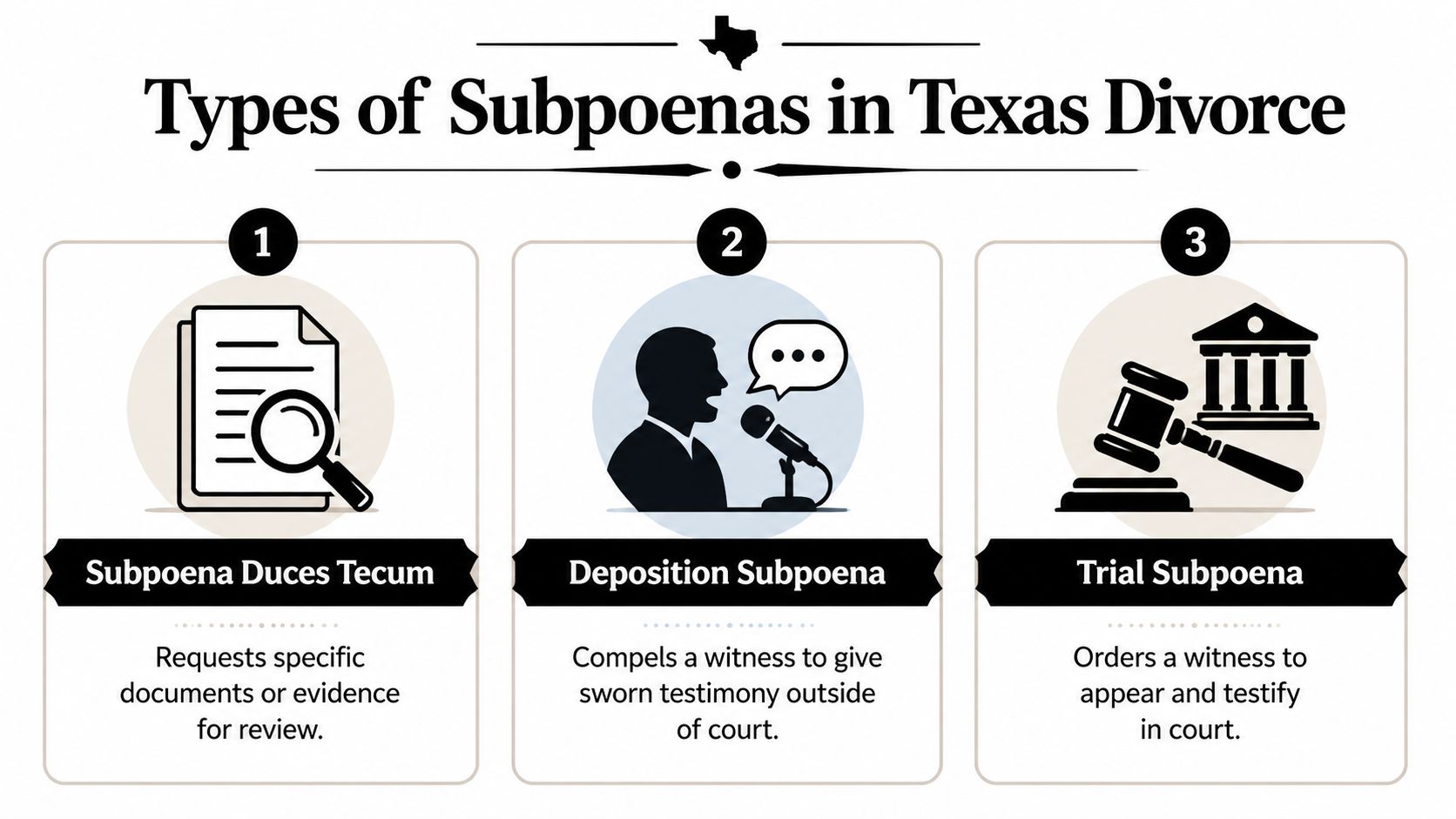
The three main forms
The most common categories are easy to separate if you focus on one question. What are you trying to make happen? Documents, testimony outside court, or testimony in court.
| Types of Subpoenas in Texas Divorce | ||
|---|---|---|
| Subpoena Type | What It Commands | Common Use in Divorce |
| Subpoena Duces Tecum | Production of specific documents or items | Bank records, payroll records, business records, account statements |
| Deposition Subpoena | Appearance to give sworn testimony outside court | Questioning a witness, accountant, employer representative, or records custodian |
| Trial Subpoena | Appearance to testify in court | Calling a witness for trial on disputed issues |
Subpoena duces tecum
This is the workhorse in many contested divorce cases. “Duces tecum” means the subpoena orders someone to bring documents or tangible evidence.
If you believe your spouse has an undisclosed account, this is often the tool used to obtain records directly from the bank. If your spouse is paid through salary plus bonus, stock options, or deferred compensation, this type of subpoena can target the employer’s records. If one spouse owns a business, it may be used to request bookkeeping records, contracts, tax support files, or internal financial statements.
This type is especially important in modern asset tracing. Hidden value doesn’t always sit in a checking account. It may move through apps, investment platforms, or digital holdings. In some cases, that includes issues tied to cryptocurrency and divorce in Texas.
Deposition subpoena
A deposition subpoena requires someone to appear and answer questions under oath outside the courtroom. Lawyers use this when documents alone aren’t enough.
For example, a records custodian at a company may explain what a payroll code means. An accountant may answer questions about business expenses. A business partner may be asked about ownership interests, distributions, or side agreements that don’t appear clearly on paper.
This tool is useful when the paper trail exists but still leaves room for dispute.
Trial subpoena
A trial subpoena is more direct. It orders a witness to appear in court and testify before the judge.
You might use this when a witness’s live testimony is necessary to explain records, challenge credibility, or support your position on a contested issue. That can matter in property disputes, support disputes, or child-related cases where a witness’s observations are relevant.
Which one fits your case
If you’re trying to decide what kind of subpoena in divorce texas applies to your situation, start with the missing proof:
- Need records from a bank, employer, or accountant. Use a document subpoena.
- Need sworn answers before trial. Consider a deposition subpoena.
- Need live testimony at the hearing or trial. A trial subpoena may be the answer.
Many cases use more than one. A lawyer’s job is to keep the request focused enough to survive challenge, while broad enough to capture the records that matter.
How Subpoenas Are Issued and Served in Texas
Many people get tripped up on this point. A subpoena isn’t enforceable just because it asks for reasonable information. In Texas, the document has to meet technical requirements, and it must be served properly.

The rule that controls
In Texas divorce proceedings, subpoenas are governed by Texas Rules of Civil Procedure Rule 176. A valid subpoena must include required details such as the court name, cause number, and the exact warning language from Rule 176.8(a). If that warning text is missing, the subpoena can be invalid. Attorneys and court clerks may issue subpoenas, and proper service is required for enforcement, as described in this discussion of Texas divorce subpoenas and Rule 176.
That sounds technical because it is technical. Small mistakes can cause major delays.
What has to be in the subpoena
A valid subpoena under Rule 176 must contain specific information. In plain terms, it needs to clearly identify the case, the court, the person or entity receiving it, and exactly what that person must do.
Common required elements include:
- Case identification: the style of the suit and cause number
- Court information: the name of the court
- Issue details: the date of issuance
- Recipient details: who must comply
- Clear instructions: the time, place, and action required
- Issuer information: the issuing attorney or authorized person’s details
- Warning language: the exact contempt warning required by Rule 176.8(a)
- Signature: the issuer’s signature
If any part of that is missing or sloppy, the receiving party may object, refuse compliance, or ask the court to quash it.
Who can issue the subpoena
Texas allows subpoenas to be issued by certain authorized people. That often includes a lawyer acting as an officer of the court, a district or county clerk, or in some settings a deposition officer under the rules tied to depositions and third-party discovery.
That doesn’t mean anyone should prepare one casually. The authority to issue a subpoena is not the same thing as freedom to draft one carelessly.
Important point: An aggressive subpoena that is poorly drafted is often less effective than a narrower one that strictly follows the rules.
How service works
Service means proper delivery. The receiving person or business has to be served in a manner recognized by the rules. The verified information available here notes that service methods can include hand-delivery with fees, certified mail, or email, depending on the circumstances and the applicable procedure.
The practical lesson is simple. Delivery matters as much as drafting. If service is defective, enforcement becomes harder.
Costs and practical planning
Subpoenas aren’t free. You may need to pay for service, witness fees, document retrieval, attorney time, and in some cases deposition-related expenses. That’s one reason lawyers often focus the request tightly. The goal isn’t to request everything possible. It’s to request what is most likely to matter.
A short explanation may help if you’re seeing this process for the first time:
A simple step-by-step view
- Identify the missing proof. Decide what records or testimony you need and why.
- Match the target to the issue. Bank for account history, employer for income records, accountant for business support files.
- Draft carefully. The request should be specific enough to be enforceable.
- Issue through proper authority. Use an attorney, clerk, or other authorized issuer.
- Serve correctly. Follow Texas procedure and include any required fees.
- Track the response. Review what arrives and decide whether follow-up is needed.
For many clients, this is the point where representation becomes especially valuable. Good subpoena practice is part law, part procedure, and part strategy.
Common Uses for Subpoenas in Your Divorce Case
A subpoena is easier to understand when you see what it does in real life. Individuals typically don’t need a lecture on legal vocabulary. They need to know whether this tool can help uncover the truth in their own divorce.

Employment and compensation records
One common use is subpoenaing an employer. This matters when a spouse’s income is disputed or when compensation isn’t limited to a simple salary.
An employer may hold:
- Payroll records: wage history, overtime, bonuses, commissions
- Benefits information: retirement plans, insurance, stock-related compensation
- Employment contracts: terms that explain future compensation or severance
- Attendance or leave records: occasionally relevant in support or custody disputes
That information may affect child support, spousal maintenance arguments, and property division discussions.
Bank and credit records
Another frequent use is obtaining bank or credit card records from financial institutions. These records can show where money went, whether an account exists, and whether spending patterns contradict what your spouse claims.
A subpoena may help you trace:
- Separate property claims: whether funds remained separate or were mixed
- Transfers between accounts: including unexplained movement of money
- Large withdrawals or unusual purchases: relevant to waste or concealment
- Debt patterns: which can matter in dividing marital liabilities
If you suspect money is being hidden, these records are often central. For a deeper look at warning signs, see this discussion of hidden assets in Texas divorce cases.
Business records in owner-operated companies
Business ownership complicates divorce quickly. A spouse may draw a modest paycheck while receiving personal benefits through the company, retaining earnings inside the business, or using business accounts in ways that blur personal and company finances.
In that setting, subpoenas may target:
| Record holder | What you may seek | Why it matters |
|---|---|---|
| Bookkeeper or accountant | ledgers, financial statements, support schedules | business valuation and cash flow |
| Business partner | ownership agreements, distribution details | who owns what and how value flows |
| Vendor or client records | contracts or payment confirmations | checking whether reported revenue appears complete |
Records tied to parenting issues
Subpoenas are not only about money. In custody disputes, records from schools, counselors, medical providers, or other institutions may become relevant. Texas courts focus on the child’s best interest, and evidence may be used to address attendance, medical care, or other parenting concerns.
These requests have to be handled with care. Privacy rules matter. Relevance matters. Judges do not look kindly on fishing expeditions into sensitive child-related records.
Use the subpoena like a flashlight, not a net. Focus on facts that actually connect to the issue before the court.
Digital trails and modern evidence
Today, financial life doesn’t live in one filing cabinet. It may sit across online accounts, payment apps, brokerages, cloud-stored statements, and text or email records held by third parties. In the right case, subpoenas can help gather those records lawfully.
That doesn’t mean every suspicion leads to every record. It means a focused subpoena can turn a vague concern into a provable fact.
How to Respond to or Challenge a Subpoena
If you receive a subpoena, your first instinct may be anger or panic. Don’t ignore it. That is usually the worst response.
A subpoena may be valid, partly valid, or defective. Your job is not to guess. Your job is to respond in a way that protects your rights.
Start by reading what it actually demands
Some subpoenas ask for testimony. Others ask for documents. Some request both. Look closely at the deadline, the categories requested, and whether the subpoena is directed to you personally, your employer, your bank, your business, or another custodian of records.
Then ask three basic questions:
- Is this subpoena properly issued and served?
- Is the request relevant to the divorce or custody case?
- Is the request too broad, too expensive, or seeking protected information?
Those questions often shape the response.
Grounds for objection
You may have legal grounds to object if the subpoena goes too far. That can happen when it seeks privileged communications, invades privacy beyond what the case justifies, or imposes an undue burden.
Common concerns include:
- Overbreadth: asking for far more than the dispute requires
- Privilege: such as attorney-client communications
- Privacy and confidentiality: especially with business or medical records
- Undue burden or expense: when compliance is unusually difficult or costly
- Harassment: when the subpoena seems designed to pressure rather than gather relevant proof
An objection does not mean “I refuse.” It means “the court should limit or review this.”
Motion to quash
A Motion to Quash asks the court to cancel or modify the subpoena. This is one of the most important defensive tools in discovery.
For example, if your new partner receives a subpoena demanding broad financial records with no clear connection to the divorce issues, a motion to quash may be appropriate. The same may be true if your business receives a sweeping request that would expose confidential information unrelated to property division.
A judge can deny the challenge, narrow the request, add protections, or quash the subpoena altogether.
If a subpoena is improper, the answer isn’t silence. The answer is a timely legal response.
What if the third party ignores a valid subpoena
This is another area where people get confused. A valid subpoena does not always produce immediate compliance. Banks, employers, and other institutions may delay, object informally, or fail to respond.
When a third party fails to comply, the next practical step is often a Motion to Compel, which asks the judge to order compliance. If the third party still refuses after that, a Motion for Contempt may follow, which can lead to fines or other sanctions, as explained in this article on enforcing Texas divorce subpoenas against third parties.
That escalation matters because it gives you a roadmap:
- First step: confirm the subpoena was valid and properly served
- Next step: seek a court order compelling compliance
- If refusal continues: pursue contempt remedies when appropriate
If your business receives the subpoena
Business owners need to be especially careful. You may have genuine confidentiality concerns, but that doesn’t create a free pass. Often the better route is to negotiate scope, object to overbroad categories, or ask for protective measures rather than refusing outright.
That approach protects both your legal position and your business operations.
The Strategic Decision to Use a Subpoena
A subpoena is a tool, not a reflex. In a Texas divorce, the better question is whether this tool is likely to change the outcome enough to justify the cost, delay, and conflict that can come with using it.
That choice is often strategic, not just procedural.
Weighing cost against likely value
A subpoena can be worth every dollar if it proves a spouse is hiding income, understating business revenue, or leaving out an account that should be part of the community estate. It can be a poor investment if it targets marginal information that does little to affect property division, support, or custody.
The costs are not limited to filing and service. Attorney time adds up. Reviewing records takes time. Depositions can become expensive. A broad request can also create a paper flood. You may end up paying to sort through hundreds of pages that do not answer the one question that matters.
There is a human cost too. Formal discovery often raises the temperature in a case. Sometimes that is necessary. Sometimes it makes settlement harder without producing enough benefit to justify the strain on your family.
A useful way to frame the issue is simple. If the missing evidence could materially shift the result, a subpoena may be money well spent. If it is only likely to confirm something minor, a narrower step may make more sense.
Cases where subpoenas often pay off
Subpoenas tend to have the strongest return when key facts sit in the hands of someone outside the marriage. That often happens in cases involving:
- Business ownership or self-employment
- Compensation that is hard to trace, such as bonuses, commissions, or deferred pay
- Suspected hidden accounts or transfers
- Disputes over whether property is separate or community
- Records controlled by banks, employers, accountants, or business partners
In these situations, third-party records can work like the neutral witness in the room. They often carry more weight than competing stories from spouses who both have something at stake.
A practical framework before you issue one
Before sending a subpoena, stop and answer a few focused questions:
| Question | Why it matters |
|---|---|
| What fact do I need to prove? | A subpoena should target a legal issue, not a general suspicion. |
| Who holds the best version of that proof? | The right source is often a bank, employer, or accountant, not your spouse. |
| How much could this fact affect the outcome? | The larger the impact on money, property, or children, the easier it is to justify the effort. |
| What will it take to get and review the records? | A request that is cheap to send may still be costly to analyze. |
| Is there a lower-cost way to get the same information? | Sometimes a narrow request for production or informal exchange solves the problem first. |
That second question matters more than clients often expect. If you ask the wrong person, you may spend time fighting over records your spouse never had in the first place.
Precision usually beats volume
Some spouses want to subpoena everyone connected to the marriage. That approach often creates noise instead of proof.
A better strategy is to start with the source most likely to have reliable, complete records. Ask for a date range tied to the disputed issue. Limit the categories to what matters. Then review what comes in and decide whether you need a second round.
That method saves money and gives you cleaner evidence. It also puts you in a stronger position during settlement talks because you can point to specific records rather than broad accusations.
What if the third party still does not cooperate
Even a well-chosen subpoena can run into practical problems. A bank may send incomplete statements. An employer may ignore the deadline. An accountant may object informally without filing anything with the court.
At that point, strategy matters again. The first question is whether the missing information is important enough to justify another round of legal work. If the answer is yes, the next steps usually involve tightening the request, documenting the noncompliance, and asking the court to order production. If the answer is no, it may be smarter to use the partial records you have and shift your effort elsewhere.
Cost-benefit analysis takes on real significance. Chasing one missing document can be wise if it proves hidden income. It can be wasteful if it only confirms a side issue that will not change the judge's ruling.
Legal judgment matters here
A seasoned Texas family lawyer does more than draft the subpoena. Counsel should help decide whether the request is worth making, where it should go, how narrow it should be, and how hard to push if the recipient resists.
The Law Office of Bryan Fagan, PLLC handles discovery and subpoena issues as part of Texas family law representation, including divorce, custody, and property disputes. Whether you work with that firm or another Texas family lawyer, the value comes from careful judgment about what evidence is worth pursuing.
Good subpoena strategy means spending your time and money on proof that can protect your finances, your credibility, and your future.
There are cases where settlement is the better move. If the likely benefit is small, the burden is high, and the issue will not meaningfully affect the result, it may be wiser to resolve that point and focus on the disputes that matter most.
Key Takeaways Your Path Forward in a Texas Divorce
If your spouse won’t cooperate, you still have options. A subpoena in divorce texas is one of the most useful tools for getting records and testimony when voluntary disclosure fails. It can help you uncover bank records, employment information, business documents, and other evidence that affects property division, support, and sometimes custody issues.
The process, though, is not casual. Texas subpoenas must be drafted correctly, issued by someone with authority, and served properly. If they are too broad, defective, or aimed at the wrong target, they can be challenged. If a valid subpoena is ignored, enforcement may require court action.
The strategic part matters just as much as the legal part. A subpoena can protect you from settling based on incomplete facts. It can also cost time and money. That’s why the right question is not just whether a subpoena is available. It’s whether it makes sense in your case.
What to do next
- Gather what you already have: account statements, tax returns, emails, payroll records, screenshots, and timelines.
- Make a list of what is missing: be specific about documents, dates, and institutions.
- Tie each missing item to a legal issue: property division, child support, spousal maintenance, or custody.
- Get legal advice early: especially if the case involves a business, hidden assets, separate property tracing, or resistant third parties.
You don’t need to walk into this blind. The more clearly you understand the records that matter, the stronger your position becomes in negotiation, mediation, or court.
If you’re dealing with a spouse who won’t provide honest financial information, or you’ve received a subpoena and need to protect yourself, schedule a free consultation with Law Office of Bryan Fagan, PLLC. You can talk through your situation confidentially, understand your options under Texas law, and build a strategy to protect your family, your property, and your future.