Skip to content
When your spouse refuses to sign, it can feel like your life is on hold and they control the next move.
They don't.
In Texas, you can still move forward with a divorce even if your spouse ignores the papers, refuses to cooperate, or won't sign the final decree. The process has rules, deadlines, and proof requirements, but it exists for exactly this situation. If you're searching for divorce without spouse signature texas, the main issue usually isn't whether the divorce can happen. It's how to get it done correctly while protecting your children, your property, and your interests.
A silent spouse creates risk in two directions. First, you can lose time if service isn't handled the right way. Second, you can lose ground if you treat a default divorce like a shortcut and submit weak paperwork on property, debt, custody, or support. Courts can grant a divorce without your spouse's participation, but judges still expect a lawful and fair final order.
Can You Get a Divorce in Texas if Your Spouse Won't Sign?
Yes. Texas law allows one spouse to file for divorce without the other spouse's consent.
That answer matters because many people come in feeling trapped by a simple sentence from the other side: “I’m not signing anything.” In practice, that refusal often changes the path, not the outcome. Your spouse can slow things down, force you to follow formal notice rules, and create more work. They usually can't stop the divorce itself.
The common understanding of divorce without a spouse signature in Texas is a default divorce. That happens when one spouse files, properly serves the other spouse, and the served spouse doesn't file an answer by the legal deadline. After that, the court can move forward based on the filing spouse's evidence.
A refusal to sign can show up in different ways:
- They won't sign a waiver so you have to use formal service
- They were served but never answered
- They won't sign the Final Decree of Divorce
- They respond just enough to delay, but not enough to resolve anything
Each situation requires a different tactical response. The common thread is that you need clean procedure. If you skip steps because your spouse is being difficult, you create an opening for delay later.
Practical rule: Your spouse's signature and your spouse's notice are not the same thing. Texas may not require their agreement, but it does require proper legal notice.
If your spouse is refusing to cooperate, focus on what the court needs from you. File the case correctly. Serve them correctly. Track deadlines. Prepare a decree the judge can sign. That's the route that gets people unstuck.
If you want a closer look at your rights when a spouse refuses to cooperate, review this discussion of what happens if your husband won't sign the divorce papers.
Understanding Your Legal Right to Divorce in Texas
One spouse wants to get the case over with. The other refuses to sign anything, ignores calls, and treats delay like a strategy. Texas law does not give that spouse veto power over the divorce.
The legal basis is Texas Family Code § 6.001, which allows divorce on the ground of insupportability. In practical terms, the marriage has become unworkable because of conflict or discord, and the court does not require mutual agreement before the case can begin. Texas also requires a 60-day waiting period before a divorce can be finalized under Texas Family Code § 6.702(a). If the other spouse still refuses to participate after proper service, the case may proceed toward default, as explained in this overview of Texas divorce without a spouse's signature.
The Meaning of Insupportability
Insupportability is Texas's no-fault divorce ground. You do not need to prove adultery, cruelty, or abandonment to file. You also do not need your spouse's signature as permission to end the marriage.
That point shapes the entire case. A spouse can refuse to cooperate, refuse to sign a waiver of service in a Texas divorce, or refuse to discuss settlement. None of that prevents the court from hearing the case if the filing spouse follows the rules.
The primary question is not whether your spouse agrees. Instead, the question is whether you can present a clean, legally sufficient case with orders the judge can sign and enforce. For clients with children, a house, retirement accounts, or a spouse who controls the finances, that is where strategy starts to matter. Delay can affect possession schedules, access to records, debt accumulation, and the condition of marital assets.
Uncontested divorce and default divorce are different cases
People often use "uncontested" to describe any divorce without a courtroom fight. In Texas practice, that can blur an important distinction.
An agreed divorce means both spouses participate and agree on the final terms. A default divorce means one spouse filed, the other spouse received proper notice, and then failed to answer or appear. The distinction is important because the preparation is different.
In an agreed case, both sides usually help draft the final decree and correct missing details. In a default case, that safety net is gone. The filing spouse has to present a decree that deals with property, debts, and if needed, conservatorship, possession, support, and medical support in a form the court can approve. If the paperwork is vague or asks for relief the pleadings do not support, the judge can refuse to sign it.
A default divorce can move the case forward, but it does not excuse weak drafting or thin proof.
Residency rules you must meet before filing
Before filing, confirm that Texas and the correct county are the proper venue for the case.
Under Texas Family Code § 6.301, one spouse must have lived in Texas for the required state residency period, and the case should be filed in the county where either spouse has resided for 90 days. Filing in the correct county prevents avoidable delays.
That check is not just procedural. It affects speed, cost, and how quickly you can get enforceable orders in place. If your spouse has moved repeatedly, is in the military, is out of state, or is trying to stay hard to locate, filing decisions require more technical analysis. Those facts can affect venue, service options, and how smoothly later orders can be enforced.
A careful filing strategy does more than get the case on file. It puts you in a better position to protect property, secure workable child-related orders, and avoid giving a noncooperative spouse another opening to slow everything down.
Filing the Petition and Proving Your Spouse Was Notified
Starting the case is straightforward on paper. The hard part is doing it in a way that holds up later.
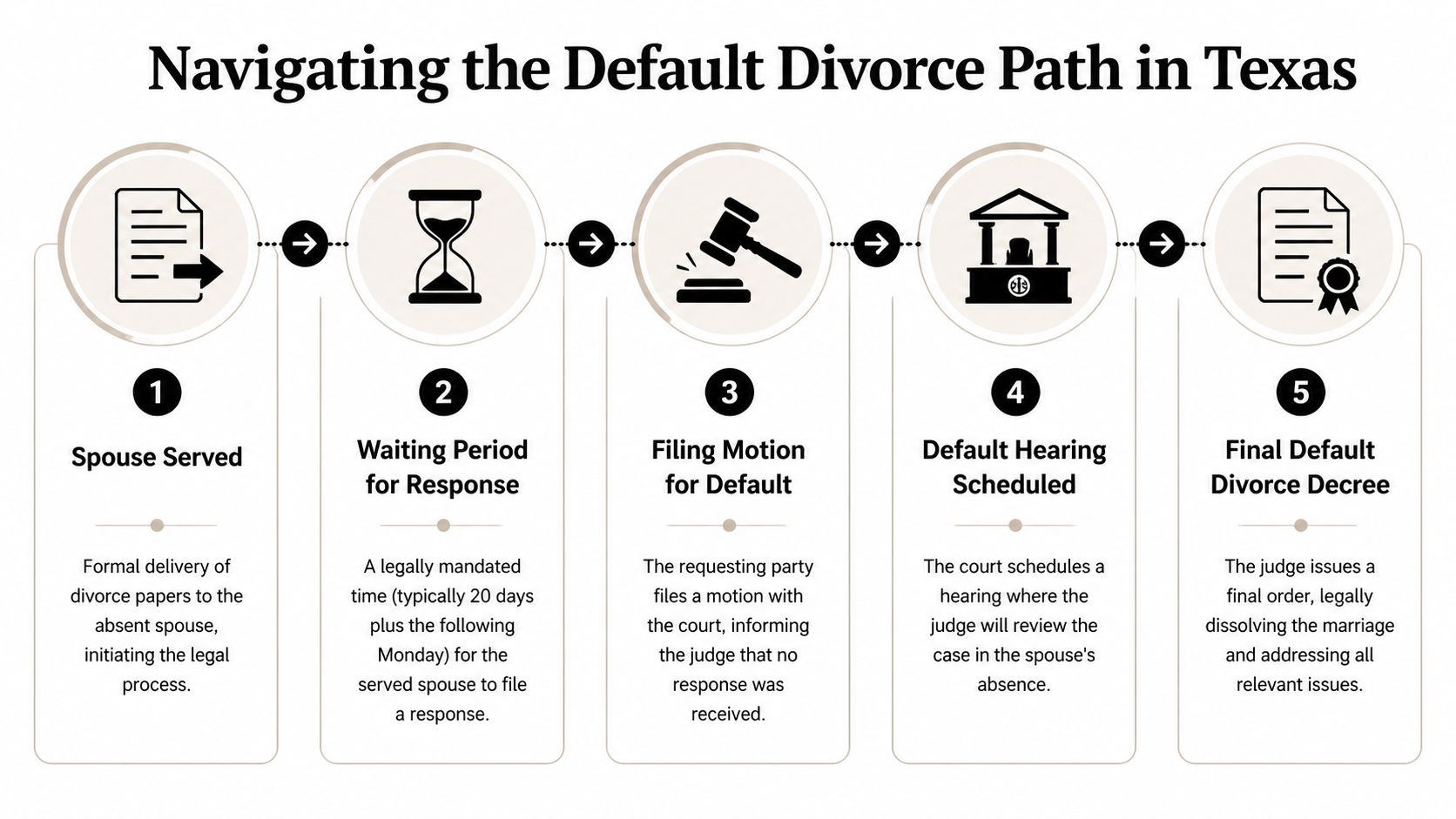
The basic sequence is this: file the Original Petition for Divorce, have the clerk issue a citation, serve your spouse, and wait for the answer deadline to pass. The deadline is 20 days from service, plus until the next Monday. If your spouse doesn't respond, you can move toward default after the required waiting period, as described in this step-by-step review of the Texas default divorce timeline.
Start with a petition that matches the real case
A rushed petition creates expensive cleanup later. Your filing should identify the court, the parties, whether children are involved, and the relief you're asking the court to grant. If there is a house, retirement account, business interest, reimbursement claim, or separate property issue, the petition should leave room for the orders you may need later.
If you expect your spouse to avoid participation, draft with finality in mind. That means thinking ahead about:
- Property descriptions that are specific enough to place into a decree
- Debt allocation that reflects the actual accounts and obligations
- Child-related requests that are detailed enough for a judge to review
- Name change requests if applicable
- Requests for temporary orders if the situation is unstable
The clerk will issue a citation after filing. That document matters because it is part of formal notice. Without proper issuance and proper service, a default can fall apart.
Service is where many default cases succeed or fail
A spouse doesn't have to cooperate, but they do have to be legally notified. Courts take service seriously because default judgments affect important rights.
Some spouses will sign a waiver of service. That doesn't mean they agree to the divorce terms. It only confirms receipt and avoids formal delivery. If that option is realistic, it can simplify the process. For a closer look, review how a waiver of service works in a Texas divorce.
If waiver isn't realistic, formal service usually becomes the next move. The process server, constable, or sheriff must complete service in a legally acceptable way, and proof of service must be filed with the court.
Why this matters: In a default divorce, the court file must show exactly how your spouse received notice. If the file doesn't prove that point, the judge may not sign your decree.
Comparing Methods for Serving Divorce Papers in Texas
| Method | Best For | Typical Cost | Process |
|---|---|---|---|
| Personal service | A spouse whose location is known and who is likely to be found in person | Varies by county and server | A process server, constable, or sheriff personally delivers the citation and petition |
| Waiver of service | A spouse who won't agree to terms but will acknowledge receipt | Usually lower than formal service | The spouse signs a waiver confirming receipt, which is then filed with the court |
| Substituted service | A spouse who is avoiding service after delivery attempts | Varies depending on motion practice and service efforts | You ask the court for permission to use an alternate method after unsuccessful attempts at personal service |
| Service by publication | A spouse who cannot be located after diligent efforts | Varies and often involves added procedural steps | Notice is provided through publication when the court allows it because the spouse cannot be found |
The best method depends on the facts, not frustration. If you know where your spouse works and lives, personal service is often the cleanest route. If your spouse is dodging the server, you may need court approval for another method. If you don't know where they are, you may be dealing with publication issues and a more cautious court review.
Keep your proof organized from the start
Judges often focus on paperwork quality in default settings. Good organization helps.
Use a simple file system and keep:
- The filed petition
- The issued citation
- The return or proof of service
- Any waiver that was signed
- Notes about failed service attempts
- Drafts of the proposed decree and related orders
This is also the point where people often make emotional mistakes. They text a spouse, send screenshots to friends, make side agreements, or assume actual notice is “good enough.” It usually isn't. Formal service rules exist because informal communication can be disputed later.
Navigating the Path to a Default Divorce Decree
Once your spouse has been served and stays silent, the case shifts from delivery to proof. That phase feels quieter, but it's where your preparation matters most.
The waiting period often gives people a false sense that nothing is happening. In reality, this is when you should be assembling the final package the judge will review. A default divorce works best when every requested order is already drafted, supported, and internally consistent.
The timeline from silence to court
Think of the process as a short legal corridor with several locked doors. You only move forward if each one opens in order.
First, your spouse is served. Next, the answer deadline passes without a response. Then the file must be ready for default settings, including your proposed decree and any supporting materials. Finally, you appear for a prove-up hearing and ask the judge to sign the order.
A typical prove-up is brief, but brief doesn't mean casual. The judge may ask who was served, whether the required deadlines have passed, whether the marriage is insupportable, and whether the requested property and child-related terms are appropriate.
If you want a practical walkthrough of that process, this guide on mastering the default divorce process in Texas is a useful companion.
What to prepare before the hearing
In many default cases, the strongest work happens before anyone steps into court.
Prepare a packet that includes:
- A proposed Final Decree of Divorce with complete terms
- Any child support or medical support forms required by the court
- A clear inventory of property and debt
- Supporting testimony or affidavit materials if needed
- A statement of evidence if your court expects one
- Copies of filed service documents in case the judge wants to review them
A common mistake is treating the decree like a template exercise. Judges want specificity. “Each party keeps the property in their possession” may sound simple, but it often creates enforcement problems. Specific descriptions work better.
What the hearing usually feels like
A default prove-up hearing often moves quickly. You are sworn in, answer direct questions, and present the decree for signature. The judge is checking whether the legal boxes are met and whether the orders are fair enough to be signed.
The court doesn't award relief because your spouse disappeared. The court awards relief because you proved your case and submitted orders the law permits.
If children are involved, expect the court to pay closer attention. Judges usually want to know where the children live, what parenting schedule is proposed, who will make decisions, and whether child support terms comply with Texas requirements. If property division is unusual or heavily one-sided, expect questions there too.
What works and what doesn't
Some default cases move smoothly because the filing spouse acts like a trial lawyer in a simple case. They organize exhibits, draft a clean decree, and answer narrow questions directly.
Other cases stall because of avoidable errors:
- Incomplete decrees that leave out retirement language, legal descriptions, or debt details
- Inconsistent pleadings where the petition asks for one thing and the decree says another
- Weak service records that make the judge uneasy
- Overreaching requests that don't look fair on their face
Courts can sign a default. Courts can also refuse to sign and tell you to come back with corrections. If you want finality, the package must be hearing-ready, not just filed.
Dividing Property and Handling Custody in a Default Divorce
A spouse's silence does not give you a blank check. In a default divorce, the court still expects orders that are fair, specific, and workable. That matters most where people usually have the most to lose: the house, retirement accounts, debt allocation, and the day-to-day structure for their children.
If your spouse refuses to participate, strategy matters more than frustration. The goal is not to ask for everything. The goal is to present a decree the judge can sign and that still protects your finances and your children six months from now, not just on hearing day.

Property division needs detail, not guesswork
Texas courts divide community property in a manner the court considers just and right. In a default case, that usually means the judge is relying almost entirely on what you put in front of the court. If the paperwork is thin, vague, or slanted too far without support, the court may hesitate to sign it.
Start with a usable inventory. Identify the home, vehicles, bank accounts, retirement accounts, credit cards, tax debt, and major personal property. If a business is involved, include the ownership interest, business accounts, equipment, receivables, and any records that help explain whether part of the value is community or separate property.
A decree is easier to enforce when it does these things well:
- Names each asset clearly so there is no confusion about what goes to whom
- Assigns debts in a realistic way based on the account, the balance, and who is expected to pay it
- Separates community and separate property carefully with documents to support the claim when available
- Includes transfer language that can be used for titles, accounts, possession dates, and turnover of property
Judges are usually more comfortable signing a default decree that looks measured and documented than one that appears driven by punishment.
Details matter here. A house may require the full legal description. A retirement account often needs more than a sentence in the decree if division will happen later through a separate order. A business that existed before marriage may still have community value if it grew during the marriage because of time, labor, or marital funds. Those are the places where a rushed default can cost a filing spouse more than they expected.
Parents need a complete parenting plan
If children are involved, the court's review gets stricter. A missing or uncooperative parent does not lower the court's duty to protect the child's best interest.
The proposed orders should give the judge a clear picture of how the children will be cared for after the divorce. That includes:
- Who will make major decisions about education, medical care, and other important issues
- Where the children will primarily live
- What possession schedule will apply
- How exchanges will work in practice
- Who will provide health insurance and pay uninsured expenses
- What child support will be paid and how it was calculated
A workable plan usually carries more weight than aggressive language. Courts tend to favor orders that reduce conflict, fit school and activity schedules, and can be followed without constant argument. If your spouse has been absent, unreliable, or unsafe, the order should address that directly with terms the court can enforce.
Mediation can still matter even with a difficult spouse
Some default cases stop being default cases. A spouse may ignore service, then appear once property or parenting terms become serious. Others answer late and resist every practical solution.
Mediation can still be useful in those situations. It may narrow the issues, produce a signed agreement on part of the case, or expose which disputes are worth presenting to the judge. That can save time and reduce the risk of a poorly drafted final order.
Mediation often makes sense when:
- Children are involved and communication is poor
- A house, business, or retirement account needs careful division
- One spouse is using delay as a pressure tactic
- You need a possession schedule that will work in real life, not just on paper
The Law Office of Bryan Fagan, PLLC manages divorce, custody, mediation, and enforcement matters for Texas families, including cases involving uncooperative spouses, complex property issues, and contested parenting disputes.
The primary risk in default cases
The primary risk in default cases is not just delay. It is ending up with orders that are too vague to enforce, too one-sided to survive scrutiny, or too incomplete to protect what matters to you.
That problem shows up in predictable places. Service was shaky. An account was left off the inventory. A separate property claim was never documented. The parenting terms did not match the children's actual routine. In each of those situations, a spouse who ignored the case early may still come back later and challenge part of the process.
Default can be an effective path to final orders. It is not a shortcut around careful lawyering. If your spouse refuses to sign, use that time to build precise property terms, realistic child-related orders, and a record that supports the outcome you are asking the court to approve.
Your Next Steps and Why Expert Guidance Matters
If your spouse won't sign, your job is to shift from emotion to sequence. File correctly. Serve correctly. Draft carefully. Present a fair final plan.
What to do next
Use this short action list to keep the case moving:
- Confirm filing eligibility by checking where the case should be filed and whether your facts support a Texas divorce petition
- Choose the right service method based on whether your spouse will sign a waiver, accept service, avoid service, or can't be located
- Build your final orders early so your property, debt, custody, and support requests are complete before the prove-up
- Collect records now including deeds, account statements, retirement information, business records, and school or medical documents for children
- Stay formal in communication and avoid side agreements that never make it into court orders
When legal help becomes hard to avoid
Some cases stay manageable. Others become risky fast.
You should take professional guidance seriously if your spouse is missing, if service has already failed, if there are retirement accounts or a business to divide, if you suspect hidden assets, or if there is a history of manipulation, family violence, or conflict involving the children. The same is true when military service, interstate issues, or high-value property are involved.
A default divorce can be simple in procedure and still be high-stakes in outcome.
You don't need to stay stuck because your spouse is refusing to cooperate. You do need a plan that protects what matters.
Common Questions About Divorce Without a Spouse's Signature
What if you can't find your spouse?
If you can't locate your spouse, the case may require a different service path. Courts usually expect real effort to locate the other party before allowing more indirect methods. When a spouse cannot be found, service by publication may become part of the process. This is one of the situations where procedural mistakes can create long-term problems, so careful handling matters.
Can your spouse challenge a default divorce later?
Yes, that can happen. The most common issue is service. If your spouse argues they weren't properly served, the court may look closely at the file. That doesn't mean every challenge succeeds. It does mean your service record, pleadings, and final decree should be clean from the start.
How long does a default divorce take in Texas?
There is no one-size-fits-all answer, but some deadlines are fixed. Texas requires a 60-day waiting period before finalization under Texas Family Code § 6.702(a), and the served spouse's answer deadline is 20 days plus the following Monday after service, based on the procedural rules described earlier in the article. Service delays, difficulty locating a spouse, court scheduling, and property or child-related complexity can extend the process.
What if your spouse files an answer at the last minute?
Then the case usually stops being a default matter. Once an answer is on file, the court generally treats it as a contested divorce unless the two of you later reach an agreement. At that point, negotiation, mediation, temporary orders, or trial preparation may become necessary.
Does a spouse have to sign the final decree?
No. A judge can sign a final decree without the other spouse's signature if the legal requirements for the case have been met and the court approves the requested relief. The missing signature matters less than proper notice, complete paperwork, and a lawful final order.
You don't have to let an uncooperative spouse control your future. If you're dealing with a refused signature, ignored divorce papers, service problems, custody concerns, or complex property issues, schedule a free consultation with Law Office of Bryan Fagan, PLLC. You can get clear guidance on your options, your next steps, and how to pursue a divorce that protects your children, your assets, and your peace of mind.