Skip to content
That court date can make it feel like everything is moving too fast at once.
When you're staring at forms, deadlines, parenting questions, and financial records, it's easy to think divorce court is mainly about saying the right thing in front of a judge. It isn't. In Texas, the stronger position usually belongs to the spouse who prepares early, organizes facts well, and understands what each step is supposed to accomplish.
If you're trying to figure out how to prepare for divorce court in Texas step by step, start with one idea: preparation creates an advantage. It helps you make better filing decisions, present cleaner evidence, negotiate from a steadier position, and avoid mistakes that cost time and money later.
Facing the Judge Acknowledging Your Concerns and Taking Control
Many individuals do not walk into divorce court feeling calm. You may be worried about your children, your home, your paycheck, or how a judge will see you. Those concerns are normal.
What helps is shifting from fear to task-based preparation. Texas courts handle divorce cases regularly. The CDC reports Texas has a divorce rate of 2.1 divorces per 1,000 people in its state data, which is one reason courts focus on orderly procedure, documents, and credible testimony rather than drama or guesswork in the courtroom (CDC Texas divorce data).
What control actually looks like
Control doesn't mean you can dictate the outcome. It means you can show up ready.
That starts with understanding what the court is likely to care about:
- Your financial picture: income, debts, accounts, property, and regular expenses
- Your parenting facts: who handles daily care, schedules, school issues, healthcare, and decision-making
- Your reliability: whether your paperwork is complete, your testimony is consistent, and your requests are realistic
Texas child support guidelines often start at 20% of net monthly income for one child under the same CDC-backed verified framework provided for this topic, which is why income proof matters from the beginning, not the week before court.
Practical rule: A judge can't work from your stress. A judge works from your evidence.
If you're unsure what the court tends to focus on in a contested case, review what judges look for in a Texas divorce case. That perspective helps you stop preparing emotionally and start preparing strategically.
What doesn't work
A lot of overwhelmed spouses make the same avoidable mistakes:
- Waiting for the hearing notice to get serious: by then, missing records can be hard to replace
- Bringing a stack of papers without a theme: documents only help if they support a clear point
- Treating court like a chance to tell the whole story: judges usually need relevant facts tied to legal issues
You don't need to be perfect. You do need to be organized, honest, and deliberate. That's the foundation of effective divorce-court preparation in Texas.
The Texas Divorce Timeline and Legal Foundation
Before the court can decide property, custody, or support issues, your case has to be in the right court and on the right timeline. At this stage, many people lose momentum because they focus on arguments before they confirm the basics.
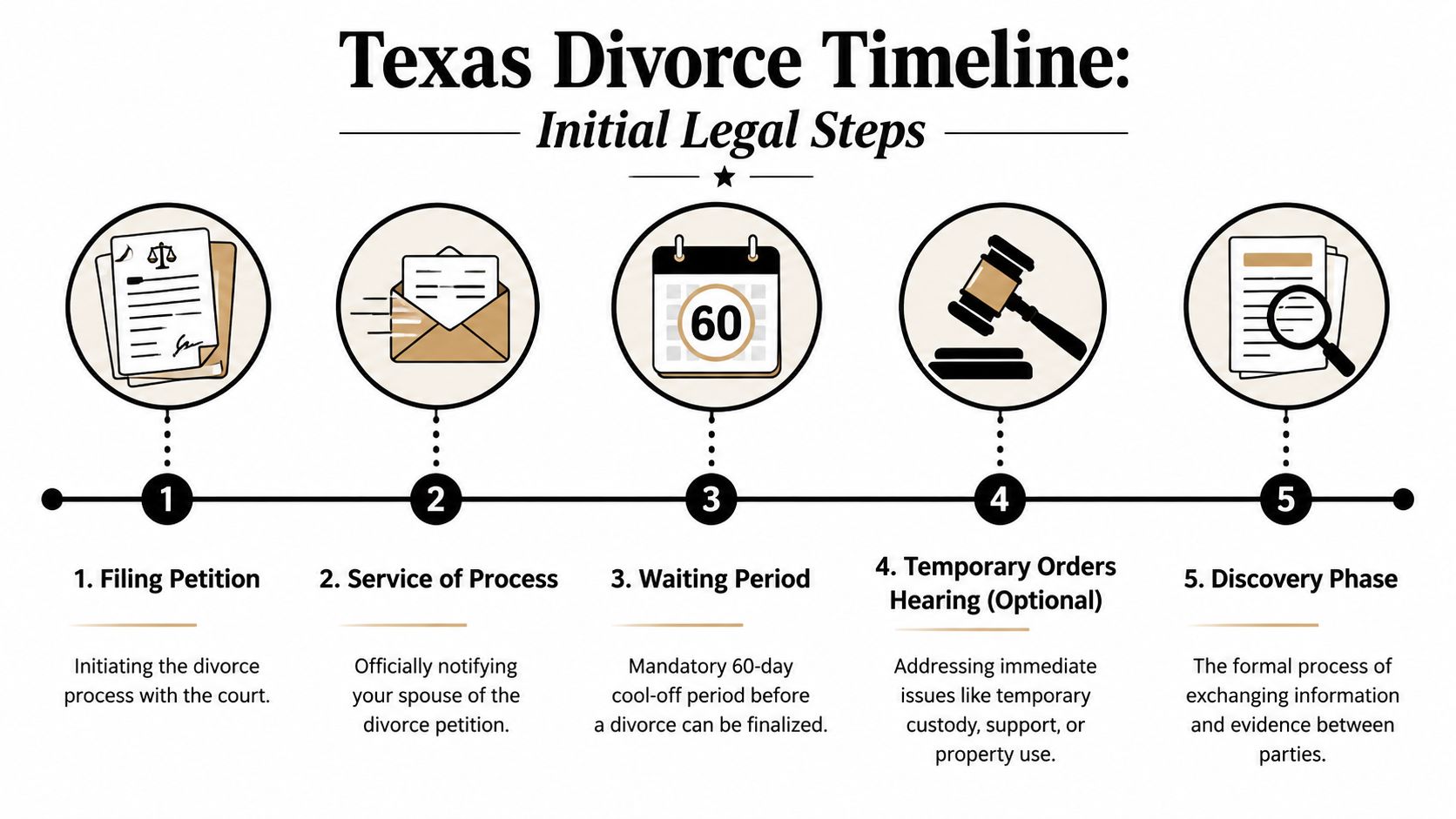
Texas requires a spouse to live in the state for at least 6 months and in the filing county for at least 90 days before filing. Texas also requires a 60-day waiting period from the filing date before a divorce can be finalized, with exceptions mainly involving domestic violence, according to Texas Law Help's divorce overview.
Step one is jurisdiction and venue
These terms sound technical, but the idea is simple.
Jurisdiction means the Texas court has authority to hear your divorce. Venue means you're filing in the proper county. If you file in the wrong place, you can create delay, added expense, and procedural headaches that have nothing to do with the merits of your case.
If you're in a military family, residency can be more nuanced. Texas Law Help notes that service members may still satisfy residency rules through Texas home state status, and time spent outside Texas with a military spouse may count as time in Texas. That can matter a great deal if your family has moved recently.
The basic filing sequence
In practical terms, the opening phase of a Texas divorce usually looks like this:
- Confirm residency and county eligibility
- Prepare and file the Original Petition for Divorce
- Serve your spouse or obtain a waiver when appropriate
- Address urgent issues through temporary orders if needed
- Move toward final orders, settlement, or trial after the waiting period and required preparation
Texas Law Help also notes that most divorces take longer than the waiting period alone. That's important because many people hear "60 days" and assume the case will be over quickly. It often won't.
Filing starts a case. It doesn't solve the immediate problems of bills, parenting schedules, or who stays in the house.
Temporary orders often decide how the case feels
If you need short-term rules while the divorce is pending, temporary orders can address child support, custody, and use of property while the case moves forward. Strategically, this matters because temporary arrangements often shape daily life for months. They can also influence how each side evaluates settlement.
A spouse who needs immediate parenting structure or financial support shouldn't wait and hope things stabilize on their own. On the other hand, not every case needs a contested temporary hearing. If you and your spouse can agree on interim terms, that can reduce pressure and legal cost.
Final doesn't mean what many people think it means
One common mistake is assuming the divorce ends when the judge signs paperwork in court. Texas Law Help emphasizes that the divorce is not final until the signed decree is filed with the clerk. That last administrative step is more than clerical cleanup. It is what closes the loop legally.
The legal foundation of your case isn't glamorous, but it's powerful. Get the filing rules right, and you protect everything that comes after.
Gathering Your Ammunition Documents and Evidence for Court
A divorce case is rarely won by passion alone. It turns on records.
The most effective evidence package in a Texas divorce is a complete one. Verified Texas-focused guidance recommends gathering recent pay stubs, three years of tax returns, bank and retirement statements, debt records, deeds, titles, and insurance policies. When children are involved, a detailed parenting plan and records of childcare and healthcare costs are especially important. Gaps in this documentation are a common reason cases get delayed, according to this Texas divorce document checklist.
Don't gather papers randomly
Every document should answer a likely courtroom question.
If the issue is property division, the court needs a reliable picture of what exists, what it is worth, and who claims it. If the issue is support, the court needs income proof and expense records. If the issue is parenting, the court needs facts that show what arrangement serves your child well in real life.
Here's a quick-reference checklist you can use.
| Document Category | Specific Examples |
|---|---|
| Income records | Recent pay stubs, tax returns, bonus or commission records |
| Banking and cash assets | Checking statements, savings statements, money market account records |
| Retirement and investment records | 401(k) statements, IRA statements, brokerage account statements |
| Real property records | Deeds, mortgage statements, refinance documents, property tax records |
| Vehicle and titled property records | Car titles, loan payoff statements, registration records |
| Debt records | Credit card statements, personal loan records, student loan records |
| Insurance records | Health, life, homeowners, auto, disability policy documents |
| Business records | Profit and loss statements, balance sheets, payroll records, ownership documents |
| Child-related records | Parenting plan drafts, school records, medical records, childcare invoices, healthcare premium records |
| Court file materials | File-stamped pleadings, waiver or answer papers, completed final decree drafts |
If you want a broader starting list before filing, review what documents you should gather before filing for divorce.
Why each category matters in court
Pay stubs and tax returns do more than show wages. They help test whether a support request is grounded in actual income rather than rough estimates.
Bank statements can reveal ordinary spending, unusual withdrawals, hidden transfers, or account patterns that need explanation.
Retirement statements matter because retirement is often one of the larger assets in a marriage, and it is frequently overlooked until late in the case.
Debt records help separate real marital obligations from vague claims that "we owe a lot." Judges and mediators work better with account numbers, balances, and dates than with memory.
Parenting records serve a different purpose. They don't exist to prove that you're the better storyteller. They help show consistency. School attendance records, medical records, childcare invoices, and a practical parenting plan can support your position far better than general statements about being a devoted parent.
Case-building insight: The best document isn't always the most dramatic one. It's the one that directly supports a decision the court has to make.
Special concerns for business owners and high-asset cases
If you own a business, your case usually needs more than basic household records. Business interests create recurring questions about income, value, reimbursement, and whether personal and business spending were kept separate.
In those cases, useful preparation may include:
- Business financial records: profit and loss statements, general ledgers, payroll reports, and ownership documents
- Asset tracing materials: records showing when an asset was acquired and how it was funded
- Professional input: a valuation expert, CPA, or forensic accountant when the numbers are disputed
For high-value estates, don't assume a spreadsheet is enough. The more complex the asset picture, the more important it is to tie each record to a legal position. Your evidence should tell the court what exists, who controls it, and why your proposed division makes sense.
Navigating Pretrial Procedures Discovery Mediation and Temporary Orders
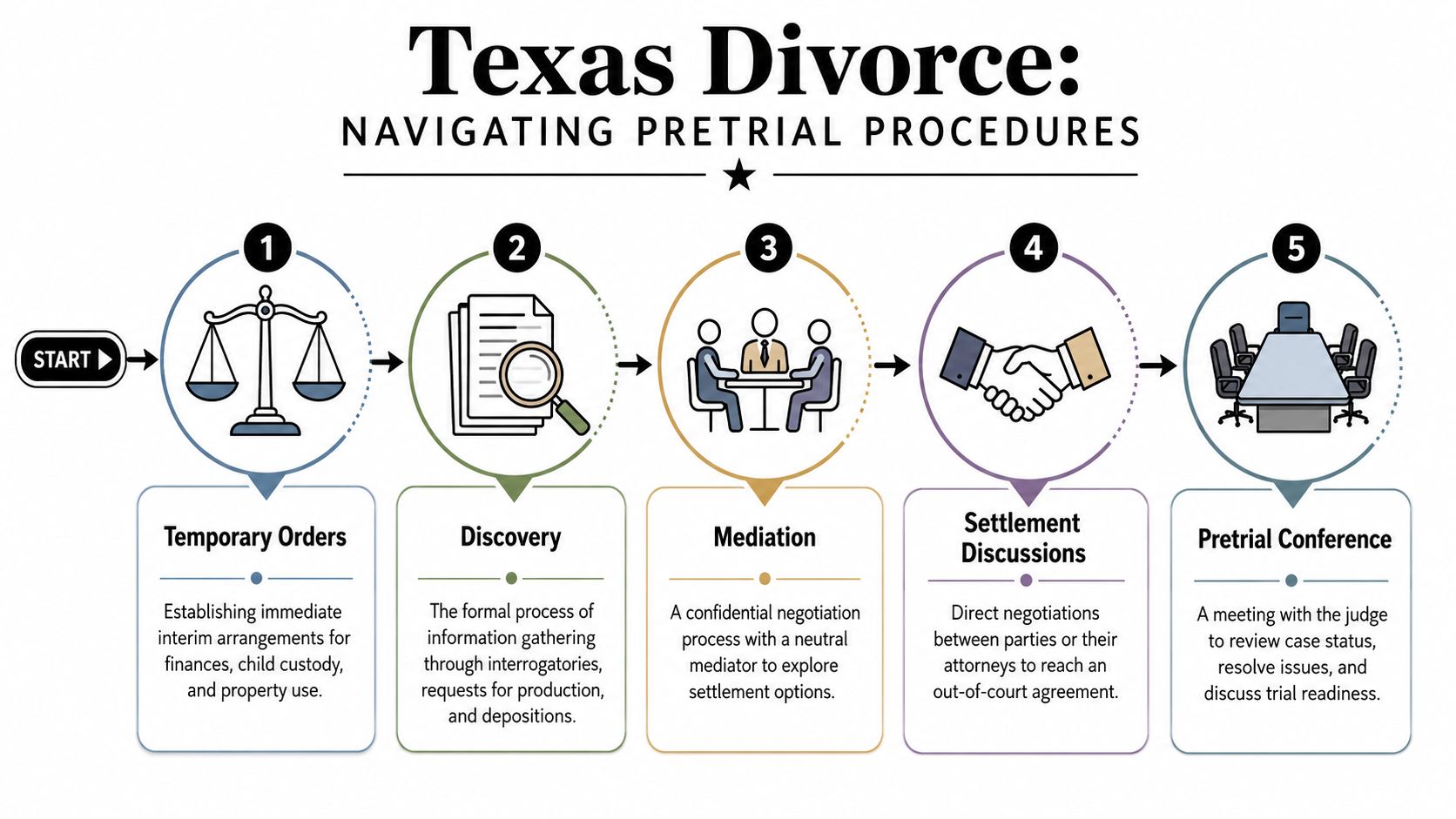
Most divorce cases are shaped before trial, not at trial. The pretrial phase is where each side tests the other side's claims, exchanges information, and learns whether settlement is realistic.
If you treat this stage as background noise, you can miss the best opportunities to protect your position.
Discovery is where unsupported claims get exposed
Discovery is the formal process of exchanging information. In practical terms, this is how one side asks the other side to produce documents, answer written questions, and clarify disputed facts.
Common discovery tools include:
- Interrogatories: written questions that require written answers
- Requests for production: demands for documents and records
- Requests for disclosure or similar case information exchanges: basic case facts and witness information
- Depositions: sworn testimony taken before trial
The strategic purpose is simple. Discovery forces each side to move from accusation to evidence.
A spouse who says an asset is separate property should be prepared to trace it. A spouse who seeks support should be prepared to back up income and expenses. A spouse who wants a specific parenting arrangement should be ready to connect that request to real facts, not broad conclusions.
Temporary orders can stabilize the ground under your feet
Temporary orders are often the most important early hearing in a contested case because they create interim rules while the divorce is pending. Those rules may address possession of property, payment of bills, child support, and parenting arrangements.
That doesn't mean every temporary-orders fight is worth having. Sometimes a negotiated temporary agreement is smarter than an expensive hearing. But when the other side is withholding money, disrupting access to children, or creating chaos around the home, temporary orders may be the fastest path to stability.
If you need a closer look at what happens in this stage, this guide to a temporary orders hearing in a Texas divorce can help you understand the process.
A short explanation can also make the process easier to picture:
Mediation isn't weakness
Many people hear "mediation" and assume it means backing down. Usually, it means the opposite. It gives you a structured chance to negotiate with better information and more control than trial usually offers.
Mediation works best when you enter with:
- A defined bottom line: know what you must keep, what you can trade, and what isn't negotiable
- Organized exhibits: a proposal is more persuasive when you can support it quickly
- A realistic lens: insisting on every point can make settlement impossible, even when a practical compromise is available
Settlement is strongest when it reflects evidence, not exhaustion.
The spouse who prepares for mediation like a trial often negotiates better than the spouse who treats mediation like an informal conversation.
Building Your Case Strategy and Preparing Witnesses
A hearing can feel chaotic if you walk in with a stack of papers and no theory of the case. The goal here is simpler than it sounds. Decide what result you want on each disputed issue, then match every document and witness to that result.
Texas judges decide specific questions, not general frustration. They want to know whether property is separate or community, what conservatorship schedule serves the child, whether support is appropriate, and which facts prove those points. General background has limited value unless it helps answer one of those questions, as reflected in Texas divorce guidance from WomensLaw.

Turn facts into positions
Strong preparation starts issue by issue.
Ask four questions for each dispute: What am I asking the judge to do? What rule or legal standard applies? What evidence supports that request? What will the other side say in response?
That framework changes how you organize your proof. Bank statements are not just financial records if they trace a separate property claim. School records are not just background if they show who handles drop-off, homework, medical appointments, and daily stability for the child. Tax returns are not just paperwork if they expose income that matters for child support, spousal maintenance, or reimbursement claims.
I often see self-represented spouses gather useful material and still lose ground because nothing is tied to a clear point. A better method is to build one folder for each contested issue. Put your best exhibits first, add a short timeline, and note what each item proves. That makes it easier to present your case and easier for the judge to follow it.
Build a case theme the judge can follow
Judges hear a high volume of family cases. They do not need drama. They need a clear, consistent explanation of why your requested outcome is fair, workable, and supported by evidence.
Your case theme should be short enough to repeat without sounding scripted. For example: the children have done well under the current routine and need stability, or the asset claimed as separate property can be traced from before the marriage through today. A good theme keeps you from wandering into side disputes that consume time and add little value.
This matters in settlement too. The spouse with a clear theory usually negotiates from a stronger position because each demand is tied to proof, not emotion.
Witnesses should prove a point you cannot prove alone
Choose witnesses with discipline. A witness should fill a factual gap, authenticate a document, explain a specialized issue, or confirm a pattern they personally observed.
Useful witnesses may include:
- Fact witnesses: people with direct knowledge of parenting schedules, financial transfers, business operations, or a specific incident
- Professional witnesses: accountants, appraisers, counselors, or other professionals whose training helps explain value, income, treatment, or child-related concerns
- Targeted character witnesses: people who can speak from repeated personal observation about parenting reliability or sobriety, if those facts are disputed
Friends and relatives can help, but only if they have firsthand knowledge. A witness who only says you are a good parent or your spouse is difficult usually adds little. Judges place more weight on concrete observation than loyalty.
A useful witness is specific, calm, and limited to what they actually know.
Prepare testimony without scripting it
Witness preparation is about accuracy. It is not about rehearsing a performance.
Go over the likely topics with each witness. Make sure they know the dates, documents, and events they can identify with confidence. Warn them not to guess, argue with opposing counsel, or volunteer extra information. A truthful answer that is brief and precise usually carries more weight than a long answer that wanders.
It also helps to test the weak points before court. Ask yourself what the other lawyer will attack. Is the witness relying on memory alone? Is there a text message, calendar entry, invoice, or medical record that backs them up? If not, decide whether the testimony still helps enough to use it.
Substance use issues require extra care because the court's focus is usually child safety, stability, and compliance with treatment recommendations, not labels or accusations. If your case involves treatment history or compliance questions, practical court-ordered addiction rehab guidance can help you understand how those facts may surface in legal proceedings.
A prepared case feels less overwhelming because every piece has a job. That is the primary goal. You are not trying to tell the judge everything that happened in your marriage. You are proving the facts that support the orders you want.
Mastering Courtroom Dynamics Etiquette and Testimony
By the time you walk into the courtroom, you want your energy focused on the substance of your case, not on guessing where to stand or how to answer.
Courtroom behavior doesn't replace evidence. It does affect credibility. A judge notices whether you listen, whether you stay composed, and whether you answer questions directly.
What to do before your case is called
Treat your hearing day like an important job interview with legal consequences.
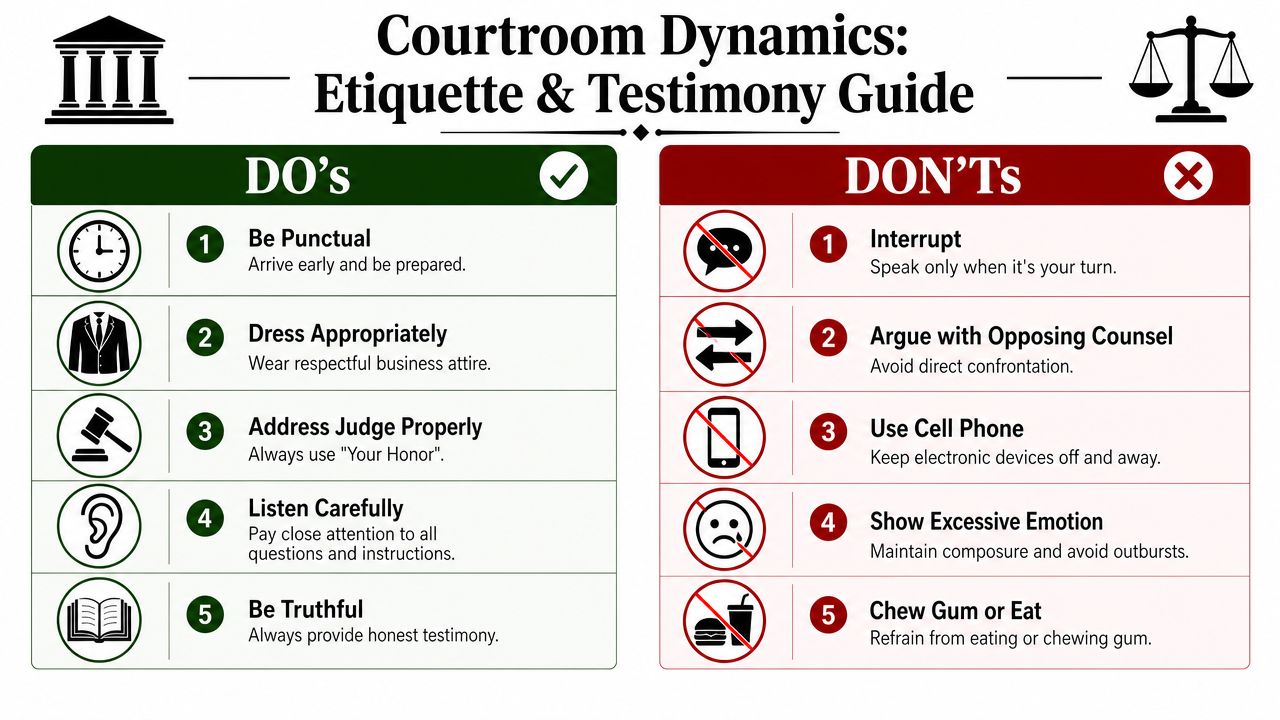
Use this checklist:
- Arrive early: give yourself time for parking, security, and finding the correct courtroom
- Dress conservatively: business attire is the safest choice
- Bring organized materials: keep pleadings, exhibits, notes, and a pen in one folder or binder
- Silence your phone: don't create a distraction you can easily avoid
If you're appearing by video, the same principles apply. Test your connection, sit somewhere quiet, and keep your documents within reach.
How to speak in court
Address the judge as Your Honor. Stand when appropriate, unless the court instructs otherwise. Don't interrupt the judge, the opposing attorney, or the witness.
When you're testifying:
- Listen to the full question
- Pause before answering
- Answer only what was asked
- Tell the truth, even when the answer isn't perfect
- Say you don't know if you don't know
Many people hurt their credibility by volunteering extra information or arguing with the question. If the opposing lawyer asks a narrow question, answer it narrowly unless your attorney tells you otherwise.
The most believable witness is usually the one who sounds measured, not rehearsed.
What to avoid
A few courtroom habits can damage your presentation quickly:
- Talking over others: this makes you seem reactive
- Making faces or visible gestures: judges notice body language
- Arguing with opposing counsel: your job is to answer, not spar
- Using the hearing to vent marital grievances: not every painful fact is legally relevant
Court is formal, but it doesn't require perfection. It requires discipline. If you stay respectful, direct, and composed, you make it easier for the judge to focus on your evidence instead of your nerves.
What to Do Next Finalizing Your Decree and Protecting Your Future
A courtroom ruling feels like the finish line, but it usually isn't. The final stretch is where details matter most.
In Texas, your divorce isn't complete until the Final Decree of Divorce is properly prepared, signed, and filed. Texas Law Help emphasizes that the divorce is not final until the signed decree is filed with the clerk in its step-by-step divorce guidance for cases without minor children. That means your job isn't over when the hearing ends.
Your decree has to match the actual ruling
The decree should clearly state the court's orders on property, debt, children, and any support obligations. If the written decree is vague, incomplete, or inconsistent with what was decided, you can create new conflict after the case should be over.
Read the decree carefully for issues such as:
- Property language: who gets which account, vehicle, debt, or real property interest
- Parenting terms: possession schedule, exchange terms, rights, and duties
- Support terms: amount, start date, payment method, and related obligations
- Implementation details: deadlines for refinance, sale, turnover, or transfer documents
For retirement division, a decree alone may not be enough. Some accounts require a separate order, such as a QDRO, to carry out the division. Insurance beneficiaries, account titles, estate planning documents, and emergency contacts may also need to be updated after divorce.
Protect the future you just fought for
A solid post-divorce checklist often includes:
- Get file-stamped copies: keep digital and paper copies of your decree and related orders
- Calendar every deadline: refinance dates, turnover deadlines, support start dates, and parenting transitions
- Complete transfer work promptly: deeds, titles, account changes, and retirement implementation documents
- Review enforcement risk: if the other side has a history of noncompliance, keep records from day one
- Update your life documents: beneficiaries, powers of attorney, and practical household records
Key takeaway
The strategic purpose of preparing for divorce court in Texas is not just to survive a hearing. It's to create a clean path from filing to enforceable final orders.
When you understand the timeline, build a complete evidence file, prepare for temporary orders and mediation, organize your legal themes, and present yourself well in court, you put yourself in a stronger position to protect your children, your finances, and your next chapter.
If you're feeling overwhelmed, you don't have to sort through this alone. The Law Office of Bryan Fagan, PLLC offers free consultations for Texans dealing with divorce, custody, support, and related family law issues. If you need help preparing for court, organizing your evidence, or building a practical strategy for settlement or trial, schedule a consultation and get clear guidance on your next step.