Skip to content
You may be reading this late at night, after another argument, another silent dinner, or another moment when you realized your marriage can't keep going like this.
If you're trying to figure out how to file for divorce in Texas, you probably don't need more noise. You need a clear path. Divorce is emotional, but the legal process works best when you break it into manageable steps and make careful decisions early.
Texas divorce law can feel intimidating at first. Still, most confusion comes from a handful of issues: where to file, what forms to use, how to notify your spouse, what happens with children, and how property gets divided. Once you understand those pieces, the process becomes much more workable.
Your First Step on a New Path
The hardest part for many people isn't signing papers. It's admitting that they need to start looking.
That search often happens when you feel exhausted, angry, scared, or all three. You may be worried about your children, your home, your retirement, your business, or whether you can get through the next month without everything unraveling. Those concerns are real, and they deserve more than a generic checklist.
Texas law gives you a process, but it doesn't give you emotional space. You have to create that space for yourself. Start by treating this as both a legal matter and a life transition. That means slowing down long enough to make smart decisions, even if your situation feels urgent.
Start with three grounding questions
Ask yourself:
Are you safe right now
If there has been family violence, threats, stalking, or coercive control, your first move should focus on protection and immediate planning.Are children involved
If so, your divorce case may also involve conservatorship, possession and access, child support, and temporary parenting rules.Are there major financial issues
A family business, real estate portfolio, retirement accounts, commissions, stock awards, or inherited property can all affect how you prepare before filing.
You don't need to know every answer before you begin. You do need to know which questions matter first.
A strong first step is learning what happens when you talk to a lawyer. If you haven't done that before, this guide to what happens at your first consultation with a divorce lawyer can help you understand the process and show up prepared.
Quiet preparation beats panic
You don't have to solve your whole divorce today. You only need to begin with clarity.
For some people, that means confirming they're eligible to file in Texas. For others, it means gathering records before a spouse moves money, locks down accounts, or changes the family routine with the children. If you're a parent, a business owner, or someone with substantial assets, early preparation matters even more because small missteps at the beginning can create bigger problems later.
The good news is that divorce in Texas follows a sequence. When you understand that sequence, the fear starts to shrink and your options become easier to see.
First Steps Before You File Your Divorce Petition
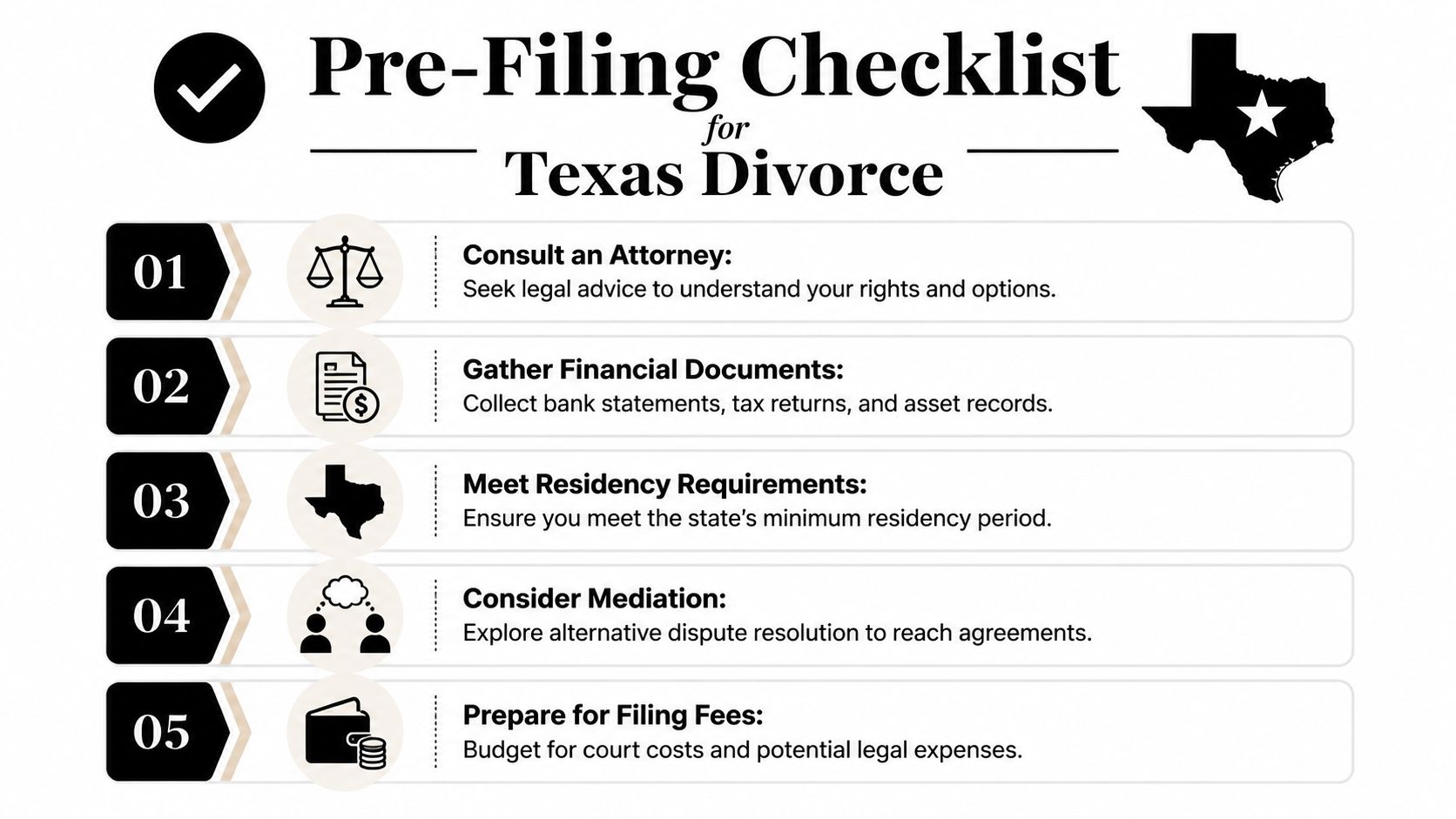
Before you file anything, make sure the court can accept your case. Many people waste time by failing to confirm this. They download forms, fill them out, and then learn they filed in the wrong place, used the wrong grounds, or left out the financial preparation that would have helped them later.
Confirm that Texas has jurisdiction over your divorce
Texas Family Code Section 6.301 sets the basic residency rules. In plain English, at least one spouse must have lived in Texas for the preceding six months and in the county where the divorce is filed for the preceding 90 days. If neither spouse meets that requirement, the court can't accept the Original Petition for Divorce, as explained in this Texas residency requirement overview.
That sounds simple, but readers often get tripped up by the county part. You may have lived in Texas long enough, but if you recently moved from one county to another, you may need to wait before filing in your new county.
A quick way to test your filing location
Use this short checklist:
State residency
One spouse must meet the six-month Texas residency rule.County residency
One spouse must meet the 90-day county residency rule in the county where the case will be filed.Military or temporary moves
If you or your spouse travel for work, serve in the military, or split time between homes, don't guess. Residency questions can get fact-specific quickly.Children in another state
Divorce jurisdiction and child custody jurisdiction aren't always identical. If your children recently moved, that can affect which court handles custody orders.
Choose the legal ground for divorce
Texas law recognizes seven grounds for divorce: insupportability, cruelty, adultery, conviction of a felony, abandonment, living apart for three or more years, and confinement in a mental hospital, as summarized in this overview of Texas divorce grounds.
Many individuals file on insupportability, which is Texas's no-fault ground. In everyday language, it means the marriage can't continue because of conflict or discord, without forcing either spouse to prove misconduct. That's usually the most practical choice because it tends to keep the case narrower and less inflammatory.
Still, fault grounds can matter in some cases. If adultery, cruelty, or abandonment affected finances or family life, those facts may influence strategy around property division or settlement negotiations. You shouldn't assume that “no-fault” always means “ignore the facts.”
Gather records before conflict gets worse
This step protects you. It also makes your lawyer's job easier and can reduce the chances of expensive disputes later.
A good starting point is this article on what documents you should gather before filing for divorce. Focus on collecting copies, not making dramatic moves. Quiet organization is usually better than confrontation.
Here are the records that matter most:
Income documents
Pay stubs, tax returns, W-2s, 1099s, bonus records, commission statements, and profit distributions.Bank and investment records
Checking, savings, brokerage, retirement, and college savings accounts.Debt information
Credit cards, personal loans, mortgages, HELOCs, business debt, and tax balances.Property records
Deeds, closing statements, vehicle titles, appraisals, and insurance schedules.Business records
Ownership documents, profit and loss statements, balance sheets, payroll records, and partnership agreements.
Special concerns for business owners and high-asset households
If you own a company, don't wait until the case is heated to figure out what your business is worth or how income flows through it. A divorce may involve questions about whether the business itself is community property, whether part of it is separate property, and whether retained earnings or owner benefits should be examined.
If you have substantial assets, tracing matters. Texas is a community property state, which means property acquired during marriage is generally presumed to belong to the marital estate, while some property may remain separate if you can prove it. Inheritance, gifts, and some pre-marriage assets often require clean records to keep them separate.
Practical rule: If an asset is important enough to fight over, it's important enough to document early.
In more contested cases, The Discovery Process in a Texas Divorce becomes the formal method for exchanging financial information before settlement or trial. That process is easier when you've already organized your own records.
Think about children before you think about forms
If you have children, your divorce isn't only about ending a marriage. It's about building a parenting structure that works after the case is over.
Texas custody law uses terms like conservatorship, possession and access, and child support. In plain English, that usually means who makes important decisions, when the children spend time with each parent, and how expenses are handled. Before filing, think carefully about school schedules, medical needs, child care, extracurriculars, transportation, and how conflict has affected the children already.
Mediation can also be worth considering early. Some couples won't be ready for it right away. Others save significant stress by resolving parenting and property issues before the case turns into a long fight.
Drafting and Filing the Original Petition for Divorce
This is the point where your case officially begins. The Original Petition for Divorce is the document that opens your divorce with the court. It tells the court who the parties are, whether children are involved, which county has jurisdiction, what legal ground you're using, and what general relief you're asking for.

If you want a deeper look at the form itself, this guide to the Texas Original Petition for Divorce walks through the filing document in more detail.
What the petition needs to say
A petition doesn't need to tell your whole life story. It does need to be accurate.
Most petitions include:
Basic identifying information
Your name, your spouse's name, and the county where the case is filed.Residency allegations
The statements showing the court has authority to hear the case.Grounds for divorce
You must plead a valid ground recognized under Texas law.Children-related information
If you and your spouse have minor children together, the petition must address that fact and request appropriate orders.Property requests
You may ask the court for a just and right division of community property and for confirmation of any separate property.
If you leave out important details, you may create delays later. If you include inflammatory allegations without a reason, you may also make settlement harder. Precision matters more than drama.
Keep your requests broad enough to protect you
Many people make the mistake of filing bare-bones paperwork that doesn't fit their real life. That's risky if your case involves retirement accounts, a business, a house, reimbursement claims, separate property issues, or parenting concerns that need temporary structure.
You don't have to prove your entire case in the petition. But you should make sure your filing asks for the categories of relief you may need. That can include temporary orders, property division, conservatorship terms, child support, and attorney's fees where appropriate.
Filing first doesn't guarantee control of the outcome. Filing carefully does improve your position.
How filing works in practice
Most Texas divorces are filed electronically through the state's portal. If you're handling part of the process yourself, e-filing can make the mechanics simpler because you can submit from home, review confirmations, and keep digital copies of what you filed.
A basic filing sequence usually looks like this:
Prepare the petition and any supporting documents
Review names, dates, and addresses carefully.Create or use your e-filing account
Follow the portal prompts, choose the correct county and case type, and upload the documents in the correct category.Pay the filing fee or file a fee-waiver request
Don't assume the court will process both instantly.Wait for the clerk to accept the filing
Submission is not the same as acceptance.Get your file-stamped copy
Keep it. You'll need it for service and for your own records.
For readers who prefer a visual explanation, this video can help you understand the filing stage more clearly:
If you can't afford the filing fee
This is one of the most common points of anxiety. You may be able to file a Statement of Inability to Afford Payment of Court Costs, sometimes called an indigency affidavit. That document asks the court to waive filing costs based on your financial circumstances.
Approval doesn't happen the same way everywhere. According to 2024 Texas State Law Library data, only 42% of indigency affidavits filed in urban counties like Houston and Dallas were approved within 14 days, while rural counties saw higher approval rates but longer processing times of 30 to 45 days, according to the Texas State Law Library forms reference.
That matters because timing affects your entire case. If your filing depends on a fee waiver, build in extra time and watch for clerk notices or court requests for additional information.
Common filing mistakes that cause trouble
A few errors show up again and again:
Wrong county
The court can't fix a residency problem just because your paperwork is otherwise complete.Missing children's information
If minor children are involved, your petition has to reflect that.Using forms that don't match your situation
A simple agreed divorce form may not fit a case with a business, retirement issues, or custody disputes.Forgetting temporary needs
If you need immediate rules about bills, parenting, or access to property, waiting too long to raise those issues can hurt you.
If your divorce is likely to stay simple and fully agreed, filing may feel straightforward. If your case involves conflict, complex assets, or children, the petition is where your strategy begins.
Serving Divorce Papers and Your Spouse's Response
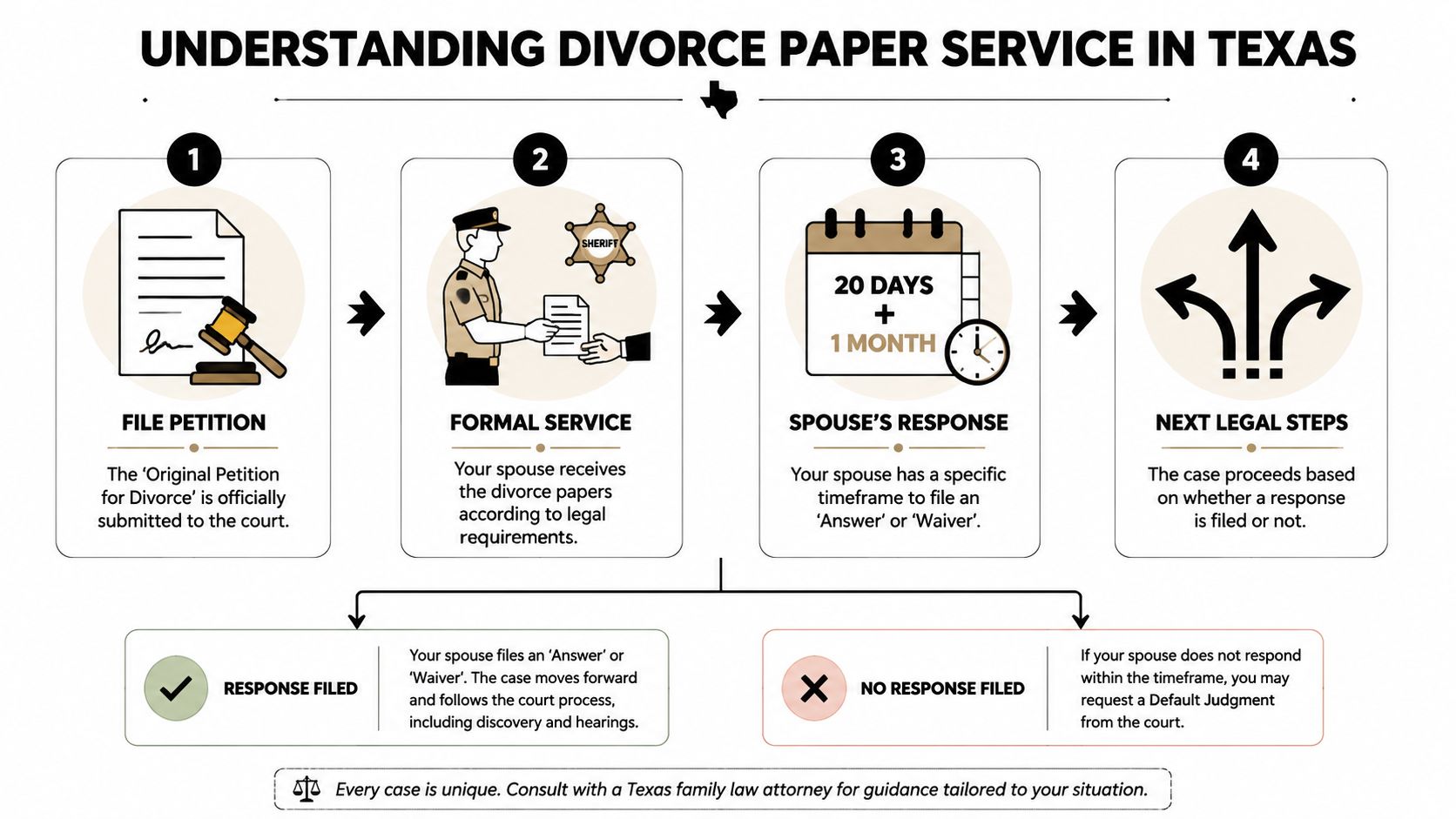
Filing the petition starts the case. Service is what gives your spouse legal notice that the case exists.
This is the part that makes many people nervous, especially if the relationship is tense. It helps to think about service in real-life scenarios instead of legal abstractions.
The simplest path is a waiver
If your spouse knows about the divorce and is willing to cooperate, the smoothest option is often a Waiver of Service. That means your spouse signs a formal document acknowledging receipt of the case without requiring a constable or process server to hand-deliver papers.
A waiver can reduce tension and keep the process moving. But it still has to be done correctly. You shouldn't assume that an informal text message saying “I got it” is enough.
When formal service is necessary
Some spouses won't sign anything. Others may avoid contact or become hostile once they learn a petition has been filed. In those cases, formal service usually happens through a constable, sheriff, or private process server.
Here's how that often plays out:
Scenario one
Your spouse is at a known home or work address. A process server delivers the filed papers, completes a return of service, and the case moves forward.Scenario two
Your spouse is difficult but locatable. You may need several attempts at different times or at different places before service is completed.Scenario three
Your spouse is actively dodging service. That may require motions for substituted service if the facts support it.
Once served, your spouse can file an Answer. That filing tells the court they intend to participate. If they don't respond after proper service, the case may move toward a default path, depending on the facts and the court's requirements.
If you don't know where your spouse is
This is more common than many people expect. A missing spouse doesn't automatically stop a divorce, but it does change the procedure.
Navigating divorce when a spouse's address is unknown is a critical issue in 12 to 15% of Texas divorce cases. Alternative service methods, like publication, are essential but can add 30 to 60 additional days to the timeline, as described in this discussion of Texas divorce service when a spouse can't be located.
That means the court may require you to show what steps you took to find your spouse before allowing an alternative method. Depending on the case, that can involve service by publication or other court-approved methods.
If your spouse is missing, treat service like a documentation project. Keep records of addresses checked, messages sent, relatives contacted, and any returned mail.
What parents should watch for during service
If children are involved, emotions can spike at this stage. A parent who feels blindsided may start withholding the children, changing routines, or making accusations. That's one reason temporary orders can become so important early in the case.
You should also think about tone. Service is a legal event, but it can trigger a family crisis if handled carelessly. Avoid using the children to deliver messages. Avoid social media commentary. Avoid treating service as punishment.
What happens after your spouse responds
Once your spouse appears in the case, the divorce moves into its working phase. That may include temporary orders, document exchange, negotiation, mediation, or litigation.
If your spouse responds cooperatively, the case may head toward an agreed resolution. If your spouse contests custody, support, property division, or separate-property claims, the case becomes more complex, but still manageable with the right structure.
Navigating the Path to a Final Decree
In the middle of a divorce case, outcomes take shape. Here, you and your spouse either build a workable agreement or ask a judge to decide disputed issues for you.
Temporary orders create stability
A divorce doesn't freeze life. Bills still come due. Children still need routines. Someone still has to stay in the house, make car payments, manage health insurance, and decide who picks up from school.
That's where temporary orders come in. These are short-term court orders that govern life while the divorce is pending. They can address possession of the home, payment of debts, use of bank accounts, conservatorship, possession and access, temporary child support, and sometimes temporary spousal support.
For parents, temporary orders often set the tone for the case. They create a framework for exchanges, school schedules, communication rules, and decision-making while the final terms are being negotiated. For business owners, temporary orders may also help protect operations, prevent interference, and preserve records.
Discovery matters when the facts are disputed
If your spouse says there's no bonus income, no hidden account, no business value, or no separate-property issue, discovery is how those claims get tested.
Discovery is the formal process for exchanging information before settlement or trial. It can include written questions, document requests, disclosures, and depositions. In some cases, experts become involved to value a business, examine tracing claims, or analyze compensation structures.
A short comparison can help:
| Process | What it does | Why it matters |
|---|---|---|
| Informal exchange | Voluntary sharing of records | Works best when both spouses are transparent |
| Formal discovery | Court-recognized information exchange | Helps uncover missing or disputed facts |
| Expert review | Evaluation by accountants or appraisers | Useful for businesses, complex assets, and tracing |
If your estate is significant, don't treat discovery like a technicality. It often determines whether settlement is informed or blind.
Mediation compared with litigation
Individuals facing divorce are often familiar with the appearance of a courtroom. Fewer understand what mediation can accomplish.
Mediation is a structured negotiation process where a neutral third party helps both sides work toward resolution. The mediator doesn't act as the judge. The mediator helps narrow disputes, test positions, and move the parties toward an agreement they can live with.
Litigation is different. A judge decides unresolved issues after hearings or trial. That can be necessary in some cases, especially when a spouse is abusive, dishonest, entrenched, or unwilling to negotiate in good faith. But litigation also places major family decisions in the hands of someone who knows your case only through evidence presented in court.
Mediation lets you shape the rules your family will live under. Litigation asks the court to shape them for you.
Which path fits which case
Mediation often works well when:
You both want control
Parents usually benefit when they can craft practical schedules instead of accepting a one-size-fits-most result.The finances are complex but knowable
Business owners and high-asset couples often prefer privacy and customized settlements once the numbers are on the table.You need flexibility
Travel schedules, school demands, and unusual compensation structures rarely fit neatly into rigid courtroom outcomes.
Litigation may be unavoidable when:
- A spouse hides information
- There are serious safety concerns
- One side refuses all compromise
- Temporary relief is urgently needed and cannot wait
If you need help with the custody side of the case, child support questions, mediation strategy, or enforcement after orders are entered, it often helps to work with a Texas family law team that handles those issues in the same practice. The Law Office of Bryan Fagan, PLLC provides information and representation in divorce, child custody, support, mediation, and enforcement matters.
The Final Decree is the document that controls your future
Every negotiation in the case should move toward one written result: the Final Decree of Divorce.
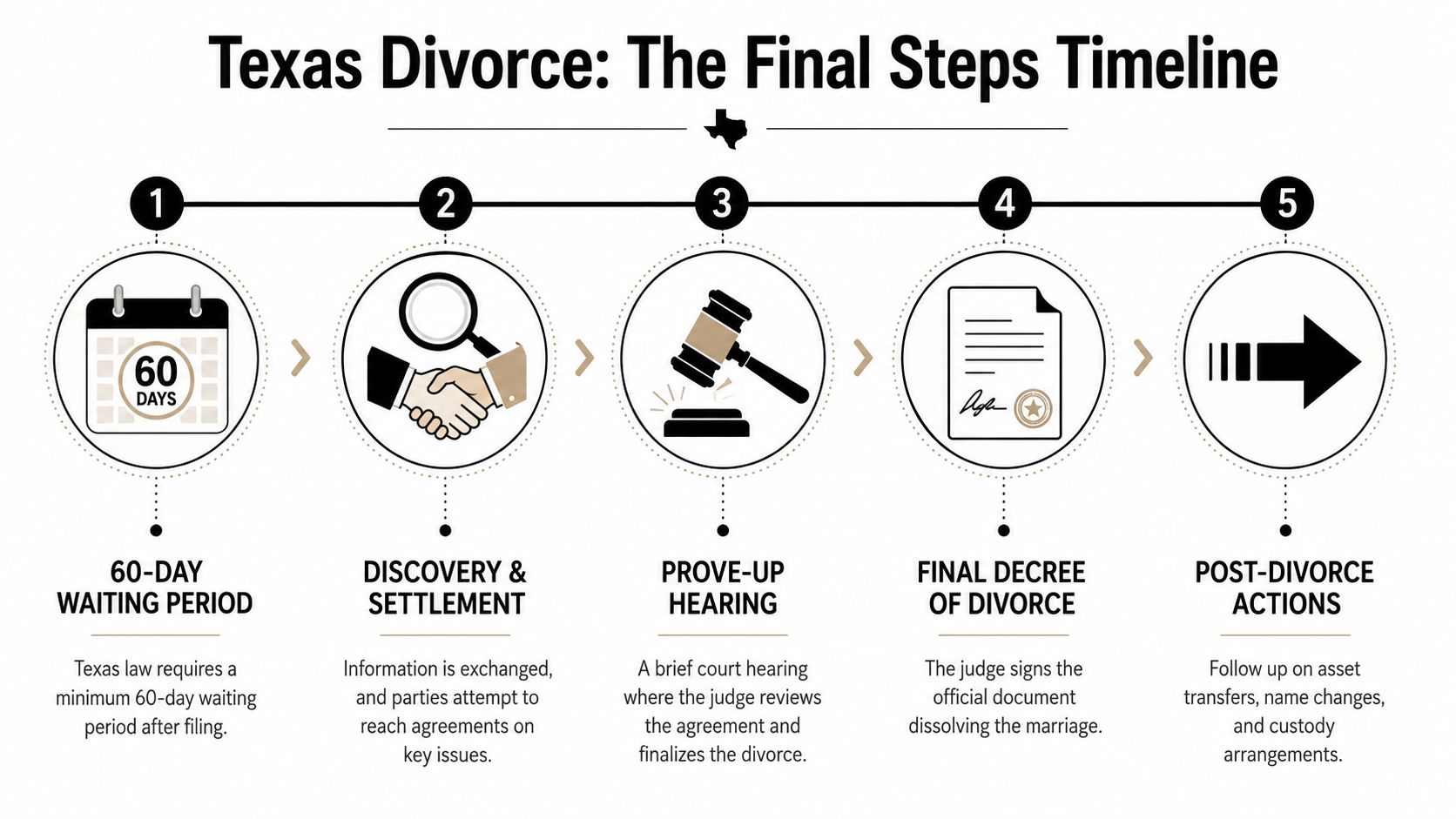
That decree doesn't just say you're divorced. It should clearly address property division, debt allocation, conservatorship, possession and access, child support, health insurance responsibilities, and any special terms unique to your family or finances. If retirement accounts need division, additional orders may be required. If real estate is involved, deeds may also need to be prepared after the divorce.
A vague decree causes post-divorce problems. A careful decree reduces them.
Finalizing Your Divorce and Moving Forward
The end of your case is often quieter than people expect. After all the stress, paperwork, negotiation, and waiting, the final step may be a short court appearance where the judge reviews the agreement and signs the decree.
The waiting period you can't skip
Texas imposes a mandatory waiting period before a divorce can be finalized. In Texas, the mandatory 60-day waiting period from petition filing to finalization is absolute. This rule applies to all cases, including the more than 111,000 divorces filed in 2024, a figure that represents a 61.4% increase from the 2015 to 2017 average and highlights growing demand on the court system, according to this analysis of Texas divorce filing trends and waiting-period rules.
For you, the practical takeaway is simple. Even if everything is agreed quickly, the court can't finalize the divorce before that waiting period runs. That timeline affects planning for housing, finances, parenting, and any expected date of legal closure.
The prove-up hearing
In an agreed divorce, the final hearing is often called a prove-up. It is usually short. You appear before the judge, answer a few basic questions under oath, and confirm that the marriage has become insupportable or that the legal grounds alleged support the divorce, that the agreement is fair or appropriate, and that the decree should be signed.
If children are involved, the judge may look carefully at whether the orders serve the children's best interests. If property division is unusual or one spouse is absent in a default setting, the court may ask additional questions.
What final review should include
Before the hearing, read the decree slowly. Then read it again.
Check these issues carefully:
Parenting terms
School pickup, holidays, exchange locations, medical decision-making, and communication rules.Support obligations
Child support amount, start date, method of payment, and health insurance language.Property division
Bank accounts, retirement plans, vehicles, debts, business interests, and personal property.Implementation steps
Deadlines for refinancing, transferring title, signing deeds, turning over property, or preparing separate orders.
A divorce decree is only as useful as its wording. If a term matters to your daily life, it needs to be written clearly enough to enforce.
What to do next
When the judge signs the decree, your marriage is legally dissolved. But your to-do list usually isn't over.
Start with practical follow-up:
Update your estate documents
Review your will, powers of attorney, and medical directives.Change beneficiaries where appropriate
Retirement accounts, life insurance, and payable-on-death accounts often need separate updates.Complete title and account transfers
Don't assume the decree alone moves every asset automatically.Adjust your financial systems
Update budgeting, direct deposit, automatic payments, and emergency contacts.Rebuild your parenting routine
Put the schedule on a shared calendar and create a stable handoff process for the children.
If your last name is changing, make a written checklist for identification, payroll, bank accounts, insurance, and school records. If you own a business, update signing authority, payroll access, internal records, and any operating documents affected by the divorce. If you received or kept separate property, keep your proof organized even after the case ends.
Key takeaway
Learning how to file for divorce in Texas isn't really about filling out one form. It's about making a series of informed decisions, in the right order, with enough care to protect your children, your finances, and your peace of mind.
If your case is simple and fully agreed, the process may stay fairly straightforward. If it involves custody disputes, a business, a high-value estate, missing-spouse service issues, or conflict over property, the details matter much more. That's when guidance becomes especially valuable.
If you're considering divorce and want clear, personalized guidance, schedule a free consultation with Law Office of Bryan Fagan, PLLC. You can talk through your specific situation, whether it involves children, support, property division, mediation, enforcement, or a high-asset estate, and get a practical plan for your next step.