Skip to content
In Texas, the absolute legal minimum for a divorce is 61 days from the date the Original Petition for Divorce is filed. In real life, most cases take longer, with many uncontested divorces finishing in about 3 months and contested divorces often lasting 6 months to over a year, depending on what you and your spouse disagree about.
When considering how long a divorce takes in Texas, you're probably not just looking for a number. You're trying to figure out how long your life will feel unsettled, how long your children may be in limbo, and how long it will take before you can make plans with confidence again.
That uncertainty is hard. The good news is that the process is more predictable than it feels at first. Once you understand the major checkpoints, the divorce timeline becomes less like a fog and more like a map.
Your Divorce Timeline What to Realistically Expect
Individuals hope their divorce will move quickly. Some can. Many don't.
The first thing to understand is that Texas puts every divorce on the same starting track. After that, the timeline splits based on one practical question. Do you and your spouse agree on the major issues, or not?
If you both agree on property division, parenting arrangements, support, and the language of the final paperwork, your case is usually an uncontested divorce. That is the smoothest path. If the two of you disagree on even one major issue and need court help to resolve it, your case becomes contested, and the timeline grows.
Two very different paths
A simple way to think about it is this:
| Divorce path | What it usually means | General timing |
|---|---|---|
| Uncontested | You reach agreement on all issues | Often around 3 months |
| Contested | You need negotiation, mediation, hearings, or trial | Often 6 months to over a year |
What makes this feel overwhelming isn't just the legal work. It's the waiting between steps. You file, then wait. You exchange documents, then wait. You attend mediation, then wait for the next setting or signature.
Practical rule: The less conflict, the more control you usually keep over the timeline.
For parents, the emotional checkpoints often matter as much as the legal ones. You want to know when temporary schedules will start, when child support may be addressed, and when a final parenting plan will be settled. For business owners and people with significant assets, the pressing question is often how long financial uncertainty will last.
You don't need to know everything today. You do need a realistic picture of what comes next. That starts with the one rule every Texas divorce has in common.
The 61-Day Rule The Foundation of Every Texas Divorce
Texas Family Code §6.702 acts like a mandatory pause button. Once a divorce is filed, the court must wait before it can finalize the case.
Under Texas law, the absolute minimum duration for any divorce is 61 days from the date the Original Petition for Divorce is filed, because there is a mandatory 60-day waiting period. Even in a fully agreed case, a judge cannot sign the final decree before day 61. A helpful explanation appears in this overview of the Texas divorce 60-day waiting period, and the same rule is discussed in Bryan Fagan's timeline guide, which also notes that uncontested divorces typically finalize within 60 to 90 days.

What the waiting period means in plain English
This rule doesn't mean your divorce will automatically finish on day 61. It means day 61 is the first day it can legally finish.
If you file on January 1, the court can't finalize your divorce before March 2. That is true even if you've already agreed on everything and signed your paperwork. The law creates a floor, not a promise.
For many people, this is the first big point of confusion. They hear "60-day waiting period" and assume their divorce will be done in 60 days. That's not how it works. The judge still needs a proper final decree, complete paperwork, and time on the court's calendar.
Rare exceptions
There are limited exceptions tied to family violence. The 60-day waiting period can be waived in cases involving a history of family violence or an active protective order, as described in Haugen Law Firm's discussion of the Texas divorce process.
That exception doesn't apply in most cases, but it's important if safety is part of your situation.
The waiting period is not a punishment. It is a legal checkpoint that applies to almost everyone, no matter how cooperative the divorce is.
If you're trying to understand why your case can't be wrapped up immediately, The Texas 60-Day Divorce Waiting Period gives a straightforward explanation of why no Texas divorce can finalize in under 60 days.
Timeline for an Uncontested Divorce The Smoothest Path
When an uncontested divorce works the way it's supposed to, it feels orderly. Not easy emotionally, but orderly.

In this kind of case, you and your spouse have already reached agreement, or you're close enough that the remaining details can be resolved without a courtroom fight. You still have to follow the legal process, but each step tends to move more cleanly.
What an agreed case usually looks like
Here is the usual sequence:
- One spouse files the Original Petition for Divorce. That filing starts the legal case and starts the waiting period clock.
- The other spouse is served or signs a waiver of service. This tells the court that both parties have proper notice.
- The parties prepare the final paperwork. This usually includes the Final Decree of Divorce and, if children are involved, parenting and support terms.
- The waiting period runs. During this time, the paperwork should be reviewed carefully and corrected if needed.
- A prove-up hearing is scheduled. This is usually a short final hearing where one spouse gives brief testimony so the judge can approve the agreement.
- The judge signs the decree. The marriage is legally dissolved at that point.
A more detailed walkthrough appears in this step-by-step guide to filing an uncontested divorce in Texas.
Why even agreed cases still get delayed
Under Texas Family Code § 6.702, the mandatory waiting period begins on the exact date the petition is filed, and day 61 is the earliest possible date for a final decree. But filing errors can stop the case from moving smoothly. According to Lishman Law's Texas divorce timeline article, mistakes such as incomplete financial disclosures or incorrect venue can suspend the timeline until corrected and often add 2 to 4 weeks.
That point matters more than people expect.
A spouse may say, "We agree on everything, so ours will be fast." Maybe. But if the decree doesn't match the petition, if the county is wrong, or if the final documents are incomplete, the case can sit until someone fixes it.
An uncontested divorce moves fastest when the agreement is complete, the paperwork is accurate, and the hearing is requested as soon as the waiting period allows.
Here's a short explanation of the process in video form:
The emotional checkpoint in an uncontested case
Most clients feel a noticeable shift once the decree is drafted. Until then, the case can still feel abstract. Once the final terms are in writing, you can usually see the finish line.
For parents, that means a parenting schedule becomes real instead of theoretical. For homeowners, it means you can start planning around refinance, sale, or possession. For working professionals, it means you can begin thinking about post-divorce budgeting in a concrete way.
Timeline for a Contested Divorce Navigating Complexity
A contested divorce takes longer because the court has to help resolve disagreement. That disagreement may involve children, a house, retirement accounts, a business, spousal maintenance, or a high level of mistrust.
In these cases, the process is less like a straight line and more like a series of checkpoints. Each checkpoint exists for a reason. The court needs enough information to make fair decisions, and gathering that information takes time.
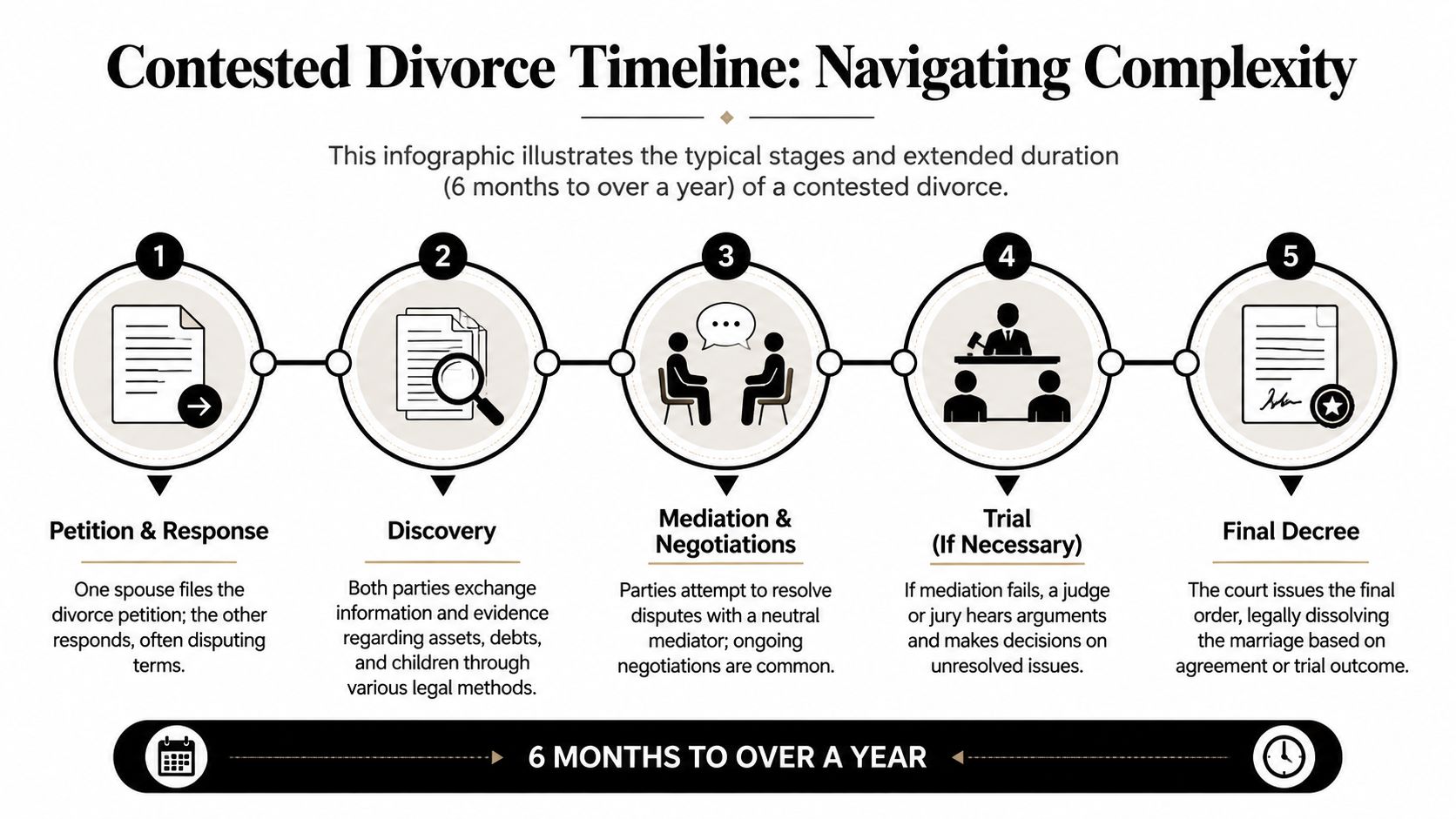
According to this discussion of contested divorce timing in Texas, contested divorces typically require 6 to 12 months, and cases involving high-value assets or child-custody disputes can extend to 18+ months. The same source explains that the discovery process alone can take 90 to 180 days.
Where the extra time comes from
A contested case often includes some or all of these stages:
Petition and answer
One spouse files, and the other spouse responds. From the start, the filings may show disagreement over property, custody, support, or fault grounds.Temporary orders
If you need rules while the case is pending, the court may hear requests about who stays in the house, who pays which bills, temporary conservatorship, possession schedules, or temporary support.Discovery
This is the information exchange stage. Each side may request bank records, tax returns, business records, retirement information, debt documents, and other evidence.Mediation and negotiation
Before trial, most courts want the parties to make a serious effort to settle.Trial setting and final hearing
If no settlement happens, the judge hears the unresolved issues and signs a final decree after ruling.
Why discovery changes everything
Discovery is where many contested divorces slow down. If one spouse owns a business, controls family finances, or claims certain property is separate rather than community, lawyers often need documents, explanations, and sometimes expert input before settlement talks become meaningful.
That is especially true in high-asset cases. A business owner may need records reviewed. A parent involved in a custody dispute may face requests for school records, medical records, or communications relevant to the child's best interests.
A trial-focused overview of that later stage appears in this article about how long a contested divorce trial can take in Texas.
A longer timeline doesn't always mean anyone is stalling. Sometimes the court simply needs more facts before it can make durable decisions.
The practical checkpoints that matter most
If your case is contested, these moments usually matter more than the calendar itself:
| Checkpoint | Why it matters emotionally and legally |
|---|---|
| Temporary orders entered | You gain short-term structure for parenting, finances, and living arrangements |
| Discovery completed | You finally see the full financial picture |
| Mediation scheduled | The case has a serious chance to resolve without trial |
| Trial date assigned | The pressure to settle often increases |
| Final decree signed | The uncertainty ends and enforcement rights begin |
If children are involved
Custody disputes often stretch a case because the court is not just dividing property. It is shaping a future parenting structure. That requires more care, more documentation, and sometimes more conflict management.
If you're also dealing with parenting issues, child support, or enforcement problems, related topics like custody, support, mediation, and enforcement often become part of the same timeline. Those issues can be negotiated together, or they can become separate points of dispute that slow the path to final orders.
Key Factors That Speed Up or Slow Down Your Divorce
Two divorces filed on the same day can end on very different dates. The law creates the starting line, but your facts determine the pace.

One of the biggest turning points is mediation. According to CTW Law Firm's discussion of Texas divorce timing, roughly 90% of contested divorce cases settle during mediation, and that stage typically happens between months 2 and 9.
The factors that tend to shorten the process
Some things are helpful:
Full agreement early on
If both spouses can settle property, parenting, and support issues early, the court process becomes much lighter.Organized documents
When you can quickly produce tax returns, account statements, debt records, deeds, and business information, your lawyer can draft and negotiate from a position of clarity.Prompt responses
Delays often come from silence. A week lost replying to emails can turn into much longer delays when hearings or mediation slots are involved.Serious mediation preparation
Mediation works best when both sides exchange the needed information before they walk in.
The factors that usually slow things down
Other facts make divorce harder to finish quickly:
Children and parenting conflict
Parents often need more than a simple decree. They need detailed terms about conservatorship, possession, decision-making, holidays, communication, and support. If you disagree on where the children will live or how decisions will be made, the timeline often stretches.
Business ownership and high-value estates
A business can be one of the biggest timeline drivers in a Texas divorce. Before anyone can divide it fairly, the parties usually need a clear picture of ownership, income, debt, and whether the business has community or separate property components.
The same is true for substantial estates, multiple properties, complex compensation, or disputed retirement interests. Speed matters less than getting the classification and division right.
Court scheduling
Even if both sides are ready, the court's calendar still matters. Hearings, prove-ups, and trial settings move on the court's timetable, not yours.
Mediation is often the point where people regain control. If the case settles there, you trade uncertainty for a written path forward.
Where legal help fits in
A lawyer can't remove the waiting period or force a judge's calendar to open up. But good process management does matter. Clear filings, complete drafts, realistic negotiation, and focused preparation often prevent avoidable delay.
If you need help evaluating whether your case is likely to stay agreed or become contested, the Law Office of Bryan Fagan, PLLC handles divorce, custody, mediation, support, and enforcement matters across Texas, including cases involving children, businesses, and complex property issues.
Frequently Asked Questions About Texas Divorce Timelines
Some timeline questions don't come up until after you've filed. These are the ones clients ask most often.
Can the 60-day waiting period ever be waived
Yes, but only in limited situations involving family violence or an active protective order. It is not waived just because both spouses agree or want to finish faster.
If your case involves safety concerns, tell your lawyer immediately. That issue affects more than timing. It may also affect temporary orders, communication, and possession arrangements involving children.
Does a military divorce take longer
It can.
Military divorces often involve extra procedural issues, especially if one spouse is on active duty or stationed elsewhere. Service, scheduling, and federal protections can all affect the pace of the case. The exact timeline depends heavily on the facts, so this is one area where individual legal advice matters.
If we agree on everything, are we guaranteed a fast divorce
Not guaranteed.
Agreement helps a great deal, but the court still needs proper paperwork, a legally acceptable decree, and a final hearing or other required finalization step. Administrative mistakes, drafting problems, or local scheduling delays can slow an otherwise smooth case.
Does having children automatically make the divorce contested
No. Parents can still have an uncontested divorce if they agree on conservatorship, possession, child support, and related issues.
What changes is the level of detail required. Parenting terms need to be specific enough for the court to approve and for both parents to follow after the divorce is final.
Can I date or make major purchases while the divorce is pending
You can make personal choices, but you should be careful. New relationships or unusual spending can create conflict, complicate settlement talks, and sometimes affect how the other side approaches custody or property issues.
Ask your lawyer before making any major financial move. During divorce, timing and appearance both matter.
Keep your focus on decisions that reduce conflict, protect your children, and preserve clear financial records.
What if my spouse is dragging things out
That depends on what "dragging things out" means. Sometimes a spouse is avoiding disclosure or refusing to engage. Sometimes the case is complex, and the legal system moves slowly.
The right response may involve tighter deadlines, court intervention, or a stronger mediation strategy. What helps most is identifying the exact source of delay instead of assuming every pause is bad faith.
What to Do Next Taking Control of Your Timeline
If you're asking how long does a divorce take in Texas, the clearest answer is this: 61 days is the legal minimum, around 3 months is common for many uncontested cases, and 6 months to 18+ months is a realistic range for contested cases depending on the issues involved.
That range feels wide because Texas divorces don't all travel the same road. Some need only paperwork and a short prove-up. Others need document exchange, mediation, temporary orders, and trial preparation before a court can make final decisions.
You do have some control over what happens next.
What to do next
Gather your records
Start collecting financial statements, tax returns, debt information, property records, and anything related to children.List the specific points of disagreement
Don't just say "everything." Separate emotional conflict from actual legal issues like custody, support, the house, or a business.Think about mediation early
If your case may become contested, mediation can be an important off-ramp from a longer court battle.Protect your children from adult conflict
Keep communication focused and child-centered. That helps legally and emotionally.Get legal advice before guessing about timing
The timeline in your case depends on your county, your facts, and whether your spouse is likely to cooperate.
A divorce is the end of a marriage, but it is also the beginning of a new legal and financial structure. The more clearly you understand the checkpoints ahead, the more steadily you can move through them.
If you're ready for clear answers about your specific situation, schedule a free consultation with Law Office of Bryan Fagan, PLLC. You can talk through your timeline, your concerns about children or property, and the practical steps that may help your case move toward a fair resolution.