Skip to content
When your marriage is changing and your home life feels uncertain, even searching for a divorce lawyer in Houston can feel like one more heavy decision.
You may be worried about your children, your paycheck, your house, or how long this will all take. You may also be asking a very practical question: how much is this going to cost me if I hire a lawyer?
A good legal guide should lower your stress, not add to it. If you're looking for a Houston divorce lawyer, you need more than a list of names. You need clear explanations, realistic cost ranges, and a better sense of what happens next under Texas law.
Starting Your Search for a Houston Divorce Lawyer
Some people start this search late at night after an argument. Others start after being served with papers, or after months of trying to keep things together. However you got here, your first instinct may be to search quickly and pick the first law office that sounds confident.
Houston makes that hard. The city is served by 388 divorce lawyers, which gives you access to a wide range of experience levels and practice focuses, but it also means you may feel flooded with options when you need calm guidance most. That figure comes from Avvo's Houston divorce lawyer listings.
What most people are really looking for
You aren't just hiring someone to file documents. You're looking for a person who can explain:
- What kind of divorce you have
- What deadlines matter right now
- What your case may cost
- How to protect your relationship with your children
- Whether settlement, mediation, or court makes the most sense
One person may need a steady negotiator because both spouses want a respectful split. Another may need a firm courtroom advocate because property is being hidden or parenting time is already becoming a fight.
Practical rule: Don't choose based on the loudest marketing message. Choose based on whether the lawyer can explain your next legal step in plain English.
A consultation can help you separate fear from facts. If you want a starting point on what that first meeting is usually like, this guide to a free consultation with a Houston divorce lawyer gives useful context.
A smarter way to narrow the field
Start by matching the lawyer to your situation.
If you have children, listen carefully to how the attorney talks about conservatorship, possession schedules, child support, and temporary stability. If you own a business or have substantial assets, pay attention to whether the lawyer can discuss tracing, valuation, and property characterization without oversimplifying. If you're hoping for a low-conflict path, ask how they use negotiation and mediation before trial.
The right fit usually becomes clearer once you understand the type of divorce you're likely facing.
Understanding the Types of Divorce in Texas
Many people use the word "divorce" as if it describes one process. In Texas, that's not how real cases work. The path your case takes depends on whether you and your spouse agree, where you disagree, and how willing both of you are to resolve issues outside the courtroom.
The legal line between uncontested and contested
An uncontested divorce only works when both spouses agree on all issues, including property, custody, and support. If even one issue remains unresolved, the case becomes contested. That point is often glossed over online, but Ramos Law's explanation of uncontested divorce in Texas makes that legal distinction clear.
That means a couple can agree about ending the marriage, yet still have a contested divorce if they disagree about who keeps the house, how retirement accounts are divided, or what parenting schedule should apply.
A third path is collaborative divorce, where both sides work toward settlement with structured negotiation and without asking a judge to decide every issue.
Comparison of Divorce Types in Houston
| Factor | Uncontested Divorce | Contested Divorce | Collaborative Divorce |
|---|---|---|---|
| Agreement level | Full agreement on all issues | One or more unresolved issues | Settlement-focused, but issues may still need structured negotiation |
| Conflict level | Usually lower | Usually higher | Often more controlled and problem-solving in tone |
| Court involvement | Limited, often focused on final approval | Greater court involvement when disputes continue | Often reduced if negotiations succeed |
| Cost picture | Usually the most economical path | Often more expensive because disputes increase work | Often between simple agreement and full litigation, depending on complexity |
| Best fit | Couples who already agree on property, custody, and support | Cases involving conflict over children, money, or both | Couples who want a private, organized settlement process |
Why this matters for cost
Many people often get blindsided. They hear "uncontested" and assume the case will stay simple. Then a disagreement over child support, a retirement account, or the sale of the house changes the legal track.
If you believe your spouse will cooperate, an agreed case may move efficiently through the statutory waiting period. Uncontested Divorce in Texas: The Faster Path gives a focused look at how agreed divorces move through that process.
When spouses agree on everything, the legal work becomes simpler. When they don't, the cost and stress usually rise with each unresolved issue.
Which path sounds most like your situation
Ask yourself a few direct questions:
- Property issues: Do you agree on who keeps what, and who will take which debts?
- Parenting issues: Do you agree on conservatorship, parenting time, and child support?
- Communication style: Can you both discuss hard topics without things breaking down?
- Trust issues: Do you suspect hidden income, hidden assets, or sudden financial moves?
If your honest answer is "we agree on almost everything except one major issue," that's still not uncontested. It may still settle, but your lawyer needs to treat it as a case with real conflict risk from the start.
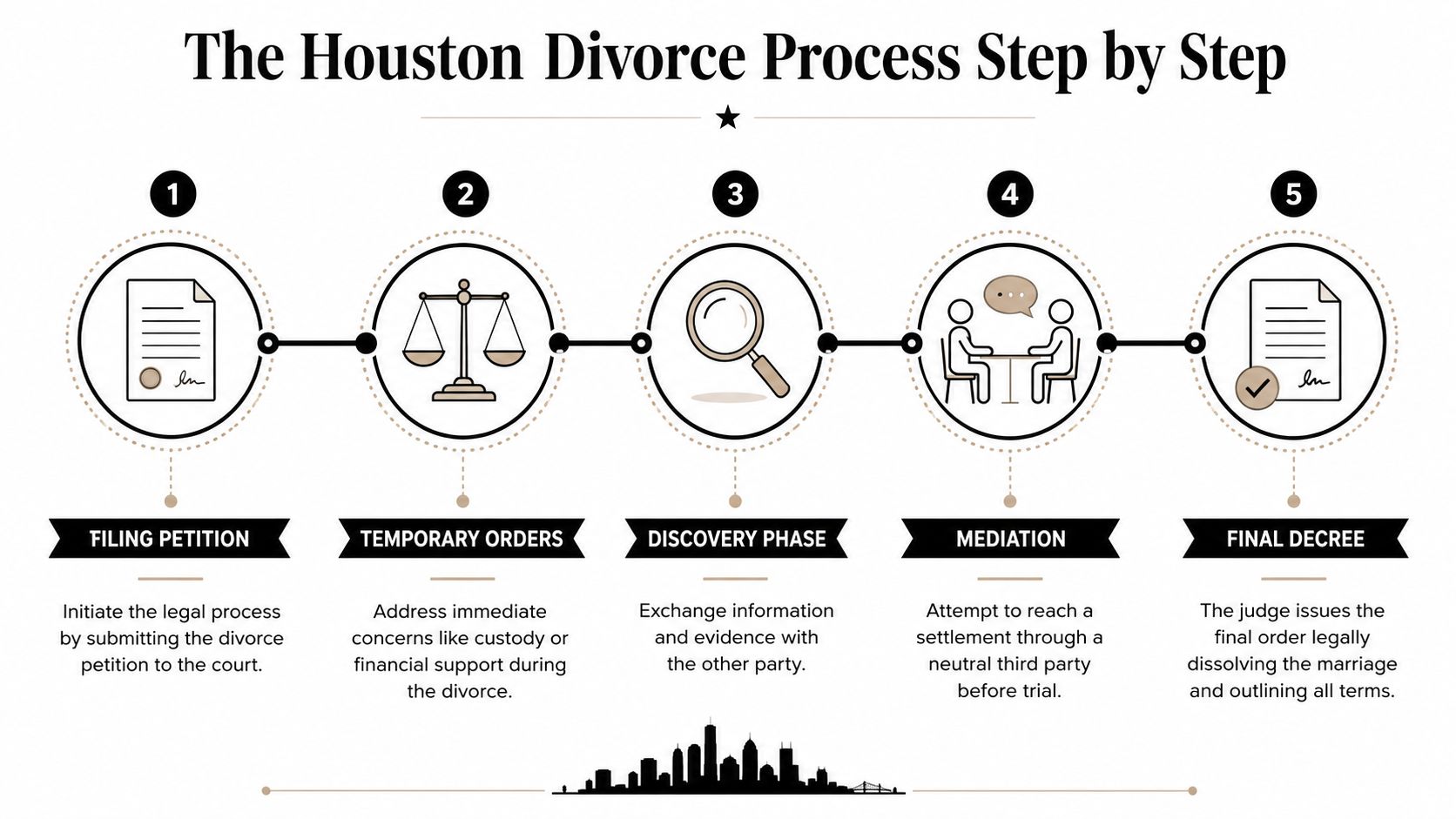
The Houston Divorce Process Step by Step
A Houston divorce usually begins on an ordinary weekday. One spouse files the paperwork, the other is served a few days later, and suddenly questions pile up fast. Who stays in the house? How long will this take? What has to be decided now, and what can wait? Seeing the process in order helps reduce that early panic.
Step one begins with filing and residency
Texas has filing rules before the court can hear the case. One spouse must have lived in Texas for at least six months and in the county of filing for at least 90 days. Filing the Original Petition for Divorce opens the case. It does not finalize anything yet, and it does not mean every decision must be made that week.
Texas also has a 60-day waiting period before a divorce can usually be finalized. That waiting period starts on the day the petition is filed. For many people, this works like a built-in timer. Even in an agreed case, there is usually a floor under how quickly things can finish.
Step two involves notice and early case decisions
After filing, the other spouse must receive legal notice unless they sign a valid waiver. If they are formally served, they have a deadline to file an answer. That response is the legal equivalent of saying, "I am here, and I want to participate in this case."
This early stage often shapes cost more than people expect.
If both spouses communicate clearly and exchange basic information early, the case may stay on a lower-cost path. If service is difficult, deadlines are missed, or one side asks for emergency court involvement, legal fees can rise much sooner. That is one reason many clients benefit from reviewing a realistic cost breakdown for Texas divorce cases before the process gets more complicated.
Some families also need temporary orders near the start of the case. These short-term rules can cover:
- Where the children stay
- Who pays which bills
- Temporary child support
- Use of the home or vehicles
- Conduct while the case is pending
Temporary orders are practical tools. They create structure while the final settlement is still being worked out.
Step three is information gathering
Next comes discovery, which is the formal exchange of information. If your divorce involves a house, retirement accounts, credit card balances, a family business, or concerns about hidden income, this stage matters a great deal.
A fair settlement depends on good information. If the financial picture is simple, discovery may be limited to pay stubs, bank statements, tax returns, and account balances. If the estate is larger or more complicated, the work can expand to business records, tracing separate property claims, appraisals, and detailed debt analysis. That difference often explains why an uncontested divorce and a high-asset divorce can have very different total costs even when both start with the same filing fee.
In cases involving children, discovery may also include school records, medical information, calendars, and messages that help show the child's day-to-day routine.
Step four often centers on negotiation or mediation
Once the facts are clearer, the focus usually shifts to settlement efforts. Many Houston divorce cases resolve through attorney negotiation, mediation, or both. Mediation uses a neutral third party to help both sides work toward an agreement on parenting, support, property, and debt.
Mediation works a lot like a structured settlement meeting with rules and a timetable. It is often less expensive than preparing for a full trial, but it still has a cost. You may pay your own lawyer for preparation and attendance, and you may also pay the mediator's fee. In a straightforward case, that expense can still save money if it prevents repeated hearings. In a high-conflict case, mediation may narrow the issues even if it does not resolve everything.
Step five ends with the final decree
The case ends when the court signs a Final Decree of Divorce. This document sets out who gets which property, who is responsible for debts, what the parenting schedule will be, whether support is ordered, and what each person must do after the divorce is final.
For an agreed divorce, the last step is often a short prove-up hearing after the waiting period has passed. For a contested divorce, finalization may come after temporary hearings, formal discovery, mediation, and sometimes trial. The process is the same road, but some cases have far more stops.
The clearest way to think about timing is this: filing starts the clock, temporary orders create stability, discovery fills in the missing facts, mediation tests whether settlement is possible, and the final decree turns the agreement or court ruling into binding orders.
How Much Does a Divorce Lawyer in Houston Cost
For many people, this is the hardest question to ask and the first one they need answered. You deserve a realistic range, not a vague promise that someone will "work with your budget."
The core numbers to know
In Houston, the average cost of a divorce attorney ranges from $200 to $500 per hour. Uncontested divorces typically cost $5,000 to $7,000 in total legal fees. Contested divorces often range from $10,000 to $30,000, and high-asset disputes can exceed $50,000. Those figures are discussed in this Houston divorce cost overview.

These numbers don't mean your case will land at one exact point. They show the range that usually reflects complexity, conflict, and how much work your lawyer must do to move the case forward.
What drives the bill up or down
A divorce doesn't become expensive just because emotions are high. It becomes expensive when the legal work expands.
Here are common cost drivers:
- Custody disputes: Parenting disagreements often require more negotiation, more drafting, and sometimes more hearings.
- Complex property issues: Business interests, executive compensation, real estate, and separate property claims usually require deeper financial review.
- Heavy discovery: The more documents that must be requested, reviewed, and challenged, the more attorney time the case uses.
- Breakdowns in settlement: Cases that could settle early sometimes become far more costly when communication collapses.
Three realistic cost scenarios
A useful way to think about cost is by scenario rather than by hourly rate alone.
| Scenario | Likely cost picture |
|---|---|
| Fully agreed divorce | Often falls within the uncontested range if both spouses truly agree on all terms |
| Moderately contested divorce | Often rises into the contested range when disputes require negotiation, drafting, mediation, or hearings |
| High-asset or business-owner divorce | Can exceed the upper contested range when tracing, valuation, and financial experts become necessary |
A lower hourly rate doesn't always mean a lower final bill. A lawyer who works efficiently and gives clear direction may reduce wasted time, confusion, and avoidable conflict.
If you're budgeting for your case, this guide on the cost of a divorce lawyer in Texas gives additional context in one place.
What to ask about fees
During a consultation, ask direct questions:
- Is this likely to be billed hourly, or is there any flat-fee component for an agreed case?
- What events usually increase fees in a case like mine?
- How do you handle mediation preparation, court appearances, and drafting?
- What can I do to keep the case organized and reduce unnecessary expense?
A trustworthy answer should be clear, not evasive. You don't need a guarantee. You do need honesty.
How to Choose the Right Houston Divorce Lawyer
The lawyer you hire will shape your experience almost as much as the facts of your case. Skill matters. So does fit.
Start with the questions that reveal strategy
Some consultation questions sound useful but don't tell you much. "How many divorces have you handled?" has value, but it doesn't show how the lawyer thinks.
Ask questions that uncover approach:
- How would you classify my case right now? An attorney should be able to tell you whether your situation looks agreed, contested, or at risk of becoming contested.
- What issues do you see becoming difficult first? Good lawyers spot pressure points early.
- How do you usually approach settlement and mediation? This tells you whether the attorney is practical, reactive, or needlessly combative.
- When do you recommend going to court? You want someone who can litigate when needed, not someone who treats every disagreement like a war.

Watch how they explain things
A strong divorce lawyer in Houston should be able to explain Texas family law in language you can repeat back later. That includes community property, conservatorship, support, mediation, and enforcement.
If the consultation leaves you more confused than when you started, that's a warning sign.
You shouldn't have to guess what your lawyer means. Clear advice is part of competent representation.
This video gives a helpful overview of what to consider during your search.
Use a simple evaluation checklist
After each consultation, write down your impressions while they're fresh.
| What to evaluate | What a good answer sounds like |
|---|---|
| Communication | Clear, direct, respectful, and responsive |
| Case strategy | Tailored to your facts, not generic |
| Fee explanation | Specific about billing and likely cost drivers |
| Temperament | Calm under pressure, not theatrical |
| Fit for your goals | Aligned with whether you want efficient settlement or stronger litigation posture |
If you're comparing multiple attorneys, how to choose the right divorce lawyer in Texas, red flags included is a useful reference point.
One practical option to consider
One option Texans often review is the Law Office of Bryan Fagan, PLLC, which handles divorce, custody, support, mediation, enforcement, and related family law matters across Texas. As with any firm, the key question is whether the lawyer's communication style and case approach fit your needs.
Navigating Special Circumstances in Your Divorce
Some divorces turn on one central issue. Others involve layers of property, parenting, and timing that need a more careful strategy.

High-asset divorces and business interests
Texas follows community property rules. Property acquired during the marriage is divided in a manner the court considers just and right, which doesn't automatically mean a strict equal split. In high-asset Houston divorces, forensic accountants are often used to trace and value business interests, executive compensation, and other complex assets, as explained by Fritz & Phillips on Houston divorce and community property.
For business owners, this usually raises several hard questions:
- Is an asset community property, separate property, or partly both?
- Has a business increased in value during the marriage?
- Were marital funds used to support a separate asset?
- Do the books reflect the actual income picture?
If you own property in multiple forms or want a broader financial planning perspective, some people also read about protecting family assets with Koru to better understand how title and ownership rules can affect long-term planning.
Parenting disputes need a child-focused strategy
When children are involved, legal terms matter, but daily life matters more. Texas courts focus on the child's best interest. In practice, that means judges look closely at stability, caregiving history, decision-making, communication, and whether each parent supports the child's needs.
A custody dispute often becomes harder when parents argue only from hurt. It becomes more productive when they present practical facts:
- school routines
- medical needs
- transportation plans
- work schedules
- communication patterns
- history of involvement in the child's life
Parents usually help their case most when they stay child-focused, organized, and calm, even when the other side isn't.
Military divorce adds timing and jurisdiction questions
Military families often face added stress because service, deployment, benefits, and residence don't always line up neatly with civilian assumptions. A military divorce may require close attention to where the case can be filed, how service is completed, and how parenting plans work when a parent may relocate or deploy.
Even when the legal foundation is still Texas family law, the strategy needs to reflect military realities. That includes planning ahead, keeping records current, and making sure temporary arrangements are realistic.
Your Next Steps and Frequently Asked Questions
You may be sitting at your kitchen table with a stack of bank statements, a few texts from your spouse, and no clear sense of what to do first. That is a hard place to be. It also means this is the moment to get organized, because early decisions often shape both stress levels and legal costs.
A divorce case works a lot like a home repair. If you identify the core issues early, the work is usually more controlled and less expensive. If problems stay hidden until the walls are open, the price often goes up. The same pattern shows up in Houston divorces, especially when a case starts as "simple" but later turns into a dispute over parenting, property, or missing financial information.
What to do next
Start with these three actions this week.
Gather the documents that affect money and parenting
Pull together income records, bank statements, retirement account records, mortgage information, credit card balances, tax returns, and any business documents that matter. If children are involved, add school information, medical details, and a basic calendar showing who handles daily care.Write down your goals in order
Put your priorities on paper. For example, you may care most about keeping a workable parenting schedule, protecting access to cash, staying in the home during the case, or avoiding a drawn-out court fight. This list helps your lawyer give advice that fits your life, not just the legal file.Schedule consultations and ask cost-specific questions
Speak with at least two lawyers if possible. Ask each one how they would classify your case at the start. Uncontested, contested, or high-asset. Then ask what usually increases fees, what can keep costs lower, whether a retainer is likely, and what steps you can take yourself to avoid paying for preventable work.
Those questions matter. A clear cost discussion is often the difference between feeling cornered and feeling prepared.
Frequently asked questions
What should you bring to the first meeting
Bring anything that helps a lawyer understand the facts quickly and accurately. That can include court papers, financial records, a list of assets and debts, a rough parenting schedule, prenuptial or postnuptial agreements, and notes about urgent concerns such as access to money, the children, or the home.
Do not wait until everything is perfectly organized.
A good lawyer can help you sort incomplete information. What helps most on day one is honesty, a timeline of major events, and a basic folder of records that gives a starting point.
What if your spouse lives out of state
A Texas divorce may still be possible. The first questions usually are where each spouse lives, whether Texas residency rules are met, where the children have been living, and whether the Texas court can make orders that affect the out-of-state spouse.
That can sound technical. In practice, your lawyer is trying to answer a simple question. Can a Houston court handle only the divorce itself, or can it also make enforceable decisions about property, support, and children? The answer affects strategy, timing, and cost, so it is worth raising early in the first consultation.
Can you remarry right after the divorce is final
No. As noted earlier, Texas law includes a waiting period after the divorce decree is signed before either former spouse can marry someone else. That post-divorce waiting period is separate from the earlier waiting period that applies before a divorce can be finalized.
If remarriage timing matters to you, mention it to your lawyer. It is a small detail that can become a major scheduling problem if no one addresses it until the end.
What if your case feels simple but emotions are rising
That is common. Many divorces begin with both spouses hoping to "just work it out," then become more expensive once distrust grows or one person starts withholding information.
Early legal advice can help you keep a manageable case from turning into a costly one. Sometimes that means using mediation at the right time. Sometimes it means getting temporary orders in place quickly so bills get paid, parenting time is stable, and everyone knows the rules while the case is pending.
How can I help control my divorce costs
Focus on the tasks that reduce attorney time. Keep your documents in one folder. Communicate in writing when possible. Make a short, dated timeline of major events. Group your questions instead of sending a new email every time one worry pops up.
That does not eliminate legal fees, but it often makes your lawyer's time more efficient.
It also helps you get better advice. When the facts are organized, your lawyer can spend less time reconstructing the story and more time helping you make good decisions.
Key Takeaway
The right Houston divorce lawyer should help you make careful decisions under pressure. You want someone who can explain the law clearly, give you a realistic cost picture, and build a plan that protects your family, your finances, and your next chapter.
If you're feeling overwhelmed, that's normal. You don't have to solve every issue before you ask for help.
If you're ready to talk through your options with a team that handles Texas divorce, custody, property division, mediation, and enforcement matters with clarity and compassion, schedule a free consultation with the Law Office of Bryan Fagan, PLLC. You can get answers about your likely divorce path, the timelines that apply to your case, and the practical next steps to protect yourself and your family.