Skip to content
You may be sitting at your kitchen table right now, searching for a way to end your marriage without turning your life into a courtroom battle.
If that's you, your instinct makes sense. You want something simpler, cheaper, and less emotionally draining. Many Texans type in “online divorce Texas” hoping they can answer a few questions, click submit, and be done.
Sometimes an online path can help. But in Texas, the phrase online divorce often means something much narrower than people expect. The hard part isn't just filling out forms. It's knowing which steps still have to happen with the court, what “uncontested” really requires, and where mistakes can delay everything.
The Promise of an Easy Online Divorce
An easy online divorce sounds like relief.
You may be thinking, “We already agree on most things. We don't want a fight. Why should this be complicated?” That's a fair question. When two people want to move forward respectfully, paying for a long legal fight can feel wasteful and cruel.
The promise you usually see online is simple. Fill out forms at home. Avoid expensive attorney fees. Finish the case quickly. For some couples, that picture is partly true. If your divorce is uncontested, digital tools can help you organize paperwork and start the case efficiently.
Why the promise and the reality don't always match
Texas doesn't have a magic website that grants divorces from start to finish.
What many companies call an online divorce is really a document preparation service. You answer questions online, and the service helps generate paperwork. But the legal system still requires filing, service, waiting periods, court review, and final approval by a judge. If children, retirement accounts, a house, a business, or debt are involved, those details matter.
Practical rule: If a website makes the process sound automatic, slow down. In Texas, divorce still ends with a court order signed by a judge.
That doesn't mean online tools are useless. It means you should judge them realistically. A low upfront price can look attractive until you learn you still need to pay court fees, follow county procedures, and prepare a Final Decree of Divorce that a judge will accept.
A more realistic way to think about it
The best way to approach online divorce Texas is this: it may be a useful starting tool for a narrow category of cases, but it isn't a substitute for understanding your rights.
That matters whether you're a parent trying to protect your parenting time, a business owner worried about valuation issues, or a spouse with significant assets who needs a careful property division plan. It also matters if you're dealing with child support, future enforcement, or the possibility of mediation if agreement breaks down.
If your case stays simple, great. If it doesn't, you'll want to know that before you sign paperwork that affects your children, your property, and your future.
What Online Divorce Really Means in Texas
A spouse sits at the kitchen table after the kids go to bed, sees a website promising an online divorce in Texas, and assumes the whole case can be handled from a laptop. That is usually not how it works.
In Texas, "online divorce" usually means you use online tools for part of the job while the court still controls the legal case. The internet can help you prepare forms, e-file documents, pay filing fees, track deadlines, and sometimes attend a short hearing remotely if the county allows it. The divorce itself still happens in a Texas court, under Texas rules, with a judge signing the Final Decree of Divorce.
That distinction matters because people often buy a platform expecting a finished service, when what they are really getting is help with paperwork.
Two different systems are involved
It helps to separate the process into two buckets.
- A document service
- The court process
A private platform may ask questions and turn your answers into divorce forms. That is similar to using tax software. It can organize information, but it does not decide whether your paperwork fits your county's requirements, whether your decree says what you intended, or whether your agreement protects you later if a dispute comes up.
The court process is separate. Texas counties use eFileTexas.gov for electronic filing, but that system is a filing portal. It is not the same thing as legal advice, case strategy, or judge approval. After filing, someone still has to handle service, waivers if appropriate, corrections requested by the clerk or court, and the final prove-up hearing.
That is where many online divorce plans start to feel less "fully online" than the advertising suggests.
Why these services are popular
Many Texas divorces are uncontested, so there is a real audience for lower-cost document help. Analysts at Ready Divorce Service's 2024 Texas divorce data report that a large share of Texas divorce filings are uncontested. That helps explain why online platforms keep appearing.
Popularity and fit are different questions, though.
An online service may work well for spouses who agree on property division, debt, and every issue involving children. It can become risky fast if one spouse is unsure about retirement benefits, the house, reimbursement claims, separate property, or the wording of conservatorship terms.
What "online" usually does not cover
Online divorce in Texas often leaves out several steps that matter:
- Reviewing whether your agreement is fair and enforceable
- Choosing the right filing county and following local court procedures
- Handling service of process or a valid waiver
- Drafting a Final Decree a judge will sign without revisions
- Preparing for the final hearing
- Fixing mistakes if the clerk rejects a filing or the court wants changes
People also get confused about living arrangements. Texas does not require spouses to live apart before filing. Some couples start the case while still in the same house. If that is your situation, Filing for Divorce While Living Together in Texas explains how that works.
One missing paragraph can create real problems. A decree that says who keeps the car but says nothing clear about the loan is a common example. The marriage ends, but the debt problem does not.
A realistic way to judge an online divorce option
Before you pay for any service, ask practical questions.
Does it only generate forms, or does it explain filing steps in your county? Will it help you understand service and waiver rules? Does it address the final decree in detail, or stop after the petition is created? If children, a home, retirement accounts, or contested debt are involved, does the platform warn you where self-help becomes risky?
Those questions help you see the difference between convenience and legal protection. In Texas, online divorce is usually a tool, not a complete substitute for understanding what the court requires and what your decree will mean after the case is over.
Are You Eligible for an Online Divorce
Before you spend money on any platform, answer one question: Is your case simple enough for an online process?
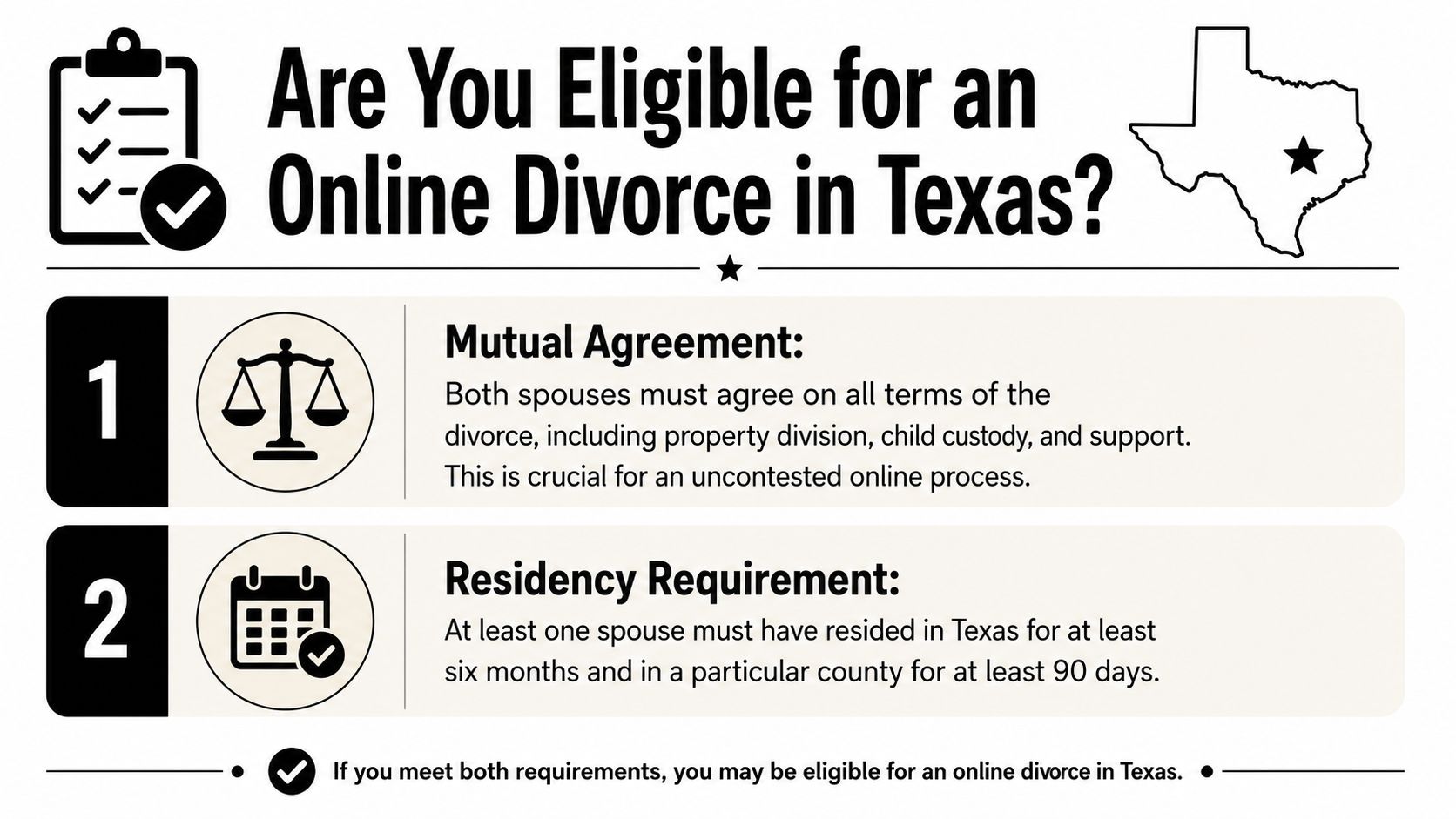
For most Texans, eligibility comes down to two essential requirements. You must meet the residency rules, and your case must be uncontested.
Residency comes first
Texas Family Code Section 6.301 sets the residency threshold. At least one spouse must have lived in Texas for six consecutive months and in the county of filing for at least 90 days immediately before filing, as summarized in this explanation of Texas Family Code § 6.301.
If you don't meet that rule, the court can't properly hear your divorce yet.
A quick example helps. If you moved to Texas recently for work, or if you changed counties not long ago, you may need to wait before filing in your current county. That can be frustrating, but it's better to know now than after your paperwork gets rejected.
Uncontested means full agreement
Many people get tripped up here.
An uncontested divorce doesn't mean you and your spouse are mostly getting along. It means you both agree on all material terms of the divorce. That usually includes:
- Property division such as the house, vehicles, bank accounts, retirement accounts, and debts
- Children's issues including conservatorship, parenting time, child support, and decision-making
- Final paperwork language so the decree accurately reflects the agreement
If there's a real dispute on any of those points, your case may no longer fit the online-only model.
A practical self-check
Ask yourself these questions:
- Can both of you sign off on the same final terms?
- Do you know what property is community property and what may be separate property?
- If you have children, do you already agree on custody and support details?
- Would either of you hesitate to sign a final decree as written?
If any answer is “not sure,” pause before buying a low-cost form package.
A divorce becomes complicated fast when the legal issue isn't the form itself, but the agreement behind it.
For parents, the biggest risk is thinking custody can be handled casually. Texas uses specific legal concepts around conservatorship, possession, and support. For business owners and people with high-value estates, the risk is signing a decree that doesn't divide ownership interests, debts, reimbursement claims, or retirement assets clearly enough to prevent future conflict.
When your case is agreed, online filing may be workable. When it isn't, getting legal advice early usually costs less than fixing avoidable problems later.
The Texas Online Divorce Process Step by Step
A lot of Texans buy an "online divorce" service expecting something like online banking. Fill out a questionnaire, click submit, and the marriage is legally dissolved. Texas does not work that way. The internet can help you prepare and file documents, but a real divorce still moves through a court, follows court rules, and usually ends with a judge signing a decree.
If your case is fully agreed, the process can still be manageable. It just helps to see the hidden steps before you start.

Step one starts with the petition
Every Texas divorce begins with the The Original Petition for Divorce in Texas. This document opens the case and tells the court the basic relief you are asking for.
That first filing is more than a formality. It sets the tone for the case, identifies the parties, and can affect what relief you may request later. Many online services help generate the petition, but they usually stop at document preparation. They do not replace the court.
Step two is filing through the state system
After the paperwork is prepared, you still have to file it with the correct court, usually through eFileTexas.gov and in the right county.
This is one of the places where the "fully online" idea starts to break down. A private platform may collect your answers, but the case is not pending until it is accepted for filing by the clerk. You may also have separate filing fees, service fees, and county-specific requirements. If the filing is rejected because of the wrong county, missing attachments, or formatting problems, the clock does not really start in the way people expect.
For a broader explanation of the filing mechanics, how to file for divorce in Texas walks through the court process in more detail.
Here's a short video that helps many people understand the filing journey in more practical terms.
Step three is notifying your spouse correctly
Filing the case is only the opening move. Your spouse must also receive legal notice unless they sign a proper waiver.
This part causes a lot of confusion. Talking about the divorce, texting a copy of the petition, or emailing papers usually does not satisfy formal service rules. In many agreed divorces, the other spouse signs a Waiver of Service to avoid personal service by a constable or process server. That can save time and money, but only if the waiver is signed in the right form and at the right stage of the case. A defective waiver can delay finalization or force you to redo part of the process.
Step four is turning an agreement into a decree the court can sign
Online platforms often sound simpler than real life.
A questionnaire may collect answers about the house, bank accounts, debts, or parenting arrangements. The harder part is turning those answers into a Final Decree of Divorce that is clear enough to enforce later. The decree needs to say who gets what, who pays which debt, when property must be transferred, and, if children are involved, the exact terms for conservatorship, possession, and support.
A decree works like the instruction manual for life after divorce. If the language is vague, the trouble often shows up later when one spouse will not refinance a loan, transfer a title, divide a retirement account, or follow the parenting schedule.
If disagreements surface at this stage, some couples use mediation to settle the remaining issues without a trial. Even in an agreed case, drafting the final paperwork carefully matters.
Step five is the final court hearing
Texas online divorce still ends with a court event, not just a confirmation email.
In many counties, one spouse attends a short prove-up hearing. Sometimes that is in person. Sometimes the court allows Zoom. The judge reviews the paperwork, confirms that the legal requirements have been met, and decides whether to sign the decree. If something is missing or drafted incorrectly, the judge can require revisions before the divorce becomes final.
That is the realistic roadmap. Prepare the documents, file them correctly, give proper notice, draft a decree that solves the practical issues, and complete the final court step. Online tools can help with parts of that process, but they do not make the court requirements disappear.
DIY Platforms vs Hiring a Lawyer
This choice isn't only about price. It's about risk, complexity, and how much support you need.
For some couples, a DIY service is enough. For others, it creates false confidence. The difference often depends on whether your agreement is complete, your property is straightforward, and your children's issues are already resolved.
The cost question is real, but it isn't the only question
The upfront numbers can make DIY options look irresistible. Online divorce services in Texas average $349, while traditional attorney-led divorces cost $15,000 or more, according to these online divorce statistics. The same source says AI-powered platforms have a 92% completion rate, while basic template services are at 55%, which tells you that quality matters even within the online category.
That doesn't mean every lawyer-led divorce costs the same, and it doesn't mean every online service performs equally. It means you should compare the full value, not just the signup fee.
Comparing Your Options DIY Service vs. Law Firm
| Factor | DIY Online Service | Law Office of Bryan Fagan, PLLC |
|---|---|---|
| Main function | Usually prepares forms based on your answers | Provides legal advice, strategy, document drafting, negotiation help, and court guidance |
| Best fit | Truly uncontested cases with simple facts | Uncontested and contested cases, including parenting disputes and property complexity |
| Cost structure | Lower upfront platform fee, but court costs and correction costs may still follow | Higher financial commitment, but includes legal analysis and case-specific support |
| Risk of form problems | Depends heavily on platform quality and user accuracy | Attorney reviews reduce the risk of missing legal terms or filing the wrong documents |
| Children's issues | Limited help if custody, support, or schedules need legal tailoring | Can address conservatorship, possession, support, and enforcement concerns in detail |
| Business or high-asset property | Often too limited for nuanced drafting | Better suited for business interests, retirement issues, reimbursement claims, and complex division |
| Mediation and negotiation | Usually not included in a meaningful way | Can advise you through mediation and settlement decisions |
| Court appearance prep | Minimal or none | Can prepare you for prove-up, hearings, and next steps |
When DIY may be enough
A DIY path can make sense if all of this is true:
- You both agree fully on property, debt, and, if applicable, child-related terms
- Your finances are simple and easy to describe clearly in a decree
- Neither spouse is hiding information or changing positions
- You're comfortable handling forms and court procedure on your own
If that sounds like your case, you may still want legal education before filing. Some Texans prefer a middle-ground approach, such as reviewing legal resources or using a structured divorce education tool before deciding whether full representation is necessary. If you're weighing that decision, do you really need a divorce lawyer in Texas is worth reading.
The cheaper option is only cheaper if it works the first time and protects what matters to you.
When hiring a lawyer usually makes more sense
Legal help becomes especially valuable when your case includes children, a house, retirement accounts, a business, separate property claims, or a spouse who may not follow through.
The same is true if you need temporary orders, expect mediation, or worry about future enforcement. A decree that looks simple can create serious problems if it doesn't clearly divide assets or set out parenting terms in enforceable language.
Timelines Costs and Common Pitfalls
A common Texas online divorce story goes like this. Someone uploads answers late at night, pays a small platform fee, and assumes the hard part is over. Weeks later, they learn the court still has its own clock, its own filing requirements, and often a final hearing that no website can attend for them.
That gap between expectation and reality is where delays and extra costs usually appear.

The timeline starts with the court's calendar, not the platform's
Online tools can help you prepare forms faster. They do not shorten Texas law. Under Texas Family Code Section 6.702, the court cannot sign the Final Decree until Day 61 after filing, and a plain-English explanation in this Texas divorce checklist discussion of § 6.702 notes that a case filed on January 1 cannot be finalized before March 2 in a non-leap year.
That is only the minimum waiting period. Real cases often take longer because papers need correction, service is delayed, a spouse does not sign on time, or the prove-up hearing is not scheduled correctly. Online divorce works more like online tax software than online shopping. The software may help you prepare, but the legal result still depends on accuracy, timing, and follow-through.
The advertised price is rarely the full price
The first number people see is often the platform fee. That number can be misleading if you treat it like the whole budget.
Court filing fees are usually separate. Service fees may apply if your spouse will not sign a waiver. Some counties require specific local procedures. Many people also end up paying for notarization, revised paperwork, e-filing charges, or limited legal help to fix a decree before the hearing. If you want a clearer budget, review the full breakdown of how much a divorce costs in Texas instead of relying on the checkout page of a document service.
There is another cost people miss. Delay has a price too. If a decree is rejected or a hearing is missed, you may spend more time off work, more money refiling documents, and more emotional energy reopening a process you thought was nearly finished.
The final hearing catches many DIY filers off guard
Many Texans hear "online divorce" and picture a process that ends when the forms are submitted. Texas usually does not work that way. In many counties, an uncontested divorce still ends with a short prove-up hearing before the judge signs the decree.
One attorney discussion of common Texas online divorce misunderstandings reports that 60% of self-represented filers miss this or other key deadlines. Whether the missed step is the hearing, a waiver, a signature, or a corrected decree, the result is the same. The case sits unfinished.
A divorce becomes final when the judge signs a valid Final Decree, not when the forms are uploaded.
The mistakes that slow cases down
Some problems show up again and again because online platforms cannot spot every practical issue in a real family case:
- A decree that sounds fair but is too vague to enforce, especially with retirement accounts, debt allocation, or parenting details
- An uncontested case that stops being uncontested once one spouse hesitates to sign
- Missed court notices or clerk messages because the filer assumes the platform is monitoring the case
- Digital document handling that creates privacy risks, especially when couples share devices or email accounts during separation. If you are uploading financial and family records, think about securing sensitive legal information
- A case that looked simple at the start but needs advice, such as separate property claims, child-related terms, or a spouse who is inconsistent
The practical lesson is simple. "Online" describes how some paperwork gets prepared and filed. It does not mean the divorce runs by itself. The more clearly you understand that, the easier it is to budget your time, your money, and your risk.
What to Do Next to Protect Your Rights
A lot of Texans reach this point believing the hard part is over. The forms are filled out, the filing is done, and the rest should be routine. In many cases, that is where avoidable trouble begins.
If your divorce is simple, an online divorce in Texas may still be a reasonable option. The key is knowing what you are handling by yourself. An online platform can help with documents, but it usually does not protect you from a vague decree, missing terms, a signing problem, or a hearing issue that leaves the case unfinished.
That matters even more if children are involved, if one of you owns a business, if retirement accounts or a house are part of the estate, or if your spouse has been cooperative one week and hard to reach the next. In those situations, the first form is often not the problem. The larger risk is agreeing to final language that looks fine today but creates conflict, expense, or enforcement problems later.
Privacy deserves attention too. Divorce paperwork often includes tax returns, pay stubs, bank records, account numbers, and details about your children. If you are sharing files by email, storing them in cloud folders, or using a shared home computer, take time to think about securing sensitive legal information before private records spread farther than you intended.
A short consultation with a Texas family lawyer can help you pressure-test your plan. That conversation can tell you whether your case still fits a DIY path, whether mediation would solve a sticking point, and whether the decree says enough to protect you after the judge signs it. It can also help you spot issues that online services do not evaluate well, such as separate property claims, child-related terms, debt language, and future enforcement.
Key Takeaway
Online divorce in Texas is a court process that uses digital tools. It is not a fully online system that runs on its own. If you treat it like paperwork only, you can miss the steps that decide whether your divorce finishes and whether your final orders protect you.
If you're considering divorce and want clear answers about your options, schedule a free consultation with Law Office of Bryan Fagan, PLLC. You can speak with a Texas family law attorney about uncontested divorce, custody, support, mediation, property division, or whether an online path fits your situation. Virtual consultations are available across Texas, so you can get practical guidance without adding more stress to an already difficult time.