Skip to content
Yes, Texas is a community property state, which means most property you and your spouse acquired during your marriage is owned equally by both of you. Texas is also one of only nine states that follow this system, which is why the rules can feel unfamiliar and surprisingly strict if you're starting a divorce in Texas.
If you're lying awake wondering whether the house, retirement account, business income, or debt in your spouse's name could affect your future, you're not overreacting. Property division is one of the most stressful parts of divorce because it touches everything at once: your finances, your home, your children, and your next chapter.
Facing Divorce and Wondering What Happens to Your Property
When people ask, is Texas a community property state, they usually want to know something more personal: What happens to my stuff, my paycheck, my savings, and my debt if my marriage ends?
The short answer is that Texas treats most property acquired during marriage as belonging to both spouses. The Texas State Law Library explains that Texas is one of only nine community property states, and that classification means property acquired during marriage is equally owned by both spouses.
That sounds simple. In real life, it rarely feels simple.
Why this causes so much confusion
You may have a car titled in your name, a bank account your spouse never touched, or a house purchased with money that came from your side of the family. It's natural to assume title decides ownership. In Texas divorce court, title is only part of the picture.
Practical rule: If property was acquired during the marriage, the court will usually start by treating it as shared unless someone can prove otherwise.
That starting point affects more than obvious assets. It can shape the outcome for retirement benefits, business interests, bonuses, stock options, and debts that built up while you were married.
What your divorce process usually looks like
Most Texas divorces move through a series of practical stages:
- Filing the petition so the case officially begins.
- Service and response so both spouses are part of the case.
- Temporary orders, if needed, to address use of property, support, or parenting issues while the divorce is pending.
- Information gathering, including financial records and property documents.
- Negotiation or mediation, where many cases resolve.
- Trial, if you can't agree.
- Final decree, which states who gets what and what each person must do next.
If you're trying to understand how courts approach dividing marital property, this guide on division of marital assets in Texas gives more detail in plain language.
You don't need to memorize every legal term today. You do need to understand that Texas law gives you rights, but protecting those rights usually depends on documents, timing, and strategy.
Understanding Community vs Separate Property in Texas
Texas property law becomes easier to understand when you use a simple image. Think of community property as a shared pot built during the marriage. Think of separate property as a backpack you brought with you or received personally.

What usually goes into the shared pot
In broad terms, property acquired during the marriage is presumed to be community property. Texas follows a strict rule summarized by Baylor Law's marital property handbook: under the rule of implied exclusion, any asset not explicitly defined as separate property is treated as community property, and the spouse claiming otherwise must prove separate status by clear and convincing evidence.
That phrase matters. Clear and convincing evidence is a high standard. It means your word alone usually won't be enough.
Why title doesn't control everything
A common misunderstanding goes like this: "The account is in my name, so it must be mine." Texas law doesn't work that way. An asset can be in one spouse's name only and still be part of the marital estate.
Here's a quick comparison:
| Property question | What often matters most |
|---|---|
| Whose name is on it | Helpful, but not decisive |
| When it was acquired | Often critical |
| Where the money came from | Often critical |
| Can you document the source | Usually essential |
If you want a deeper explanation of how courts apply the just-and-right framework, How Property Is Divided in a Texas Divorce explains that issue in more depth.
What counts as separate property
Separate property is narrower than commonly understood. To protect it, you usually need a paper trail that shows where it came from and why it falls outside the shared pot.
A judge doesn't assume property is separate just because one spouse says it is. The proof has to be specific.
That is why old statements, closing documents, gift records, and inheritance paperwork can become some of the most important papers in your entire case.
Common Examples of Separate Property and Key Exceptions
Separate property often sounds straightforward until you try to apply it to your real life. A family gift gets deposited into a joint account. A business started before marriage grows during marriage. A home bought before marriage is paid down with marital income. Those are the situations where people get stuck.

Assets that often qualify as separate
Texas law recognizes several common categories of separate property. As explained in this summary of separate property rules in Texas, property may qualify as separate if it was owned before marriage, inherited, received as a gift, received as a personal injury settlement other than lost wages, or assigned to one spouse by a pre- or post-nuptial agreement.
Here are familiar examples:
- A house you owned before marriage. If you bought it before the wedding, that starting point matters.
- Money left to you by a parent or grandparent. An inheritance meant for you personally may stay separate.
- Jewelry or valuables given just to you. A true gift to one spouse can qualify.
- A personal injury recovery for the injury itself. The exception is the part tied to lost wages.
- Property defined as separate in a marital agreement. A valid agreement can change the usual default rules.
For a fuller discussion of tracing and proof issues, this article on separate property in a Texas divorce is a useful companion.
Where people accidentally create problems
The biggest trouble spot is commingling. That's when separate and community funds get mixed together so thoroughly that proving the original source becomes difficult.
A simple example helps. Suppose you receive an inheritance, then deposit it into a joint checking account used for groceries, mortgage payments, and family bills. If the records become muddy, proving what portion stayed separate can be much harder.
Keep separate property separate if you can. If you can't, keep records that let you trace every major movement of money.
Real estate, retirement, and businesses
Texas also applies the inception of title rule. FindLaw explains that under Texas law, property is characterized based on when and by whom it was originally acquired, not just when paperwork changed hands later.
That rule matters for:
- Real estate bought before marriage but paid on during marriage
- Retirement accounts that may contain both pre-marital and marital portions
- Closely held businesses started before marriage and expanded later
If you own a company, valuation and division issues can become especially technical. The firm's article on Dividing a Business in a Texas Divorce addresses how closely held businesses are valued and divided.
How a Judge Actually Divides Your Property in a Divorce
This is the point many people miss. Equal ownership during marriage doesn't guarantee an equal split in divorce court.
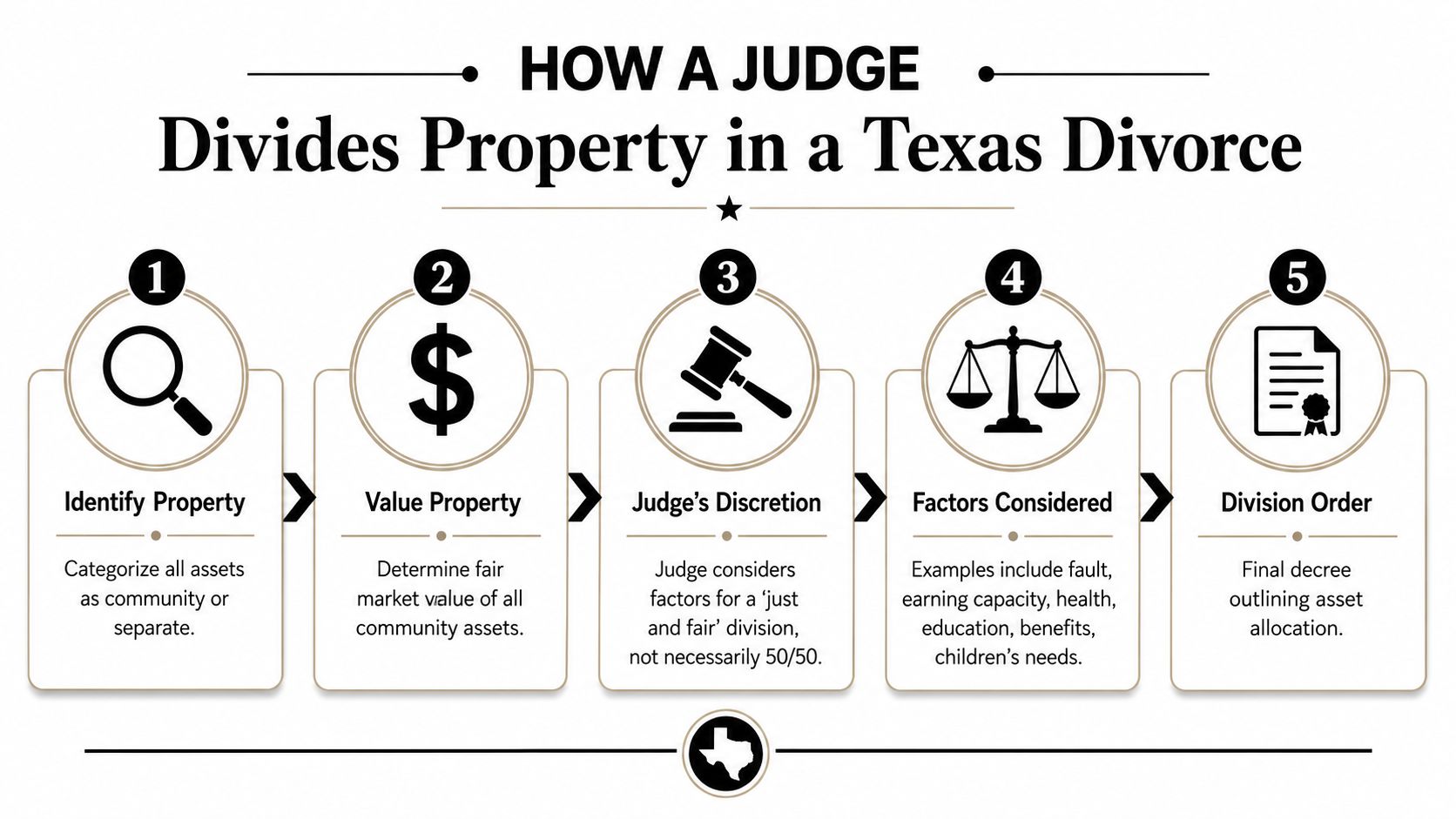
Texas courts use a just and right standard. According to this explanation of Texas community property law, the Texas Family Code requires a just and right division rather than a rigid equal split. That means the court has discretion to divide community property unevenly when the facts support it.
A visual summary may help:
The myth that community property always means half
Many spouses walk into divorce believing the judge will cut everything down the middle. Sometimes the outcome is close to equal. But Texas law does not require a mechanical half-and-half result.
TexasLawHelp notes that a court must make a just and right division while considering children's needs, each spouse's education and earning capacity, fault in the breakup, and which spouse has custody of the children.
That means the court looks at the story behind the numbers, not just the numbers themselves.
What judges often examine
A judge may weigh several factors when deciding whether an unequal division is fair:
- Fault in the breakup. If one spouse's conduct contributed to the marriage ending, that can matter.
- Earning power going forward. A spouse with far greater future earning capacity may not be treated the same as a spouse who stepped back from work.
- Child-related responsibilities. If one parent will carry more of the day-to-day child care, the court may consider that reality.
- Education, health, and financial need. The law allows room for practical fairness.
Here is a plain example. One spouse may have stayed home with children while the other built a career. On paper, both own the community estate. In court, the judge may decide that an exactly equal split wouldn't be just because the spouses are not leaving the marriage on equal financial footing.
Later in the case, mediation often becomes the place where these arguments turn into proposals. Many Texas divorces settle there instead of trial, especially when each side sees the risk of leaving the decision to a judge.
This short video gives a helpful overview of how these issues play out in practice.
The basic court path from filing to decree
Property division usually unfolds through a sequence like this:
- File the divorce petition.
- Exchange information about assets, debts, and records.
- Attend hearings for temporary issues if necessary.
- Negotiate or mediate proposed property terms.
- Present evidence at trial if no agreement is reached.
- Receive a final decree that assigns property and debt.
If your divorce also involves children, property strategy should be coordinated with custody, support, and possession issues because those topics can influence settlement decisions and court outcomes.
Implications for Debts and Estate Planning
Property rules don't stop at divorce. They also affect debt exposure and what happens when a spouse dies without a plan in place.

Debts can be part of the picture too
Many people focus only on assets, but debt matters just as much. A loan, credit card balance, or tax issue tied to the marriage can affect what each spouse walks away with after divorce.
If you're trying to sort out responsibility for liabilities, this article on what happens to debt in divorce can help you understand how Texas courts often approach those questions.
Even when a debt is in one spouse's name, community property issues can still matter. That's one reason full financial disclosure is so important during the divorce process.
A property division that looks fair on paper may not be fair at all if one spouse keeps the assets and the other absorbs the obligations.
Why estate planning matters under Texas property law
Community property rules also shape inheritance if a spouse dies without a will. One especially important rule concerns separate real property. According to this discussion of Texas inheritance outcomes, if a spouse dies without a will, the surviving spouse receives a life estate in one-third of the deceased spouse's separate real property, while the remaining interest passes as provided under Texas intestacy rules.
That kind of result surprises families all the time. People often assume marriage alone guarantees a clean transfer of all property to the surviving spouse. It doesn't.
Practical planning points for families
If you want fewer surprises later, start with these steps:
- Review title and ownership records. Know what was acquired before marriage, during marriage, and by whom.
- Update beneficiary designations. These can affect retirement accounts and other assets outside a will.
- Coordinate divorce and custody planning. Parenting arrangements, support, and property decisions often connect in real ways.
- Think beyond the divorce decree. Enforcement problems can arise later if orders are vague.
For many families, mediation is a useful place to resolve both financial and parenting disputes with more control and less uncertainty than trial.
What to Do Next to Protect Your Assets and Future
By now, the answer to is Texas a community property state should feel clearer, but also more realistic. Yes, Texas follows community property rules. No, that doesn't mean divorce court always ends in a strict half-and-half division.
A practical checklist for your next move
Start with the basics and do them carefully:
- Gather records early. Pull deeds, bank statements, retirement statements, tax returns, business documents, loan records, and any papers tied to gifts or inheritances.
- Separate your categories. Make a rough list of what you believe is community property, what may be separate, and what needs more proof.
- Avoid mixing funds. If you receive inherited money or hold pre-marital assets, don't blur the trail unnecessarily.
- Think about agreements. Texas law allows spouses to change the default approach. As explained here, couples can use a post-marital agreement to alter standard community property division, and courts will usually approve an agreed property and debt plan as just and right.
- Prepare for mediation. Many Texas divorces resolve there, and organized records provide an advantage.
- Look at the whole case. Property decisions often connect with child support, custody schedules, temporary orders, and later enforcement.
If you have children or significant assets
If you're a parent, don't treat property division as separate from your parenting case. The parent who will handle more day-to-day care often needs a realistic financial structure after divorce. If you own a business, have substantial retirement savings, or received family wealth, documentation becomes even more important.
If you also need to think about wills and trusts while reviewing marital property, Cremation.Green's guide to estate planning offers a helpful overview of the difference between a will and a trust.
Key Takeaway
Your most important moves are simple. Learn what you own, document where it came from, and don't assume "community property" means "automatic 50/50." If your divorce involves fault claims, uneven earning power, custody issues, or complex assets, strategy matters just as much as the numbers.
If you're facing divorce and need answers about property division, custody, mediation, support, or enforcement, schedule a free consultation with Law Office of Bryan Fagan, PLLC. You can talk through your situation, identify what may be community or separate property, and build a plan to protect your assets, your children, and your future with clarity and confidence.