Skip to content
Your financial life can feel like it's under a microscope the moment divorce becomes real, especially if you're worried that money, a house, or retirement savings could be split in ways that don't reflect what you brought into the marriage. Texas law does give you tools to protect what's yours, but those tools work best when you understand the rules, gather the right proof, and act before records go stale or accounts get moved.
Understanding Texas Property Law The Foundation of Your Defense
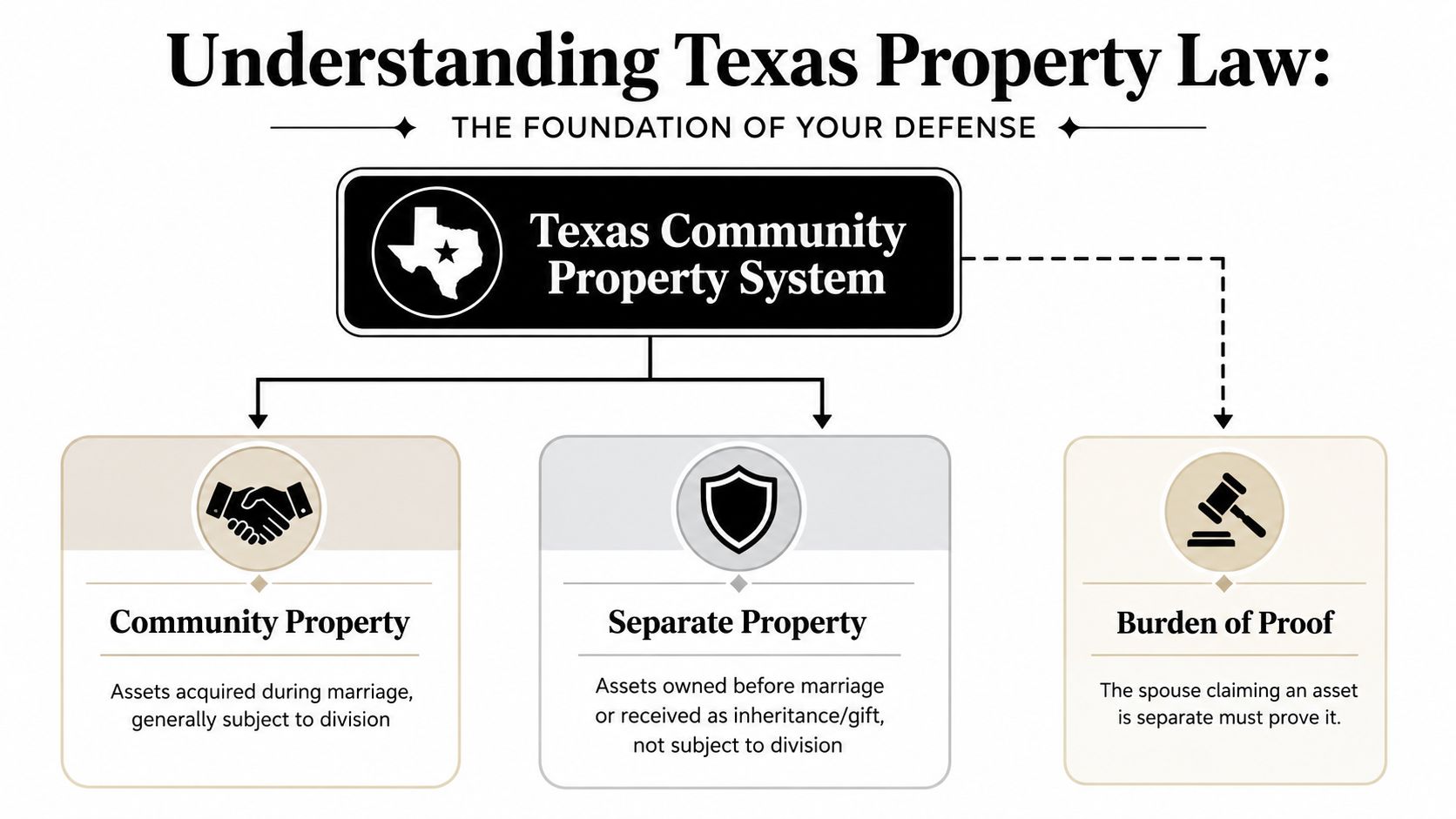
If you're anxious about what happens to your money in a Texas divorce, start with the two legal buckets that control everything, community property and separate property. Texas Family Code § 7.001 requires a just and right division of community property, while Texas Family Code § 3.001 says inheritance is separate property, even if you received it during the marriage or the day before filing. That means the court can divide community property, but it cannot award your separate property to your spouse if you prove it belongs to you.
What the court presumes
Texas starts with a community-property presumption for every asset owned at divorce. In plain English, that means the law assumes the asset is community unless you prove otherwise with clear and convincing evidence. That is a high burden, so paperwork matters as much as the asset itself.
The spouse claiming separate ownership has to prove it. If the paper trail is thin, the presumption usually wins.
That presumption is why people searching for how to protect assets in a divorce Texas need more than general caution. You need proof that links the asset to a premarital account, a gift, an inheritance, or another separate source. Without that connection, a judge may treat the asset as part of the marital estate even if you always thought of it as “yours.”
What separate property really means
Separate property includes assets you owned before marriage and property acquired by gift or inheritance. If you can trace the source, Texas law keeps that property out of division. If you can't trace it, the court may treat the asset as community property because the presumption has not been rebutted.
That's where a lot of people get tripped up. A bank account, for example, is not protected just because your name is on it. What matters is where the money came from and whether you can prove it.
For readers who want a deeper property overview, How Property Is Divided in a Texas Divorce explains the just-and-right division of community property in depth. If you're still trying to decide whether Texas treats you and your spouse as owning everything jointly, this resource pairs well with the more detailed community-property explanation at Texas divorce law guidance on community property.
Building Your Case Creating a Financial Inventory
Protection starts with an inventory, not a courtroom argument. If you want a real chance of proving separate property, gather at least five years of financial records, including bank statements, tax returns, retirement statements, debt records, deeds, titles, and business financials. That record set gives you the timeline you need to show where the money started, where it moved, and what it became.

Build the inventory before negotiations start
Create a line-item list of every asset and debt you know about. Include checking and savings accounts, retirement plans, brokerage accounts, real estate, vehicles, business interests, credit cards, mortgages, and personal loans. Then note three things next to each item, the current holder, the likely source of funds, and whether you believe it is separate or community property.
A clear inventory does two jobs. First, it helps you see the full marital estate instead of guessing. Second, it gives your lawyer a map for tracing. Texas courts care about the origin of the property, not just the label on the account, so your list should follow the money from the first deposit to its present form.
Practical rule: If you can't explain an asset's source in one sentence, you probably need more records before mediation.
Watch for commingling
The biggest record problem is commingling, which happens when separate funds and marital funds get mixed. Once that happens, your job gets harder because you have to reconstruct the source of the money from account history and transaction records. That's why it helps to open a new account in the inheriting spouse's name only when a new inheritance comes in, and keep that account free of household spending.
Clean segregation matters because it makes tracing easier later. If inherited money lands in a joint checking account and pays the mortgage, groceries, and credit cards, the paper trail can become difficult to unwind. If the same inheritance sits in a separate account and never pays marital bills, the trace is usually much stronger.
A lot of people ask how to protect assets in a divorce Texas after the fact, when the records already feel messy. The honest answer is that you start by organizing what exists, not by panicking about what's lost. If you can match each asset to a document and each document to a source, you've already improved your position.
Protecting High-Value and Complex Assets
High-value divorces raise different problems because the asset itself may be hard to value, hard to divide, or both. Retirement benefits earned during marriage are generally treated as community property, and dividing an employer-sponsored plan usually requires a Qualified Domestic Relations Order, or QDRO, so the transfer happens without creating avoidable tax or early-withdrawal issues. Texas spousal maintenance also creates pressure on the financial picture because Texas Family Code § 8.055 caps maintenance at the lesser of $5,000 per month or 20% of the obligor's average monthly gross income, and eligibility is narrow.

Businesses need records, not guesses
If you own a closely held business, valuation becomes a separate fight inside the divorce. Texas lawyers often have to separate the value of the company from the value of the owner's personal efforts, and that's where issues like goodwill and ownership structure come up. The right response is usually a professional valuation supported by books, tax returns, ownership agreements, profit-and-loss statements, and any records showing whether the company grew through marital labor or pre-marriage investment.
If your home or investment property has title defects, conflicting deeds, or unclear ownership history, it can also complicate divorce classification. A useful outside resource on that type of paper problem is BatchData's guide to title problems, because a title issue can affect what gets sold, refinanced, or defended as separate property.
Equity compensation deserves special attention
Stock options and restricted stock units add timing questions. Vesting dates, grant dates, and the marriage timeline all matter because benefits earned during marriage may be treated differently from benefits earned before or after. If you're employed by a company that grants equity, keep award letters, plan documents, vesting schedules, and annual statements together so the timeline stays clear.
Retirement accounts and equity compensation can also change the settlement conversation because a mistake in classification can affect both division and support strategy. If an asset is misidentified, the dollar value of the divorce outcome can shift dramatically, which is why owners and executives need a careful review before mediation.
For business owners, one practical option is to work with a Texas family law team that regularly handles asset tracing, valuation coordination, and settlement planning. The Dividing a Business in a Texas Divorce resource addresses closely held businesses in more detail, and the Law Office of Bryan Fagan, PLLC also guides clients through property division, retirement division, and support issues when the estate is more complex.
Untangling Commingled Funds A Guide to Tracing
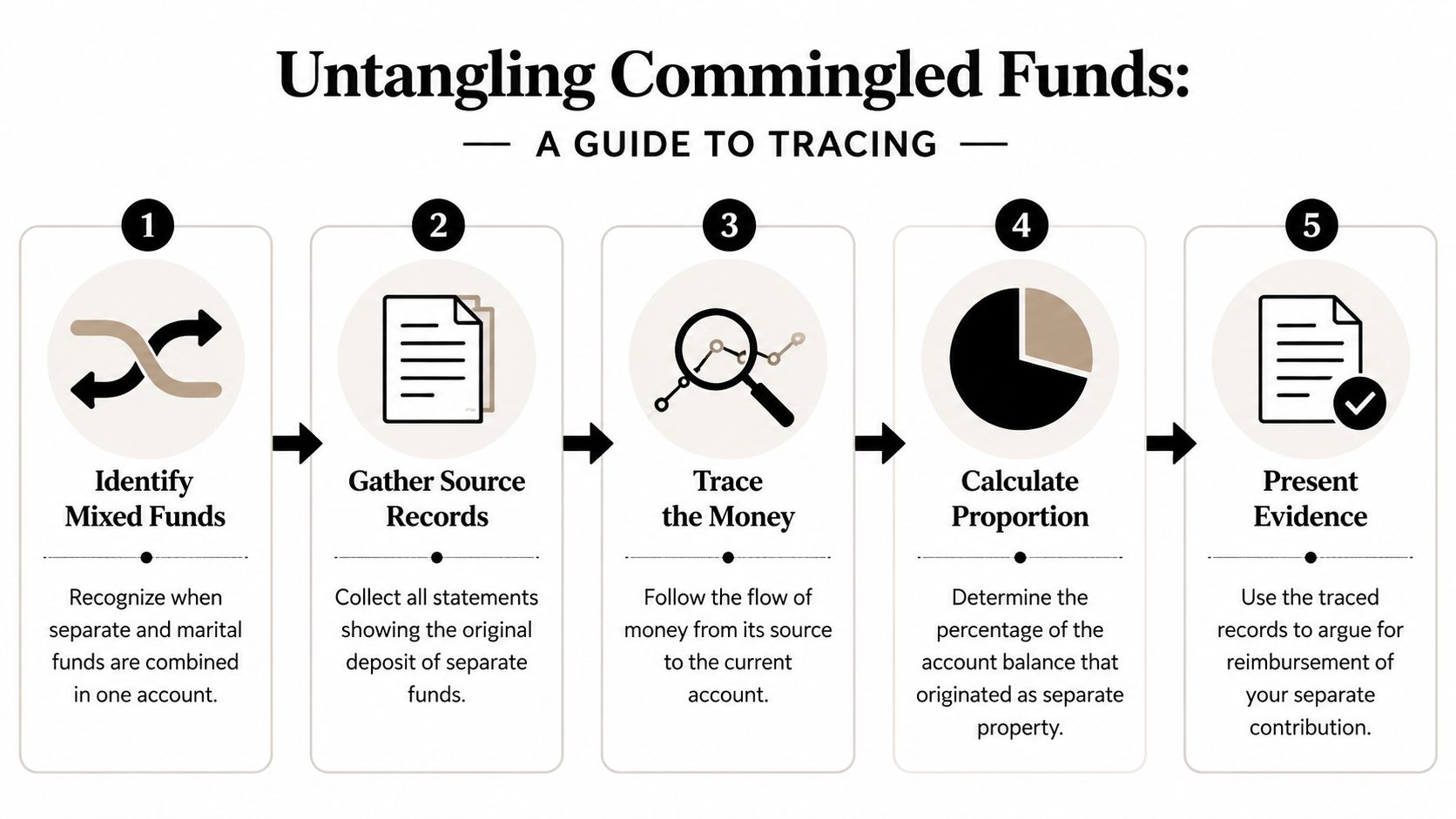
If you've already mixed inherited money with joint funds, you're not alone, and the situation is still workable in many cases. The legal task is to trace the separate source through the account history and show where it went, whether it stayed in cash, paid for a down payment, or bought another asset. Texas law does not reward panic, it rewards documentation.
Follow the money, not the label
Tracing starts with source records. You want the statement that shows the inheritance deposit, gift transfer, premarital account balance, or other separate contribution, then the statements that show every transfer after that point. If the separate money went into a joint account, the next question is whether you can still identify the amount through withdrawals, deposits, and balances.
Reimbursement claims can matter in these situations. If separate funds were used to improve community property, such as paying part of a down payment or funding renovations, the law may allow you to argue for reimbursement even when the original asset itself cannot be returned in kind. The key remains the same: proof.
If you can show the paper trail from source to use, your claim gets much stronger. If you can't, the court may have no reliable way to separate the funds.
What evidence helps most
Account ledgers, wire confirmations, canceled checks, mortgage records, and closing statements are often the strongest proof because they show movement. Tax returns can help explain annual income and ownership history. If the funds moved through several accounts, each account statement matters because the chain has to stay intact.
The Texas-focused tracing guide at Tracing Separate Property in a Texas Divorce is useful if you want a more focused explanation of how courts look at source records and mixed funds. The same logic also helps when you're trying to reconstruct a retirement rollover or a business contribution that started as separate property and then merged into broader household finances.
Use the process before the fight gets worse
You do not need perfect records to begin. You need the oldest statement you can find, the most complete account history available, and a clean timeline of transfers. The more mixed the money is, the more important it becomes to document the origin and destination of each transfer rather than relying on memory.
Using Legal Tools for Immediate Protection
Once divorce is on the horizon, the risk shifts from classification to preservation. If an account can be drained, a vehicle sold, or a debt run up before temporary orders are in place, even a strong tracing case can lose practical value. That's why Texas lawyers often move quickly for temporary restraint and discovery when there's any sign of financial gamesmanship.
Practical rule: Asset protection during divorce is not just about proving ownership, it's also about keeping the property from disappearing before the decree.
Temporary orders can stop bad moves early
A Temporary Restraining Order or temporary injunction can limit unusual transfers, sales, withdrawals, or concealment while the case is pending. If you believe a spouse is trying to move money or dispose of property, this tool can preserve the estate until the court can sort out ownership and division. The Texas-specific process also makes mediation a major checkpoint before the Final Decree of Divorce is entered.
If you need a practical overview of that emergency tool, the firm's page on Temporary Restraining Order Divorce Texas explains how restraint can fit into a larger divorce strategy.
Discovery finds what the first draft of the estate left out
Discovery is where your lawyer asks for the documents the other side may not volunteer. Requests for production can target bank records, retirement statements, credit card records, business ledgers, and title documents. Depositions let your attorney ask direct questions about transfers, accounts, debts, and asset use under oath.
That process matters if separate funds were commingled, because the court needs real evidence, not assumptions. It also matters in high-asset cases because the first financial snapshot is often incomplete. A spouse may forget to disclose an account, undervalue an asset, or leave out a transfer that changes the division analysis.
The goal here is simple. Freeze the financial picture, gather the missing documents, and use the court process to preserve what you've already traced. When those steps happen early, mediation has a better chance of producing a fair result, because both sides are negotiating from the same financial picture.
Your Next Steps A Strategic Action Plan
Start with four moves, inventory, document, trace, consult. First, list every asset and debt. Second, gather the records that prove where each item came from. Third, trace any separate money that was mixed with marital funds. Fourth, sit down with a Texas family law attorney before mediation or temporary orders, because timing affects what can be preserved and how the estate is argued.
Texas divorce usually moves from the Original Petition, to service, to discovery, to mediation, and then to a Final Decree of Divorce. That timeline matters because each step is a chance to protect or lose negotiating power. If you wait until the end, you may be stuck trying to reconstruct accounts that should have been preserved earlier.
What to do next
- Pull records now: Download statements, deeds, retirement summaries, tax returns, and loan documents before access changes.
- Separate new funds immediately: If you receive an inheritance or other separate asset, keep it in a distinct account and avoid using it for household expenses.
- Mark every mixed transaction: Make notes about deposits, transfers, and purchases while the details are still fresh.
- Prepare for mediation: Bring a clean financial summary so settlement talks focus on facts, not confusion.
Protecting assets in divorce is not about being aggressive for the sake of it. It's about being organized, honest, and fast enough to keep your proof intact.
If you're trying to protect your property, retirement, or business interests in a Texas divorce, the Law Office of Bryan Fagan, PLLC can help you build a plan around tracing, temporary orders, mediation, and final division. Visit Law Office of Bryan Fagan, PLLC to schedule a free consultation and get clear guidance on what to protect, what to document, and what to do next.