Skip to content
You're staring at divorce papers, and the part that feels simple on paper is often the part that goes wrong in real life. If you serve them the wrong way, your case can stall before it ever reaches the issues you care about, like custody, support, or property.
What Serving Divorce Papers Means for Your Case
Serving divorce papers is the formal way Texas makes sure your spouse knows a case has been filed. It is about legal notice and a fair chance to respond, and that is what gives the court permission to move your case forward.
Texas divorce courts do not act on a filed petition alone. Once service is complete, the court has proof that the other spouse was notified, and the case can proceed in the ordinary way. Texas Legal Help explains that the response clock starts right after service, and the answer deadline runs on a fixed schedule, 20 days plus the following Monday at 10:00 a.m. (Texas Legal Help).
Do not treat service like paperwork busywork. A bad service attempt can stall the case, force you to start over, or give your spouse an easy way to challenge what you filed.
Practical rule: sloppy service slows your divorce. Clean service keeps the case on track.
Service is the court's proof that your spouse had official notice, whether the case is contested, agreed, or headed toward a default because your spouse stays silent. The court is looking for proper notice, not drama or a surprise confrontation. If you want your divorce to move without avoidable delays, handle service the right way from the start.
Required Documents and Who Can Legally Serve Papers
Before anyone hands over paperwork, you need the right documents in the right hands. In a Texas divorce, the core papers are the Original Petition for Divorce and the Citation, and they are typically served together so the respondent knows a lawsuit exists and how to respond.
If you want a plain-English breakdown of what starts the case, the document itself is described in The Original Petition for Divorce in Texas, which explains what that filing must contain. You can also review the broader document checklist in this guide to essential filing papers: https://texasdivorcelawyer.us/essential-documents-for-filing-for-divorce-in-texas-a-handy-guide/
Texas divorce practice is strict about who can serve. A spouse can be served by a constable, sheriff, or private process server, and in some situations the court clerk can arrange service. Texas court divorce instructions also note that the petitioner cannot personally serve the spouse, even if the relationship is calm and both people are trying to stay respectful. The point is not personal confrontation, it is credible proof for the court. (Texas courts divorce instructions)
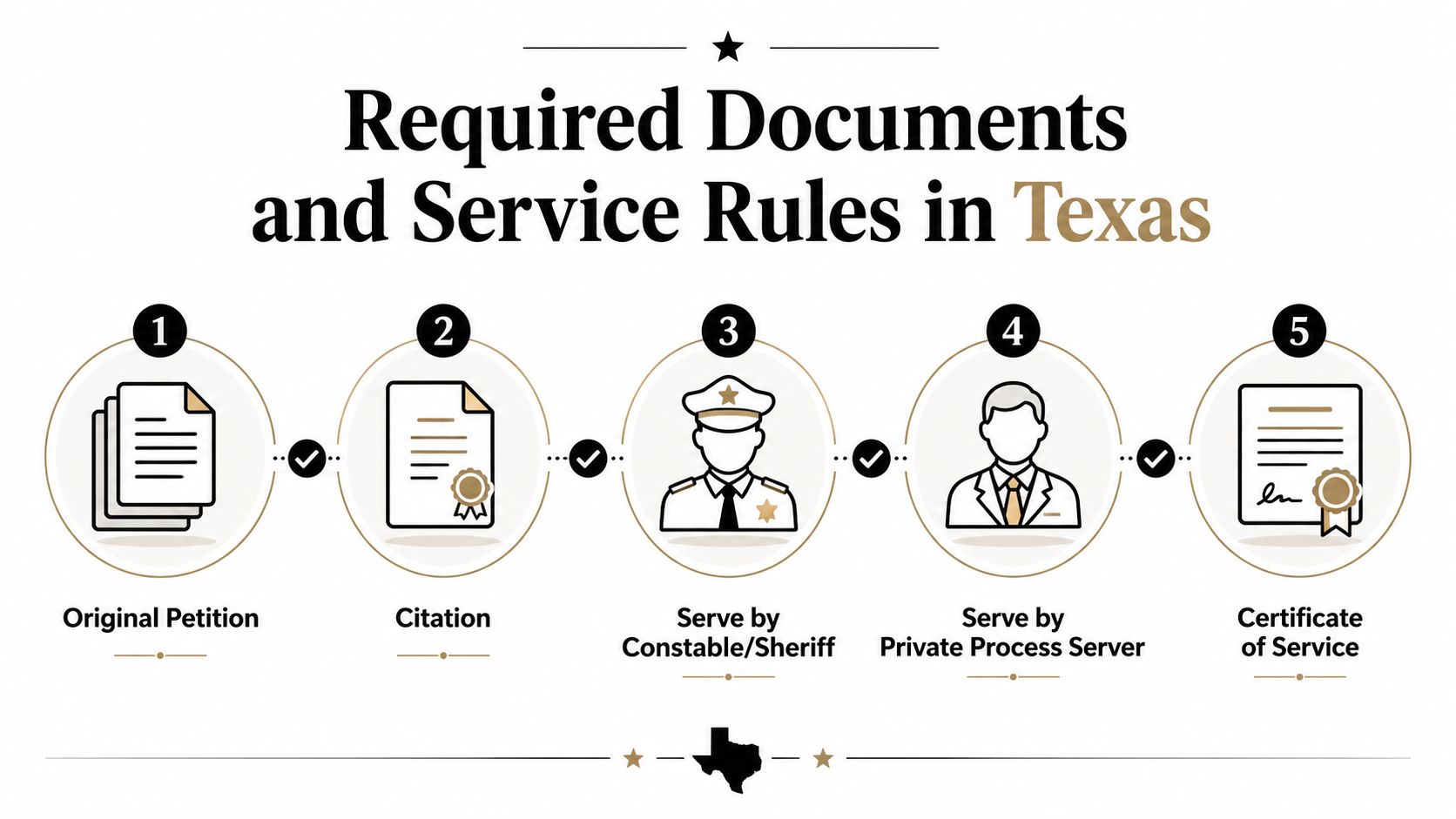
A constable or sheriff is the traditional route. A private process server is often the more flexible option when you need someone who can work around a spouse's schedule or evasiveness. Certified mail can work in some uncontested situations, but it depends on the spouse signing for it, which is why it is not the method I'd lean on when the facts are messy.
The court cares about proof, not good intentions. If the method you choose can't produce clean proof of service, it's the wrong method.
Use the method that fits your case, not the one that feels easiest in the moment. If your divorce is straightforward and your spouse is cooperative, you may not need the most aggressive service route. If there's tension, avoidance, or a custody fight brewing, reliability matters more than convenience.
Choosing the Right Service Method for Your Situation
Not every divorce needs the same service strategy. The right choice depends on how cooperative your spouse is, whether you know where they live, and how much risk you're willing to tolerate if the first attempt fails.
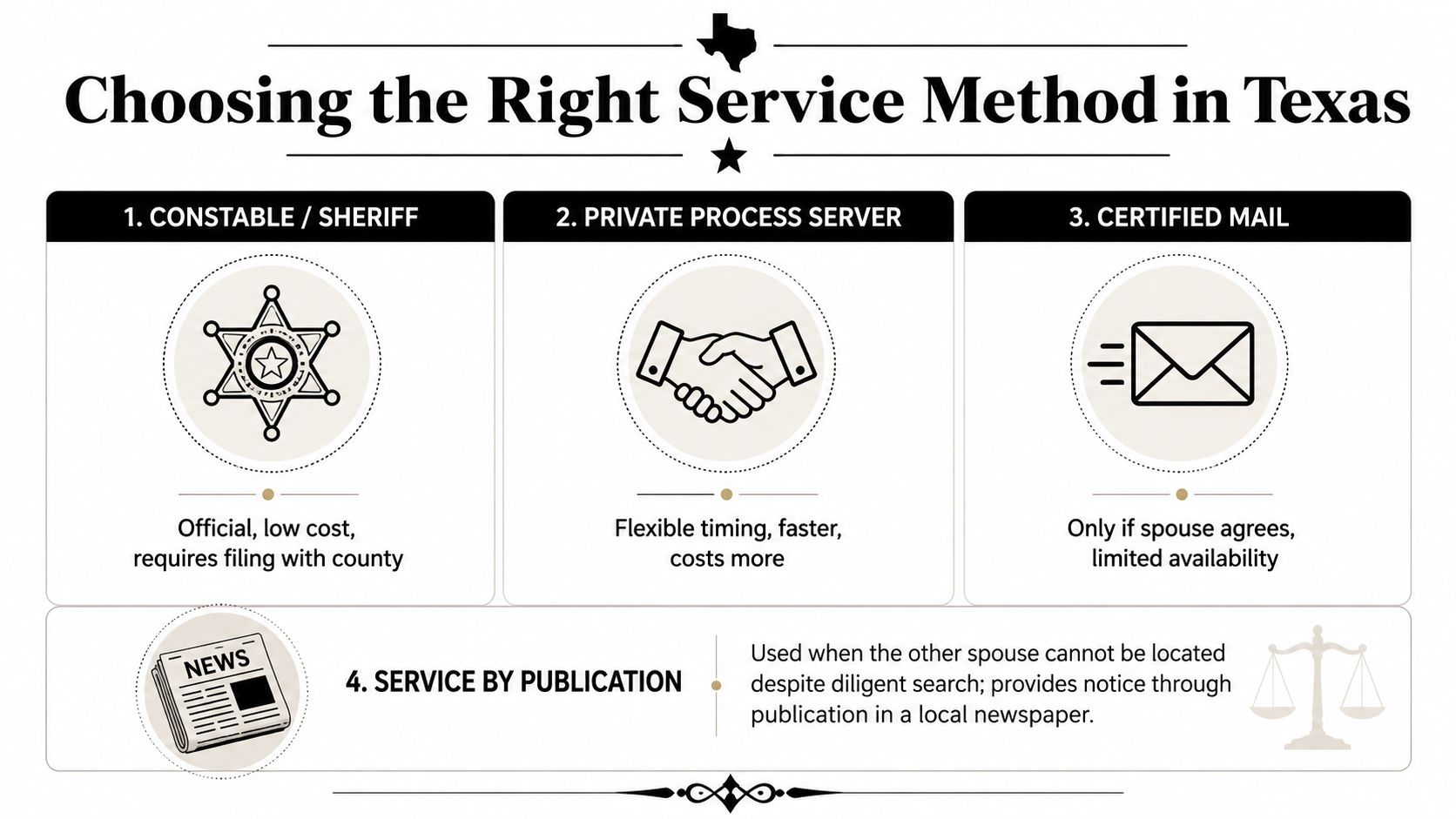
Personal service through a constable, sheriff, or process server
This is the most dependable route when you want a clean paper trail. The server hands the documents directly to your spouse and then files proof that the delivery happened. Texas Legal Help identifies this as the standard service path, and it is the one I trust most when the case may become contested or when you need the court record to be airtight. (Texas Law Help)
Certified mail
Certified mail can be useful when both sides are cooperating and the spouse is likely to sign the return receipt. The problem is obvious, if they do not sign, you have not completed service. That makes certified mail a poor choice when you suspect delay tactics or emotional resistance.
Waiver of service
A waiver can be a smart option in an uncontested divorce, especially when both people want to move quickly and avoid the cost and friction of formal delivery. Texas Law Help discusses when a waiver can fit the process and why it must be handled carefully, because an informal agreement is not enough by itself. For a focused overview, see the firm's waiver resource at waiver of service in Texas divorce cases.
Substituted service
When direct service fails, a judge can authorize a different method. That is not automatic. You need facts showing why the usual route is not working, and the court has to approve the alternative before you rely on it.
If you are dealing with an out-of-state spouse, a spouse living in another county, or someone who keeps changing addresses, your best move is to pick the method that creates the strongest proof, not the one that sounds fastest. In many cases, a private process server is the practical middle ground. In a cooperative case, a waiver may save time. In a hostile case, personal service is usually worth the extra effort because it reduces the chance that you will have to start over.
What to Do When Your Spouse Cannot Be Located or Evades Service
This is the part most guides barely touch, and it is where many Texas divorces get stuck. If your spouse is avoiding service or has vanished, the court expects you to show that you tried before asking for an alternative.
Texas State Law Library materials say you need a diligent search before the court will let you move to service by posting or publication. That means checking with friends, family, former employers, the last known address, social media, voter registries, and property tax records. (Texas State Law Library) Keep notes, save screenshots, and document who you contacted and what you learned.
Build the search record the court wants
A judge is not looking for perfection. The judge is looking for effort that makes sense. If you skip obvious leads, your request for alternative service can fail.
Good documentation beats vague effort every time. Write down dates, names, phone numbers, emails, and every address you checked.
If your spouse cannot be found, Texas law may allow service by posting or publication depending on the facts. Posting is not allowed when minor children are involved, which makes that detail critical in custody-related divorces. Texas State Law Library explains that distinction, and it matters because parents often need a different service path than childless spouses. For a deeper look at publication-based service, use this guide: https://texasdivorcelawyer.us/divorce-by-publication-texas/
If your spouse is in the military, you need to slow down and verify the service rules before you proceed. Military divorces often involve extra steps because courts want to avoid entering orders against someone who may have special legal protections. If the spouse is out of state, you also need to confirm the method still gives the court valid notice.
A practical resource can help you track down a usable address before you waste weeks on the wrong service attempt. If that is where you're stuck, a tool like verify a physical address can help you confirm whether the last known location is still viable.
If you're trying to protect your position while the other side dodges process, a resource on documenting allegations and defending your posture in family litigation, like Gonzalez & Waddington divorce defense, can be useful context for how seriously courts and counsel take paper trails and proof.
Deadlines, Proof of Service, and What Happens After
Once service is complete, the case starts to move on the court's schedule, not yours. Your spouse's deadline to answer has passed, and the key question becomes whether your file is ready for the next step. If you are trying to serve a spouse who is hard to locate, evading service, or stationed out of state, the practical work often starts before that deadline ever arrives. A clean address search matters here, which is why people often need to verify a physical address before they spend time on a failed attempt.
Proof of service carries the weight. Texas divorce courts want a return, affidavit, or other proper record showing who served the papers, when service happened, and exactly how it was done. If that record is missing details or looks wrong, the court can slow the case down even if the papers reached the other spouse. That is a bad trade. A service attempt that cannot be proven usually helps no one.
What the court wants to see
The file should tell a clean story. The petition, the citation, the service method, and the proof that service was finished all need to line up before the case can move with confidence.
Once the answer deadline passes, the next step depends on whether your spouse appeared. If an answer is filed, the divorce moves into the normal contested track, where temporary orders, negotiation, mediation, and decree terms usually come into play. If no answer is filed, you may be able to ask for default relief, but only if the court can trust the service record. Judges do not grant default divorce orders on a shaky file.
Texas divorce also has a mandatory waiting period before finalization, so the service stage affects more than just the answer deadline. Proper service gets the case into the right lane, and good proof keeps it from stalling when you are ready to finish. If the other side is cooperative, a waiver can still be the cleaner path in an uncontested case. Use it only when it is executed correctly and belongs in the file. A casual agreement is not enough, and a friendly text message does not replace formal proof.
A strong service file gives the court no reason to stop your case.
Common Mistakes That Delay Your Divorce and How to Avoid Them
The biggest delays usually come from people trying to be efficient. They want to save time, avoid conflict, or keep the process quiet, then the case stalls because the court cannot rely on the service record.
One common mistake is using the wrong person to serve the papers. If you hand the petition and citation to your spouse yourself, or ask a friend who is not authorized, the service can be defective from the start. The court does not care that the papers reached your spouse if the delivery method does not meet Texas rules.
Another mistake shows up in tougher cases, especially when a spouse is dodging service or lives somewhere else. A rushed attempt at the wrong place can waste weeks. Serving at an old address, a workplace that will not allow process servers on company property, or a military location without checking the proper procedure often forces you back to square one.
Waivers create their own traps. If both spouses are cooperative, a properly executed waiver can keep the case moving without formal service. If the waiver is signed incorrectly, not notarized when required, or filed before the other spouse has seen the petition, the court may treat the paperwork as useless and the uncontested path falls apart.
Filing the proof late is another mistake that causes avoidable delay. If the return of service never gets filed, or gets filed with missing details, the judge may refuse to move the case forward even when the papers were delivered. That problem shows up most often when people assume the server will handle everything for them and never check the file.
Avoid these traps
- Don't serve a spouse at work without checking the rules first: Some employers will not allow process on company property, and a public scene can push the service issue into a bigger problem than the divorce itself.
- Don't send papers to a location you have not confirmed: If your spouse moved, travels for work, or splits time between homes, the wrong address can waste the attempt and give you no usable proof.
- Don't rely on an unauthorized helper: A neighbor, relative, or friend who is not allowed to serve papers can ruin the attempt even if they physically hand over the documents.
- Don't leave a waiver sitting unsigned or incomplete: If the other spouse is cooperating, finish the waiver correctly and get it filed on time, or you lose the benefit of avoiding formal service.
- Don't wait to check the court file: If proof of service is missing, flawed, or filed under the wrong case information, fix it before you ask for the next step.
If your divorce involves property division, children, or a spouse who is trying to avoid the process, service mistakes can complicate the entire case. A delay at the start can interfere with temporary orders, settlement talks, and the final decree. In the broader financial picture, homeowners may also want to review resources like lower your 2026 tax bill with INTELLI while they sort out what the divorce will mean for cash flow and property-related costs.
Your Next Steps and When to Consult a Texas Divorce Attorney
Your action list is straightforward. File the petition, request citation, choose a service method that fits your spouse's situation, complete service, file the proof, and watch the answer deadline closely. If your spouse cannot be found, document your search before asking for alternative service. If both of you want to keep things uncontested, use a properly executed waiver, not a casual verbal promise.
That becomes even more important in cases involving children, business ownership, or significant property. When you are trying to divide a house, retirement, a company interest, or future tax exposure, service mistakes can create avoidable friction. If you're also thinking ahead to property tax issues after divorce, a resource like lower your 2026 tax bill with INTELLI may be relevant in the broader financial picture, especially for homeowners who need to protect cash flow during and after the case.
Some divorces are simple enough to handle with careful paperwork. Others are not. If your spouse is evasive, out of state, in the military, or contesting custody or property, a Texas family law attorney can help you choose the right service path and keep the case moving.
If you need help with divorce service, custody, support, mediation, or enforcement, the Law Office of Bryan Fagan, PLLC can walk you through the process with clarity and steady guidance. For a deeper step-by-step resource on the full filing sequence, see How to File for Divorce in Texas.
If you're ready to move forward, the Law Office of Bryan Fagan, PLLC can help you handle divorce service the right way and avoid the delays that come from missed paperwork or bad process. Visit Law Office of Bryan Fagan, PLLC to schedule your free consultation and get clear guidance on the next step in your Texas divorce.