Skip to content
Texas does not currently offer covenant marriage, so there is no separate covenant-marriage divorce track in the state. Texas divorces normally proceed under the standard no-fault ground of insupportability.
You may be searching “covenant marriage divorce Texas” because you married under a covenant agreement somewhere else, your spouse mentioned a stricter divorce process, or you assumed a religious ceremony created a special legal status. That confusion is understandable. Texas law and the law of the state where you married can raise different questions, especially when you share children, a business, real estate, retirement accounts, or other valuable property.
The practical starting point is simple: determine whether your marriage is a covenant marriage under the law of the place where you entered it, then identify the Texas court and legal rules that apply to your divorce. The information below can help you organize that conversation with a Texas family-law attorney.
Understanding Covenant Marriage and Texas Divorce
Suppose you married in Texas, moved to another state for a few years, and now live in Houston. You and your spouse may remember discussing a church covenant, premarital counseling, or a commitment to seek reconciliation before separating. Those facts can feel legally significant, but a religious promise or counseling session doesn't automatically create a statutory covenant marriage.
Texas doesn't currently offer covenant marriage as a marriage option. Texas legal and family-law educational materials identify Louisiana, Arizona, and Arkansas as the states that currently offer it, and Texas isn't among them. You can review the Texas-focused discussion in this overview of Texas divorce laws, but the central point is that Texas has no separate covenant-marriage divorce track in effect today.

Why your paperwork matters
Covenant marriage is a legally distinct form of marriage created under another state's statute. If you entered one, your marriage certificate and any covenant-marriage declaration can matter. A standard Texas wedding certificate, church ceremony, or private promise generally doesn't transform an ordinary Texas marriage into a covenant marriage.
Texas Family Code provisions instead provide the ordinary divorce framework. That usually means the court evaluates the case under insupportability, along with issues involving children, support, property, and debts. Your next step is to gather the marriage certificate, any covenant documents, prior court orders, and records showing where you and your spouse have lived.
What Is Covenant Marriage
A covenant marriage is a legally recognized marriage option designed to make divorce more difficult than dissolution of an ordinary marriage. Couples who select that status typically agree to additional premarital preparation and accept narrower divorce grounds or counseling requirements under the law of the state where they marry.
The current states identified in the Texas legal materials are Louisiana, Arizona, and Arkansas. Texas doesn't offer the option. That distinction matters because a couple living in Texas can't elect covenant status after an ordinary Texas wedding, and a faith-based commitment alone doesn't create the statutory status.
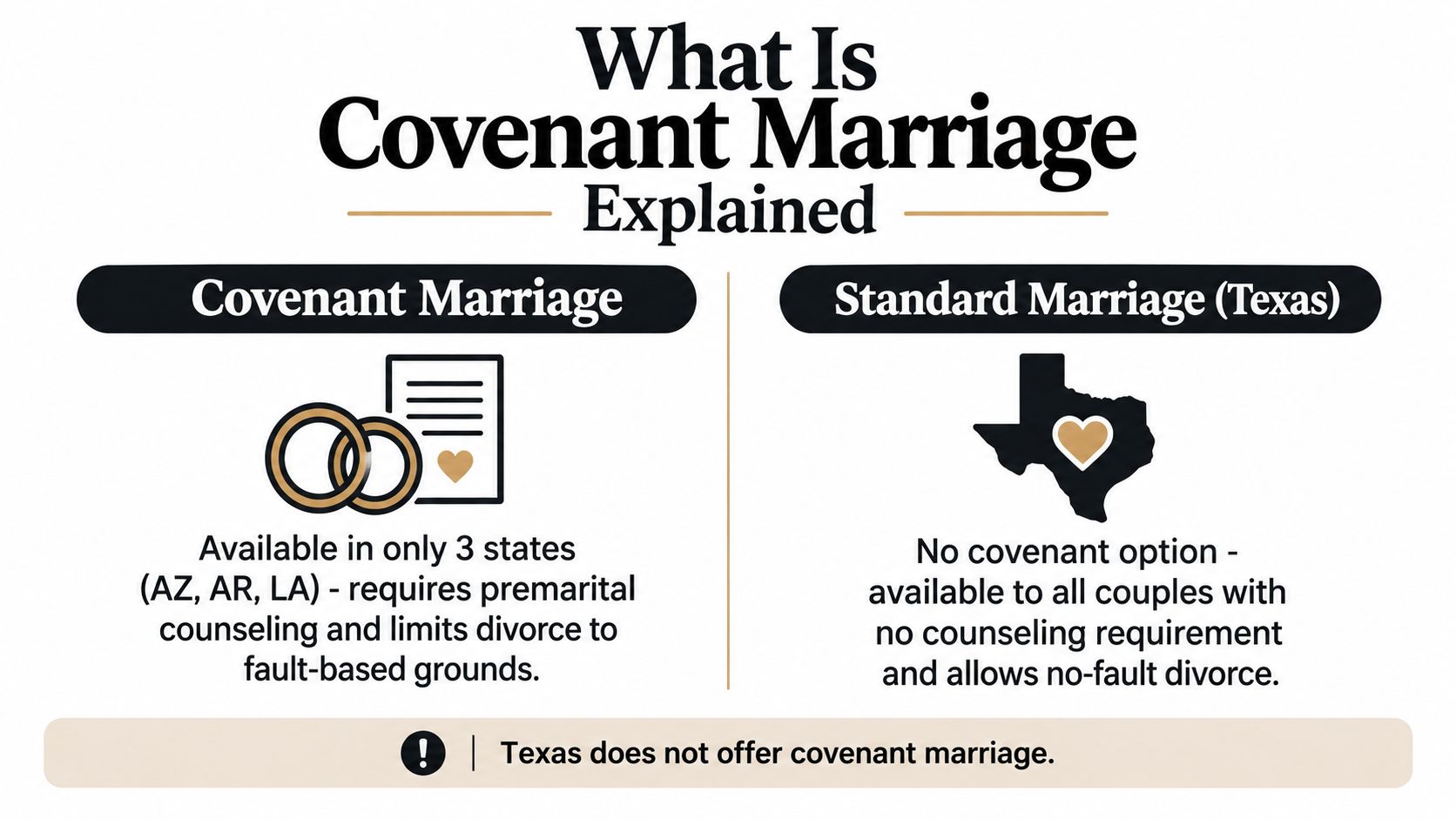
How the two ideas differ
You can think about the difference in three steps:
-
Identify the legal source. A covenant marriage comes from a statute and formal election under a state law. An ordinary marriage may include religious vows, but those vows don't usually alter the civil divorce standard.
-
Check the marriage records. Look for a document that specifically identifies the marriage as a covenant marriage. Don't rely only on memories of premarital counseling or language used during the ceremony.
-
Separate faith questions from court requirements. You may want pastoral counseling or reconciliation efforts for personal reasons. The Texas court, however, decides the divorce under applicable family law.
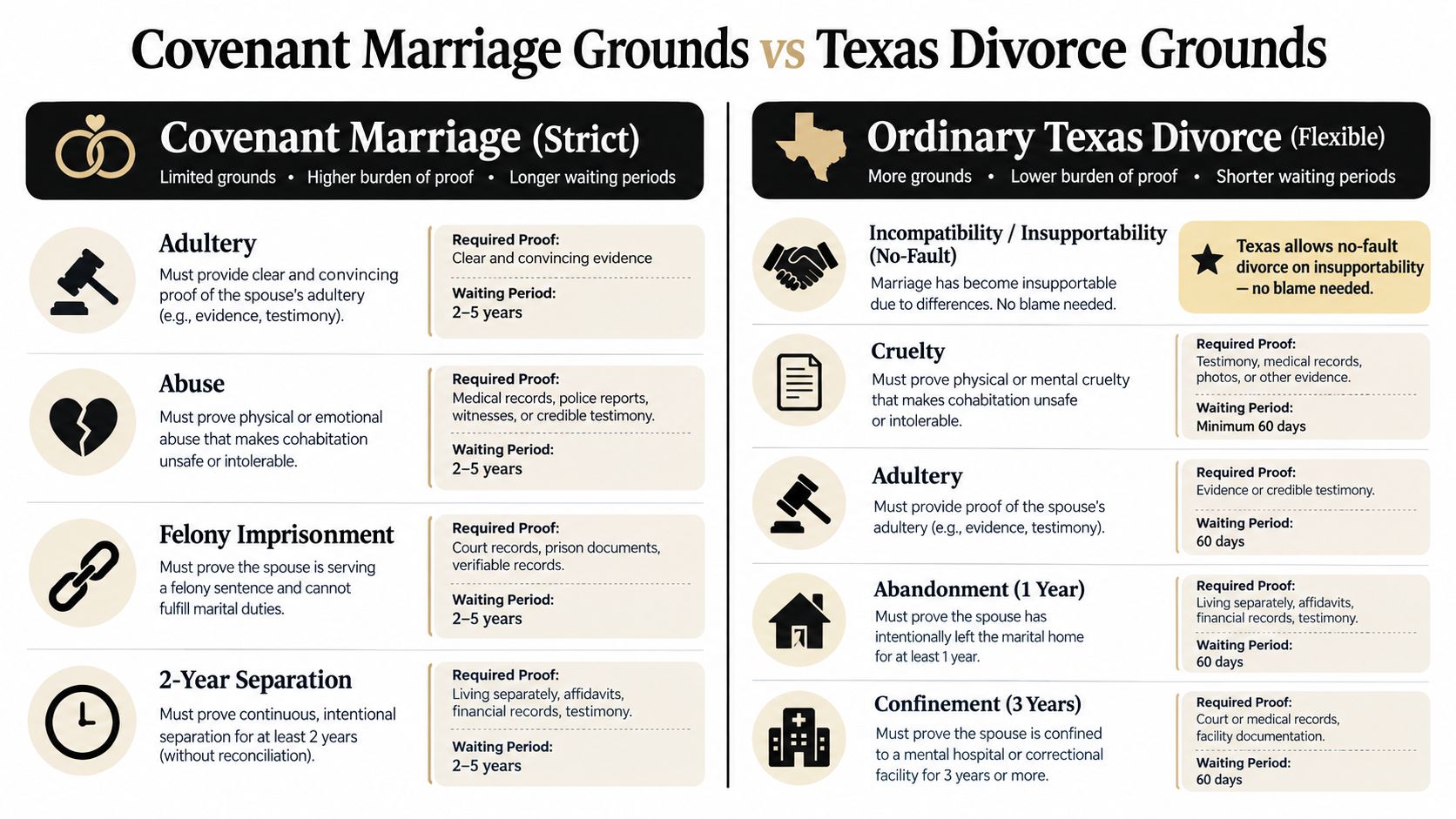
A covenant-marriage statute may limit dissolution to listed grounds such as adultery, felony imprisonment, abandonment, family violence, or prolonged separation. Ordinary Texas divorce generally doesn't require you to prove one spouse's moral blame when the marriage meets the statutory insupportability standard.
How Texas Has Considered Covenant Marriage Over Time
A search for covenant marriage in Texas can lead to old legislative proposals and create the impression that Texas couples may still choose this status. Texas has considered covenant-marriage legislation, including efforts from 1999 and later, but those proposals never became part of the Texas Family Code. A proposal is like a draft blueprint. It may show what lawmakers considered, but it does not change the rules a court applies today.
The proposed framework would have made ending the marriage more demanding than ordinary Texas divorce. One proposal required counseling before a covenant-marriage divorce could proceed, with a narrow exception. Another allowed divorce based on insupportability only when both spouses agreed and completed the required counseling. For couples who elected that status, those conditions would have changed how a no-fault divorce worked in practice.
The proposals also used longer separation periods than the ordinary Texas process. Their timelines included:
- Living apart for at least three years in one proposed circumstance.
- After a legal separation order, two years without reconciliation if there were no minor children.
- Two years and six months if there were a minor child.
These details explain why online discussions sometimes describe covenant marriage as a commitment with a higher threshold for dissolution. They describe proposed legislation, however, not a current Texas filing requirement.
Practical rule: A bill, proposal, or legislative discussion does not control your divorce unless it became applicable law. Your attorney should review the current statute and your actual marriage documents, rather than relying on an online description of a proposed Texas covenant-marriage system.
That distinction matters especially if you married under a covenant statute in another state and now live in Texas. The out-of-state records may affect how the marriage is identified, but Texas legislative history alone does not create covenant status here. If your records show an ordinary marriage, the current Texas divorce framework governs the proceeding.
Covenant Marriage Grounds versus Ordinary Texas Divorce Grounds
A spouse who married under a covenant in another state may expect Texas to require proof of adultery, felony conviction with imprisonment, abandonment for a defined period, family violence, or prolonged separation. Those grounds can apply under a covenant-marriage statute, sometimes with reconciliation counseling before filing. They do not create a separate Texas filing track. Texas has not adopted the proposed covenant-marriage structure.
Texas Family Code § 6.001 provides the ordinary no-fault ground of insupportability. A court may grant a divorce when conflict or discord has destroyed the marital relationship and leaves no reasonable expectation of reconciliation. The Texas Family Code divorce provisions state that rule, while this guide to grounds for divorce in Texas explains related options.
Why abuse questions require care
A client may describe a relationship as abusive and ask whether that description automatically satisfies a covenant-marriage ground. The answer depends on the governing statute and the evidence. Legislative language identified family violence as a limited ground, but it did not make every harmful act an automatic basis for ending the marriage.
Family violence may match a listed ground when the applicable law defines it that way. Verbal or emotional abuse can cause serious harm without fitting a narrow covenant-marriage provision. Addiction, gambling, pornography, or coercive control may also damage a relationship without appearing as independent grounds in a covenant statute.
Safety planning comes first. If there is an immediate risk, seek help and ask an attorney about protective orders and temporary court relief. Those requests address present safety, custody, property, or financial concerns, even when the divorce itself proceeds under a different legal ground.
Texas insupportability generally does not require the same narrow proof of fault. Your attorney can separate the reason the relationship ended from the specific orders you need, such as protection, temporary custody arrangements, or safeguards for property.
If You Married under a Covenant in Another State and Now Live in Texas
You married under a covenant statute in another state, moved to Texas, and now need a divorce. Your Texas residence does not automatically erase the covenant designation. It also does not mean the other state's restrictions automatically govern every issue in a Texas case. The answer depends on the marriage documents, each spouse's residence, the children's history, and whether a Texas court has jurisdiction.
Begin by gathering the records that define the marriage. Locate the marriage certificate, covenant declaration, premarital agreement, counseling records, and any orders issued by the state where you married. Tell your attorney where both spouses live and where the children have lived. Those details help identify the proper court and whether another state's law raises a recognition or choice-of-law question.
Texas has no covenant-marriage track in its Family Code. A Texas divorce therefore does not follow the same statutory structure used by a state that created covenant marriage. The other state's law may still matter, much like a rule printed on a contract from another jurisdiction. Your attorney must examine the specific statute and documents rather than assume either that the covenant controls or that it disappears.
If Texas is the proper forum, prepare for a case that may include these decisions:
- File an Original Petition for Divorce with the marriage, residency, children, property, and requested relief identified.
- Serve the other spouse, or obtain a legally valid waiver or answer.
- Request temporary orders for parenting schedules, support, residence, debt payments, or property protection when needed.
- Exchange information and attempt negotiation or mediation.
- Present an agreement to the court, or prepare for a contested hearing.
- Obtain a final decree addressing the marriage and unresolved issues.
A spouse living elsewhere can raise jurisdiction, service, or objection questions. Review this guide to Texas divorce involving an out-of-state spouse and bring those questions to a Texas family-law attorney before filing.
Texas Divorce Process, Timelines, and Waiting Periods
Texas divorce procedure begins with the petition, not with the final hearing. The spouse who files submits the pleading that asks the court to dissolve the marriage and address related issues. The Original Petition for Divorce in Texas must contain the information needed to start the case, including the basic facts and relief requested.
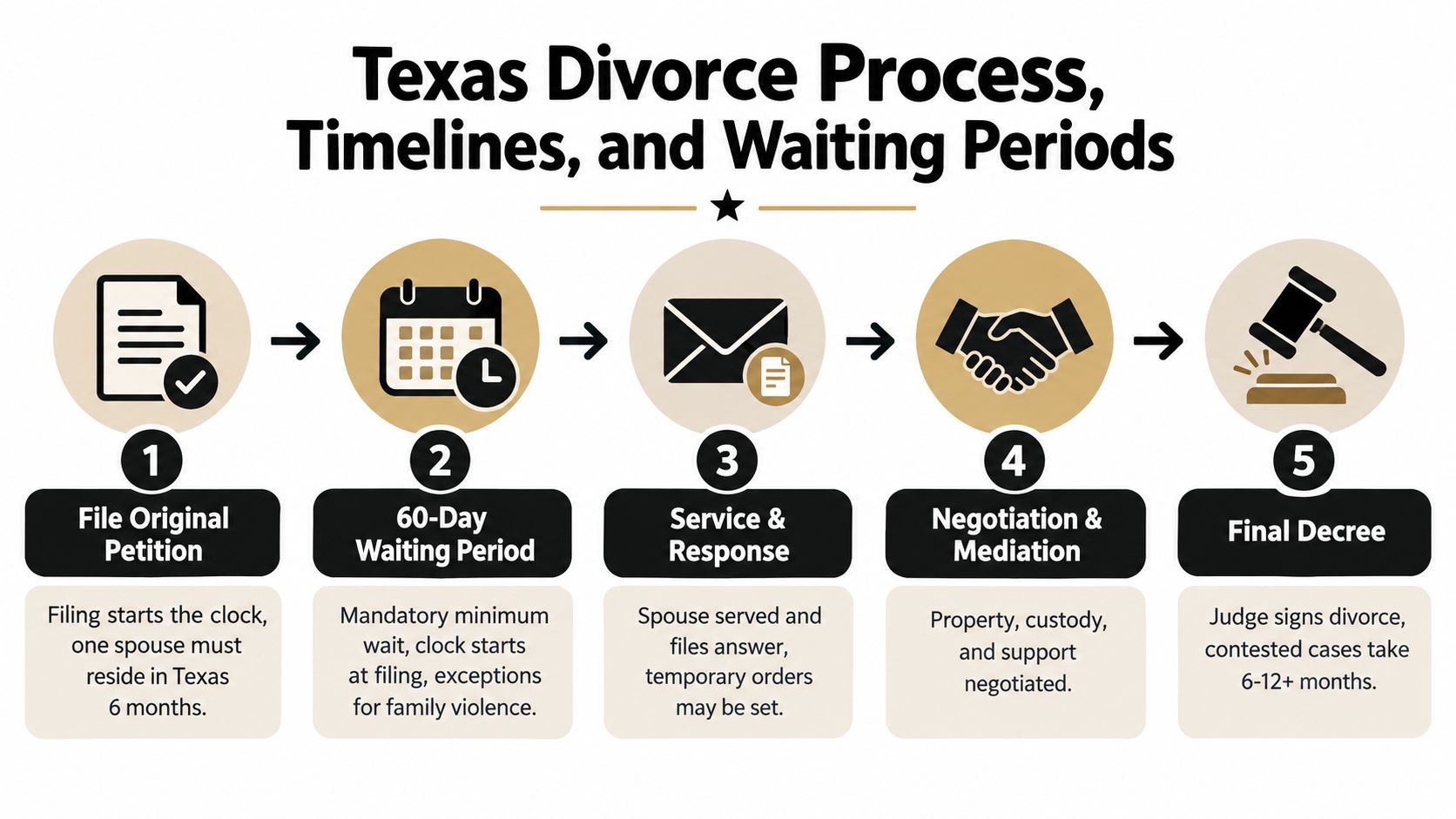
The core steps
1. File the petition. Filing starts the court case and the statutory waiting-period clock. You should prepare for property, custody, support, and safety concerns before submitting the petition because the requests in that document shape the early case.
2. Observe the 60-day waiting period. Texas Family Code § 6.702 generally requires 60 days to pass before a court may grant the divorce, and the countdown begins when the petition is filed. The statute provides two family-violence exceptions. The court may waive the waiting period if the respondent was finally convicted of or received deferred adjudication for family violence, or if the petitioner has an active protective order or magistrate's order for emergency protection based on family violence. Review the Texas waiting-period statute with counsel.
3. Complete service or waiver. The responding spouse must receive proper notice unless the spouse signs a valid waiver or files an answer. Temporary orders may set the rules while the case is pending, especially when you need immediate direction about children, expenses, or property.
4. Negotiate and mediate. Mediation gives both spouses a structured opportunity to resolve property, custody, support, and other terms without asking a judge to decide every disputed issue. A mediated agreement still needs to be documented correctly and incorporated into the final decree.
5. Obtain the final decree. The judge signs the decree after the legal requirements are satisfied and the unresolved issues are presented. An uncontested case may move differently from a heavily contested case, and disputes over businesses, high-value estates, custody, or hidden assets can require substantial preparation.
Property Division, Custody, and Support in Texas Divorce
Divorce doesn't end with the question of whether the marriage should be dissolved. Your final orders also determine how you and your spouse will divide property, make decisions for children, exchange possession, and handle support. A covenant-marriage question shouldn't distract you from preparing for those practical consequences.
Texas is a community property state. Property acquired by either spouse during the marriage is generally community property, and Texas law presumes property possessed by either spouse during the marriage or at divorce is community property unless a spouse proves separate-property status by clear and convincing evidence. Only community property is divided in the divorce. The Texas community-property presumption makes records especially important.
Protecting the financial picture
If you own a business, collect financial statements, tax returns, ownership records, compensation information, and evidence of contributions. A business can involve separate-property claims, community value created during the marriage, or valuation questions that require careful financial analysis.
If you have a high-value estate, identify real estate, investment accounts, retirement interests, stock options, valuable personal property, insurance, debts, and trusts. Don't transfer, conceal, sell, or retitle assets to gain an advantage. Preserve records and ask counsel how to protect assets lawfully while the case proceeds.
Planning for parents
For parents, custody decisions involve conservatorship, possession, access, and decision-making authority. You should build a parenting proposal that reflects school schedules, transportation, medical needs, extracurricular activities, communication, and any safety concerns. Child support and medical-support issues should be addressed as part of the broader parenting plan, not treated as an afterthought.
A workable parenting order protects your child's routine and gives both parents clear instructions they can follow.
Temporary orders can establish a short-term structure while you negotiate or prepare for trial. If a spouse violates a court order after the case, enforcement may become necessary. Your attorney can help you connect property strategy, parenting evidence, support records, mediation, and enforcement planning into one coherent case.
Practical Next Steps and When to Contact a Texas Family Law Attorney
Begin with a document folder, whether paper or electronic. Include your marriage certificate, any covenant-marriage paperwork, court notices, protective orders, bank and investment records, tax documents, property records, business information, and communications relevant to parenting or safety. Write down important dates and explain where you and your spouse have lived.
You should seek legal advice early if your marriage began under a covenant statute, your spouse lives outside Texas, or you disagree about whether Texas is the proper place to file. Counsel is also important when you own a business, have a high-value estate, face coercive control or family violence, serve in the military, or expect a contested custody or property case.
Questions to bring to your consultation
- Does my marriage certificate identify a covenant marriage?
- Which state law may affect the marriage's legal status?
- Can I file in Texas, and what facts establish jurisdiction?
- What should I request for temporary custody, support, or property protection?
- Which assets may be community property, and what evidence supports separate-property claims?
- Is mediation appropriate, and what should I prepare before attending?
- What should I do if my spouse violates an order?
What to do next: Don't let an unfamiliar label delay a careful review of your actual documents. Texas doesn't currently provide a separate covenant-marriage divorce process, but an out-of-state covenant marriage can still justify specific legal analysis before you file.
The Law Office of Bryan Fagan, PLLC offers guidance on Texas divorce, custody, support, property division, mediation, and enforcement, including cases involving out-of-state marriages and complex estates. Visit Law Office of Bryan Fagan, PLLC to schedule a free consultation and discuss the documents, timeline, and next steps for your situation.