Skip to content
When your spouse has disappeared and your life feels frozen, it’s hard to know whether the law can still help you move forward.
If you’re searching for answers about divorce by publication texas, you’re likely dealing with more than paperwork. You may be carrying fear, frustration, and a long list of practical questions. Can you still file? What if you share children? What if your spouse shows up later and tries to undo everything?
Texas does provide a path forward when a spouse can’t be found. But this process is narrow, court-supervised, and easy to misunderstand. It’s also one of the few divorce procedures where getting a final decree isn’t the same as getting lasting peace. That matters most when child custody, child support, property division, business interests, or retirement accounts are involved.
Stuck in a Marriage Because You Can't Find Your Spouse?
You may have spent months trying old phone numbers, asking relatives, checking social media, and waiting for some sign of where your spouse went. Meanwhile, the marriage still exists on paper. You can’t fully close that chapter, and you may feel like the missing person is still controlling your life by doing nothing at all.
Texas law recognizes that problem. In limited situations, you may ask the court to let you serve divorce papers by public notice instead of personal delivery. That process is called service by publication. It is designed for cases where a spouse can’t be located after serious effort.
Texas overall has a relatively low divorce rate compared with the national average, but individual family law cases can still be complicated. Texas maintains a divorce rate of 2.1 divorces per 1,000 population, which is below the national average, according to Texas divorce statistics summarized here. Cases involving a missing spouse are one example of that complexity.
Practical rule: Divorce by publication is usually a last resort, not a shortcut.
That distinction matters. Judges don’t grant publication because a spouse is hard to deal with, refusing to cooperate, or ignoring texts. The court usually wants proof that you’ve made a real and documented effort to find the other person first.
If you’re in this position, you’re not alone, and you’re not out of options. A missing-spouse divorce can move forward when the facts support it. If you want a broader overview of that path, this guide to missing spouse divorce in Texas is a helpful starting point.
Qualifying for a Divorce by Publication in Texas
Before the court lets you use publication, you must show that your case belongs in a Texas court and that more traditional service methods won’t work. Those two points sound simple, but they’re where many people get stuck.

Start with residency
Texas courts can only grant a divorce if residency requirements are met. In plain English, that means either you or your spouse must have lived in Texas long enough, and in the county where you file long enough, for that court to hear the case.
This is one of those areas where people often confuse “where I live now” with “where I’m allowed to file.” If you moved recently, or if your spouse disappeared after moving around, the filing county may need close review before anything else happens.
If children are involved, jurisdiction gets even more sensitive. Custody decisions depend on more than where you currently live. The court may look closely at where the children have been living and which court has authority to make conservatorship and possession orders.
The court expects a diligent search
The heart of a divorce by publication case is the diligent search. This means more than saying, “I don’t know where my spouse is.” You must usually show the judge what you did to try to locate them.
A proper search often includes efforts like these:
- Checking last known addresses: You may need to review old leases, utility records, mail, or prior residences.
- Contacting known relatives or friends: Courts often expect you to try people who may reasonably know where your spouse is.
- Reviewing online information: Social media, professional listings, and public-facing directories may matter.
- Looking at public records: Depending on the facts, that can include court records, jail records, or property-related records.
- Following obvious leads: If someone tells you your spouse may be in another city, ignoring that lead can hurt your request.
Judges want to see effort, not assumptions. If your affidavit is vague, incomplete, or skips obvious steps, the court may deny publication and require you to keep searching.
A weak search record can create problems later, even if the court initially signs off on publication.
Your affidavit matters more than most people realize
You’ll usually need an Affidavit of Diligent Search. Think of it as your sworn timeline of what you tried, when you tried it, and what happened. This document should be factual, organized, and specific.
A stronger affidavit usually does three things well:
- Lists concrete actions you took to find your spouse.
- Gives dates or timeframes so the court can see the search was real and recent.
- Explains the results of each effort, even when the result was “no response” or “address no longer valid.”
If your spouse has children with you, owns a business with you, or may claim separate property later, your affidavit becomes even more important because the court will want confidence that publication really was necessary.
Plain-English legal issues to keep in mind
Texas family law also affects what the court can decide once the case is filed:
- Property division: Texas is a community property state, which generally means property acquired during marriage may belong to both spouses.
- Children: Courts focus on the child’s best interest when deciding conservatorship, possession, and support.
- Final orders: A decree signed after publication may not be as durable as one entered after confirmed personal service.
For parents and business owners, that last point is especially important. If your decree divides a closely held business, addresses reimbursement claims, or includes custody terms, every early filing step needs to be done carefully.
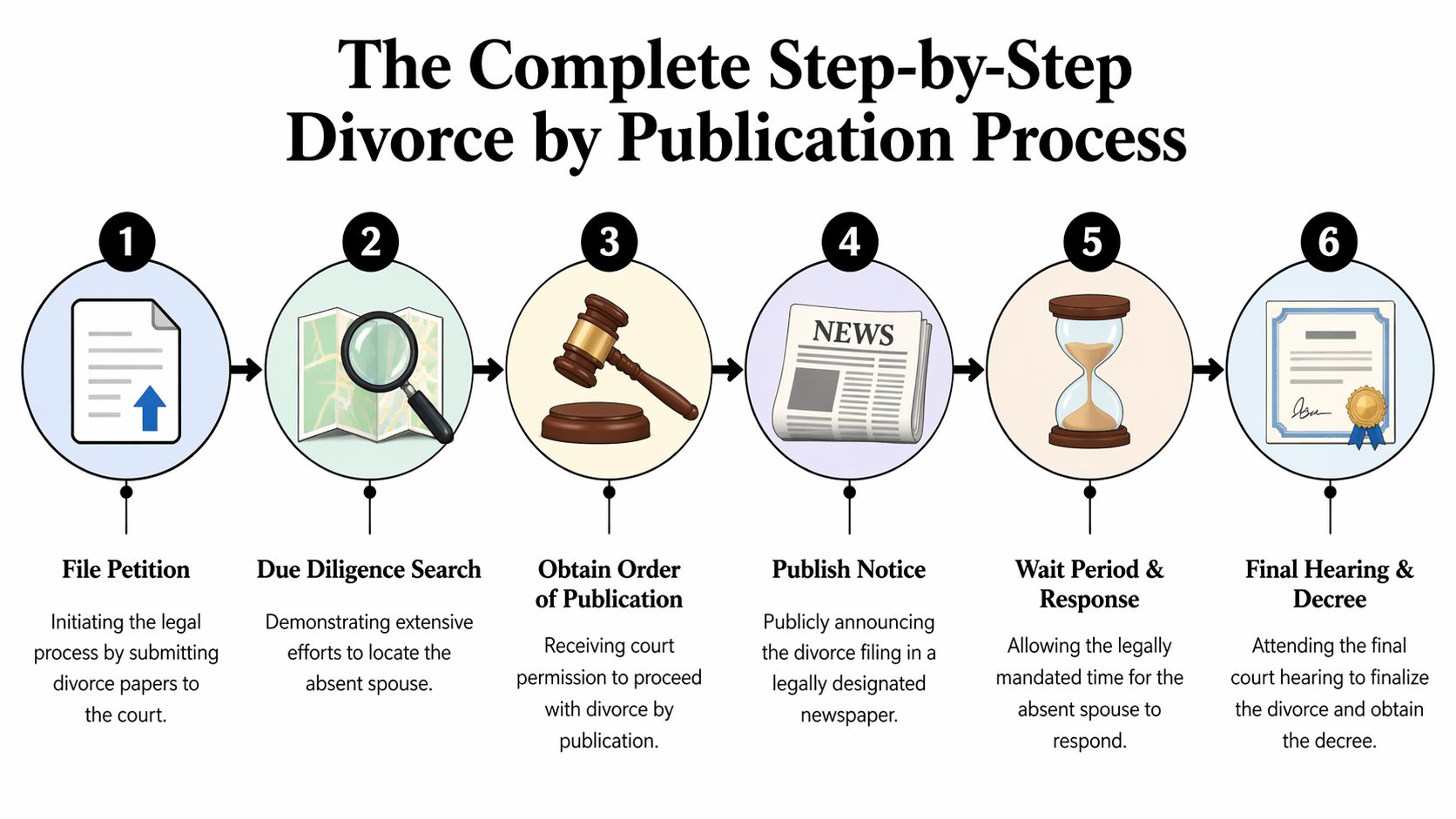
The Complete Step-by-Step Divorce by Publication Process
This process feels less overwhelming when you see it in order. Each step builds on the one before it, and skipping details early can create expensive problems later.
File the divorce petition
The case begins with an Original Petition for Divorce filed in the proper Texas court. This document identifies the parties, confirms the marriage, and tells the court what relief you’re requesting.
If you have children, real property, retirement accounts, or a family business, your petition should reflect that clearly from the start. Courts don’t like surprises at the prove-up hearing, especially in default settings.
You may also need other opening documents required by your county, such as civil case information forms or standing-order notices. Some counties have local procedures that affect filing sequence and document format.
Ask the court for permission to use publication
After filing, you don’t automatically get to publish notice. You usually must file a motion or request asking the court to authorize service by publication, supported by your affidavit showing diligent search efforts.
That request tells the judge, in effect, “I tried reasonable methods. I still can’t find this person. Please allow another form of notice.”
At this stage, many cases slow down. If the affidavit is too thin, if names are misspelled, or if addresses don’t line up with earlier filings, the court may require corrections.
If you want a broader look at how defaults work in Texas family court, this step-by-step guide to default divorce in Texas can help connect the pieces.
The judge reviews your request
A judge must sign an order allowing publication before notice is published. Until that happens, publication isn’t valid service.
The court may ask questions such as:
- What was the spouse’s last known address
- Who have you contacted to try to locate them
- Did you search obvious online or public record sources
- Are children involved
- What property issues need to be decided
If the judge believes ordinary service still might work, the request may be denied or postponed.
Courts want publication used only when better notice isn’t available.
An attorney ad litem may be appointed
In publication cases, the court may appoint an attorney ad litem for the missing spouse. This lawyer does not represent you. Their role is to protect the interests of the absent party and to make an effort to locate them.
That can surprise people. They assume publication means the case becomes one-sided. It doesn’t. The court builds in extra protection because publication is a weaker form of notice than personal service.
The attorney ad litem may review your file, examine your search efforts, and report back to the court. If your search was incomplete, the ad litem may say so.
For parents, this role is especially important. Child-related orders entered after publication often receive closer scrutiny because the court wants to avoid unfairness to a parent who may not have learned of the case.
A short video can help make these court steps easier to picture:
Publish the notice
Once the judge signs the order, notice must be published in the manner the court requires. The publication must follow the court’s instructions and any applicable rules about content and placement.
The notice generally tells the missing spouse that a divorce case has been filed and gives information about the court and case. It is not a newspaper ad in the ordinary sense. It is a formal legal notice, and wording matters.
You will also need proof that the publication occurred properly. That proof becomes part of the court record.
Wait for the response period
After publication, the law requires time for the missing spouse to respond. During this period, several things can happen.
A spouse may appear and file an answer. A relative may contact the court. The attorney ad litem may find better contact information. Or no one may respond at all.
This waiting period can be emotionally frustrating because it may feel like nothing is happening. In reality, the court is protecting due process. That protection is one reason the final decree can stand up better later, if the steps were done carefully.
Attend the prove-up hearing
If the spouse does not answer, you may move toward a default prove-up hearing. At that hearing, you present testimony and paperwork showing the court that all legal requirements were met and that the requested orders are appropriate.
The judge may ask about:
- Residency
- The diligent search
- The publication record
- Children and proposed conservatorship
- Property and debts
- Whether the requested division is fair
If children are involved, the court may limit what it is willing to order unless jurisdiction and notice issues are fully supported.
Receive the final decree
If the judge approves the case, the court signs a Final Decree of Divorce. That decree ends the marriage and sets out the orders that apply to property, debts, children, and any name change.
For business owners or people with substantial assets, the decree should be drafted with care. Vague language about real estate, retirement accounts, reimbursement claims, or business control can lead to enforcement problems later. A decree that is technically final can still be difficult to use if it doesn’t clearly assign rights and obligations.
Hidden Risks and How to Protect Your Final Decree
A divorce by publication can solve the immediate problem of a missing spouse. It can also create long-term vulnerability if the case is handled too casually. That’s the part many online guides don’t explain well enough.

Default doesn’t always mean durable
When a spouse is served by publication and never appears, the resulting decree is often a default judgment. People hear “default” and assume the case is over for good. In reality, publication-based defaults can be more exposed to later attack than decrees entered after personal service.
That’s especially true if the missing spouse later argues they could have been found with a better search. If your affidavit skipped obvious steps, left out likely relatives, or ignored available records, the absent spouse may claim the notice was not adequate.
The court will look closely at process. It won’t be enough to say you believed your spouse was gone for good.
The strength of your final decree often depends on the strength of the search record behind it.
Child custody and support need extra caution
Publication cases become more sensitive when children are involved. Courts are cautious about binding an absent parent on custody, visitation, and support issues when notice was indirect.
The practical risk is not just legal theory. The risk is future instability. A parent may reappear and ask the court to revisit conservatorship, possession, or support. If the original file doesn’t show careful compliance, you may find yourself back in litigation after believing the case was finished.
That’s one reason attorney ad litem involvement matters so much. Under Texas Rule of Civil Procedure 244, publication cases involving a non-answering party require that safeguard, as discussed in this TexasLawHelp article on service by publication when you can’t find the other parent. That same discussion also notes a common content gap. Many guides explain the process but don’t explain the practical weaknesses of later child-related enforcement and modification fights.
For parents, a careful approach may include:
- Narrow and realistic requests: Ask for orders the court can confidently support on the record.
- Detailed child facts: Provide accurate information about the child’s residence, needs, school, and daily care.
- Thoughtful decree language: Avoid vague conservatorship provisions that invite later conflict.
- Planning for modification risk: Assume the absent parent may appear later and structure orders accordingly.
The cost is usually higher than people expect
Many people assume a missing-spouse divorce should cost less because the other spouse isn’t participating. In Texas, the opposite is often true.
According to this discussion of Texas divorce by publication, the average cost of a standard divorce without children in Texas is approximately $15,600, while divorce by publication usually costs more because of added legal steps, court filings, and newspaper publication fees. Those added costs often include preparing detailed search materials and addressing ad litem requirements.
That matters for any family under financial strain. It matters even more for people trying to divide a house, protect a business, or stabilize a parenting arrangement after separation.
How to fortify the decree from the beginning
If you’re moving forward with publication, think beyond getting the decree signed. Think about making it harder to challenge later.
A stronger file usually includes these features:
An organized search log
Keep a written record of every call, message, search, lead, and returned mail item.Consistent facts across all filings
Names, dates, addresses, and family details should match from petition to affidavit to final decree.A complete child-related record
If children are involved, give the court a clear basis for every requested order.Specific property descriptions
Real estate, vehicles, retirement plans, and business interests should be identified carefully.Active coordination with the attorney ad litem
Provide documents promptly and treat the ad litem as part of the court’s due-process safeguard, not an obstacle.
Some people also choose to work with experienced counsel because publication cases combine procedural rules with long-term strategy. The Law Office of Bryan Fagan, PLLC handles Texas family law matters including divorce, custody, support, mediation, and enforcement, which can matter when a publication case later turns into a modification or enforcement dispute.
Are There Alternatives to Service by Publication?
Publication is not the only option when a spouse won’t cooperate. Sometimes the primary issue isn’t that your spouse has vanished. It’s that they’re avoiding service, moving around, or making personal delivery difficult.
In that situation, substituted service may be a better fit. Substituted service means the court allows notice by another method that is more likely to reach the spouse than newspaper publication. Depending on the facts, that may involve leaving papers with someone at a proper location or using another court-approved method.
When substituted service may work better
Substituted service usually makes more sense when you know something meaningful about where your spouse can be found. Maybe you know their workplace, the home where they’re staying, or a location where they reliably receive messages or packages.
Publication, by contrast, is for the situation where you don’t know where they are after a serious search.
For many people, the practical question is simple. Are you dealing with a missing spouse, or an evasive spouse? The answer changes strategy.
Divorce by Publication vs. Substituted Service in Texas
| Factor | Service by Publication | Substituted Service |
|---|---|---|
| Best fit | When the spouse cannot be located after a diligent search | When the spouse’s location is partly known but personal service has failed |
| Court view | Last-resort notice method | Alternative notice method that may still be more direct |
| Cost | Often higher because of publication-related steps and added process | Often depends on service attempts and court-approved method |
| Timeline | Can slow down because court approval and publication requirements must be completed | May move more directly if the court approves a practical substitute |
| Child-related durability | Can be more vulnerable to later challenge | Often stronger than publication if notice was reasonably calculated to reach the spouse |
| Proof needs | Heavy focus on search efforts | Heavy focus on failed service attempts and why the substitute method is likely to work |
Don’t forget cooperative alternatives
If your spouse is reachable and willing to sign, there may be even simpler options than either of these service methods. In some Texas divorces, a spouse can sign a waiver after filing, which avoids formal service altogether. That only works when the facts and timing are handled correctly, but it can reduce friction in the right case.
If you’re not sure whether your facts support publication, substituted service, or waiver, this Texas waiver of service divorce guide can help you compare the options.
The strongest service method is usually the one that gives the court the clearest proof that your spouse had fair notice.
What to Do Next Your Path to a Final Decree
If your spouse can’t be found, you do not have to stay trapped in legal limbo. Texas courts can allow a divorce to move forward, but publication works best when every step is deliberate and documented.
Your next move should be practical. Gather names, old addresses, screenshots, returned mail, social media leads, employment information, and any public-record clues you already have. Start building your search history in one place. Small details that seem unimportant now may matter a great deal when a judge reviews your affidavit.
If you have children, own a business, hold retirement assets, or expect a property dispute, treat the case with extra care. The goal isn’t only to end the marriage. The goal is to get a decree that is clear, enforceable, and better protected from future challenge.
Key takeaway
A divorce by publication in Texas can open a door when your spouse has disappeared. But it is not a shortcut. It is a last-resort process that requires strong proof, careful drafting, and attention to long-term risk, especially in cases involving custody, support, and complex property.
What to do next
Take these steps as soon as possible:
- Collect your records: Put together marriage information, last known addresses, and all search attempts.
- Identify risk areas: Note any children, real estate, business ownership, retirement plans, or support issues.
- Get legal guidance early: A procedural mistake at the front end can create serious problems at the back end.
- Prepare for the final hearing now: The decree you want later depends on the file you build today.
A free consultation can help you understand whether publication is appropriate in your case and how to strengthen the outcome before you file.
Frequently Asked Questions About Divorce by Publication
Can I get divorced in Texas if I have no idea where my spouse lives?
Possibly, yes. But the court usually requires proof that you made a serious effort to find your spouse first. A judge will want details, not broad statements. If your search record is weak, the court may refuse publication.
Is divorce by publication the same as a default divorce?
Not exactly. Publication is a method of service. Default happens when the other spouse does not file an answer after being served or notified in a legally approved way. A publication case often ends in default, but the two terms do not mean the same thing.
If we have children, can the court still finish the divorce?
Sometimes, but child-related orders require added care. Courts are generally more cautious with conservatorship, possession, and support when the absent parent was served by publication. That is one reason these cases often need careful pleading, stronger proof, and realistic expectations.
Will the court divide property if my spouse never appears?
The court can address property issues in the final decree, but the strength of those orders depends in part on proper notice and clear drafting. If the estate includes a house, retirement accounts, reimbursement claims, or business interests, vague language can create later enforcement problems.
How long does a divorce by publication take?
The timeline depends on the court, the quality of your filing, the publication process, and whether an attorney ad litem must be involved. Cases often take longer than people expect because the court is balancing your need for closure with the absent spouse’s due-process rights.
Is this cheaper than a regular divorce?
Often, no. Publication cases can cost more because of the extra procedural work, publication expenses, and ad litem involvement. That surprises many people.
What if my spouse shows up after the divorce is final?
That can happen. If the spouse argues they did not receive fair notice or that your search was not adequately diligent, they may try to challenge parts of the decree. Child-related provisions are often the most sensitive area. That is why detailed records and careful drafting matter so much.
Should I try this on my own?
Some people do, but publication cases are less forgiving than standard uncontested divorces. If your case includes children, significant assets, support questions, or a missing spouse with uncertain whereabouts, legal advice can help you avoid mistakes that are hard to fix later.
If you're dealing with a missing spouse and need a clear plan, schedule a free consultation with Law Office of Bryan Fagan, PLLC. You can talk through your search efforts, the risks in your case, and the best path toward a final decree that protects your future.