Skip to content
Ending a marriage without turning your life into a courtroom fight is possible, but only if the agreement is done carefully.
Starting Your Divorce with Agreement Not Conflict
You may be in a place many Texas couples reach. The marriage is ending, but the goal isn't revenge. You want a clean process, a fair result, and as little damage as possible to your children, finances, and peace of mind.
That usually starts with one honest conversation. You and your spouse may already agree on the house, the bank accounts, or the parenting schedule in broad terms. What many overlook is that broad agreement isn't enough. Texas courts need a final written order that says exactly what happens, when it happens, and who is responsible for what.
An agreed final decree divorce texas case gives you a structured way to do that. Instead of asking a judge to decide every issue after a trial, you and your spouse resolve the terms yourselves and present the finished agreement for court approval. For many families, that's the difference between moving forward and getting stuck in months of conflict.
Texas has seen lower divorce rates than in past years, and the state reports approximately 1.4 to 1.9 divorces per 1,000 population, below the national average. In 2023, the Texas Judiciary reported about 60,755 divorces without children and 47,731 divorces with children filed, according to Texas divorce statistics. Even with that decline, the practical question for you is still the same. How do you end this marriage in a way that protects your future?
For many couples, the best first step is a guided settlement process rather than immediate litigation. If you're still working through terms, mediation for divorce in Texas can help turn a fragile verbal understanding into a complete written agreement.
A peaceful divorce isn't a casual divorce. It still needs precision.
When the process is handled well, an agreed decree gives you control, privacy, and a clearer path to closure. When it's handled poorly, it creates the kind of loose ends that come back later as enforcement fights, missed deadlines, and expensive corrections.
What an Agreed Final Decree Really Means in Texas
An agreed final decree of divorce is the court order that ends your marriage and sets the rules for everything that survives the marriage. Think of it as the written rulebook for your separate lives. It covers property, debts, parenting terms, support, and any other issue that must be decided before the court closes the case.

It is not just paperwork
A decree isn't a memo between spouses. Once the judge signs it, it becomes a binding court order. If one party ignores it, the other party may ask the court to enforce it.
That legal weight matters because many people enter divorce with a handshake mindset. They assume, "We both know what we meant." Courts don't enforce intentions very well. Courts enforce language.
Under Texas Family Code Section 7.001, the court must divide community property in a way that is just and right. If children are involved, the decree also has to reflect the standards that govern conservatorship, possession, access, child support, and medical support under the Texas Family Code. Even in an agreed case, the paperwork must be complete and legally workable.
Why many spouses prefer this route
When both spouses consent to all terms, an agreed decree can avoid the uncertainty of trial. It also tends to reduce the financial strain of the case. According to this discussion of Texas final divorce decrees, an agreed final decree can reduce litigation costs by 40 to 60 percent compared to a contested case.
At the final prove-up hearing, you typically testify that the agreement is fair and voluntary. If the judge approves it, the judge signs the decree and the divorce is finalized.
Practical rule: If a term matters to you, it belongs in the decree. If it isn't in the decree, don't assume the court will treat it as part of the deal.
What an agreed decree usually addresses
A solid decree answers practical questions like these:
- Who keeps which property and when that transfer happens
- Who pays which debt and whether refinance or account closure is required
- Who makes decisions for the children if you have minor children
- When each parent has possession and how exchanges occur
- Whether support is owed and how it will be paid
- What deadlines apply for deeds, titles, retirement orders, or turnover of personal property
That is why an agreed divorce isn't "easy" in the lazy sense. It's efficient when it is drafted with care.
Essential Clauses Your Agreed Decree Must Contain
The strength of your decree is in the details. Many post-divorce disputes happen because the spouses agreed in concept but never nailed down the mechanics. "You'll keep the truck" sounds clear until the loan is still joint, the title isn't transferred, and the insurance policy stays in the wrong name.
Property division under Texas Family Code Section 7.001
Texas follows community property rules, and Section 7.001 requires a division that is just and right. In practice, that means your decree should identify property specifically and assign it clearly.
A good decree doesn't just say "Wife receives the bank account" or "Husband keeps the tools." It names the account, the institution, the last digits when appropriate, and who is responsible for any related fees, balances, or transfer steps. It also addresses real estate, vehicles, household goods, tax issues, and reimbursement claims if those are part of your agreement.
A decree should also include debt language with the same level of detail. Credit cards, personal loans, mortgages, business lines of credit, and tax debt need direct allocation. If one spouse is supposed to refinance a debt, the decree should say so plainly and include a deadline.
Conservatorship, possession, and access under Section 153
If you have children, your decree needs much more than "we will co-parent." Texas courts focus on the best interest of the child under Texas Family Code Section 153.
That means the decree should state:
- Conservatorship terms about parental rights and duties
- Possession and access schedules with days, times, holidays, and summer periods
- Exchange logistics such as pickup locations, school pickup provisions, and what happens when school is not in session
- Decision-making authority for education, medical care, and extracurricular activities
Parents often do well when they think beyond normal weeks. Travel, birthdays, make-up time, extracurricular conflicts, and communication rules can all become future arguments if the decree stays too general.
Parents don't need a perfect relationship to follow a clear parenting plan. They need a decree that leaves less room for guessing.
Child support and medical support under Section 154
Child support terms must be workable on paper and in real life. Texas Family Code Section 154 contains the guideline framework for support. The verified data provided for this article notes guideline support can include 20% of net resources for one child, decreasing incrementally under the statutory framework discussed earlier.
Your decree should spell out:
- Who pays support
- When payments begin
- How payments are made
- Who provides health insurance
- How uninsured medical costs are shared
- How reimbursement requests are submitted and paid
Medical support is one of the most overlooked parts of agreed decrees. If the language is weak, parents end up fighting over premiums, provider access, reimbursements, and deadlines.
Retirement accounts and QDRO problems
Retirement assets are one of the biggest traps in a DIY agreed divorce. A decree may award a portion of a 401(k), pension, or similar plan, but the decree alone often doesn't move the money. For many plans, a separate Qualified Domestic Relations Order, or QDRO, is required after the decree.
According to Texas Law Help's divorce guide, a separate QDRO is required for retirement plans like 401(k)s post-decree to avoid major tax problems. That means you can't safely assume the words "split the retirement equally" are enough.
Common mistakes include:
- Using vague percentages without a valuation date
- Ignoring gains and losses after the date of division
- Failing to identify the correct plan name
- Delaying the QDRO until after distributions or account changes create new complications
Business interests and high-value assets
Business owners need sharper drafting than most online forms provide. If a spouse owns an LLC interest, professional practice, partnership share, or closely held company, the decree should address valuation, records, tax treatment, control, and any buyout terms.
The same Texas Law Help reference notes that nearly 28% of agreed divorces involving business owners face post-decree disputes due to ambiguous valuation or division language. That should get your attention if you own a company, work in a family business, or have compensation tied to ownership.
A business clause usually needs more than "Husband is awarded the business free of any claim by Wife." It may need language covering accounts receivable, inventory, goodwill disputes, debt responsibility, and access to documents for tax filing purposes.
Other clauses people forget
Some of the most important decree provisions are the least dramatic:
| Clause | Why it matters |
|---|---|
| Turnover deadlines | Property fights often come from no firm handoff date |
| Deed and title language | Real estate and vehicles need transfer documents |
| Tax filing terms | Refunds, liabilities, and dependency claims should be clear |
| Name change language | Needed if one spouse wants to restore a prior name |
| Residual property language | Helps avoid arguments about items not listed specifically |
One practical drafting point is to include language that catches omitted claims or leftover issues, so the decree doesn't accidentally leave a gap that invites later litigation.
The Two Paths of Divorce Agreed vs Contested
Texas divorces generally move down one of two roads. Either the spouses build the final terms themselves, or they ask the court to decide the disputed issues after litigation.
That doesn't mean every agreed case is friendly or every contested case is explosive. It means the decision-making power lands in different places.
Why the agreed path is common
In Texas family courts, more than one-third of family law cases were resolved by an agreed judgment in recent years, according to the Texas Judiciary annual statistical report. That tells you something important. Reaching an agreement is not unusual. It is a regular and significant part of how Texas families resolve cases.
When people hear "uncontested," they sometimes think it sounds simplistic. It isn't. It is often the more strategic route when both spouses want a predictable outcome and enough control to preserve assets and parenting stability.
Agreed Decree vs. Contested Trial A Comparison
| Factor | Agreed (Uncontested) Divorce | Contested Divorce |
|---|---|---|
| Decision-making | You and your spouse shape the terms | Judge decides disputed issues |
| Cost pressure | Usually lower when negotiation works | Usually higher because litigation expands the work |
| Privacy | More terms are resolved outside a trial setting | More personal details may be aired in court |
| Timeline | Often more streamlined if documents are complete | Often slower due to hearings, discovery, and trial settings |
| Emotional strain | Usually easier on children and co-parenting relationships | Often increases conflict and mistrust |
| Flexibility | Allows customized solutions | Court orders may be narrower and less tailored |
The question isn't whether divorce is hard. It is who will control the hard decisions.
What works and what doesn't
What works in an agreed case is full disclosure, realistic expectations, and careful drafting. Spouses who exchange information transparently and resolve the details in writing usually move faster and with less damage.
What does not work is using an agreed divorce to rush past unresolved resentment or complicated finances. If one spouse is hiding assets, refusing to disclose debts, or insisting on vague language to "keep it simple," the case may need a more formal contested structure before it can be resolved safely.
Your Roadmap to an Agreed Final Decree
Most agreed divorces break down for one of two reasons. Either the spouses never reach a full agreement, or they reach one informally and then lose momentum when the paperwork and court process begin.
The process is manageable when you treat it like a sequence of tasks rather than one giant legal event.
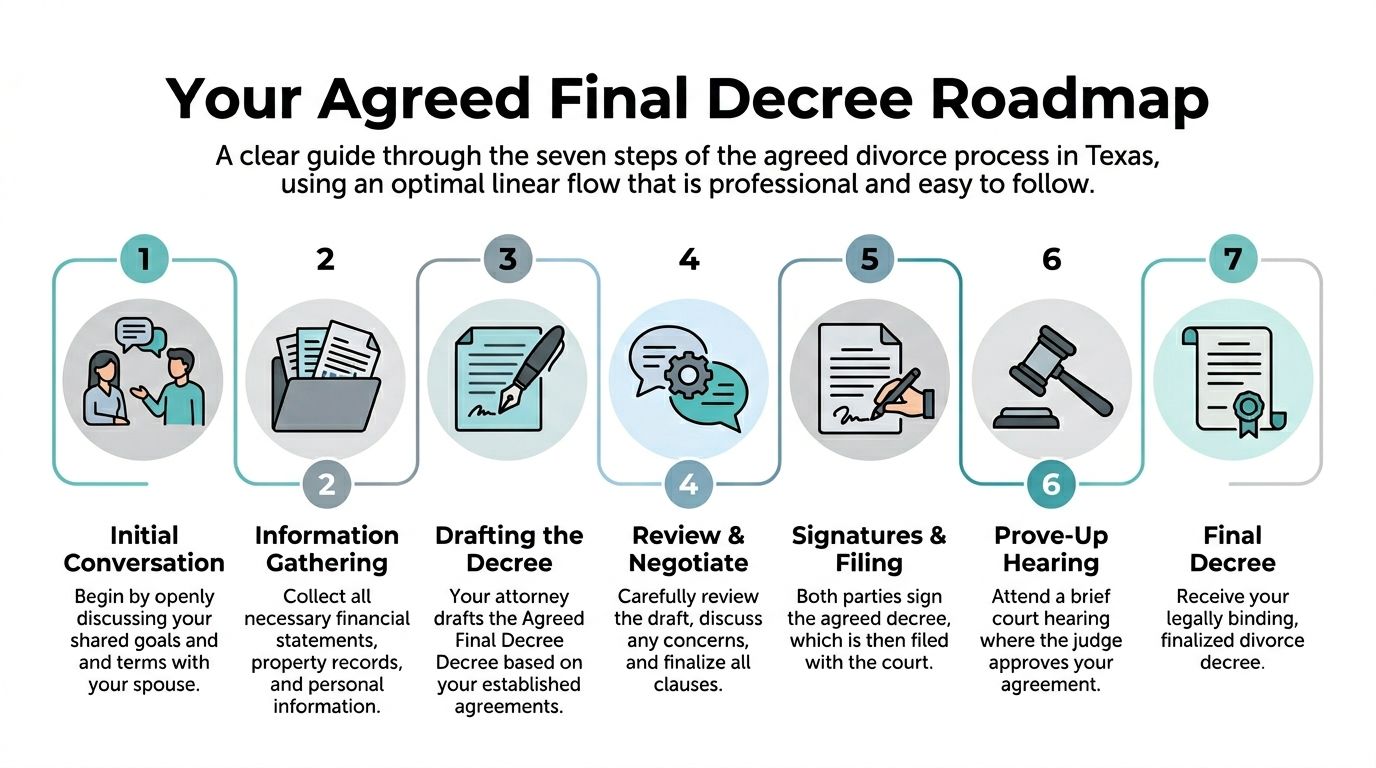
Step 1 through Step 3
Reach a complete agreement
Partial agreement isn't enough for an agreed final decree. You need terms on every issue that applies to your case, including property, debt, children, support, and any special items like retirement accounts.Gather the documents
Pull deeds, retirement statements, mortgage information, vehicle information, tax returns, business records, and anything else needed to draft precise language. This stage often reveals missing issues that the spouses hadn't discussed yet.File the divorce petition
One spouse files the Original Petition for Divorce in the proper Texas court. That filing opens the case and starts the formal timeline.
Step 4 through Step 5
Handle service or waiver correctly
In many agreed cases, the responding spouse signs a Waiver of Service instead of being formally served by a process server. This can keep the case calmer and more efficient, but the waiver has to be executed properly.Draft the decree with real detail
Agreed divorces either become durable or fragile during the drafting process. The decree should convert every point of agreement into enforceable court language. If retirement benefits are involved, the decree should also anticipate any needed QDRO work. If a business is involved, valuation and transfer language need careful attention.
Practice note: Verbal fairness doesn't equal legal clarity. The decree has to tell the court exactly what to sign and tell each party exactly what to do.
Step 6 and Step 7
Sign the final documents after careful review
Both spouses should review the final draft line by line before signing. Dates, legal descriptions, account identifiers, parenting schedules, and support terms need to match the actual agreement.Wait out the required period and finish the case
Texas has a mandatory waiting period before most divorces can be finalized. Once the waiting period has passed and your paperwork is ready, the case moves to prove-up.
A practical checklist helps at this stage:
- Check names and dates so they match all filed pleadings
- Confirm property descriptions for houses, land, vehicles, and retirement plans
- Review child-related language for school-year schedules, holidays, and medical support
- Verify signatures and any notarization requirements that apply
- Prepare the final hearing packet so the judge receives a clean set of documents
If you want legal help with drafting or reviewing the final order, the Law Office of Bryan Fagan, PLLC offers Texas divorce resources and assistance with final decree preparation. That can be especially useful when your case includes children, retirement benefits, business assets, or post-divorce transfer obligations.
Finalizing Your Divorce The Prove-Up Hearing
For many people, the prove-up hearing sounds more intimidating than it really is. In an agreed case, it is usually a brief final appearance where the court confirms the legal requirements have been met and the decree is ready to sign.

What usually happens at prove-up
The judge or court staff will want the final paperwork in proper form. At the hearing, the spouse presenting the case generally answers short questions under oath. The court is usually confirming basic points such as residency, the date of marriage, whether the waiting period has passed, and whether the agreement was entered voluntarily.
If children are involved, the court may pay closer attention to conservatorship, possession, support, and medical support terms. If the paperwork is clear and compliant, the hearing is often straightforward.
For a closer look at what judges commonly expect, review this guide to the Texas divorce prove-up hearing.
Virtual hearings changed the process
Many Texas courts now handle agreed prove-ups remotely. According to Texas divorce frequently asked questions discussing virtual prove-ups, 65% of uncontested divorces in major metro areas are now finalized by Zoom. That shift can move cases faster, and the same source states some cases can be finalized in as little as 62 days.
Virtual prove-ups help people who can't easily miss work, arrange child care, or travel downtown for a short hearing. They also create a more convenient finish line for spouses who have already done the hard work of settling.
The risks people underestimate
Convenience doesn't fix bad paperwork. The same source notes a 15% higher rejection rate for pro se filers in virtual settings due to incomplete disclosures or technical problems.
That shows up in ordinary ways:
- A missing signature page can stop the hearing
- An unreadable scan can delay approval
- Wrong screen name or login issues can create confusion when the case is called
- A spouse who doesn't appear as required can prevent finalization in some situations
Here is a practical overview before your hearing:
| Hearing format | Main benefit | Main risk |
|---|---|---|
| In-person prove-up | Easier to hand up documents and correct small issues on site | Travel, waiting time, and schedule disruption |
| Virtual prove-up | Convenience and faster access in many counties | Tech failures and stricter scrutiny of incomplete filings |
This short video can help you understand the final hearing stage more clearly.
Before a virtual prove-up, test your camera, audio, internet connection, file names, and signed documents as if court starts ten minutes early. Sometimes it does.
What to bring or prepare
For in-person hearings, bring your filed papers, photo identification, and any county-specific final hearing documents. For virtual hearings, have the same materials organized digitally and in printed form if possible.
The goal is simple. You want the judge looking at a complete decree, not a repair project.
Life After the Decree Modification and Enforcement
A signed decree ends the divorce case, but it doesn't freeze your life. Jobs change. Children grow up. People move. Income rises or falls. A decree has to be strong enough to enforce and flexible enough to address legal changes later.
When modification may be needed
If your decree includes child-related orders, later changes may require a modification. Texas law generally looks for a material and substantial change in circumstances before custody, visitation, or child support terms are changed.
Common examples include a parent relocating, a major shift in work schedule, a significant change in a child's needs, or ongoing problems with the current parenting arrangement. Not every inconvenience justifies a modification, but a real change in family circumstances may.
Child-related terms are the most common area for modification. Property division usually works differently. Once the property division in a divorce decree is final, changing the substance of that division is much harder than changing child-related terms.
When enforcement becomes necessary
An agreed decree is still a court order. If your former spouse doesn't follow it, the court can be asked to enforce it.
That can happen when someone:
- Fails to pay child support
- Refuses to surrender property
- Ignores possession or access terms
- Won't sign transfer paperwork
- Violates reimbursement or debt-payment obligations
If that happens, documentation matters. Keep copies of the decree, payment records, communications, receipts, calendars, and any missed transfer deadlines. The cleaner your records are, the easier it is to show the court what happened.
For a practical look at available remedies, read about enforcing a divorce decree in Texas.
A decree only protects you if the terms are specific enough to enforce. Precision at the drafting stage makes post-divorce problems easier to fix.
The long-term value of a well-drafted decree
A carefully drafted decree does more than close the case. It reduces future disputes, creates clear deadlines, and gives the court something concrete to enforce if problems arise.
That is why agreed divorces deserve real legal attention, especially when children, retirement assets, real estate, or business interests are involved. The cleaner the order, the easier it is to live with after the divorce is over.
Key Takeaways and Your Next Steps with Confidence
If you and your spouse can reach a full agreement, an agreed final decree divorce texas case can be the most practical path forward. It gives you more control over the outcome, avoids much of the stress of trial, and can save substantial litigation cost when compared to a contested case.
But the agreement is only half the job. The other half is turning that agreement into a decree that is specific, enforceable, and built for real life. That matters even more when your case involves children, retirement plans, real estate, or a family business.
Keep these points in mind:
- Agreement must be complete before the case can function as agreed
- Drafting must be precise because vague language creates future fights
- Virtual prove-ups can be efficient but only when your paperwork and technology are ready
- Post-divorce enforcement and modification depend heavily on how well the decree was written in the first place
You have already carried enough emotional weight. You shouldn't have to guess whether your final decree protects you.
If you're close to settlement, reviewing your decree before filing can prevent expensive mistakes. If you're still negotiating, legal guidance can help you turn informal promises into a workable Texas court order.
If you're ready to move forward, schedule a free consultation with Law Office of Bryan Fagan, PLLC. You can get clear answers about your agreed decree, your court process, and the practical next steps to finalize your divorce with confidence.