Skip to content
That final, signed divorce decree should have been the moment you could finally move on, but that relief disappears when your ex-spouse treats the court's orders like mere suggestions. It can leave you feeling frustrated, angry, and powerless. But you are not powerless. Your divorce decree is a legally binding court order, and if it's being ignored, you have powerful options in Texas to enforce it.
Your Divorce Is Final, But The Orders Are Being Ignored
When you get that final, signed divorce decree, it's supposed to feel like closure. It’s the official end of one chapter. For many people, though, that feeling is cut short when their ex-spouse simply doesn't follow through. It’s a frustratingly common scenario that can leave you feeling like the legal fight never really ended.
The good news is that you don't have to put up with it. The Texas Family Code provides a clear path for what to do when your ex-spouse disregards a judge's rulings. Your decree isn't just paper; it’s an enforceable command from the court.
Understanding Your Rights Under a Texas Decree
Whether you're dealing with missed child support payments, a refusal to sell the marital home, or failure to hand over property you were awarded, the law is on your side. The primary legal tool you’ll use is a Motion to Enforce. Filing this motion in the same court that granted your divorce kicks off the process of holding your ex-spouse legally accountable for their actions (or inaction).
It’s important to know that Texas courts keep jurisdiction over these cases, meaning they have the authority to force your ex to comply with the original decree. A judge can impose serious penalties for non-compliance, ranging from financial sanctions all the way to jail time for contempt of court.
This guide will walk you through the practical, step-by-step process of enforcing your divorce decree. We'll cover how to spot violations, gather the right proof, and navigate the court system with confidence. The first step is realizing you have rights, and there are powerful ways to protect them.
Pinpointing Violations and Gathering Your Proof

It’s one thing to feel that your divorce decree is being ignored; it's another to prove it to a judge. Before you can take action, you need to build a case with cold, hard evidence for every single violation. This isn't about airing grievances or venting your understandable frustration. It's about creating a clear, factual record that leaves no room for doubt in a judge's mind.
Building Your Case for Financial Violations
The good news is that financial violations often leave a clear paper trail, making them easier to document. When your ex-spouse fails to make court-ordered payments like child support or spousal maintenance, your job is to gather every piece of paper that proves it. You’re not just showing what they haven’t paid; you’re proving the absence of funds you were supposed to receive.
Focus on collecting these key items:
- Payment Logs: Create a simple spreadsheet or notebook. For each payment, list the due date, the amount owed, and whether it was paid on time, late, or not at all. Be meticulous.
- Bank Statements: Go through your bank records and highlight where the expected child support or alimony deposits should be, but aren't.
- Communication Records: Save every text, email, or message where you discuss or request the missed payments. This shows the judge your ex knew about the obligation and your attempts to resolve it.
For example, if spousal support was due on the 1st of each month, your log should have a clear "unpaid" entry for every missed month. Match that with a bank statement showing no deposit, and you've created a straightforward, factual narrative for the court. A common mistake is letting a few missed payments slide. Establishing a pattern of non-compliance early is what gives your enforcement action real strength.
Documenting Property and Debt Violations
Property division orders can be trickier, but the principle is the same: gather proof. These violations often involve a failure to do something, like refinancing a mortgage to get your name off the loan or failing to turn over a specific piece of property. Your goal is to show the court that the ordered action simply never happened.
In Texas, enforcing your decree is essential when your ex doesn't follow court orders. According to the Texas Family Code, you'll file a Motion to Enforce in the same court that granted your divorce, as it keeps jurisdiction over property division. You can discover more about Texas divorce procedures and statistics to better understand the legal framework.
To prove a property violation, collect evidence like:
- Loan and Mortgage Statements: If your ex was ordered to refinance the house but you're still getting statements with your name on them, that's direct proof of a violation.
- Deeds and Titles: For assets like a car or house, if the title or deed was never transferred as ordered, a copy of the current document is your evidence.
- Written Correspondence: Keep copies of any letters or emails you sent to your ex or their attorney reminding them of their obligation to hand over an asset or settle a debt.
Proving Parenting Time Denials
Violations of a possession order—what most people call custody and visitation—can be the most emotionally draining. When you're being denied court-ordered time with your child, solid documentation is your most powerful tool. A consistent, detailed log is absolutely essential.
Your log should be a factual journal, not an emotional one. For every single incident, write down:
- The date and time of the scheduled visit or exchange.
- A brief, objective description of what happened (e.g., "Arrived at 6:00 PM for scheduled weekend possession. Ex-spouse said child was not available and refused to open the door.").
- Who was present and if there were any witnesses.
- Any communication that happened, like texts or calls right before or after the missed visit.
Keeping this log prevents the situation from devolving into a "he said, she said" argument in front of the judge. Instead, you provide the court with a concrete timeline of violations, which is exactly what you need to enforce your parenting plan.
The Legal Remedies a Texas Court Can Use
It’s one of the most maddening experiences after a divorce: your ex-spouse is treating a judge’s legally binding order like a friendly suggestion. You have a signed divorce decree, but they’re not following through. So, what can you actually do about it?
Fortunately, Texas courts don't take kindly to their orders being ignored. When you're ready to enforce your divorce decree, you're not just fighting your ex—you're asking a judge to step in and back you up with a whole toolbox of powerful remedies designed to compel compliance.
The Two Main Paths to Enforcement
In Texas, there are two primary legal actions to force someone to follow a court order. While they sound similar and are often filed together, they serve distinct purposes.
Motion to Enforce: This is a direct request asking the court to force your ex-spouse to follow a specific part of the decree. Maybe they were supposed to sign over a car title or pay you a certain amount from a 401(k). The main goal here is simple: to make the original order happen.
Motion for Contempt: This is where things get serious. A contempt motion asks the court to punish your ex-spouse for willfully and intentionally disobeying the decree. To find someone in contempt, a judge must believe your ex knew what the order said and deliberately chose to ignore it. This can lead to hefty fines, an order to pay your attorney's fees, and even jail time.
An experienced family law attorney can help you decide which motion—or a combination of both—is the right strategy for your case. Often, just the threat of being held in contempt is enough to get an uncooperative ex to finally do what they were ordered to do.
Powerful Tools for Financial Violations
When it comes to money—like unpaid child support, spousal maintenance, or a debt they were supposed to pay—Texas courts have some of the most robust enforcement powers in the country. The system is designed to get you the money you're owed.
A judge can deploy several financial remedies, including:
- Wage Withholding Order: This is the go-to tool for unpaid child support and is incredibly effective. The court orders your ex's employer to deduct payments directly from their paycheck.
- Bank Account Levy: A judge can authorize the seizure of money directly from your ex-spouse’s bank accounts to cover what's owed.
- Property Lien: The court can place a lien on your ex's non-exempt property, like a house or land. This means they can't sell or refinance that asset without paying you first.
- License Suspension: For significant child support arrears, a judge has the power to order the suspension of your ex's driver's license, professional licenses (like for nursing or law), and even recreational licenses.
When a parent fails to pay court-ordered child support, judges don't just see it as someone defying an order. They see it as a parent failing a fundamental duty to their own child. This is why the remedies are so strong and why courts tend to act decisively.
Solutions for Property Division Violations
Getting the property you were awarded in your divorce isn't optional. If your ex refuses to hand something over or won't sign a necessary document, the court has ways to force their hand. To dig deeper into the specific procedures, you can learn more about how to file a contempt of court motion in Texas.
Here's a look at some of the most common enforcement actions and the remedies a Texas court can provide.
Common Enforcement Actions and Court Remedies in Texas
| Violation Type | What It Looks Like | Potential Court Remedy |
|---|---|---|
| Financial Default | Unpaid child support, alimony, or failure to pay a joint debt. | Order to pay arrears, wage garnishment, bank levies, property liens, license suspension, attorney's fees. |
| Property Transfer Failure | Refusing to sign a deed to transfer a house or a title for a vehicle. | A Clarification Order spelling out exact steps and deadlines. The court can even appoint someone to sign on their behalf. |
| Refusal to Surrender Assets | Not turning over specific items like furniture, art, or electronics awarded to you. | A Turnover Order, which directs a constable or sheriff to seize the property and deliver it to you. |
| Business or Complex Asset Issues | Obstructing the sale of a business or mismanaging a shared rental property. | Appointment of a Receiver, a neutral third party who takes control of the asset to manage or sell it per the decree. |
These remedies ensure the property division outlined in your decree becomes a reality, not just words on paper. A Turnover Order, in particular, is a powerful tool where a judge orders your ex to hand over a specific piece of property to a constable or sheriff, who then delivers it directly to you. It's often used for things like cars, furniture, or other significant personal belongings.
Navigating The Enforcement Court Process
Filing a motion is just the first step. What comes next is a structured court process designed to get you the resolution you deserve. Knowing what to expect can take a lot of the anxiety out of the equation and empower you to move forward with confidence.
The process kicks off once your attorney files the motion and makes sure your ex-spouse is properly "served" with the legal documents. This officially puts them on notice that you're asking the court to step in.
It’s absolutely critical to act quickly. Texas law puts a clock on how long you have to take action. For most property division issues, you have a two-year statute of limitations from the date your divorce decree was signed to file a Motion to Enforce. This deadline makes it crucial to address property violations as soon as you spot them.
The road from filing a motion to getting a final court order has a few key stops along the way. The flowchart below breaks down the simple path from identifying a violation to securing a legal remedy.
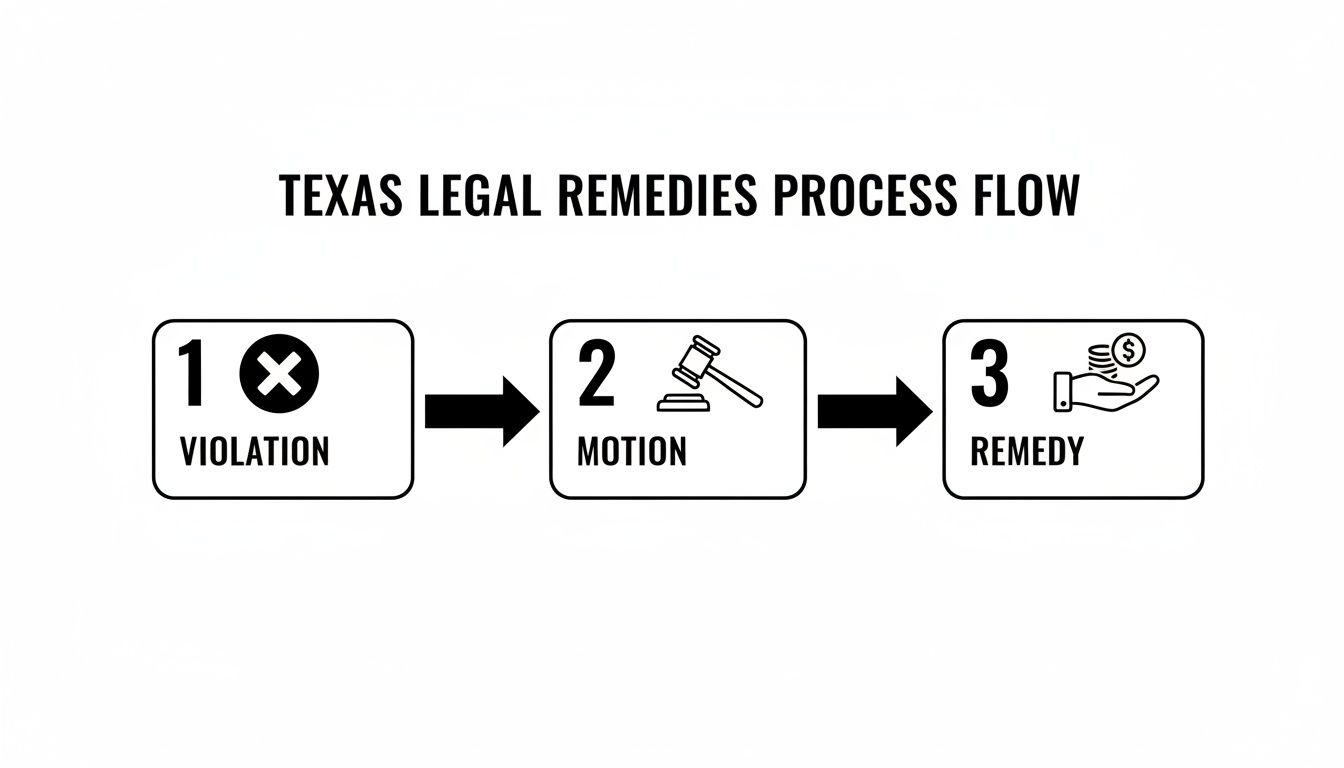
As you can see, a documented violation is the trigger, a legal motion is your tool, and a court-ordered remedy is the ultimate goal.
The Role of Mediation Before a Hearing
Before you ever set foot in a courtroom for a final hearing, the judge will almost certainly require you and your ex-spouse to attend mediation. Many Texas counties mandate this step because it’s a powerful way to resolve disputes without a formal—and often more expensive—court battle.
In mediation, a neutral third-party mediator guides a conversation between you, your ex, and your respective attorneys. The goal is to hammer out a solution you can both live with. For instance, if the problem is a string of missed child support payments, a mediated settlement might create a payment plan for the arrears and confirm a wage withholding order is put in place. If you can resolve the issue in mediation, you save an incredible amount of time, money, and emotional energy. A successful mediation results in a binding agreement that the judge signs, turning it into an enforceable court order.
Preparing for the Court Hearing
If mediation doesn't lead to a resolution, your case will head to a formal court hearing. This is where all the evidence you’ve carefully gathered becomes the star of the show. Your attorney will present your case to the judge, using your documents and testimony to prove the divorce decree was violated. As you head into these formal legal steps, it helps to understand how different types of evidence are documented. For example, understanding the critical role of a deposition transcript as legal testimony can prepare you for what might happen if sworn testimony needs to be taken before the hearing.
Your attorney will methodically lay out the facts for the judge by:
- Presenting your payment logs, bank statements, and other financial records.
- Showing the court the detailed journal you kept of denied parenting time.
- Submitting copies of property titles or loan documents that prove a transfer never happened.
What to Expect From Your Ex-Spouse’s Defense
Your ex-spouse will have their chance to present a defense, and it’s important to be ready. Common defenses include claiming an "inability to pay" for financial obligations or arguing there was a simple misunderstanding about the decree's terms.
A good attorney comes prepared to dismantle these arguments. For an "inability to pay" defense, your lawyer can use legal tools to investigate your ex's true financial picture, requesting bank records and pay stubs to show the court whether the claim is legitimate or just an excuse. We make sure our clients are fully prepared to counter these defenses with hard facts. You can learn more about filing a Motion to Enforce in our detailed guide to see exactly what paperwork is involved.
The judge will listen to both sides, review all the evidence, and then make a final decision. If the judge finds in your favor, they will issue orders to enforce the decree, including any of the remedies we’ve discussed.
Enforce or Modify? Choosing the Right Path
When your ex-spouse ignores the terms of your divorce decree, it can throw your life into chaos. Your first instinct is probably to force them to comply. But sometimes, life changes in ways that make the original order genuinely unworkable. This leaves you at a fork in the road: do you file for enforcement or ask the court to modify the order?
The Difference Between Enforcement and Modification
Think of it this way: enforcement is backward-looking. It’s about holding your ex accountable for past violations of the current court order. A modification, on the other hand, is forward-looking. It’s about convincing a judge that the rules need to be changed for the future because of a "material and substantial change" in circumstances.
- An enforcement action says: "You didn't follow the order, and the court needs to make you pay up and follow it from now on."
- A modification action says: "Our situation has changed so much that the old order is no longer practical or fair. We need a new one."
When Modification Makes More Sense
Let's say your decree requires your ex to pay $1,200 a month in child support. They've paid on time for years, but then they're seriously injured on the job and put on long-term disability, cutting their income in half. Suddenly, they start missing payments.
In this case, filing a Motion for Contempt might bring a sense of justice, but it won't magically produce the money. A judge is unlikely to throw someone in jail who genuinely cannot pay. The more effective, solution-focused approach would be to file a Motion to Modify, asking the court to adjust the child support amount based on your ex’s new financial reality.
It’s also worth noting that the legal tools for enforcement are constantly being refined. For example, new Texas laws taking effect through 2026 are expanding the court's authority in certain family law matters. As you can learn from new Texas family laws you will feel in court, staying on top of these changes is key to building a strong case.
What Can and Cannot Be Modified in a Texas Decree
Here’s the most important rule to remember: some parts of your decree are written in stone, while others can be changed.
In Texas, the division of your property and debts in a divorce decree is almost always final and cannot be changed or modified. Once the judge signs off, the house, retirement accounts, and credit card debt are divided for good.
Orders related to your children, however, are a different story. A court always keeps the power to modify orders concerning the kids, because their needs and your circumstances will inevitably change over time. These orders include:
- Child Custody (known as possession and access in Texas)
- Child Support payments
- Geographic Restrictions (rules about where the child can live)
If you're dealing with violations of a parenting plan or support order, you have to figure out if the problem is defiance or a genuine change in circumstances. An experienced attorney can help you dissect the situation and determine if an enforcement, a modification, or sometimes both, is the right strategy.
What to Do Next to Protect Your Rights
Going back to court when you thought the divorce was finally over is frustrating. You’re exhausted, and the idea of another legal battle feels overwhelming. You don’t have to face this by yourself. The most important thing you can do right now is get professional legal advice from an attorney who lives and breathes enforcing divorce decrees in Texas.
Your divorce decree isn't just a piece of paper—it's a binding order from a judge. Remember, well-organized evidence is what makes or breaks an enforcement case. Texas law gives judges powerful tools to make sure you get the property, support, and time with your kids that you were promised.
Know Your Options
Taking action begins with understanding what the court can actually do for you. For instance, if your ex has stopped paying child support or alimony, one of the most effective remedies is wage garnishment. You can learn more about how to garnish wages in Texas for support arrears in our detailed guide on the topic. Knowing about powerful options like this helps you see that there’s a clear path forward.
Take the First Step
You’ve already done the hard work of getting through the divorce; now it’s time to ensure those final orders are followed. Don't let violations slide. When you call an attorney, you’re no longer just sitting with your frustration. You’re taking control with a legal partner in your corner, ready to fight for the rights a judge has already granted you.
We invite you to schedule a free, confidential consultation with the experienced attorneys at The Law Office of Bryan Fagan, PLLC. We will listen to what’s happening, review your decree, and give you a straightforward, strategic plan to protect your rights and your future. You’ve earned this finality, and we are here to help you secure it.
Common Questions About Enforcing a Divorce Decree
When an ex-spouse decides to ignore a court order, it's natural to have a lot of urgent questions. Here are some straightforward answers to the most common concerns we hear from clients in your situation.
How Long Do I Have to Enforce My Divorce Decree in Texas?
Time is critical. For the division of property, you generally have a two-year window from the date the judge signed your decree to file a Motion to Enforce. This makes it vital to act fast if your ex hasn't turned over property, sold the house, or refinanced a shared debt.
The timeline for collecting unpaid child support, however, is much longer. You can pursue a judgment for child support arrears for many years, and that judgment can be collected long after your child has become an adult.
Can My Ex Be Forced to Pay My Attorney's Fees?
Yes, and this is one of the most important tools in the Texas Family Code. If you file an enforcement action and the judge finds your ex-spouse willfully violated the decree, the court can order them to pay your reasonable attorney's fees and court costs. This provision exists to level the playing field, ensuring you aren’t punished financially just because your ex-spouse refused to follow a court order.
What if My Ex-Spouse Moved Out of State?
This is a common worry, but an out-of-state move doesn’t put your ex beyond the reach of the law. A federal law called the Uniform Interstate Family Support Act (UIFSA) creates a clear framework for enforcing child support and spousal support orders across state lines. This allows Texas courts to work directly with courts in your ex's new home state to compel payment, often through actions like wage garnishment. A knowledgeable attorney can handle these cross-jurisdictional issues, making sure distance doesn't stop you from enforcing your Texas divorce decree.
You don't have to accept it when your ex-spouse ignores your court orders. At The Law Office of Bryan Fagan, PLLC, our dedicated attorneys are ready to help you enforce your rights and get the peace of mind you deserve. Schedule a free, confidential consultation with our team today by visiting https://texasdivorcelawyer.us and take the first step toward holding your ex accountable.