Skip to content
Feeling stuck when your spouse ignores your divorce petition is incredibly frustrating, but your life doesn't have to stay on hold. Texas law provides a clear, solution-focused path forward called a default divorce. This legal process is designed to help you finalize your divorce with confidence, even if your spouse refuses to participate. It allows a judge to grant the divorce based on your side of the story, as long as you have followed all the required steps.
Your Path Forward When a Spouse Is Unresponsive

When you file for divorce, the law calls you the "Petitioner," and your spouse becomes the "Respondent." The Texas Family Code is crystal clear: you must give your spouse formal, official notice that you’ve started a divorce case. This crucial step is called service of process.
Once your spouse has been properly served, a legal clock starts ticking. They have a specific deadline to file a formal "Answer" with the court to participate in the divorce.
But what happens when they just… don't? If they miss that deadline, you can ask the court for a default judgment, allowing you to move forward without them.
Understanding the Purpose of a Default Divorce
A default divorce isn’t a punishment. It's a practical tool to ensure the legal system doesn't grind to a halt just because one person chooses to ignore the process. Without it, an uncooperative spouse could trap you in a marriage indefinitely, leaving you unable to move on with your life, your finances, or your future.
Think of it like an important meeting you've scheduled. You send the invitation, book the room, and show up prepared. If the other person simply doesn't appear, the meeting proceeds based on the information provided by the person who is present. In court, this means the judge will make a final decision using only the evidence and testimony you provide, as long as you've followed the rules.
According to the Texas Rules of Civil Procedure, a judge can issue a final ruling in your favor if the other party fails to appear or answer. This prevents one spouse from stalling the divorce process indefinitely by simply ignoring it.
The Most Critical First Step
Before a Texas judge will even consider granting a default divorce, you must prove one thing above all else: that your spouse received proper legal notice of the lawsuit. This is absolutely non-negotiable.
You must provide the court with a "Return of Service," a formal document signed by a professional process server or constable. This form is a sworn statement confirming the exact date, time, and method used to deliver the divorce papers to your spouse.
Without this proof, the court has no power to act. This rule protects your spouse’s constitutional right to due process—the right to be notified about a lawsuit and have an opportunity to respond. If service wasn't done correctly, any default judgment you get could easily be thrown out later on.
A default divorce is just one of several ways to end a marriage in Texas. To see how it compares to other options, take a look at our comprehensive guide to the different types of divorce in Texas. Understanding all your options is the first step toward regaining control.
Your Step-By-Step Guide to the Default Divorce Process
Navigating the Texas court system can feel overwhelming, especially when you’re doing it on your own. But once your spouse has been officially served with divorce papers and their time to respond has run out, the ball is back in your court. Here’s a clear, step-by-step breakdown of what comes next.
Initiating the Default Judgment
Your first move is to formally ask the judge to finalize the divorce based on your spouse’s failure to participate. You do this by filing a document called a Motion for Default Judgment.
This motion tells the court that your spouse was properly served, they did not file a legal Answer by the deadline, and you are now ready to move forward without them. Think of it as officially pointing out their absence so the judge can proceed with your case.
Essential Supporting Documents
Simply filing the motion isn't enough. The court needs a specific set of documents to ensure the process is fair, even to the non-responsive spouse. You’ll need to prepare and file these along with your motion:
- Servicemembers Civil Relief Act (SCRA) Affidavit: This is a sworn statement confirming your spouse is not on active military duty. Federal law gives special protections to active-duty servicemembers, preventing a default judgment against them. You must do your due diligence to check their status before signing this under penalty of perjury.
- Certificate of Last Known Address: You must provide the court with your spouse's last known mailing address. This is a procedural safeguard, ensuring the court has a record of where it could send official notices.
- The Final Decree of Divorce: This is the single most important document you will prepare. It’s the final order the judge will sign, and you must draft it yourself. It needs to detail everything—how property and debts are divided, and if you have children, all the orders for custody, visitation, and child support.
A common and costly mistake is thinking the court will write the Final Decree for you. It won't. You must present a complete, detailed, and legally sound decree that the judge can simply review and sign. An incomplete or poorly drafted decree will be rejected, sending you back to square one.
To help you get started, we've created a timeline that breaks down these crucial steps and the waiting periods involved.
Texas Default Divorce Timeline and Key Steps
This table summarizes the critical milestones and mandatory waiting periods in a Texas default divorce. It gives you a clear overview of the entire process from the initial filing to the final hearing.
| Step | Action Required | Typical Timing / Deadline |
|---|---|---|
| 1. Filing the Petition | You file the Original Petition for Divorce, starting the case. | Day 1. The 60-day mandatory waiting period begins. |
| 2. Serving Your Spouse | Your spouse is officially served with the divorce papers. | Usually within a few days or weeks of filing. |
| 3. Waiting for an Answer | Your spouse's deadline to file a formal Answer with the court. | By 10:00 AM on the Monday after 20 days have passed since they were served. |
| 4. Filing for Default | If no Answer is filed, you file a Motion for Default Judgment. | Can be filed any time after the answer deadline passes. |
| 5. Finalizing the Divorce | You attend a "prove-up" hearing to finalize the divorce. | Cannot occur until at least 61 days after the Original Petition was filed. |
Following this timeline is non-negotiable. Missing a deadline or trying to schedule a hearing too early will only lead to frustrating delays.
Observing the Mandatory Waiting Period
Texas law requires a mandatory 60-day waiting period for all divorces, and default divorces are no exception. This countdown begins the day you file the Original Petition for Divorce.
You cannot finalize your divorce until at least 61 days have passed. This "cooling-off" period, established by Texas Family Code Section 6.702, exists to give couples a chance to reconsider and ensures divorce isn't a rash decision. Even with a completely unresponsive spouse, you must respect this timeline.
Requesting and Attending the Final Hearing
Once the 60-day waiting period is over and your spouse's deadline to answer has passed, you can schedule your final hearing. This brief court appearance is often called a "prove-up" hearing. You'll need to contact the court's clerk to get on the judge's calendar.
At the hearing, you'll give short, simple testimony to "prove up" the facts of your case. The judge will ask a few basic questions to confirm your identity, grounds for divorce, and that your proposed orders in the Final Decree are fair. If everything is in order, the judge will sign the Final Decree of Divorce on the spot, and your divorce will be official.
Getting the first steps right is critical. To better understand the document that kicks off the entire divorce, you can learn more about the Texas Original Petition for Divorce in our in-depth guide.
How to Prove Your Case to the Judge
Walking into a courtroom by yourself can feel intimidating, but getting a default divorce isn't an automatic win. You still need to tell your story to the judge. This final hearing, known as a “prove-up,” is your opportunity to present a complete and convincing case, even if your spouse is a no-show.
You are responsible for demonstrating why the terms you’re proposing for your property, debts, and children are fair and legally sound. It's about more than just showing up—you need to have your testimony straight and your documents organized to earn the judge’s signature.
The Standard for Dividing Property
In Texas, all marital property must be divided in a way that is “just and right.” When your spouse doesn’t show up to contest your requests, you get to propose how your assets and debts are split. However, the judge still needs to be convinced your plan is equitable, not just a one-sided grab.
To do this, you have to paint a clear picture of your marital estate for the judge. Practical advice for business owners or those with high-value estates is to have these things ready for your hearing:
- A Detailed Inventory: Put together a complete list of all assets—homes, cars, bank accounts, business interests—and all debts, like mortgages, loans, and credit card balances.
- Proposed Division: Clearly lay out which assets and debts you’re asking to keep and which ones you believe your spouse should be responsible for.
- Justification: Be ready to give a quick, common-sense reason why your proposed split is fair. For example, you might propose keeping the family home since you live there with the children, while your spouse is assigned the loan for a car they already drive.
Your job is to make it easy for the judge to understand the financial situation and approve your plan. The more organized and clear you are, the more smoothly the hearing will go.
This infographic breaks down the simple, three-stage path of a typical Texas default divorce.
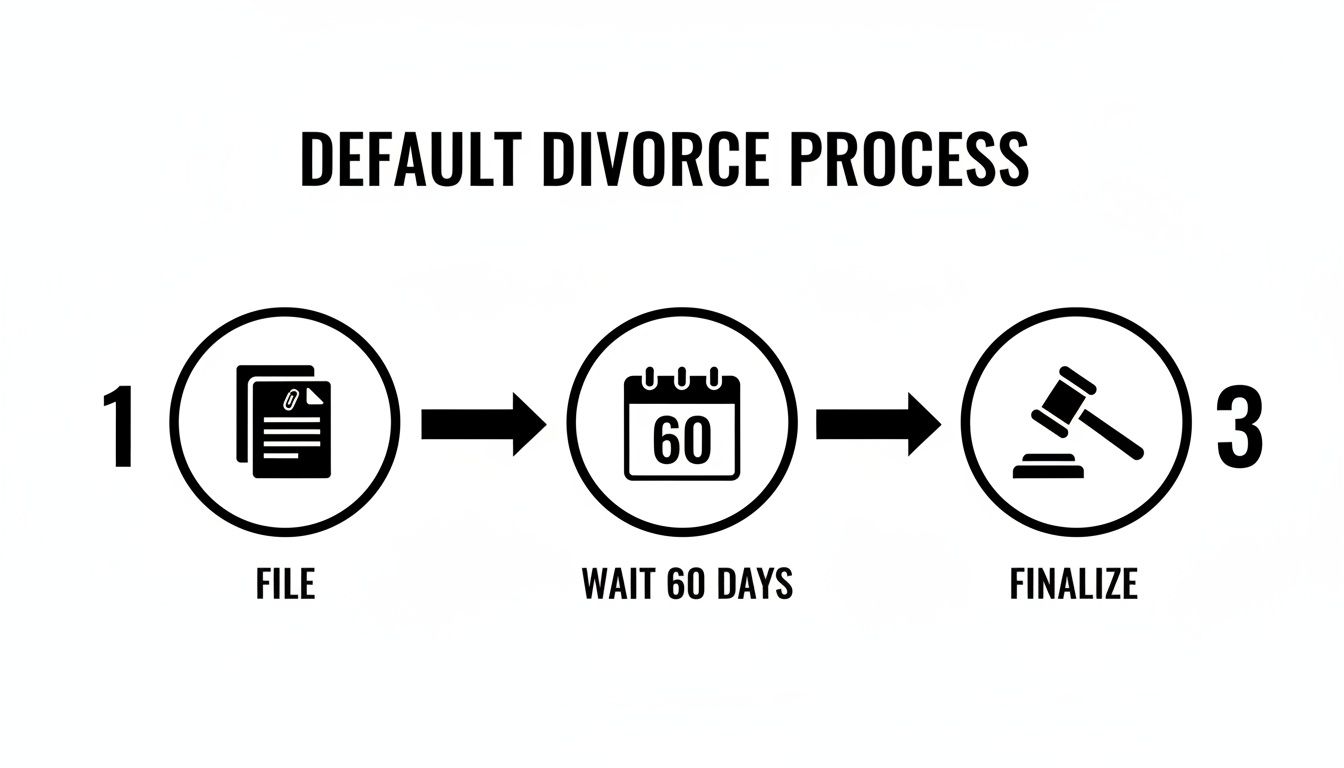
As you can see, even in a default case, there’s a structured legal journey. After filing, the mandatory waiting period gives the process time before you can finalize things.
Proving What Is Best for Your Children
When children are involved, the court’s entire focus shifts to one single, powerful standard: the “best interest of the child.” This legal principle, rooted in the Texas Family Code, dictates every decision a judge makes about custody, visitation, and support.
At your prove-up hearing, the judge won't just rubber-stamp your custody request. As a parent, you must provide testimony showing that your plan gives your children a stable, safe, and nurturing home.
You need to be prepared to answer questions about:
- Custody (Conservatorship): Explain why you should be the parent who gets to decide where the children live.
- Visitation (Possession and Access): Lay out the visitation schedule you've proposed for your spouse. Even in a default divorce, the non-participating parent is usually awarded a Standard Possession Order unless you can prove it would endanger the child.
- Child Support: Show your math for guideline child support based on what you believe your spouse earns. If you have no idea what their income is, you can ask the judge to set support based on minimum wage at 40 hours per week.
Making your case effectively is the last hurdle in a default divorce. For a closer look at this crucial court appearance, you can read our guide on the Texas divorce prove-up process. It offers even more detail on what to expect.
Even with an empty chair on the other side of the courtroom, your duty is to present a case that is complete, fair, and follows the law. If you prepare your testimony and get your documents in order, you can walk into that final hearing with confidence and finalize your divorce.
Understanding the Risks of a Default Divorce

When your spouse doesn't respond to divorce papers, it might feel like a green light to move on. But a default divorce isn't a simple shortcut—it's a legal process with serious, long-term consequences for both of you.
While a default judgment offers a path forward, it’s one with potential pitfalls. Whether you're the one filing or the one who has gone silent, the stakes are incredibly high. The decisions made in your absence carry the full force of the law, shaping your financial future and your relationship with your children for years to come.
Risks for the Person Filing the Divorce
Even if you're the one driving the process, you aren't immune to risk. As the Petitioner, your biggest worry is that the default judgment could be challenged and thrown out down the road.
If your spouse later proves there was even a minor mistake in how you handled the service of process—the formal delivery of divorce papers—a judge could void the entire divorce. That means the final decree gets erased, and you are forced to start the whole painful process from scratch. All that time, money, and emotional energy will have been for nothing.
To protect yourself, you must follow every single procedural rule to the letter. Any slip-up gives your spouse a legal opening to undo a judgment you thought was final.
Severe Consequences for the Non-Responsive Spouse
If you are the Respondent—the spouse who hasn't filed an Answer—the risks are far more immediate and severe. Ignoring a divorce lawsuit is one of the worst mistakes you can make in a family law case. By failing to show up, you are giving up your right to have any say in the outcome.
The consequences of staying silent can be devastating and often include:
- Losing Your Marital Property: The judge will likely approve whatever property division your spouse asks for. This could mean you lose your claim to the house, retirement accounts, business interests, and other assets you built together.
- Unfavorable Financial Orders: You might be ordered to pay a large amount in child support or spousal support based only on your spouse’s side of the story. You get no chance to present your own financial reality.
- Restricted Parental Rights: The court could sign off on a custody plan that drastically limits your time with your children. You surrender the opportunity to negotiate a fair visitation schedule or have input on major decisions affecting their lives.
In a default divorce, the judge makes decisions with only one side of the story. The Final Decree of Divorce becomes a legally binding order based entirely on the information your spouse provides, and your silence is treated as agreement.
Understanding these risks is vital. Divorce trends in Texas already show complexities in who initiates proceedings. Statistics show that women file for divorce more often than men, with some studies suggesting women initiate around 69% of divorces in the state. You can discover more insights about these demographic patterns in Texas divorce filings and see how they compare to national trends.
Regardless of who files, staying silent means giving up all control. A default judgment isn't a temporary fix; it's a final, powerful court order. Decisions about your property, your money, and your kids will be made without you, and trying to reverse them is an expensive, uphill battle that rarely succeeds. Taking action is your only defense.
Can a Default Divorce Judgment Be Reversed?
Finding out a default judgment has been entered against you feels like the ground has vanished from beneath your feet. It’s a gut-wrenching moment, but Texas law provides a very small window of opportunity to fight back. If you didn't respond to a divorce petition in time, you must act with extreme urgency.
Courts generally prefer to decide cases on their merits, not by default. But to get a second chance, you can't just ask for one—you have to meet a specific and demanding legal standard. Your primary tools for this fight are a Motion for New Trial and, in some situations, a Restricted Appeal.
The Motion for New Trial and its Strict Deadline
Your most immediate and powerful option is filing a Motion for New Trial. This is a formal legal request asking the judge to set aside the default judgment and reopen the case so you can finally have your say.
Be warned: you are on a very tight clock. Under the Texas Rules of Civil Procedure, you must file this motion within 30 days of the date the judge signed the Final Decree of Divorce. This is a hard-and-fast deadline. If you miss it, your chances of undoing the judgment drop dramatically.
To succeed, you can't just claim it was a mistake. You must satisfy a three-part legal test known as the "Craddock factors," which comes from a landmark Texas Supreme Court case.
Meeting the Craddock Factors to Reverse the Judgment
To persuade a judge to grant you a new trial, you have to prove all three of the following elements with clear, convincing evidence.
- Your Failure to Answer Wasn’t Intentional: You have to show that failing to file an Answer was due to a mistake or an accident, not because you were consciously indifferent or just decided to ignore the lawsuit. For example, perhaps you were hospitalized, or you never actually received the papers because of a service error. Simply saying you "didn't know what to do" is rarely a strong enough excuse.
- You Have a Meritorious Defense: You must present a valid legal defense to the claims made in the divorce. This doesn't mean you have to prove you’ll win the entire case. It means showing the judge that, if given a chance, you have a legitimate case to present about property division, custody, or support that could lead to a different outcome. You might have evidence proving a major asset is your separate property or facts showing a different custody plan is in your child's best interest.
- Granting a New Trial Won’t Harm the Other Party: You need to show that setting aside the default judgment won't cause an unfair delay or otherwise injure your spouse. A common way to do this is to offer to pay for the attorney's fees your spouse incurred to get the default judgment, proving you're ready to move forward with the case immediately and in good faith.
A common misconception is that being aware of a lawsuit is the same as being legally served. The Texas Supreme Court has recognized this distinction. Even if you knew your spouse filed for divorce, you may be able to prove your failure to answer wasn't intentional if you can show you were never properly served with the official court papers and therefore weren't on notice that your deadline to act was ticking.
While the challenges of reversing a divorce can feel immense, broader trends offer some perspective. Texas has seen a significant decline in its divorce rates over the past few decades. The state's divorce rate is now 2.1 per 1,000 residents, lower than the national average and a steep drop from the 5.5 per 1,000 rate seen in 1990. You can read more about Texas divorce statistics to understand the wider context.
The Urgency of Taking Immediate Action
If a default judgment has been entered against you in your divorce, time is your greatest enemy. That 30-day deadline for filing a Motion for New Trial is absolutely unforgiving. Every single day that passes makes it harder to protect your rights to your property, your finances, and your children.
You simply cannot afford to wait. The moment you learn about a default judgment, your first and only step should be to contact an experienced family law attorney. We can immediately assess what happened, determine if you meet the Craddock factors, and take swift action to file the necessary motions to protect your future. Don't let a procedural misstep turn into a lifelong regret.
What to Do Next to Protect Your Future
Whether you're the one pursuing a default divorce or you've just been hit with one, the steps you take next are absolutely critical for protecting your family and your finances. A default divorce in Texas might seem like a shortcut, but it’s a legal minefield. One wrong move can lead to financial headaches and custody problems that last for years. Think of this as your guide to moving from uncertainty to a clear path forward.
If You Are Filing for a Default Divorce
Getting the judge to sign your default decree is a huge milestone, but it's not the finish line. That signed order is just a piece of paper until you take the steps to enforce it.
You still have crucial tasks ahead of you to secure your assets and future:
- Legally Transfer Property: You’ll need to file the right paperwork, like a special warranty deed for real estate, to officially transfer any property the judge awarded you into your name.
- Divide Retirement Funds: To split accounts like a 401(k) or pension, you must have a Qualified Domestic Relations Order (QDRO) drafted and submitted to the plan’s administrator. This is a complex legal document and a step that is often missed.
- Untangle Your Finances: You need to close all joint bank accounts and ensure any shared debts are refinanced into the responsible person's name, just as the decree orders.
Making sure the judgment is actually put into effect is the final, non-negotiable step in securing your new beginning.
If a Default Judgment Was Entered Against You
If you’ve just found out a default judgment was granted against you, you must act fast. Time is your greatest enemy. You have an extremely short window—often just 30 days—to challenge the court’s decision.
You must get legal help immediately to see what your options are, such as filing a Motion for New Trial. If you wait too long, the judgment will likely become permanent, leaving you stuck with potentially devastating orders about your property, money, and children.
Once the legal process is complete, the emotional journey of starting over begins. When the dust finally settles, the next big step is learning how to deal with divorce and rebuild your life.
What to Do Next
Whether you’re the Petitioner or the Respondent, trying to handle a default divorce without professional guidance is a gamble. A single mistake can put your financial security or your rights as a parent at risk. You don't have to walk through this complicated process on your own.
At The Law Office of Bryan Fagan, PLLC, our attorneys understand the intricacies of a default divorce in Texas. We are here to protect your rights, your children, and your financial future with knowledge and compassion, no matter which side of this you’re on. Don't leave something this important to chance.
Schedule a free, confidential consultation with us today. Let us help you navigate this difficult time with the confidence you deserve, so you can build the strongest possible foundation for your next chapter.
Frequently Asked Questions About Default Divorce
It’s only natural to have a lot of questions when dealing with something as unique as a default divorce. The process can feel strange and one-sided. Here are plain-English answers to the most common concerns we hear from clients in this situation.
What Happens If I Cannot Find My Spouse to Serve Them Divorce Papers?
This is a bigger hurdle than most people realize. If you've genuinely tried to find your spouse through what the court calls a diligent search but have come up empty, you can't just proceed with a standard default. You have to get the court's permission to serve them in a different way.
Texas law offers a couple of practical solutions for this:
- Substituted Service: This lets a process server leave the divorce papers with another person—anyone over 16—at a location the judge agrees is likely to get the notice to your spouse, such as their last known job or a parent's house. You have to convince the judge that this method is reasonably likely to provide notice.
- Service by Posting: This is the absolute last resort. The divorce notice gets posted on the courthouse door. It's used when you have truly no idea where your spouse could be and no other way to reach them.
To use either of these methods, you must file a sworn affidavit detailing every single step you took to find your spouse. The rules are incredibly strict, and judges scrutinize these requests closely. Getting legal help here is almost always a wise move to prevent your case from being thrown out on a technicality.
How Are Child Custody and Support Decided in a Default Divorce?
When children are part of the equation, a judge's number one priority is always the "best interest of the child," a standard straight from the Texas Family Code. In a default divorce, the judge will likely approve the custody, visitation, and child support you’ve laid out in your proposed Final Decree of Divorce. However, they'll only sign off if you provide testimony that persuades them your plan is genuinely what's best for your children.
Your spouse's silence means they’ve given up their chance to argue their side. The judge's decision on everything related to the children will be based entirely on the evidence and testimony you bring to the final hearing.
This means you need to be ready to explain why you should be the parent to decide where the child lives and why your proposed visitation schedule is fair and practical. For child support, if your spouse's income is a mystery, you can ask the judge to set support based on the assumption they work a 40-hour week at minimum wage.
Is a Default Divorce Cheaper or Faster Than a Regular Divorce?
A default divorce can be faster and less expensive than a contested one. You avoid back-and-forth negotiations, lengthy discovery processes, and expensive trial preparation. This can save you a significant amount of time, money, and stress.
However, "cheaper and faster" isn't a guarantee. The procedural rules for a default divorce must be followed perfectly. Any mistake—from how you serve the papers to a missing signature on an affidavit—can give your spouse a reason to challenge and undo the judgment down the road. Fixing that kind of mess is often far more expensive and time-consuming than doing it right the first time, which makes getting expert legal advice from the start a smart investment.
Navigating the complexities of a default divorce in Texas requires careful attention to detail and a clear understanding of your legal rights and obligations. At The Law Office of Bryan Fagan, PLLC, we have the experience to guide you through every step, ensuring your rights are protected and your future is secure. Don't face this process alone. Schedule a free, confidential consultation today by visiting our website at https://texasdivorcelawyer.us to get the compassionate, expert help you deserve.