Skip to content
Facing the reality of a divorce can feel like your world is being turned upside down.
When you’re facing a separation, the term “litigation” can sound downright terrifying. It often brings to mind images of dramatic courtroom battles and endless conflict. But in Texas, that’s not the whole story. Divorce litigation is simply the formal, court-guided process you enter when you and your spouse can’t agree on every single detail of your separation on your own. It's not an automatic declaration of war; it’s the structured framework the legal system provides to get you from uncertainty to a fair, final resolution.
What Divorce Litigation in Texas Really Means
Let’s clear the air. Divorce litigation in Texas refers to the entire journey through the family court system—from the moment you file the first petition until the day a judge signs your Final Decree of Divorce. It's the playbook everyone follows to make sure the process is orderly and predictable, especially when your emotions are running high.
This process becomes necessary when you and your spouse are at an impasse on the big issues that will shape your future. It creates a controlled environment to work through disagreements over:
- Property Division: How will your home, vehicles, retirement accounts, and other assets be divided under Texas’s community property laws?
- Child Custody: Who will have the right to make key decisions for your children, and what will the possession schedule actually look like?
- Financial Support: Is child support or spousal maintenance going to be a factor in your family's future?
A Process, Not Just a Fight
It’s much more helpful for you to think of litigation as a formal system for protecting your rights, rather than just a fight. The Texas Family Code lays out the rules of the road, preventing one spouse from taking advantage of the other. For instance, once you file for divorce, the court typically issues temporary restraining orders that stop either person from draining bank accounts, selling off property, or removing you from health insurance.
The real goal of divorce litigation is to move your family from a place of ambiguity and conflict to one of legal clarity and stability. It gives you a defined path forward when you can’t get there on your own.
This legal framework is actually designed to encourage a resolution. In fact, most counties in Texas require couples to attend mediation—a formal negotiation session with a neutral third party—before a judge will even hear your case at a final trial. This means the system itself pushes you toward finding common ground, even when you’re in the middle of a formal "litigation" process. An experienced attorney doesn't just fight for you; they guide you through these rules, using them to secure a stable and fair outcome for you and your family.
The Texas Divorce Litigation Timeline Step by Step
One of the hardest parts of facing a divorce is the crushing feeling of not knowing what comes next. That uncertainty can feel like you're navigating in the dark, but understanding the process provides a clear roadmap, turning your anxiety into a plan of action. The divorce litigation Texas process isn't a chaotic free-for-all; it's a series of well-defined stages designed to bring order and fairness to a difficult time.
Think of it as a path with specific milestones. Each step has a purpose, moving you and your spouse toward a final resolution, whether you get there through a negotiated agreement or a judge’s decision.
This visual captures the emotional and procedural journey through divorce litigation, starting with the initial anxiety, moving through the structured court process, and ending with a focus on resolution.
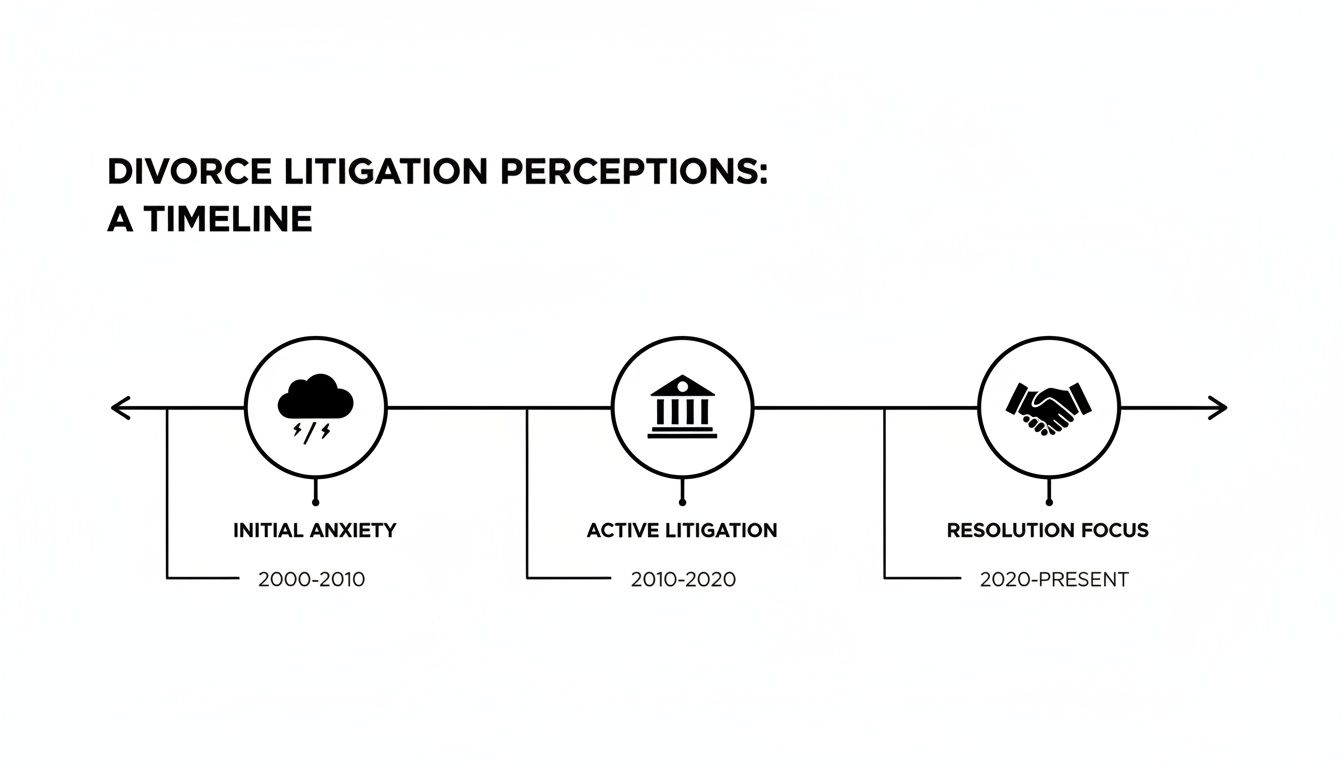
The image shows that while litigation can feel like a storm, it’s a structured path forward. Knowing these steps helps you prepare for what's on the horizon.
To give you a clearer picture, here’s a simplified breakdown of the main phases you can expect in a typical Texas divorce lawsuit.
Key Stages of Texas Divorce Litigation
| Stage | Purpose | Typical Timeline |
|---|---|---|
| Filing & Service | To officially start the divorce case and legally notify your spouse. | 1-4 Weeks |
| Temporary Orders | To establish temporary rules for custody, support, and property use during the divorce. | 1-2 Months |
| Discovery | To gather financial information and evidence from your spouse. | 3-6 Months |
| Mediation | To attempt to negotiate a settlement with a neutral third-party mediator. | 1-2 Days |
| Final Trial/Agreement | To finalize the divorce either by agreement or through a judge's ruling. | 6-12+ Months |
While every case is unique, this table gives you a general sense of the flow. Now, let's dig into what each of these stages really means for you.
Step 1: Filing the Original Petition for Divorce
The legal process officially kicks off when one spouse, who becomes the Petitioner, files an "Original Petition for Divorce" with the court. This legal document isn't about placing blame; it's a formal request asking the court to dissolve the marriage.
The Petition gives the court the essential facts: details about you, your spouse, and any children. It also states the legal grounds for the divorce, which in Texas is most often "insupportability." This simply means the marriage has become unworkable, and there's no reasonable hope of reconciliation.
Step 2: Service of Process and the Respondent's Answer
Once the Petition is filed, your spouse, now called the Respondent, must be officially notified. This formal notification is known as service of process. Typically, a constable or a private process server will personally deliver a copy of the lawsuit papers to the Respondent.
After being served, the Respondent has a strict deadline to file a legal document called an "Answer." This is their formal response telling the court they will be participating in the case. If an Answer isn't filed on time, the judge might grant a default judgment, potentially giving you everything you asked for.
Under the Texas Family Code, your divorce cannot be finalized until at least 60 days have passed from the date the Original Petition was filed. This mandatory "cooling-off" period is designed to give you and your spouse time to reflect and potentially reconcile before the marriage is legally terminated.
Step 3: Temporary Orders Hearing
Life doesn't just hit pause while your divorce is pending. That's why the Temporary Orders Hearing is one of the most critical early steps in the entire process. This hearing sets the ground rules that will govern your lives until the divorce is final.
A judge will make temporary decisions on crucial, immediate matters, including:
- Who gets to live in the family home?
- Who is responsible for paying which bills?
- What will the temporary child custody and visitation schedule look like?
- Will one spouse pay temporary child support or spousal support to the other?
These orders are all about creating stability and predictability for you and your children during a very turbulent time.
Step 4: The Discovery Phase
Discovery is the formal process of gathering information and evidence from your spouse. Think of it as the fact-finding mission of your divorce. It’s how your attorney ensures all financial cards are on the table and prevents assets from being hidden or undervalued.
Common discovery tools used to get this information include:
- Requests for Production: Asking for documents like bank statements, tax returns, and retirement account information.
- Interrogatories: Written questions that your spouse must answer under oath.
- Depositions: Out-of-court oral testimony given under oath in front of a court reporter.
This stage is absolutely essential for building a complete financial picture to make sure your community property is divided in a just and right manner.
Step 5: Mediation – A Required Step Toward Settlement
Before you can ever have a final trial, nearly every Texas court will require you and your spouse to attend mediation. This is a confidential negotiation session where a neutral third-party mediator helps you and your attorneys try to reach a settlement on all your disputed issues.
Mediation puts you in the driver's seat, giving you the power to control the outcome of your own divorce rather than leaving it in a judge's hands. The vast majority of Texas divorce cases are successfully settled at mediation, saving both of you the immense stress and expense of going to trial. You can find out more by exploring our in-depth article on understanding the timelines of divorce in Texas.
Step 6: Final Trial or Finalizing an Agreement
If you reach a full agreement in mediation, your attorneys will draft a Final Decree of Divorce. This is the comprehensive legal document that lays out all the terms of your settlement. After a brief court appearance to "prove up" the divorce, a judge will sign the Decree, and your divorce will be legally final.
If you can't agree on everything, your case will be set for a Final Trial. At trial, both sides present evidence and testimony, and a judge will make the final decisions about your property, your finances, and your children. While a trial is sometimes unavoidable, it is truly the last resort in the Texas divorce litigation process.
How Fault and No-Fault Grounds Impact Your Case
Going through a divorce is always personal, and for many people, the reason the marriage is ending feels just as important as the split itself. Texas is a “no-fault” divorce state, but that doesn't mean the "why" doesn't matter. In fact, understanding how to use fault-based grounds can be a critical part of your legal strategy. It can make the difference between a standard 50/50 split and an outcome that truly reflects the reality of your marriage.
At its most basic, a no-fault divorce means you don’t have to prove your spouse did something specific to cause the divorce. The most common path is filing based on insupportability under Texas Family Code § 6.001. This simply means the marriage has become unbearable due to conflict, with no reasonable hope of reconciliation. It allows you to dissolve the marriage without airing all the painful details in a public courtroom.
But the law also acknowledges that sometimes, one spouse's behavior is the direct cause of the marriage's breakdown. These are known as fault grounds, and they can be a powerful tool for you.
When to Consider Using Fault Grounds
While a no-fault filing is definitely simpler, there are very good strategic reasons your attorney might advise you to allege fault. If you can prove your spouse is at fault for the divorce, a judge has the discretion to award you a disproportionate share of the community estate—meaning you could receive more than 50% of the marital property.
Texas Family Code § 7.001 says a court must divide the marital estate in a way it deems "just and right," considering the rights of each party and any children. Proving fault is one of the biggest factors a judge will look at when deciding what’s "just and right."
This is where the "why" of your divorce transforms from an emotional point into a powerful legal advantage. It gives the court a reason to look beyond a simple 50/50 division and consider a more equitable outcome based on what actually happened in your marriage.
Common Fault-Based Grounds in Texas
The Texas Family Code lays out several specific grounds for a fault-based divorce. To win on these grounds, you need credible evidence, which is why the discovery process is so vital.
- Cruelty: This isn't about petty arguments. It involves conduct from your spouse—like physical or emotional abuse—that makes living together unbearable for you.
- Adultery: Proving infidelity requires more than just your gut feeling. You’ll typically need circumstantial evidence that shows your spouse had both the inclination and the opportunity to cheat.
- Felony Conviction: This applies if your spouse was convicted of a felony, imprisoned for at least one year, and has not been pardoned.
- Abandonment: This is more than just your spouse moving out. You must prove they left with the intent to abandon you and stayed away for at least one year.
Alleging and proving these claims ties directly into the discovery phase of your case. Your lawyer would use tools like requests for documents and depositions to gather proof, such as financial records showing money spent on an affair or witness testimony about cruel treatment.
While many people cite a lack of commitment for their divorce, infidelity remains a huge factor, showing up in nearly 60% of cases. This lines up with the legal reality where proving fault like adultery can have major financial consequences. You can discover more insights from a study on Texas divorce statistics.
Protecting Your Family with Temporary Orders and Discovery
That time between filing for divorce and getting the final decree can feel like you're living in limbo. It’s a period filled with uncertainty about your money, your home, and especially your children. This is where the pre-trial phase becomes one of the most important parts of your entire case. It's your chance to create stability and get the facts straight, using two powerful legal tools: Temporary Orders and the Discovery process.

Think of this phase as setting the rules of the game while the divorce is still playing out. These procedures are designed to protect you, your kids, and your assets from impulsive decisions or unfair moves. They bring immediate structure to the chaos and set the stage for long-term clarity.
Setting the Ground Rules with a Temporary Orders Hearing
A Temporary Orders Hearing is often the very first—and most important—court date you'll have. This is where a judge lays down the rules of engagement that will govern your lives until the divorce is final. These aren't just suggestions; they are legally enforceable court commands that create stability when everything else feels up in the air.
During this hearing, a judge can make critical, on-the-spot decisions about things like:
- Child Custody: Establishing a temporary possession schedule to give your children predictability.
- Child Support: Ordering temporary support payments to make sure your children’s needs are met right away.
- Spousal Support: Deciding if you need temporary support from your spouse while the divorce is pending.
- Use of Property: Figuring out who gets to live in the family home and who can use certain cars.
- Bill Payments: Ordering who is responsible for paying the mortgage, car notes, and other shared debts.
These orders are all about maintaining the status quo. They prevent either spouse from making sudden, one-sided changes that could hurt you or your kids.
Preventing Financial Chaos with Injunctions
A crucial part of Temporary Orders is the injunction. An injunction is simply a court order that stops someone from taking specific actions. In a divorce, these are absolutely vital for protecting the marital estate you’ve built together.
A standard Temporary Restraining Order (TRO) automatically goes into effect in many Texas counties the moment you file for divorce. This order immediately freezes your financial situation, preventing either you or your spouse from draining bank accounts, selling off property, or changing insurance beneficiaries.
This is the court's way of hitting the "pause" button on your finances. It ensures that the property you both worked for will still be there to be divided when your case is finalized. Ignoring these orders can bring about serious legal trouble.
Uncovering the Truth with the Discovery Process
Once some stability is established with temporary orders, the next phase of your divorce litigation in Texas is Discovery. This is the formal, fact-finding mission of your case. It’s the legal process your attorney will use to gather all the necessary information and evidence from your spouse, painting a complete picture of your marital estate.
Discovery is how your attorney makes sure all the cards are on the table. It’s designed to stop assets from being hidden, undervalued, or conveniently "forgotten." The main tools used in this process include:
- Requests for Production: These are formal written requests for your spouse to turn over documents like bank statements, tax returns, retirement account details, and business records.
- Interrogatories: A list of written questions that your spouse must answer truthfully and under oath.
- Requests for Admission: This is a list of statements that your spouse must either admit or deny, which helps you narrow down the issues you actually need to fight about.
- Depositions: This is out-of-court testimony where your attorney questions your spouse (or other witnesses) under oath, with a court reporter transcribing every word.
This isn’t about being unnecessarily aggressive; it’s about being thorough. The information gathered during discovery becomes the evidence you'll use to argue for a just and right division of your property and to ensure any support calculations are based on accurate financial data. You can learn more about how this critical process works by reading our detailed guide on the role of discovery in a divorce.
Understanding the Financial Realities of Your Divorce
The question of "how much will this cost?" is almost always the first, and most stressful, thought that comes to mind when you're facing a divorce. It's a completely valid concern, and you need a realistic picture of the financial side of divorce litigation in Texas. The simple truth is, there’s no fixed price tag—the cost is directly tied to the level of conflict between you and your spouse.

This picture says it all. Divorce requires careful financial planning, and the more you and your spouse can agree upon, the more you can control the costs. But don't mistake saving money for cutting corners—investing in an experienced attorney is often the single most effective way to protect your financial health for the long haul.
What Drives the Cost of Divorce Litigation
At its core, the cost of your divorce comes down to attorney time. The more issues there are to fight over, the more time your legal team has to spend preparing, negotiating, and potentially arguing your case in court.
Several key factors can dramatically increase what you'll spend:
- Contentious Child Custody Battles: When you and your spouse can't agree on decision-making rights or the possession schedule, it can lead to extensive and expensive legal work.
- Complex Property Division: If you own a business, have multiple real estate properties, or hold significant investments, the detailed analysis required to value and divide them fairly takes time.
- Disputes Over Fault: Trying to prove grounds like adultery or cruelty often requires more intensive discovery, which naturally leads to a more expensive process.
- Hidden Assets: If you suspect your spouse is hiding money or property, your attorney will need to launch a thorough financial investigation to uncover the truth.
Make no mistake, the financial burden of divorce litigation in Texas is among the highest in the country. Average costs range from $15,600 to $23,000, depending on how complicated your case gets. In fact, Texas ranks as the 5th most expensive state for divorce, a direct reflection of our detailed community property laws.
How Attorney Fees Work
Most family law attorneys in Texas work on an hourly basis and will ask for an initial payment known as a retainer. This money is placed into a special trust account, and your attorney’s hourly fees are billed against that balance as they work on your case. When the funds in the retainer run low, you'll be asked to replenish it.
Investing in a skilled attorney isn't just an expense; it's a strategic move to protect your future. A well-argued case can secure a more favorable division of your assets, potentially saving you far more money in the long run than the cost of your legal fees.
Cost-Saving Solutions like Mediation
Thankfully, a full-blown, expensive trial is not your only option. As we’ve mentioned, most Texas counties actually mandate mediation before you can even get a final trial date. Mediation is a powerful and cost-effective process where you, your spouse, and your lawyers meet with a neutral third-party mediator to negotiate a settlement.
Resolving your case in mediation is almost always less expensive than going to trial. It gives you control over the final outcome and lets you finalize your divorce on your own terms, not a judge's. For a comprehensive look at how assets are handled, you might be interested in our guide on Texas divorce property division.
While the financial side of divorce can feel daunting, understanding what drives the costs empowers you to make smarter decisions. By focusing on solutions and working with an experienced attorney, you can manage the expenses while fiercely protecting your financial future.
What to Do Next
You don’t have to figure this all out on your own. The decisions you make right now will have a lasting impact on your financial future and your family's life for years to come. The single most important step you can take is to get trusted legal advice from an attorney who understands your specific circumstances and is ready to advocate for you.
Strategic preparation changes everything. This means getting a firm grasp on your finances, understanding your rights under the Texas Family Code, and seeing the power in procedures like temporary orders and discovery. While the system provides a roadmap, having the right legal guide in your corner is what makes the journey focused and manageable.
It’s true that Texas divorce rates have dipped below the national average recently, but we’re also seeing a rise in "gray divorces" among couples married for decades. You can find more details on Texas divorce trends here. This just goes to show that your family's situation is unique. Your story demands a strategy built just for you, not some cookie-cutter solution.
Taking action is the first step toward protecting yourself and your children. An initial conversation with an experienced attorney can provide immediate clarity and a sense of direction.
The Law Office of Bryan Fagan, PLLC, is here to help you move through this complex time with both compassion and confidence. We invite you to schedule a confidential, free consultation with our team. Let’s work together to build a strategy that protects your rights, your family, and your future.
Frequently Asked Questions About Texas Divorce
Going through a divorce brings a wave of questions, and the uncertainty can feel overwhelming. Getting clear, straightforward answers is the first step toward finding your balance. We’ve compiled a few of the most common questions we hear about divorce litigation in Texas to help you get the clarity you need.
How Long Does a Contested Divorce Take in Texas?
When you and your spouse can’t agree on the key issues, your divorce is "contested." In Texas, a contested divorce typically takes anywhere from six to 12 months to finalize. Of course, this is just an average.
The timeline can easily stretch longer if your case is particularly complex. Things like intense child custody disputes, arguments over high-value assets, or even just a backed-up court calendar can extend the process significantly. Every divorce timeline must also include the state's mandatory 60-day waiting period, which starts the day you file the original petition.
Can I Get a Divorce in Texas if My Spouse Lives Elsewhere?
Yes, absolutely. A Texas court’s power to hear your case—what lawyers call jurisdiction—is based on your residency, not where your spouse happens to live.
To file for divorce in Texas, you must have lived:
- In the state of Texas for at least the last six months.
- In the specific county where you file for at least the last 90 days.
As long as you meet these two requirements, you can file your petition. From there, specific legal steps must be taken to formally “serve” your spouse with the divorce papers, even if they're in another state or country. An experienced attorney can handle this crucial step to make sure it's done correctly and the court has authority over your case.
What Is the Difference Between Mediation and Litigation?
This is a great question, and it's a common point of confusion. Think of it this way: Litigation is the entire formal court process. It’s the whole journey, starting from the moment you file the first petition all the way until a judge signs the final decree.
Mediation, on the other hand, is a specific, crucial step within that litigation journey. It's a confidential meeting where you, your spouse, and your lawyers sit down with a neutral third-party professional—the mediator—to try and negotiate a settlement agreement.
In most Texas counties, mediation is a mandatory step you must complete before a judge will even allow you to set a final trial. It's an incredibly powerful tool for resolving your disputes without the time, expense, and stress of a courtroom battle.
Do I Have to Go to Court for a Texas Divorce?
You don't necessarily have to go to court for a full-blown trial. In fact, the vast majority of Texas divorces are settled well before that ever happens. If you and your spouse can reach a complete agreement—either on your own or with a mediator's help—your attorneys will draft a document called a Final Decree of Divorce.
Once you both agree, that document is presented to a judge. You may still need to make a brief, simple court appearance to "prove up" the divorce, but it’s a quick, uncontested formality, not a contentious trial.
The legal road ahead can feel complicated, but you don't have to walk it alone. Having a knowledgeable and compassionate guide is crucial to protecting your family and your future. The team at The Law Office of Bryan Fagan, PLLC, has helped hundreds of Texas families navigate these challenges with confidence and care.
We invite you to schedule a free, confidential consultation to discuss your situation. Let us help you understand your options and map out a clear strategy for what comes next. Contact us at https://texasdivorcelawyer.us to take the first step.