Skip to content
You may be staring at a stack of bank statements, a lease, school calendars, and text messages, wondering which problem to solve first.
Divorce in San Antonio can feel personal and procedural at the same time. Your home life is shifting, but the court still expects deadlines, forms, and decisions. That's why choosing the right divorce lawyer in San Antonio matters so much. A good lawyer doesn't just file paperwork. Your lawyer helps you slow the panic, sort out what matters most, and avoid mistakes that can follow you long after the divorce is over.
Why Choosing the Right Divorce Lawyer Matters
A lot of people call a lawyer after weeks of trying to “keep things civil” on their own. Then the situation changes fast. One spouse moves money, the other changes the school pickup routine, or a simple conversation about who keeps the house turns into a fight about custody and bills.
That's usually the moment when legal guidance stops feeling optional.
A strong divorce lawyer in San Antonio gives you structure when everything else feels unstable. You need someone who can explain what the court cares about, what your next filing should be, and what issues can wait. You also need someone who understands that not every divorce is a courtroom battle. Some cases need quick temporary orders. Others need careful negotiation and parenting-focused planning.
What good legal guidance looks like
The right attorney should help you do at least three things well:
- Protect your position early: Early decisions about where you live, what you pay, and how you communicate with your spouse can affect the whole case.
- Translate legal language: Terms like community property, conservatorship, temporary orders, and final decree shouldn't feel like another barrier.
- Keep children at the center: If your kids are struggling, legal strategy alone isn't enough. Many parents also benefit from child-focused resources such as this integrative approach to child divorce support, which explains emotional adjustment in plain language.
Practical rule: The best lawyer for your case isn't always the one who talks toughest. It's the one who can match strategy to your goals, your risks, and your family.
Some readers are looking for a calm, efficient uncontested divorce. Others are dealing with hidden accounts, a family business, military benefits, or concerns about a child's safety. Those situations call for different skills. The more specific your situation is, the more important your lawyer choice becomes.
Understanding Texas Divorce Basics
Texas divorce law makes more sense once you sort it into four questions: Can you file here? Why is the divorce being filed? What belongs to the marriage? What will the court focus on if children are involved?
That framework helps because people often hear legal terms before anyone explains what problem each term is solving.
Residency and filing eligibility
Before Bexar County can hear your divorce, the court must have the right connection to you or your spouse. Under Texas Family Code Section 6.301, one spouse must have lived in Texas for at least six months and in the county of filing for at least 90 days.
This catches many San Antonio families off guard. A recent move to Bexar County may mean you are not ready to file here yet, even if you and your spouse have already separated. If timing is a concern, a step-by-step guide to the Texas divorce process from filing to finalization can help you see where eligibility fits into the larger timeline.
A simple way to view residency is this: filing in the wrong county is like showing up at the wrong office with the right paperwork. Your forms may be prepared, but the court still cannot move your case forward until the residency rules are met.
No-fault divorce, and when conduct still matters
Texas allows a no-fault divorce. That means you do not have to prove adultery, cruelty, or abandonment just to end the marriage. Many divorces are filed on the ground of insupportability, which usually means the marriage can no longer continue because of conflict or discord.
Confusion starts here. No-fault affects the reason the marriage ends. It does not automatically erase conduct from the rest of the case.
For example, if one spouse drained accounts, hid money, ran up unusual debt, or spent community funds on an affair, that behavior can still affect property division. In some cases, conduct also matters when a judge considers temporary requests or attorney's fees. The key point is simple. You may not need to prove fault to get divorced, but facts about misconduct can still shape the outcome.
Property, custody, and support in plain English
Texas follows community property rules. Marriage works like a financial partnership. Property and debt acquired during the marriage are often presumed to belong to the community estate, even if only one name appears on the title, loan, or account. Separate property is usually what a spouse owned before marriage, plus certain gifts and inheritances received individually.
That distinction matters a lot in San Antonio cases involving homes, retirement accounts, military benefits, small businesses, and credit card debt. A title does not answer the whole ownership question. Tracing, reimbursement claims, and records often matter more than people expect.
If children are involved, Texas courts focus on the best interest of the child. You will usually hear three terms:
- Conservatorship: Who has the right to make major decisions about the child
- Possession and access: The parenting schedule and when each parent has time with the child
- Child support: Money paid to help cover the child's living expenses
These terms sound technical, but each one points to an everyday issue. Who picks the school? Where does the child sleep on school nights? Who pays for health insurance, activities, and basic needs?
Many contested cases still settle before trial, often in mediation. If you want a clearer explanation of that process, Divorce Mediation in Texas: How It Works explains why mediation is such a common part of resolving family law disputes.
A good way to read Texas divorce law is to translate every legal label into a household question. Who owns what, who decides what, and who pays for what.
Texas Divorce Process Step by Step
The process feels much less intimidating when you see it in order.
A San Antonio divorce begins in one place. Divorces in San Antonio are filed exclusively through the Bexar County District Clerk's Central Filing Department at 101 W. Nueva, Suite 217. The filing fee for an Original Petition for Divorce in 2026 ranges from $350 to $401 (San Antonio divorce filing details).
Here is the process at a glance:
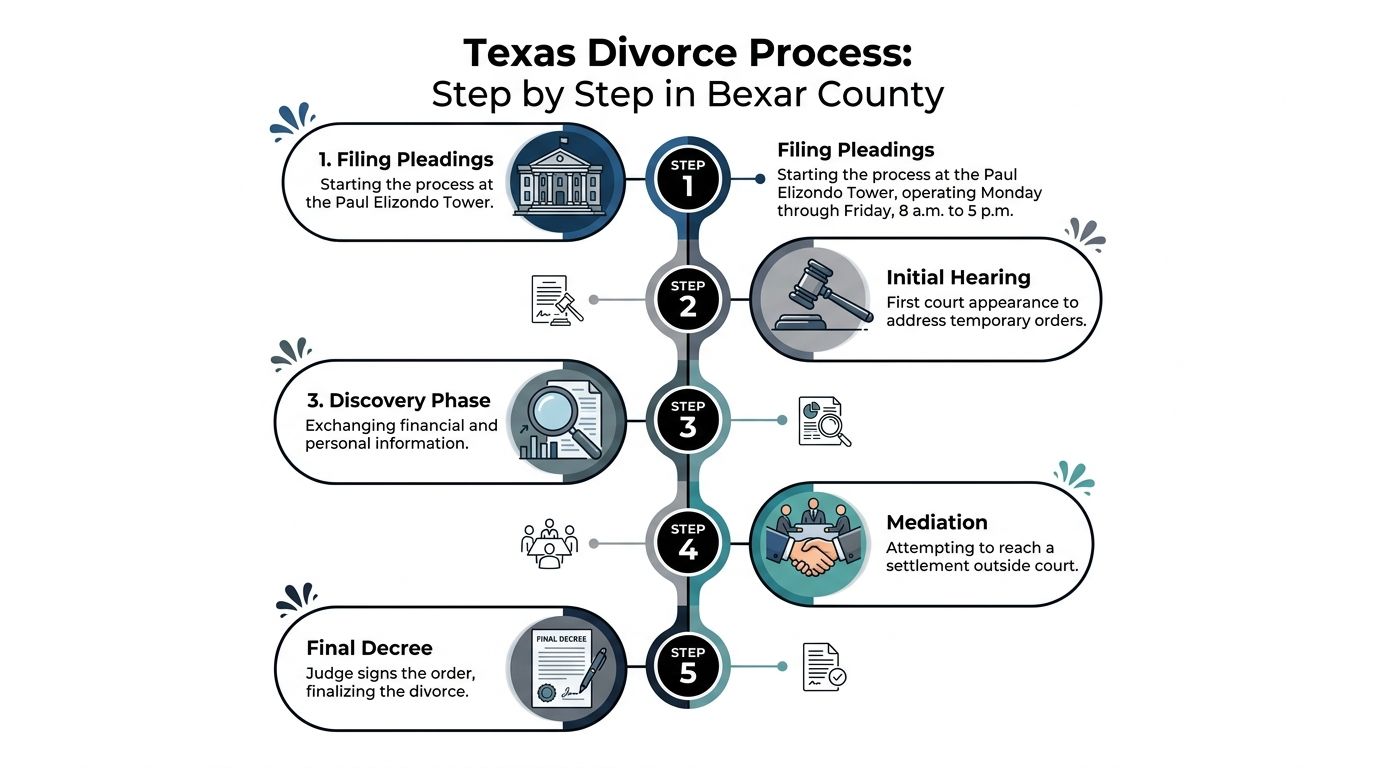
Filing the case
The case starts when one spouse files the Original Petition for Divorce. In Bexar County, that filing goes through the Central Filing Department in the Paul Elizondo Tower, which operates Monday through Friday from 8:00 a.m. to 5:00 p.m.
At this stage, the court file opens, the case gets a cause number, and the filing spouse sets the process in motion. If you want a practical walkthrough of the sequence, this guide on the Texas divorce process from filing to finalization is a helpful companion.
Service and response
After filing, the other spouse usually must be formally served unless service is waived. Formal service matters because it gives legal notice and starts response deadlines.
This is one place where people make costly mistakes. Handing your spouse a copy yourself or texting a photo of the petition usually doesn't replace proper service requirements.
Temporary orders and early stability
Some couples keep functioning while the divorce is pending. Others need court rules immediately.
Temporary orders can address issues like:
- Use of the home: Who stays in the house while the case is pending
- Parenting schedules: A short-term routine for pickup, overnights, and holidays
- Bill payment: Who covers mortgage, rent, insurance, or other key expenses
- Conduct restraints: Limits on harassment, hiding children, or moving assets
Temporary orders don't usually decide the whole case forever, but they often shape daily life for months. Treat them seriously.
Here is a visual explanation of the overall process before and after those early hearings:
Discovery, negotiation, and mediation
If the case involves disputes about income, property, debts, or parenting, both sides may exchange documents and information. Lawyers call this discovery.
That may include requests for account records, business records, retirement information, inventories of property, and written answers under oath. In a high-conflict case, this phase can reveal problems that weren't obvious at filing.
Most cases don't end in a full trial. Many settle through attorney negotiation or mediation after the facts are clearer.
Final decree and closeout
If you reach agreement, the court can sign a final decree based on the settlement terms. If you don't, the judge decides the unresolved issues after a hearing or trial.
Before you leave the process, make sure the decree deals with practical details. Titles, accounts, possession schedules, support, debt responsibility, and any transfer documents all need careful attention. A signed decree ends the case, but poor drafting can create new disputes after the divorce is final.
Overview of Divorce Services Available
Not every divorce needs the same level of legal work. That's why San Antonio firms usually offer several types of divorce-related services rather than one standard package.
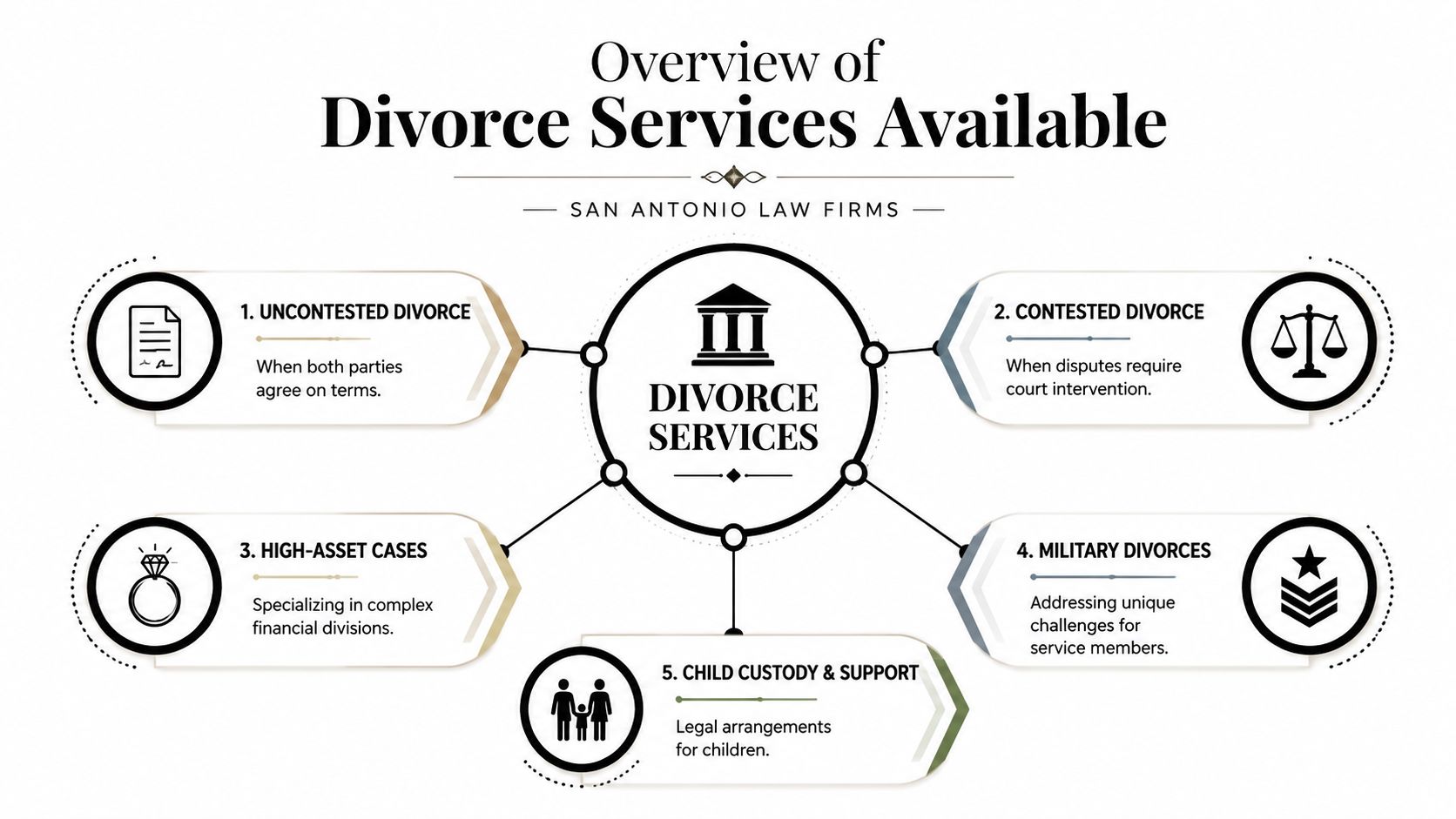
Side by side view of common case types
| Service type | Best fit | Main legal focus | Court involvement |
|---|---|---|---|
| Uncontested divorce | You both agree on key terms | Drafting, review, filing, final decree | Usually limited |
| Contested divorce | You disagree on one or more major issues | Strategy, evidence, hearings, settlement efforts | Often significant |
| High-asset divorce | You own businesses, investments, real estate, or complex compensation | Property characterization and division | Often detailed and document-heavy |
| Military divorce | One spouse serves or recently served | Jurisdiction, timing, military-specific issues | Varies by case |
| Custody and support disputes | Parenting conflict is central | Conservatorship, possession, support, child-focused evidence | Often substantial |
Uncontested and contested cases
An uncontested divorce works best when both spouses are in full agreement about property, debt, and any child-related terms. These cases still require careful drafting. A “friendly divorce” can go sideways if the decree leaves out retirement language, transfer steps, or a clear parenting schedule.
A contested divorce is different. You may disagree about the house, custody, support, business value, or even basic facts. In those cases, your attorney's role shifts from simple document preparation to active case management, negotiation, and courtroom advocacy.
Cases that need specialized attention
Some divorces involve more than a marital home and checking account.
- Business owners: You may need records that separate business operations from personal spending.
- High-value estates: Real estate portfolios, investment accounts, deferred compensation, and tracing separate property can all complicate the case.
- Military families: Deployment, residence questions, and service-related benefits can change strategy.
- Bilingual or international paperwork: If you need foreign-language marriage or divorce records translated for use in your case, certified divorce document translation services may help keep filings accurate.
Related family law services
A divorce lawyer in San Antonio may also handle connected matters, including:
- Temporary restraining orders: For urgent property or conduct concerns
- Child support disputes: Establishing or adjusting support obligations
- Enforcement actions: When a spouse ignores an order
- Mediation support: Preparing positions and settlement language
A lot of clients don't realize they may need more than “a divorce filing.” They may need a lawyer who can also guide them through parenting plans, support issues, and enforcement if the other side stops cooperating.
Typical Fees and What Affects Your Cost
A divorce budget in San Antonio works a lot like a home repair estimate. The basic job may look straightforward at first, but the price changes once you see what is behind the walls. In divorce cases, those hidden layers are usually disputed parenting issues, missing financial records, temporary hearings, and the amount of court involvement required in Bexar County.
For a closer look at typical Texas divorce lawyer costs, including hourly rates, retainers, and flat-fee ranges, start with the fee structure your lawyer uses. Some firms bill by the hour. Some offer a flat fee for an agreed divorce. Others use a hybrid approach, such as a flat fee for drafting and hourly billing if the case becomes contested.
Comparison of fee structures
| Fee Type | Typical Rate | Range |
|---|---|---|
| Hourly billing | Attorney charges by time spent | $250 to $500 per hour |
| Initial retainer | Upfront deposit to begin work | $2,500 to $5,000 |
| Flat fee for uncontested divorce | One set price in qualifying cases | $1,000 to $3,500 |
| Contested divorce total | Broader litigation-based cost | $7,500 and up |
Those dollar ranges should always be read with one question in mind. What has to happen in your case for the lawyer to earn that fee?
An agreed divorce usually costs less because the lawyer is handling drafting, filing, and review instead of repeated conflict. A contested divorce costs more because each disagreement creates a new layer of work. One hearing can mean client calls, document review, legal research, drafting, courthouse time, and follow-up orders. That is why two spouses filing at the same Bexar County courthouse can end up with very different bills.
Child-related disputes often change the budget fastest. Analysts cited in the Texas divorce cost guide and this discussion of Texas divorce cost with contested issues found that contested cases involving custody issues cost much more than agreed divorces, especially when court hearings or multiple disputes are involved.
Hidden costs that surprise people
The attorney fee is only one part of the total.
In San Antonio cases, the overlooked expenses are often the ones tied to local procedure. Filing in Bexar County starts the case, but service of process, temporary orders, mediation, and obtaining records can add up quickly. If your case needs multiple court settings or extra coordination to get on the docket, your overall cost can rise even if the legal issues themselves are not unusual.
Common added expenses include:
- Court filing costs: Separate from the attorney's retainer
- Service fees: Paying a constable, sheriff, or private process server to deliver papers
- Temporary-order hearings: Extra preparation, exhibits, and court time
- Mediation fees: Often split between spouses, but still a real out-of-pocket cost
- Custody evaluations or other child-related assessments: These can become one of the largest non-attorney expenses
- Discovery costs: Subpoenas, business records, property tracing, and document-heavy review
- Order drafting after hearings: Clients are often surprised that winning a hearing is not the end. Someone still has to prepare the written order and get it signed
Budgeting note: Ask for the billing policy in writing. You want to know whether the retainer is refundable, when it must be replenished, how often invoices go out, and which costs are billed by outside providers rather than the law firm.
Local practice also affects cost in ways many articles skip. San Antonio firms should be able to explain where your case will be filed, what Bexar County scheduling tends to look like, how temporary hearings may affect strategy, and which expenses are court costs versus lawyer time. That breakdown helps you compare lawyers more fairly and decide whether settlement, mediation, or litigation fits your goals and budget.
Preparing for Your Lawyer Consultation
Your first consultation goes better when you walk in with facts, not just frustration.
A lawyer can give clearer advice when you bring organized information about property, debt, income, and children. That preparation can also save you fees later because your attorney won't need to spend as much time chasing basic background details.

Bring the documents that shape the case
Start with the records that define your financial and family life.
- Property records: Deeds, titles, mortgage statements, refinance papers, closing records, and recent statements tied to real estate or vehicles
- Income proof: Pay stubs, tax returns, bonus records, commission statements, and business income records if either spouse is self-employed
- Account information: Bank accounts, retirement accounts, investment statements, and credit card balances
- Debt documents: Personal loans, business loans, lines of credit, and any debt in one or both names
- Child-related records: School calendars, report cards, counseling records, medical information, and any current parenting schedule
If you want a fuller picture of what to expect from the meeting itself, this guide on what happens at your first consultation with a divorce lawyer is worth reading before you go.
Write down your goals before the meeting
Many people make the mistake of gathering documents but never deciding what they want.
Try listing your priorities in order. For example:
- Keep a stable schedule for the children.
- Stay in the house until the school year ends.
- Protect separate property claims.
- Avoid unnecessary courtroom hearings if possible.
That list helps your lawyer tailor strategy. A case aimed at quick resolution looks different from a case focused on proving financial misconduct or preserving a business interest.
If misconduct matters, organize facts carefully
Don't bring a loose folder of screenshots with no timeline. Put events in order.
Useful preparation often includes:
- Dates and events: When money moved, when an account changed, when a child schedule broke down
- Documents tied to the event: Statements, emails, texts, or app messages
- Witness context: Who saw what, and whether that person is relevant
- Questions about legal impact: Whether the conduct affects property division, attorney's fees, or temporary orders
Bring facts, not theories. Your lawyer can tell you what matters legally once the story is organized.
Red Flags and Questions to Ask
Choosing a lawyer under stress can lead to rushed decisions. That's when red flags matter most.

Red flags you shouldn't ignore
Some warning signs show up in the first conversation.
- Vague fee answers: If a lawyer can't explain billing structure clearly, you may end up confused and frustrated later.
- No real focus on family law: Divorce, custody, and property division have their own procedures and pressure points.
- Promises of guaranteed outcomes: No honest lawyer can promise that you'll get the house, full custody, or fees paid by the other side.
- Poor communication early: If calls or emails are already inconsistent before you hire the firm, that often won't improve once the case is active.
Questions that tell you a lot
Ask direct questions. You're not being difficult. You're making an important hire.
Consider asking:
- How do you approach settlement versus trial in a contested divorce?
- How do you prepare for mediation in cases involving children?
- How do you evaluate claims that property is separate rather than community?
- When can fault-based conduct matter even though Texas is a no-fault state?
- In what situations might a judge consider ordering one spouse to contribute to attorney's fees?
- How involved will I be in drafting, reviewing, and approving major decisions?
That last set of questions matters because many online summaries oversimplify fault. Texas doesn't require fault to grant a divorce, but serious misconduct can still affect property division and, in some cases, attorney's fees. You want a lawyer who can explain that nuance without overselling it.
A good consultation should leave you better informed, not more intimidated.
Fit matters as much as credentials
You may hire a very capable lawyer and still end up with a poor fit if their style clashes with your needs. Some clients want frequent updates and detailed planning. Others want efficient summaries and direct recommendations.
If you leave the meeting feeling rushed, confused, or pushed into a one-size-fits-all strategy, keep looking.
Client Testimonials and Next Steps
A few months after a divorce is over, many San Antonio clients describe the same turning point. It usually was not a dramatic court hearing. It was the moment they realized their lawyer had a clear plan, explained what would happen at the Bexar County courthouse, and kept small problems from turning into expensive ones.
That is what people tend to remember. They remember whether the process felt confusing at every step, or whether someone translated it into plain English and kept the case on track.
In agreed cases, clients often appreciate careful drafting, prompt updates, and instructions that make filing, signing, and finalizing feel manageable. In contested cases, they often value a lawyer who stays steady, spots what actually matters under Texas law, and does not let every angry text or accusation drive up fees.
What clients usually value most
The strongest feedback usually centers on practical things, not slogans:
- Clear explanations: They understood what the judge in Bexar County was likely to focus on, and what was mostly background noise.
- Local process guidance: They knew where documents would be filed, what deadlines applied, and how San Antonio procedure could affect timing.
- Cost awareness: They were told about more than the base retainer. They also understood possible added costs, such as filing fees, service fees, mediation, custody evaluations, or extra hearing preparation.
- Measured strategy: Their lawyer used conflict carefully instead of turning every disagreement into a larger fight.
- Respect for family realities: Parenting issues, school schedules, and day-to-day logistics were treated like real problems to solve, not abstract legal points.
Some clients also prefer firms that offer educational material alongside legal representation. As noted earlier, the Law Office of Bryan Fagan, PLLC offers family-law services, consultations, articles, videos, and a DIY Divorce eCourse for people who want to better understand process questions before or during a case.
Take care of your legal case and your mental health
Divorce affects more than pleadings and court dates. It can disrupt sleep, concentration, parenting patience, and decision-making.
That matters because legal choices made under stress can have long consequences. A good lawyer helps with the legal side. Emotional support often needs a different kind of professional or resource. If the separation has left you feeling stuck or overwhelmed, reVIBE Mental Health's guide to healing may be a useful place to start.
What to do next
Keep the next steps simple, like packing for a short trip before a longer one. You do not need everything today. You do need the basics in one place.
- Gather core documents, such as tax returns, pay stubs, bank statements, mortgage or lease records, and any existing court orders.
- Write down your top priorities. For example, keeping the house, protecting separate property, creating a workable parenting plan, or controlling legal costs.
- Make a short list of urgent issues tied to San Antonio practice, such as temporary possession of the home, access to accounts, child pickup schedules, or immediate safety concerns.
- Book a consultation and ask how the lawyer handles Bexar County filing, temporary orders, mediation, expected fee ranges, and the hidden costs that often surprise people later.
Those steps will not solve the whole case. They will put you in a much better position to make a sound first decision.
Key Takeaway
A divorce lawyer in San Antonio should do more than file papers. Your lawyer should help you understand Texas rules, move through Bexar County procedure with less stress, protect your financial position, and create a workable plan for your children and future.
If you feel overwhelmed, that doesn't mean you're unprepared. It usually means the situation is serious enough to deserve clear guidance.
If you're facing divorce, custody issues, or questions about property division in Texas, a conversation can give you clarity quickly. Schedule a free consultation with Law Office of Bryan Fagan, PLLC to talk through your options, understand the process, and decide what next step fits your situation.