Skip to content
You may feel like your life split into before and after the conversation that told you the marriage was over. In that moment, the hardest part isn't just the paperwork, it's figuring out which divorce lawyer Austin can help you protect your children, your money, and your peace of mind.
Austin has a crowded divorce-law market, and that can make the search feel worse, not better. One legal directory lists 760 results for divorce attorneys in Austin across 231 different law firms, while another lists 27 divorce lawyers available in the city, which means you have options, but you also need a filter that helps you separate marketing from real value. That's the point of a practical decision framework, because you don't need every lawyer, you need the right one for your case and your timeline. Austin divorce attorney listings
The fastest way to reduce panic is to get organized before you start calling offices. If you need help gathering the papers that usually matter most, the essential legal documents for 2026 resource can give you a simple checklist to keep nearby while you prepare.
Navigating Your First Steps in an Austin Divorce
You can be sitting at the kitchen table, staring at unopened mail, wondering what you're supposed to do first. That feeling is common, and it gets worse when every search result claims to be the answer.
A better first move is to narrow the field with a simple question, what kind of help do you need right now? In Austin, where there are hundreds of divorce listings, you're not choosing from a shortage, you're choosing from overload. A smart search starts by sorting lawyers by the kind of case they handle, the way they communicate, and whether they can work within the reality of Travis County procedure.

Start with the problem, not the ad
If you already know the marriage is ending, don't waste energy trying to make the situation feel smaller than it is. Start by naming the issues that matter most, children, property, a house, a business, retirement accounts, or safety concerns. That list tells you what kind of lawyer belongs in your first calls.
Practical rule: the right lawyer should make your case feel more manageable after the first conversation, not more confusing.
A good Austin family-law office should be able to explain whether your situation needs immediate filing, temporary orders, or a longer strategy. It should also help you understand what documents are missing and what can wait. If the office can't speak plainly about those basics, keep looking.
Use Texas law as a sorting tool
Texas divorce law gives you a few fixed anchors. The Texas Divorce Residency Requirements snapshot reflects the 6-month state and 90-day county rules before you can file, which is why a local lawyer matters from the start.
That doesn't just affect paperwork. It affects where your case gets filed, how quickly you can start, and what court process you'll be dealing with in Travis County. A lawyer who handles Austin cases every week is more likely to spot avoidable delays before they cost you time and momentum.
The Strategic Advantage of a Travis County Lawyer
A divorce lawyer who knows Texas law in general can help. A lawyer who knows Travis County procedure is more useful when your case needs to move without mistakes.
Texas divorce procedure starts with the Original Petition for Divorce, filed in the district court of the county where residency requirements are met. Texas Family Code § 6.301 requires that at least one spouse has lived in Texas for six continuous months and in the filing county for at least 90 days before filing (source). That residency rule is not a formality. It decides whether your case can begin at all.
Local knowledge saves time and frustration
A Travis County lawyer understands the pace of local filing, service, and court settings. Divorce is not only about the law, it is also about how the courthouse handles the case in practice. A lawyer who works here regularly knows the details that keep a case from stalling, including filing mistakes that send you back to the start.
That local experience matters even more when property is complicated. If your divorce involves business interests, hidden accounts, or high-value assets, a lawyer may need to work with financial professionals. For readers who want to know whether accounting help belongs in the case, the guide to forensic accounting during divorce explains where that kind of analysis fits.
Timing matters in real life
The date you file affects the whole case. Texas Family Code § 6.702 imposes a mandatory 60-day waiting period before a court may grant the divorce, with limited domestic-violence-related exceptions.
That means even an agreed divorce still has to sit through the waiting period. A lawyer familiar with Travis County can use that time well, keep the file on track, and help you understand what happens after filing without unnecessary detours.
Local counsel also helps you make the right first moves after the petition is filed. If you need temporary orders, service, or a plan for property disclosures, a Travis County lawyer can tell you what needs attention now and what can wait. That is why local knowledge is a strategic advantage, not just a convenience.
For a closer look at how different family court matters call for different kinds of representation, the Texas family court lawyer guide is a useful place to compare options.
What Kind of Divorce Representation Do You Need
An Austin divorce does not all move the same way. If the spouses already agree on property, children, and support, a simpler legal setup may fit. If trust is thin, records are missing, or one side is pushing for an unfair result, the case needs a lawyer who is ready to press for answers and protect the record.
Austin lawyers usually work through three broad paths, uncontested, contested, and collaborative. Each one fits a different kind of case, and the wrong fit can cost time, money, and a strong position.
Compare the main paths
| Path | Best fit | What it usually means |
|---|---|---|
| Uncontested divorce | You and your spouse already agree on major terms | Faster, simpler, and often more cost-conscious |
| Contested divorce | There are disputes over children, property, or support | Court involvement, negotiation, and possibly trial prep |
| Collaborative divorce | Both sides want a settlement-focused process | Structured cooperation outside court with professional support |
The cost difference often tracks the amount of conflict, not just the amount of paperwork. In Austin, an uncontested divorce is usually less expensive because the lawyer is documenting agreements and filing the case, while a contested matter can become more expensive when discovery, custody disputes, or trial preparation enter the picture. That is one reason the right legal approach matters before the case gets sideways.
Mediation, collaboration, and litigation are not the same thing
Mediation can fit inside either an uncontested or contested case, because a neutral third party helps both spouses work toward agreement. Collaborative divorce is different. The parties agree to keep the matter out of court and use trained professionals to reach a settlement. Litigation is the court-based route, and it becomes the right option when one side will not cooperate, when the facts are disputed, or when the other person is hiding information.
If you are deciding which route fits your situation, a practical overview like what type of lawyer do you need for family court can help you match the case to the right legal style. The key question is whether your case can be resolved by agreement or whether it needs a lawyer who is prepared to prove issues, challenge assumptions, and protect your position in Travis County court.
The Essential Checklist for Interviewing Austin Lawyers
Your consultation should feel like a working interview, because you are choosing someone who may handle some of the most sensitive decisions in your life.
The point is to find out whether the lawyer understands cases like yours and whether the firm communicates in a way you can live with. A smart consultation also shows you who will work on your file, not just whose name appears on the website.
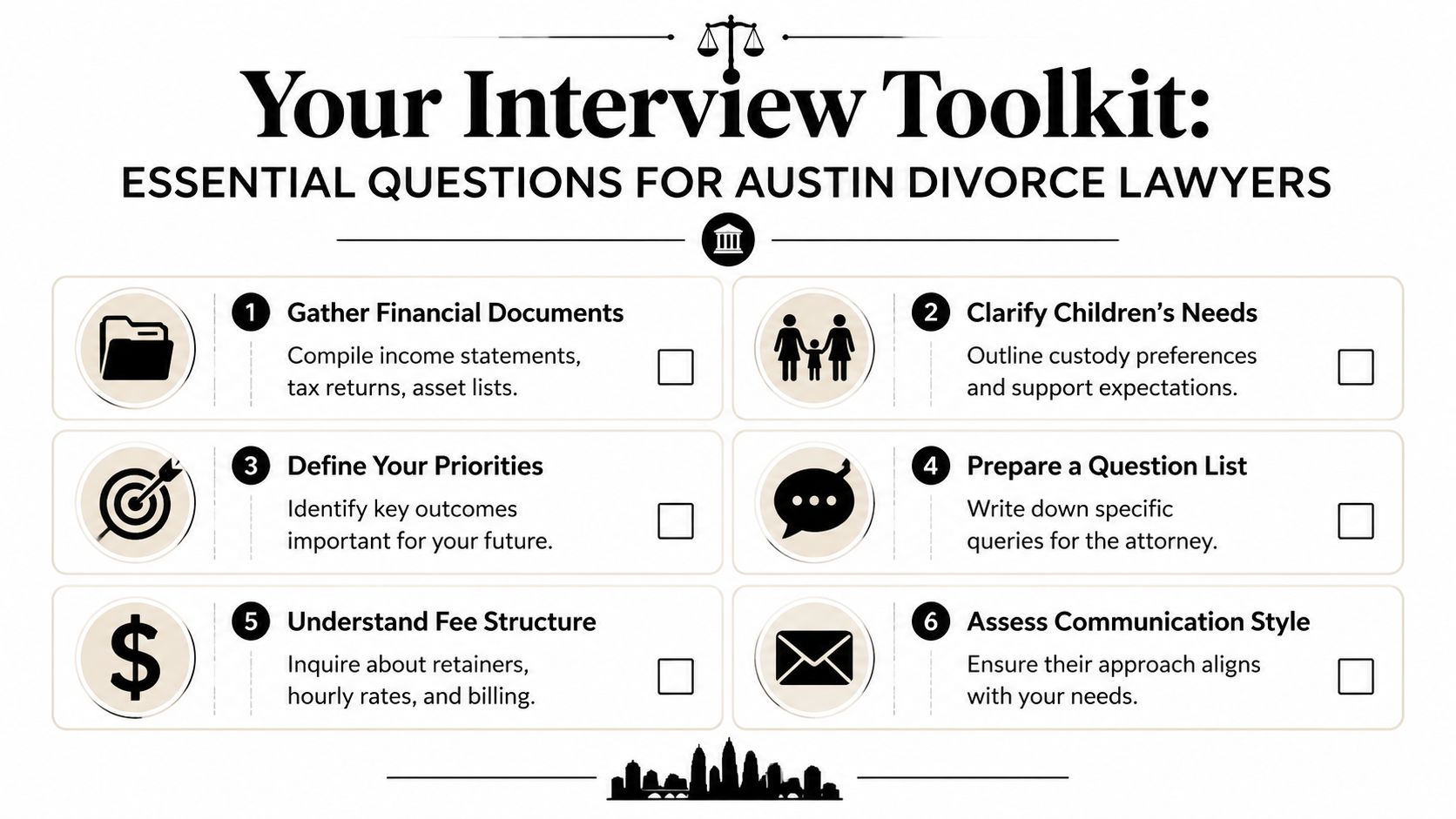
Questions that reveal real fit
Use your consultation to ask direct, plain-English questions. A good starting point is what questions should you ask a divorce lawyer before hiring them, then use the meeting to get answers that apply to your facts.
- What kinds of divorce cases do you handle most often in Travis County? Local experience matters because Travis County practice has its own pace and expectations.
- How do you approach negotiation versus litigation? The answer should match your comfort level and your spouse's behavior.
- Who will work on my case day to day? If a paralegal or associate does most of the work, you should know that upfront.
- How do you keep clients updated? Communication style matters as much as legal skill.
- What happens if my case becomes contested? A good lawyer should explain that shift clearly.
- How do you handle cases involving children, support, or safety concerns? Those issues can change the pace of the case fast.
A consultation should also help you understand the law in practical terms. A lawyer worth hiring should explain the timing of the process without sounding rushed or dismissive, especially because even a straightforward divorce still has built-in waiting periods under Texas law.
Use the meeting to test clarity
If the lawyer speaks in jargon, pushes you to sign immediately, or dodges questions about fees, that is a warning sign. If they can explain your options in plain English, identify the next step, and tell you what documents you need, that is a much better sign.
You are also trying to learn how the firm handles the first stretch after you hire them. Who opens the file, who sends the paperwork, how quickly they respond, and whether they give you a concrete plan for the first filing all matter when you are already under stress. Those details often tell you more than a polished website ever will.
An experienced Austin divorce lawyer should be able to connect your answers to the practical realities of Travis County, not just give generic reassurance. If you leave the meeting with clear next steps, a realistic sense of cost, and a better read on whether the lawyer is organized and direct, you have probably asked the right questions.
Preparing for Your Consultation and What Comes Next
A first meeting goes better when you arrive with the right information in hand. If you show up with half-remembered dates and no documents, the lawyer can only give broad guidance. If you arrive prepared, the conversation gets specific, and the advice becomes more useful.
Start with the basics, income records, a list of assets and debts, any court papers you already have, and notes about your children's schedules or special needs. If safety is part of the picture, say so early. If your spouse controls the finances or owns a business, make that clear too, because those facts can change the strategy right away.
What to organize before you meet
- Income information so the lawyer can evaluate support issues.
- Property records so division can be discussed in realistic terms.
- Child-related facts so custody and possession questions stay front and center.
- Any prior messages or court filings that show what has already happened.
- A short timeline of major events in the marriage, separation, and recent disputes.
You should also use the consultation to ask whether the case is likely to be agreed or contested. That choice affects both cost and pace. A lawyer who handles Austin divorce cases should be able to explain those trade-offs plainly and tell you whether your situation calls for a careful settlement approach or a more aggressive posture. If you want a clearer sense of how a consultation should work, this guide to your first meeting with a divorce lawyer lays out the questions that matter.
Practical rule: if you can explain your case in one page, your lawyer can usually give sharper advice in less time.
What usually happens after you hire counsel
After you hire a lawyer, the first step is often filing the Original Petition for Divorce and starting the case in the proper Travis County court. Temporary Orders may follow if you need immediate structure for bills, parenting schedules, or use of the home while the divorce is pending.
The filing date starts the court process, and Texas law still requires a waiting period before the judge can finalize the divorce. That timeline gives your lawyer room to stabilize the case and work toward practical arrangements while the court process continues.
A lawyer should also tell you what the first stretch of representation looks like. You need to know who opens the file, who sends paperwork, how quickly the office responds, and what the first filing will be. Those details matter when you are already under stress, and they tell you a great deal about how the firm operates.
Take Control of Your Future with the Right Legal Partner
The right divorce lawyer does more than file papers. The right lawyer helps you make decisions with a clear head when everything feels uncertain.
That starts with local knowledge, careful vetting, and honest communication. It also means choosing someone who can explain Travis County procedure, Texas timelines, and the trade-offs between settlement and litigation without making you feel rushed. If you're a parent, a business owner, or someone with significant property at stake, that clarity matters even more.
You do not have to sort this out alone. A compassionate Austin family law team can help you understand your options, protect what matters most, and move forward with a plan that fits your life.
A CTA for Law Office of Bryan Fagan, PLLC. Schedule a free consultation to talk through your divorce, custody, or property concerns with a Texas family law team that offers practical guidance and virtual appointments for Austin clients.