Skip to content
For most family court issues in Texas, you need a Board-Certified Family Law Attorney. That specialization matters because divorce, custody, support, and property cases all turn on rules and procedures that a general lawyer may not handle every day.
When your home life is already under strain, trying to figure out the legal side can feel like too much all at once.
You may be asking one question that sounds simple but carries a lot of weight: What type of lawyer do you need for family court? If you're dealing with divorce, a custody fight, child support, enforcement, or a protective order, the answer usually isn't just "a lawyer." It's a lawyer whose practice is built around Texas family law, and whose experience matches the exact kind of dispute you're facing.
That distinction matters more than commonly understood. A custody case isn't handled the same way as a property-heavy divorce. A support modification isn't the same as a protective-order hearing. And a military family has issues that look very different from a short, uncontested divorce with no children.
Feeling Overwhelmed Is Normal Your First Step Is Here
A lot of people first look for a lawyer late at night, after an argument, after being served, or after realizing the case is getting more serious than they expected.
You might be staring at paperwork that makes little sense, wondering whether you need a divorce lawyer, a custody lawyer, or someone else entirely. That confusion is common. Family court touches your children, your finances, your home, and your future. Of course it feels personal and urgent.
I often think about the parent who starts by saying, "I just need help filling out a few forms," and then discovers the other parent is asking for a very different custody schedule. Or the spouse who assumes the divorce will be simple, only to learn that retirement accounts, a business interest, or separate-property claims have to be sorted out carefully. In Texas family court, small misunderstandings can turn into expensive and stressful problems.
Practical rule: If the case affects your children, your support obligations, your safety, or how property will be divided, start with a lawyer who regularly appears in family court.
That doesn't mean every case requires full courtroom litigation. Some matters can be resolved through agreement, mediation, or limited-scope legal help. But even then, the right starting point is usually the same: a family lawyer who can identify the core issues before they grow.
Here is the reassuring part. You don't have to know every legal term before you ask for help. You only need enough clarity to match your problem to the right kind of attorney.
A good Texas family lawyer helps you answer questions like these:
- Is this mainly a divorce case? You may need help with filing, temporary orders, and a final decree.
- Is the dispute about the children? Then custody, possession, conservatorship, and child support may be the central issues.
- Are finances the main problem? Business ownership, retirement, real estate, debt, and separate-property claims call for deeper property analysis.
- Do you need urgent protection? Cases involving family violence or immediate risk often need fast action.
Once you know which category fits your situation, your next steps become much more manageable.
The Foundation What Is a Texas Family Law Attorney
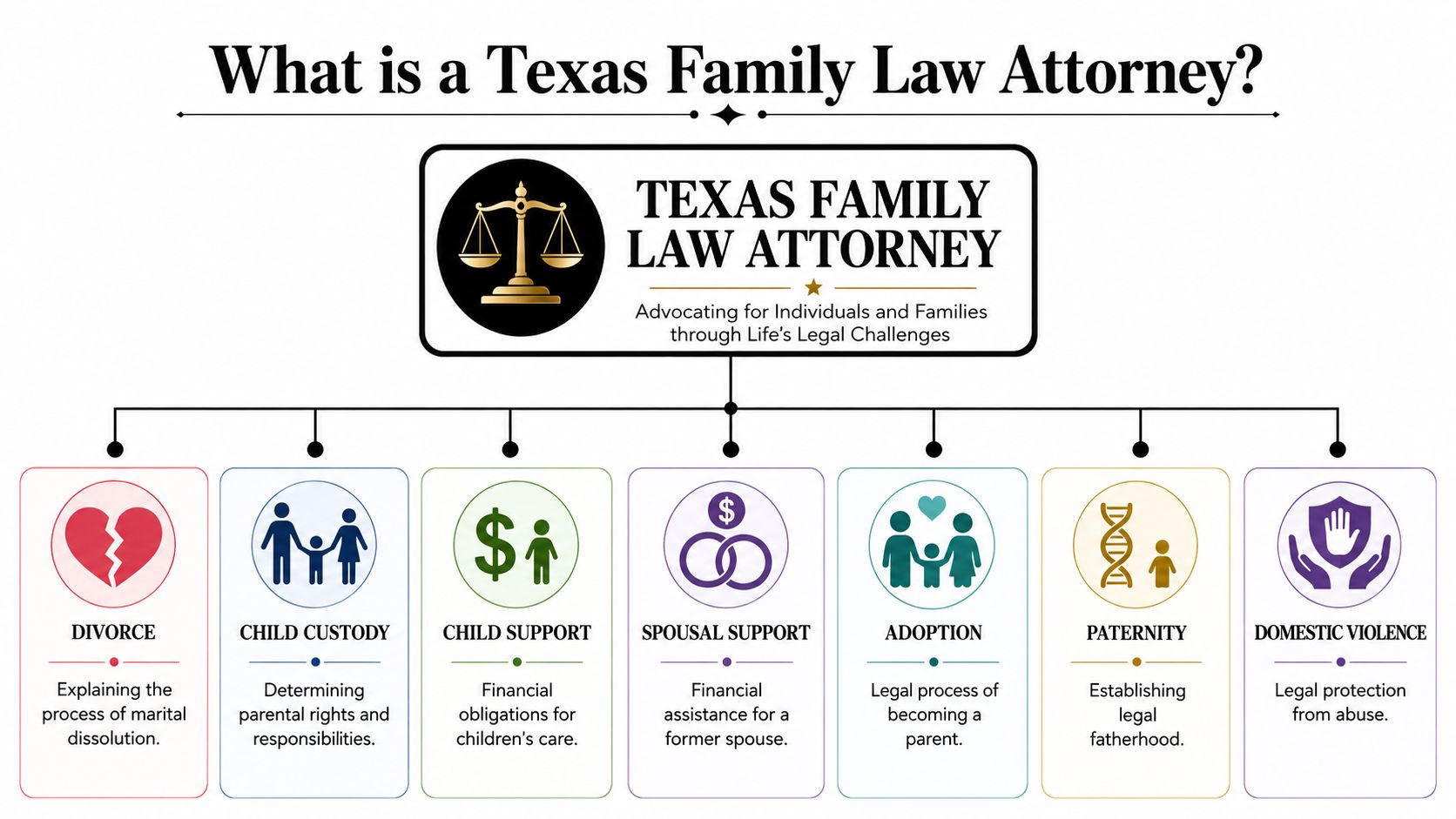
A family law attorney handles legal matters involving families and close relationships. That includes divorce, child custody, child support, spousal support, paternity, adoption, and protective-order matters. MetLife's overview of family law attorneys puts it plainly: in family court, the lawyer you need is usually a family law attorney, and the best fit is one with family-court experience tied to your specific case type.
Why specialization matters
You wouldn't go to a foot doctor for heart surgery. Family court works the same way.
A general civil litigator may be smart and capable, but family cases involve their own statutes, court forms, hearing practices, and practical dynamics. In Texas, those cases often move quickly when temporary orders, parenting schedules, or emergency relief are involved. The lawyer needs to know not only the law, but how family courts function.
For many Texas families, the gold standard is a Board-Certified Family Law Attorney through the Texas Board of Legal Specialization. Board certification can be especially useful when your case involves contested custody, business valuation, tracing separate property, enforcement, or unusually high conflict. It signals focused experience in family law rather than a broad practice that only occasionally handles these cases.
The right lawyer isn't just someone who can file papers. It's someone who can spot the issue that will matter most to the judge before that issue defines the whole case.
What these lawyers actually do
A Texas family lawyer often helps with both legal analysis and day-to-day case management. That may include:
- Filing the case: Drafting the original petition and requesting temporary relief when needed.
- Responding to claims: Reviewing the other side's requests and preserving your position early.
- Building the parenting case: Organizing facts that affect conservatorship, possession, and decision-making.
- Handling finances: Identifying community property, separate property, debts, and support issues.
- Negotiating settlement: Preparing for mediation and drafting enforceable agreements.
- Preparing final orders: Making sure the decree or order says what it needs to say.
If you want a fuller picture of the day-to-day role, this breakdown of what a divorce lawyer actually does and what they don't is a useful companion.
And if your issue is specifically divorce procedure, How to File for Divorce in Texas: Step by Step walks through the full sequence from petition to final decree.
A helpful comparison for financial agreements
Some readers also want to understand how family-law planning compares to relationship-based financial agreements used elsewhere. For a practical outside comparison, Everglow Prosperity's BFA guide gives context on how couples sometimes formalize financial expectations in another legal system. It isn't Texas law, but it can help you see why precise drafting matters when family relationships and money overlap.
Matching Your Case to the Right Legal Specialist
The question isn't only whether you need a family lawyer. It's which kind of family-law experience fits your case.
Guidance on family-law specialization makes this point clearly: custody cases call for evidence strategy around best-interest factors, support cases require correct income calculation, and property-division cases require tracing and valuation of assets. The more complicated the issue mix, the more valuable a specialist becomes.
Which Family Law Specialist Do You Need?
| If Your Situation Involves… | You May Need an Attorney with Expertise In… |
|---|---|
| Disagreement over where the children live | Custody litigation, parenting plans, temporary orders |
| Child support disputes or modifications | Income review, guideline support, enforcement |
| A business, real estate portfolio, or large retirement accounts | Complex property division, valuation, tracing |
| Family violence or safety concerns | Protective orders, emergency hearings |
| One spouse in the military | Military divorce, relocation, parenting logistics |
| A prior court order that isn't being followed | Enforcement, contempt, modifications |
| A mostly agreed divorce | Uncontested divorce, decree drafting, mediation review |
For contested custody cases
If your main concern is your children, look for a lawyer with strong custody and visitation experience.
Texas custody cases often turn on practical facts. Who takes the child to school? Who handles medical appointments? Is there a history of missed exchanges, instability, or conflict? A lawyer in this space needs to know how to present parenting facts in a way that lines up with the child's best interest and the court's expectations.
You should also ask whether the lawyer regularly handles temporary-orders hearings. Early orders often shape the rhythm of the whole case.
For support disputes and enforcement
Some family-court problems look simple because they involve a number on paper. They usually aren't.
If your case involves child support, spousal maintenance, arrears, or enforcement, you want a lawyer who is careful with income analysis, documentation, and order language. In these cases, details matter. Variable income, self-employment, bonuses, and under-the-table payments can complicate support issues quickly.
A support-focused attorney should also be comfortable reading existing orders line by line. Enforcement cases often rise or fall on whether the prior order is specific enough to enforce.
For high-asset or business-owner divorces
If either spouse owns a business, has significant investments, or claims certain property is separate, you need a lawyer who understands tracing, valuation, and classification.
Many people are often blindsided. They assume the court will split everything in half. But before anything can be divided, someone has to identify what is community property, what may be separate property, how debts are treated, and whether an asset needs valuation. A lawyer without experience in these issues may miss records that matter.
This kind of case often benefits from a more strategic pace. Rushing can create avoidable mistakes.
For military families
Military divorces and custody cases often involve scheduling, relocation questions, and service-related practical problems. The family-law attorney you hire should understand how military life affects possession schedules, communication with children, and the timing of court proceedings.
The lawyer doesn't need a separate label on their website to be useful. But they should be able to talk comfortably about service-related complications and how those facts affect your case strategy.
For domestic violence and urgent safety concerns
If there has been family violence, threats, stalking, or controlling behavior, the right lawyer is one who acts quickly and understands protective orders and emergency relief.
These cases are different from ordinary scheduling disputes. The timeline can be fast. The facts need to be organized clearly. And the lawyer should know how to present urgent concerns without losing focus. If safety is part of your case, tell the attorney's office that at the first contact so they can respond appropriately.
When urgency is real, don't wait for the "perfect moment" to get advice. Family-court timing can matter as much as the underlying facts.
For modifications after divorce or custody orders
A lot of people think they only need a lawyer at the start of a case. In reality, family law often continues after the final order.
If you need to change custody, visitation, or support, or if the other party isn't following the current order, look for a lawyer with modification and enforcement experience. These cases require careful reading of the old order and a practical view of what the court will and won't change.
If you're still deciding whom to call, this guide on how to choose the right divorce lawyer in Texas, red flags included can help you compare attorneys more effectively.
Unique Aspects of Texas Family Law You Must Know
Texas family law has its own rules, and those rules shape what kind of lawyer you should hire.
Community property and separate property
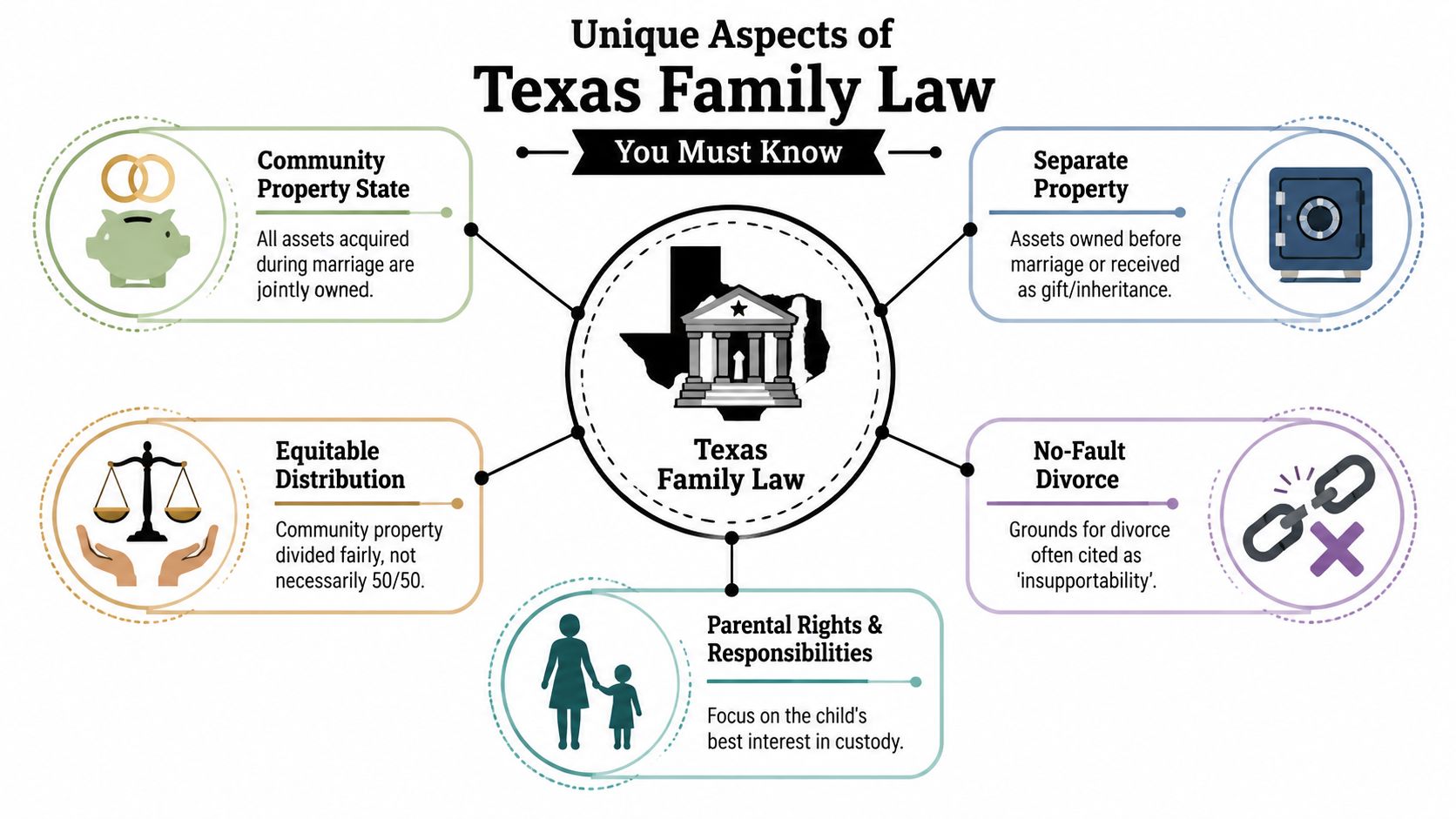
Texas is a community property state. In plain English, that means property acquired during marriage is generally treated as belonging to the marital estate, while certain property may remain separate, such as assets owned before marriage or received by gift or inheritance.
That sounds straightforward until real life enters the picture. What if one spouse started a business before marriage and grew it during marriage? What if separate funds were mixed into a joint account? What if one spouse used inherited money for a home down payment? These questions are why property-focused family-law experience matters.
For business owners and families with significant assets, your lawyer should be comfortable identifying records, timelines, and ownership issues early. The legal label attached to an asset can affect the bargaining power in settlement throughout the case.
Conservatorship and possession in Texas
Texas usually talks about conservatorship, possession, and access rather than using only the everyday term "custody."
Parents often get confused here. Conservatorship deals with rights and duties involving the child. Possession and access deal more with the schedule. Many cases also raise questions about the Standard Possession Order, which often serves as a default framework for parenting time. That doesn't mean every family gets the same arrangement. It means the court starts from a familiar structure and then looks at the child's best interest.
Local procedure matters more than people expect
A family-law attorney doesn't just apply statewide law. The lawyer also has to understand and work within local practice. The New York City Bar's family-law guidance notes that family-law attorneys deal with both state rules and local family-court procedure, and that procedural mistakes can affect jurisdiction, what evidence is allowed, and whether final orders are enforceable. The same practical lesson applies in Texas. Local court habits, filing practices, and hearing expectations can shape how your case moves.
A technically correct argument can still fail if it's presented in the wrong procedural posture or with the wrong supporting paperwork.
That is why county-level experience matters. A lawyer who understands how local courts handle temporary orders, mediation settings, and final prove-ups can help you avoid unnecessary detours.
The basic divorce path in Texas
If you're filing for divorce, the process usually includes these major steps:
- Filing the petition
- Serving the other spouse or obtaining a waiver
- Addressing temporary issues, such as use of property, support, or parenting arrangements
- Exchanging information and negotiating
- Attending mediation when appropriate
- Finalizing the decree
Many contested Texas divorces resolve through mediation rather than trial. If mediation is part of your path, Divorce Mediation in Texas: How It Works gives a practical overview of that process.
How to Prepare for Your First Lawyer Consultation
Your first meeting with a lawyer goes better when you don't try to tell your whole life story from memory.
Bring structure. Bring documents. Bring questions.
What to gather before the meeting
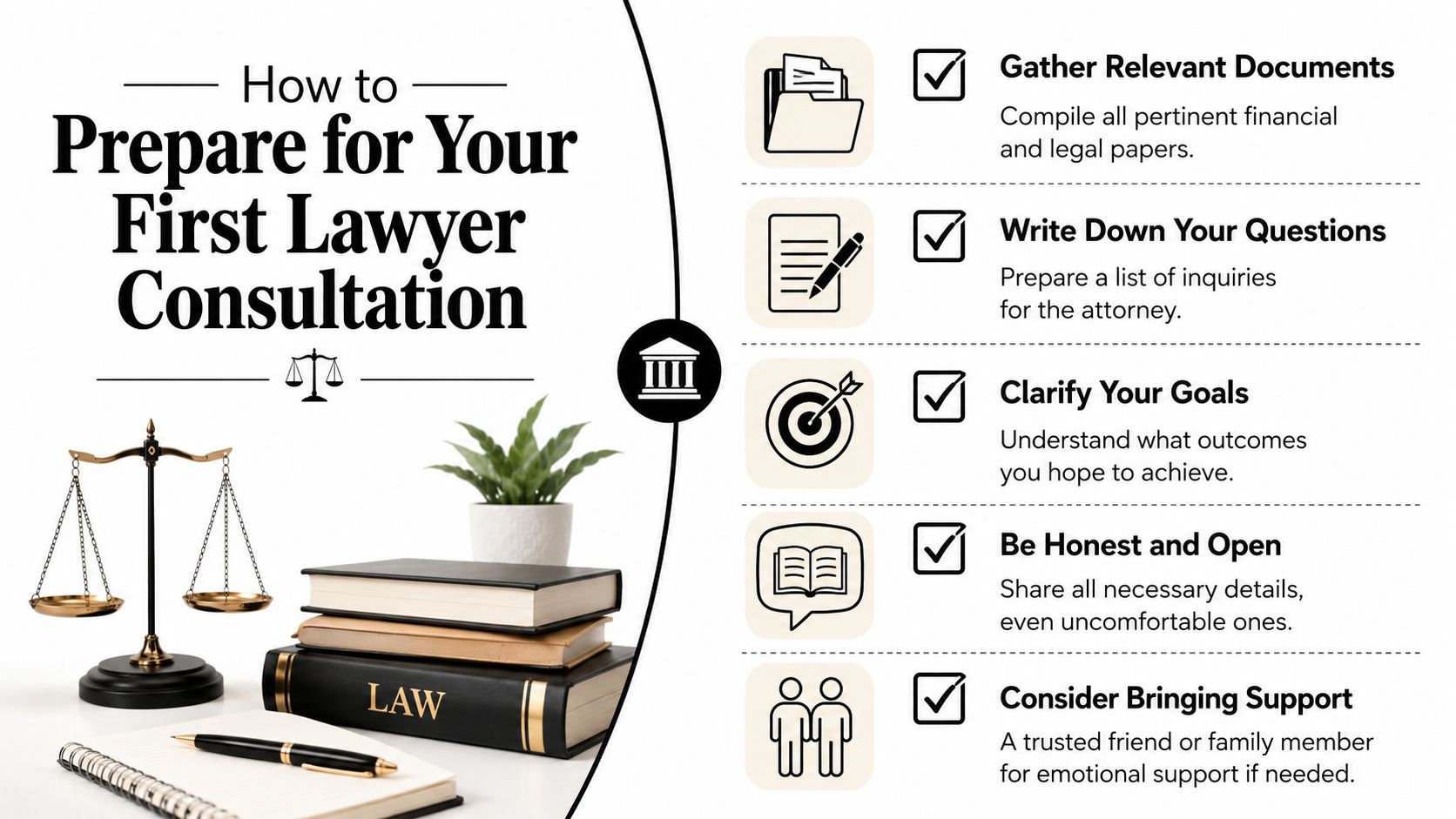
Start with the basics. You don't need a perfect binder, but you do need enough information for the lawyer to identify the core issues.
- Court papers: Any petition, citation, prior orders, notices of hearing, or signed agreements
- A short timeline: Marriage date, separation date, children's birthdates, major case events
- Financial documents: Pay stubs, tax returns, account statements, mortgage information, business records if relevant
- Property list: Home, vehicles, retirement, debts, and anything you believe is separate property
- Child-related information: Current schedule, school details, medical issues, and communication concerns
If there has been abuse, threats, stalking, or serious substance-abuse concerns, make a clear note of that so the lawyer can assess urgency.
Questions worth asking
You aren't just hiring a person with a law license. You're choosing someone to guide major decisions in a stressful season.
Ask questions that reveal how the lawyer thinks:
- How much of your practice is family law?
- Have you handled cases like mine before?
- What do you see as the biggest issue in my case?
- Do you expect mediation, temporary orders, or both?
- How do you prefer to communicate with clients?
- What documents do you need from me first?
The State Bar of Texas advises prospective clients to compare communication style, the lawyer's case plan, fee reasonableness, and whether the lawyer explains the process clearly. That's practical advice. You need a lawyer who can make the process understandable, not more confusing.
Here is a helpful video to watch before your appointment:
How to make the consultation more useful
Be direct about your goals. If keeping a business intact matters most, say so. If your top priority is a stable parenting schedule, say that. If you want an efficient uncontested resolution, say that too.
Also be honest about the bad facts. Family cases rarely improve when a client hides details because they're embarrassing. Your lawyer can usually work with difficult facts. Surprise facts are much harder.
For a fuller picture of the meeting itself, this guide on what happens at your first consultation with a divorce lawyer can help you walk in more prepared and less anxious.
What to Do Next Taking Control of Your Future
The first strong decision in a family-court case is choosing the right type of lawyer.

If your case is in Texas family court, the safest starting point is usually a Board-Certified Family Law Attorney or another lawyer whose practice is concentrated in family law and whose background matches your dispute. That might mean custody litigation experience, skill with financial tracing in a high-asset divorce, or urgent protective-order work.
If you can hire counsel, don't wait until the case is already off track. Early advice often helps you avoid mistakes involving filing, evidence, temporary orders, and settlement terms. If you're still at the decision stage, even one focused consultation can give you a clearer map.
Some readers are in a harder position financially. That reality is common. A University of California Law Journal study states that 80% of people in family-law matters nationwide go to court without a lawyer. Texas guidance also makes clear that private family-law cases generally don't come with court-appointed counsel, which is why legal aid, referral services, limited-scope help, and self-help resources matter so much.
That doesn't mean you have no options if full representation isn't realistic. You may be able to look for:
- Legal aid programs for qualifying applicants
- Referral services through bar or county resources
- Unbundled services for document review, coaching, or hearing preparation
- Domestic-violence resources if safety is part of the situation
- Self-help tools such as TexasLawHelp materials for forms and procedural guidance
Getting help in stages is still getting help. You don't have to solve the entire case in one move.
If you're dealing with divorce, custody, support, property division, mediation, or enforcement in Texas, one practical option is Law Office of Bryan Fagan, PLLC, a Texas family-law firm that handles these matters and offers consultations for people trying to understand their next step.
Key takeaway
Ask yourself two questions.
First, what is the issue in my case: children, support, property, safety, or enforcement?
Second, does the lawyer I'm considering handle that issue regularly in Texas family court?
When you can answer those two questions clearly, you're already in a stronger position. You don't need to know everything today. You just need to take the next right step for your family.
If you're unsure what kind of family lawyer fits your case, schedule a free consultation with Law Office of Bryan Fagan, PLLC. You can talk through your divorce, custody, support, mediation, or enforcement concerns in plain English, get a clearer sense of your legal options in Texas, and decide on a path that protects your children, your finances, and your peace of mind.