Skip to content
When you're staring at the possibility of divorce, even simple choices can feel heavy.
You may be worried about your children, your house, your retirement, your business, or just how to get through the next month without making a costly mistake. That is why choosing counsel isn't an administrative step. It's the first decision that shapes every decision after it.
The Most Important Decision in Your Divorce Is Your First One
A divorce case in Texas can involve property division, parenting schedules, temporary orders, mediation, court hearings, and a final decree that will affect your daily life long after the case ends. If you hire the wrong lawyer, you may spend more money, lose time, and create conflict that could have been managed better from the start.
Texas law gives you a framework, but your facts drive the outcome. Under the Texas Family Code, a divorce may involve community property, which generally means property acquired during marriage is subject to a just and right division. If you have children, conservatorship, possession, and support become central issues. In plain English, the court wants a workable result, but it won't build your strategy for you.
That is where the right lawyer matters. You don't just need someone who can file papers. You need someone who can tell you, early, whether your case is likely uncontested, contested, child-centered, financially complex, or headed toward trial.
Why this choice carries so much weight
The lawyer you hire helps you make decisions about:
- Filing strategy: Whether to file first, where to file, and whether temporary restraining orders or temporary orders are needed
- Property approach: How to identify separate property, community property, reimbursement issues, and business interests
- Parenting issues: How to handle conservatorship, possession schedules, school decisions, and child support
- Process options: Whether negotiation, mediation, collaborative methods, or litigation make the most sense
Practical rule: A good Texas divorce lawyer should reduce uncertainty, not add to it.
You should also think about the emotional side of the case, especially if children are involved. Legal strategy matters, but so does helping your family adjust in a healthy way. If you're trying to understand what divorce can feel like from a child's perspective, this children psych guide on parental divorce is a useful companion resource.
The first goal is clarity, not speed
Many people start by asking, "Who is the best divorce lawyer near me?" A better question is, "Who handles my kind of Texas divorce with a clear plan, realistic advice, and a process I can live with?"
That shift matters. It moves you away from marketing and toward fit, skill, and judgment. Once you know what to verify and what to ask, this decision becomes much more manageable.
Beyond the Consultation How to Verify a Lawyer's Expertise
A polished consultation can create confidence. It does not prove competence.
Texas family law is state-specific. Community property rules, custody standards, support issues, enforcement remedies, and local courtroom practices all require focused experience. One of the biggest gaps in most advice on How to Choose the Right Divorce Lawyer in Texas (Red Flags Included) is that it talks about personality, but not enough about verification.

Check for true Texas family law focus
Start with the lawyer's actual practice, not the website headline. Some lawyers handle family law every day. Others "also do divorces" while spending much of their time on unrelated matters. That difference shows up fast when a case turns difficult.
Look for signs of a concentrated Texas family law practice:
- Primary case type: Ask what percentage of the lawyer's current work is family law
- Texas-specific experience: Ask how often the lawyer handles divorce, custody, support, enforcement, and property division matters in Texas courts
- Issue match: Ask whether the lawyer regularly handles the exact issue you have, such as high-asset division, military divorce, business ownership, relocation disputes, or enforcement
A useful outside perspective on this problem appears in this discussion of red flags when choosing a family law attorney in Houston, which warns against lawyers who handle a little of everything or make broad promises before they know the facts.
Board Certification matters
One practical way to verify deeper expertise is to ask whether the lawyer is Board Certified in Family Law by the Texas Board of Legal Specialization. That credential doesn't mean every non-certified lawyer is unqualified, but it does give you an objective marker to examine.
You should ask direct questions:
- Are you Board Certified in Family Law in Texas?
- If not, how much of your practice is devoted to Texas family law?
- How many recent cases have you handled involving facts like mine?
- Do you personally appear in court on these cases?
Those questions are better than asking, "Are you experienced?" Most lawyers will say yes. Specific questions create useful answers.
County-level experience is not a small detail
Texas law is statewide, but local practice can vary by county. Docket movement, preferred scheduling methods, courtroom expectations, and mediation culture often differ. A lawyer who understands your county can give you more realistic advice about timing, temporary hearings, and what kind of preparation matters most.
Use this as a screening tool during your consult:
| What to verify | Why it matters |
|---|---|
| Recent cases in your county | Local procedure and judge expectations can affect strategy |
| Familiarity with temporary orders practice | Early hearings often shape possession, support, and household finances |
| Mediation habits in local courts | Some courts strongly push settlement before trial |
| Trial readiness | Even if your case settles, leverage often comes from credible preparation |
If you want a closely related example of what to compare during your search, this guide on key considerations when choosing a divorce lawyer in Fort Worth gives a helpful local lens.
A confident consultation should survive follow-up questions. If it doesn't, that's your answer.
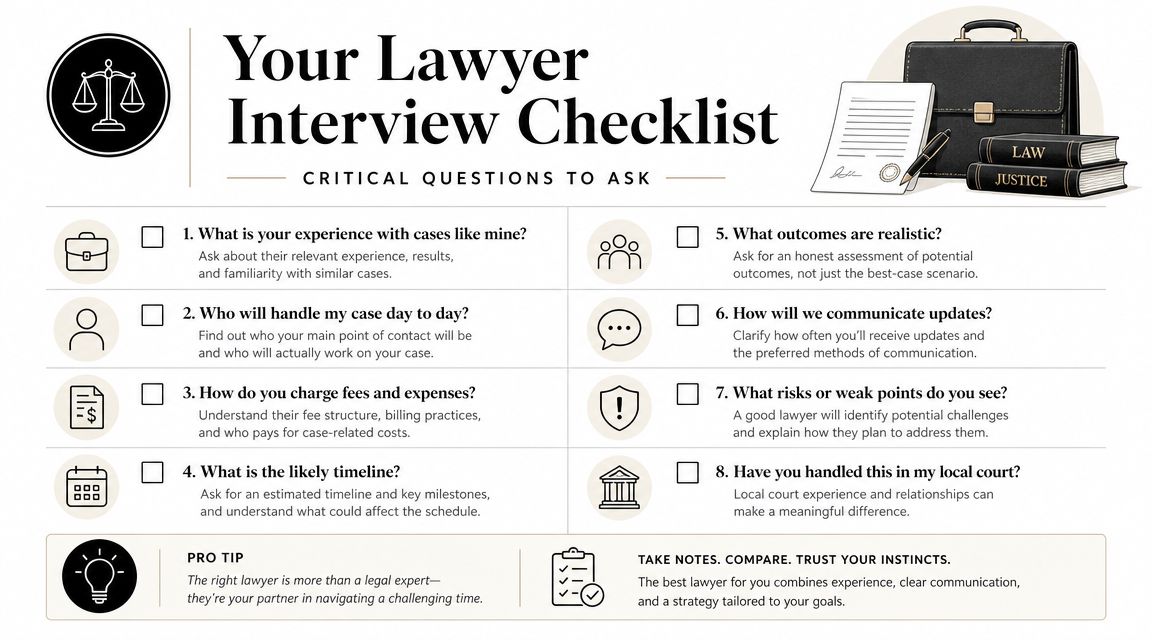
Your Lawyer Interview Checklist Critical Questions to Ask
The consultation is not a performance review of you. It's an interview of the lawyer.
Texas divorce law covers more than ending a marriage. It includes the path from original petition to service, answer, temporary orders, discovery, mediation, final negotiation, prove-up or trial, and the final decree. If children are involved, the lawyer should also explain conservatorship, possession, child support, and any urgent custody issues in plain English.
A broad view matters because Texas is not dealing with a tiny or simple divorce environment. One Texas legal summary, citing public-health data, reports that the divorce rate fell from about 3.8 divorces per 1,000 residents in 2003 to about 2.7 per 1,000 in 2023, while total divorces moved from approximately 83,995 to 82,969 over the same period, which shows a large and varied legal market where complex divorce issues still require experienced counsel (Texas divorce statistics overview).
Ask strategy questions that reveal judgment
These questions tell you whether the lawyer sees your case clearly or is just giving generic reassurance.
- What are the biggest pressure points in a case like mine? You want to hear specifics such as tracing separate property, preparing for a temporary orders hearing, managing communication around the children, or valuing a business.
- What would make this case settle well, and what usually causes it to escalate? Strong answers show practical experience.
- Do you expect mediation in my case? In many Texas divorces, mediation is a major checkpoint before trial.
- What should I do in the next two weeks, and what should I avoid doing? This is often where good lawyers separate themselves from average ones.
Ask who will actually handle the work
Many clients hire one person and then communicate mostly with someone else. That isn't always bad. It becomes a problem when the structure is unclear.
Use questions like these:
- Who will draft the petition, discovery, and proposed orders?
- Will I deal mainly with the attorney, a senior associate, or a paralegal?
- Who prepares me for mediation or a temporary hearing?
- If my attorney is in court, who responds to urgent questions?
Client-side insight: A firm with a clear team structure can be more efficient than a solo system, but only if roles are explained up front.
Ask about communication and timing
Texas divorce clients often feel most anxious in the silence between events. Communication standards matter.
Here is a practical checklist:
- Response policy: How quickly do you return calls or emails?
- Status updates: Will I receive updates even when there is no major hearing set?
- Document review: How do you share drafts and collect revisions?
- Emergency issues: What counts as urgent, and how do I reach someone if parenting or financial problems erupt after hours?
Ask fee questions without hesitation
Fees are part of strategy. A lawyer who dislikes fee questions may also dislike accountability.
Ask directly:
- How does the retainer work?
- What work is billed by the attorney, and what work is billed by staff?
- How often will I receive invoices?
- What events tend to increase costs in a Texas divorce?
- How do you use mediation, paralegal support, or client homework to control expense?
If you'd like a focused list to bring into your consult, this resource on what to ask a divorce attorney is worth reviewing.
Ask for the roadmap from filing to final decree
The lawyer should be able to explain the likely process in plain English:
- Filing the Original Petition for Divorce
- Service or waiver
- Answer and any counterpetition
- Temporary orders, if needed
- Exchange of information and discovery
- Negotiation and mediation
- Trial, if settlement fails
- Final Decree of Divorce and post-decree follow-through
If children are involved, ask how temporary parenting schedules, final possession terms, and child support may be addressed. If property is complex, ask how bank records, retirement accounts, business interests, or reimbursement claims are usually handled.
Matching the Lawyer to Your Divorce Type
A lawyer can be good and still be wrong for your case.
The right match depends on what your divorce requires. Texas divorces often fall into categories that need different strengths. You should hire for the problem in front of you, not for a general impression.

Uncontested and low-conflict divorce
If both spouses agree on most issues, the best lawyer may be one who is organized, efficient, and careful with documents rather than aggressively theatrical. In these cases, mistakes often come from poor drafting, incomplete disclosures, or sloppy decree language.
You still need someone who understands Texas requirements for filing, the waiting period, settlement paperwork, and how to turn an agreement into enforceable orders.
Child-centered contested divorce
When the main conflict involves parenting, look for a lawyer who can explain conservatorship, possession, and child support clearly. Under the Texas Family Code, custody disputes usually focus on the child's best interests, not on which parent feels more wronged.
Ask whether the lawyer has recent experience with temporary orders, school decision disputes, possession schedule modifications, and enforcement. The right lawyer in these cases is steady, credible, and prepared.
The lawyer you want for a parenting case is often the one who stays calm while the facts get emotional.
High-asset and business-owner divorce
If you own a business, receive complex compensation, hold investment accounts, or believe separate property claims are in play, you need a lawyer who is comfortable with records, valuation issues, and financial tracing. These cases are rarely solved by broad statements about "fighting for everything."
The lawyer should be able to discuss business records, reimbursement, division options, and settlement structures in a grounded way. If household finances are tangled, even practical tools can matter. Couples who have used mixed account systems often benefit from understanding flexible hybrid money approaches for couples because account structure can affect how easily financial history is explained during divorce.
Military and special-circumstance divorce
Military divorce, interstate issues, and enforcement-heavy cases need targeted knowledge. Deployment, jurisdiction questions, retirement issues, and remote participation can change the strategy.
This is also where process support matters. A firm such as Law Office of Bryan Fagan, PLLC offers Texas family law representation along with in-person and virtual consultations, which can be relevant if you're balancing distance, work travel, or military service.
Warning Signs Red Flags You Can't Afford to Ignore
People often excuse early warning signs because they're stressed and want help quickly. That is how expensive hiring mistakes happen.
In Texas, cost pressure can build fast. One Texas legal source reports that the average divorce without shared children costs about $15,600, while a divorce with shared children averages $23,500, and filing fees usually range from about $250 to $350 (Texas divorce cost and process discussion). Those numbers are exactly why transparency, planning, and communication matter before you sign anything.

Red flags in what the lawyer says
Some warning signs come directly out of the lawyer's mouth.
- Guarantees: If a lawyer promises you'll get custody, keep the house, or "win everything," step back. No ethical lawyer can guarantee an outcome before the facts are developed.
- Oversimplification: If your case involves children, property, support, or business interests and the lawyer acts like it is all routine, that should concern you.
- No downside analysis: Good lawyers discuss risks. Weak ones sell certainty.
Red flags in how the firm operates
Other warning signs show up before legal work even begins.
| Red flag | What it may mean |
|---|---|
| Calls and emails go unanswered | The firm may be overloaded or disorganized |
| Nobody can explain billing clearly | You may face surprise charges and weak cost control |
| Intake staff gives legal conclusions | Roles inside the firm may be poorly managed |
| Pressure to sign immediately | The firm may value conversion over fit |
| No clear point of contact | Communication problems often continue after hiring |
Watch this closely: The way a firm handles the first consultation often predicts the way it will handle your case.
Red flags in strategy and ethics
Be cautious if a lawyer encourages revenge, dramatic social media behavior, hiding assets, or using children to gain an advantage. Those approaches usually increase cost and damage credibility.
You should also be wary if the lawyer cannot explain when mediation makes sense, how temporary orders work, or what the next procedural milestone is. Even contested cases need a roadmap.
If you've already hired counsel and are seeing these problems, this guide on signs it might be time to change your divorce lawyer in Texas can help you evaluate your options.
A small discomfort now can prevent a large problem later
You do not need to ignore your instincts to seem reasonable. If a lawyer is evasive, rushed, careless with facts, or dismissive of your concerns in the first meeting, those traits usually do not improve once the retainer is paid.
Taking the Next Step How to Make Your Final Choice with Confidence
By this point, the decision should feel narrower and more concrete.
You are not choosing the lawyer with the flashiest consultation. You are choosing the lawyer who has verified Texas family law experience, understands your type of case, explains the process clearly, and runs a practice that can support you. That includes operational fit. Who does the work, how quickly the team responds, whether paralegals are used efficiently, and whether the firm can handle virtual meetings for busy professionals, out-of-town spouses, or military families are all practical issues that many people overlook, even though they shape the client experience in real ways, as discussed in this overview of how process fit affects choosing a Texas divorce lawyer.
Use a final decision filter
Before you hire anyone, ask yourself:
- Does this lawyer understand the facts that matter in my case?
- Did I receive clear answers about strategy, staffing, and fees?
- Can this firm handle the pace and communication demands of my situation?
- Did the lawyer explain Texas divorce procedure in a way I understood?
- Do I trust this person to tell me the truth, even when the answer isn't easy?
If the answer to any of those questions is no, keep looking.
What to do next
Gather your financial documents, make a short timeline of your marriage and current concerns, and schedule consultations with lawyers who appear to have real Texas family law focus. Bring your questions in writing. Compare answers side by side.
A good decision here can protect your time, your finances, and your future relationship with your children. You do not need perfect certainty before you start. You need a sound process and a lawyer who respects the stakes.
If you're ready to talk through your options, schedule a free consultation with Law Office of Bryan Fagan, PLLC. You can discuss your divorce, custody, property, mediation, or enforcement concerns with a Texas family law team that handles these cases every day, and you can get clear answers about process, strategy, and next steps before deciding how to move forward.