Skip to content
You're trying to keep your footing while one of the biggest questions in your divorce sits in the middle of everything, your home, your kids, and your financial future. In Texas, the answer to who gets the house in a divorce is rarely simple, but it does follow clear rules, and those rules can help you make better decisions right now.
Your Home is More Than Just an Asset
A house is never just walls and a roof in a divorce. It's where birthdays happened, where routines were built, and where your daily life still feels anchored. That emotional weight matters, because it's usually the first reason people want to know who gets the house in a divorce in Texas.

The first question is legal, not emotional
Texas courts start with community property rules, not with whose name feels most connected to the house. If the marital home was acquired during the marriage, it's generally presumed to belong to both spouses, even if only one spouse is on the deed, and Texas Family Code § 3.003 puts the burden on the spouse claiming separate ownership to prove it.[^1] That presumption shapes almost every home dispute.
In other words, the court does not begin by asking who wants the house more. It starts by asking whether the home is part of the marital estate and, if it is, how the equity or title should be divided in a fair way. TexasLawHelp explains that separate property can't be awarded to the other spouse absent clear and convincing evidence, which is why the paper trail matters so much.[^1]
Practical rule: If the home was bought during the marriage, don't assume the deed controls the outcome. The source of the money often matters more than the signature on the title.
That's also why guides like How Property Is Divided in a Texas Divorce focus on the court's division process instead of a simple yes-or-no answer. A house can be sold, awarded to one spouse, or balanced through other assets, depending on the facts.
Community Property vs Separate Property Explained
A divorce often turns on one practical question, who really owns the house once the marriage is over? In Texas, the answer usually depends on whether the home is community property or separate property, and that distinction affects both the legal outcome and the financial picture for each spouse.
Why the deed is only part of the story
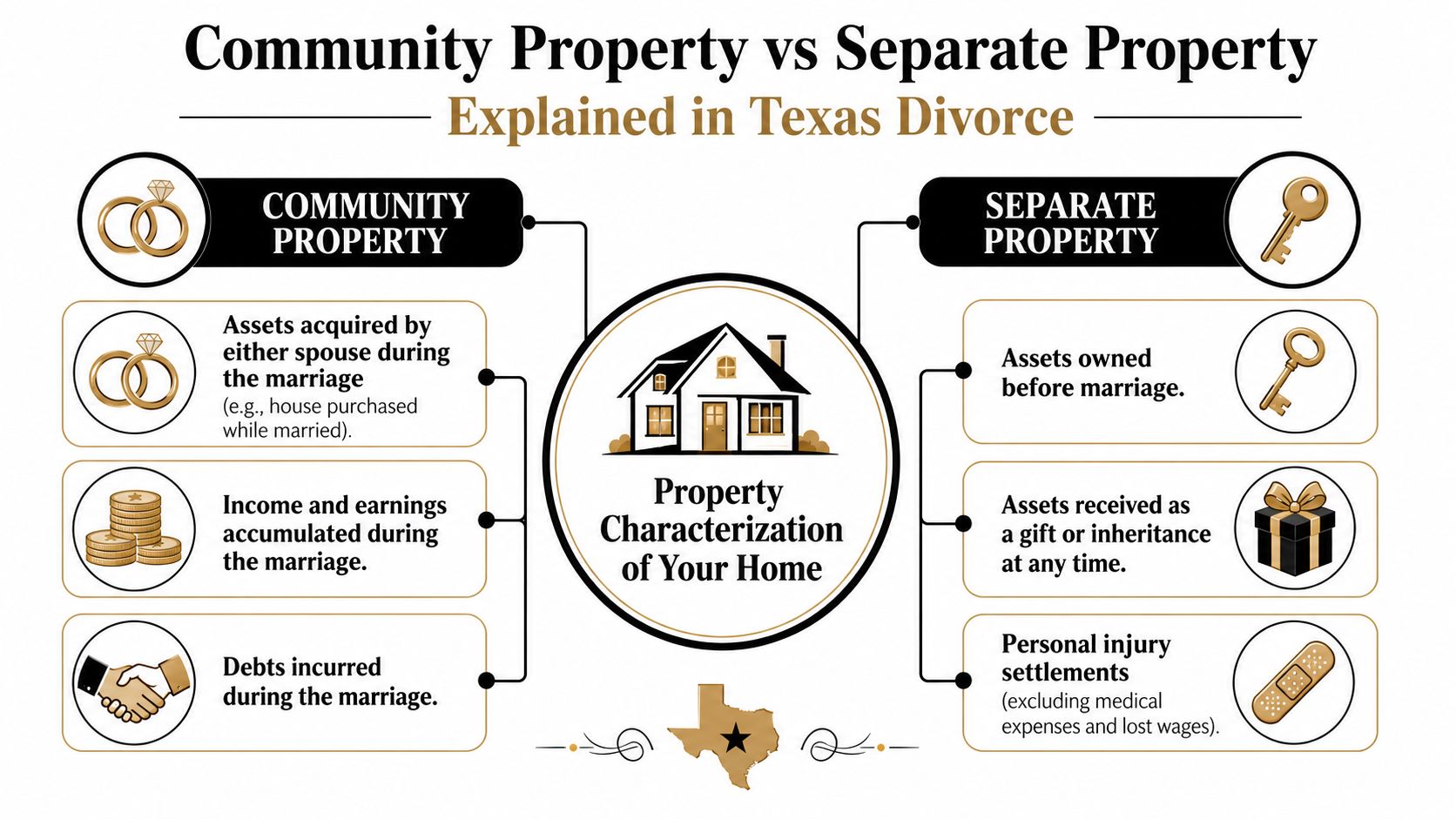
Texas follows a community property system, so a home acquired during the marriage is generally presumed to belong to both spouses, even if only one spouse's name appears on the deed.[^2] Texas Family Code § 3.003 places the burden on the spouse claiming separate ownership to prove it with clear and convincing evidence.[^2] That standard matters because the deed may show who signed paperwork, but it does not always show where the money came from or how the property should be classified.
Separate property covers a different category. It generally includes property owned before marriage or property received as a gift or inheritance, and a house can qualify if the buyer can prove it was purchased with separate-property funds.[^3] The paper trail is often what decides the issue, including the closing statement, bank records, and any documents showing the source of the down payment or purchase money.
For a fuller explanation of how Texas law draws that line, see our guide on separate vs. community property.
A spouse saying, “My name is on the mortgage, so it's mine,” is usually starting with the wrong question. Texas courts care about characterization first.
What usually causes confusion
The most common mistake is assuming that one spouse's name on the deed automatically makes the house separate property. It does not. Texas divorce courts do not decide the house by title alone, and if separate funds were used, the spouse claiming that status has to prove it.[^3] That is why tracing matters so much in a divorce involving a house, especially if the purchase happened years ago and the records are spread across old accounts, refinances, or lump-sum transfers.
Practical questions help narrow the issue. When was the home bought? What money paid for it? Can you show where that money came from? If the answer to any of those questions is unclear, the characterization issue may need a closer review before you negotiate a settlement or sign a decree.
The Texas Standard A Just and Right Division
A Texas judge does not start with a 50/50 split. The court applies a just and right division of the community estate, and that can include the house, so the final result may be unequal when the facts support it.[^4] In practice, that flexibility matters because two families with similar houses can leave divorce with very different outcomes.
What a judge may look at
A court may give one spouse a larger share when the facts justify it, including fault in the breakup, a difference in earning power, or domestic violence.[^4] A house can end up with one spouse if that spouse is also taking on the mortgage and the other obligations tied to ownership. In other cases, the home is sold and the proceeds are divided. The judge is looking at the whole marital estate, not only the emotional pull of one property.
Why equal doesn't always mean fair
Many people hear “fair” and immediately think of an even split. Texas uses just and right, which can be equal, but does not have to be.[^4] If one spouse earns far more, or if the court finds other facts that matter to the overall estate, the division can shift in that spouse's direction.
Attorney insight: If the house is your largest asset, look at the rest of the decree too. Keeping the home can come with mortgage debt, taxes, repairs, and a tradeoff in another asset, so the choice changes the full financial picture.
The phrase who gets the house in a divorce in Texas often sounds like a simple ownership question, but the underlying issue is whether keeping the house works with the rest of the settlement. A home award can affect monthly cash flow, support arrangements, and what each spouse receives from the rest of the property division.
Three Common Paths for the Marital Home
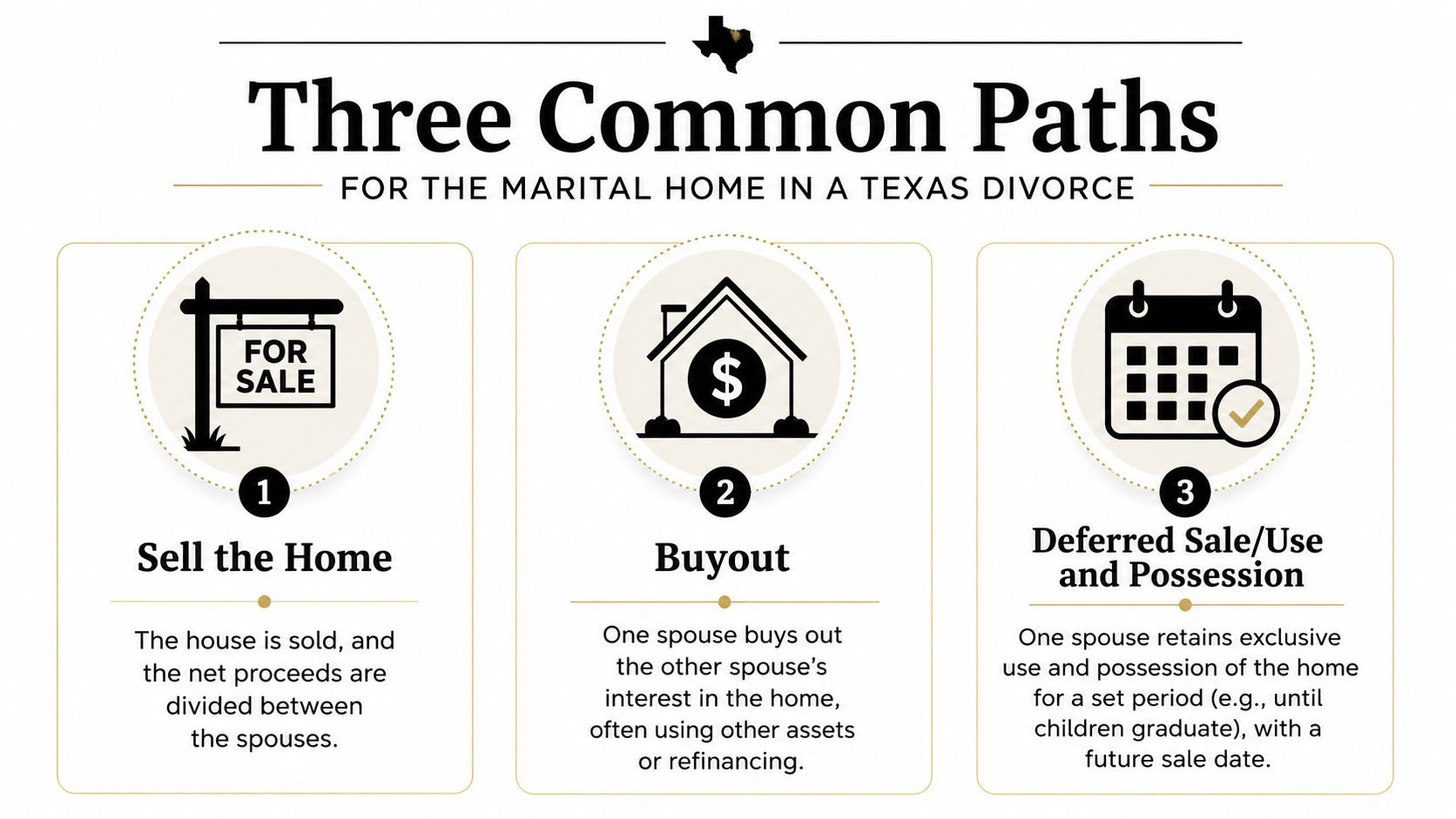
Once the home is characterized and the court or spouses know it's part of the marital estate, most cases move toward one of three paths. The right path depends on cash flow, equity, and whether one spouse wants to stay in the home long term.
Sell the home
Selling is often the cleanest option when neither spouse can comfortably carry the house alone. The home is listed, sold, and the net proceeds are divided according to the decree or settlement. It can feel painful, but it also removes the pressure of future mortgage payments, repairs, and ongoing conflict over possession.
Our guide to selling a home during divorce explains why this choice often makes sense when both spouses need a clear financial reset. If neither side can refinance or buy the other out, selling may be the most realistic result. A court can order that outcome when the parties can't agree.[^1]
Buy out the other spouse
A buyout means one spouse keeps the house and compensates the other spouse for their share of the equity.[^5] That compensation can come through cash or other assets, but the main question is whether the spouse keeping the home can handle the new monthly obligations. A refinance is usually part of the picture, because the spouse who stays often has to qualify for a new mortgage at current rates, which averaged around 6.9% in 2025.[^5]
That matters in a very practical way. A buyout can look workable on paper and still strain the household budget once mortgage payments, taxes, insurance, and maintenance are all added together. If you're unsure whether a buyout is even possible, the refinancing question should come first, not last.
Offset with other assets
Sometimes one spouse keeps the home while the other receives a larger share of another community asset. That might mean retirement funds, investments, or other marital property. The trade can work well when both spouses want certainty and neither wants to force a sale.
If the other spouse doesn't answer the divorce petition at all, the process can shift in a different direction, and Default Divorce in Texas: When a Spouse Doesn't Respond becomes relevant. That is a separate procedural issue, but it can affect how the court reaches the final property order.
A court may also allow one spouse to remain in the house for a limited period before a later sale. That arrangement sometimes helps when children need stability or when the spouses need time to plan the transition. The structure matters because it affects housing, taxes, and timing.
Untangling the Finances Mortgages Liens and Equity
A house can be the most valuable part of a divorce, but it also carries some of the biggest financial obligations. Ownership gets a lot of attention, yet the debt tied to the property often decides whether keeping the home is realistic.
During the divorce
Temporary orders usually decide who pays the mortgage, taxes, and other ongoing costs while the case is pending. That matters because missed payments can hurt credit and create problems later when one spouse is trying to qualify for a new loan or settle the final division. In a contested case, the court can put short-term rules in place so the home does not fall behind while the divorce is still open.
If one spouse wants to stay in the house, the question is bigger than getting a name off the deed. The mortgage still has to be addressed, and the title does not always match the loan. TexasLawHelp explains that a home acquired during marriage is generally presumed to be community property, even if only one spouse is listed on the deed, unless separate-property funds were used.[^3] In practical terms, that means both spouses may still have an interest in the equity, even when only one spouse appears in the mortgage records.
After the final decree
The final decree should say who receives the house and who is responsible for the related expenses. TexasLawHelp also notes that a Special Warranty Deed should be filed to transfer the spouse's interest.[^6] That deed changes title, but it does not automatically free a spouse from the mortgage note. If the lender does not release that person, the debt can still follow them if the payments are missed.
Removing a name from the title only solves part of the problem. If the mortgage remains in both names, the financial exposure can remain in both names too.
That is why refinance planning should start early, especially when the spouses disagree about the home. If one spouse plans to keep the property, the next question is whether that spouse can qualify on their own and handle the new monthly obligation. The practical side matters as much as the legal one, because assuming a mortgage after divorce often determines whether the home can stay with one spouse or has to be sold. Fault issues can also affect the broader property division, and Grounds for Divorce in Texas: No-Fault and Fault explains how those issues can shape the overall settlement.
Special Considerations in a Texas Divorce
Some home disputes are layered with extra issues that change the strategy. A protective order, military service, or a complicated estate can all shift how the house is handled.
A spouse dealing with family violence may seek exclusive use of the home while the divorce is pending. In that situation, the court's priority is safety and stability, not just ownership paperwork. A temporary order can keep one party out of the house even before final property division is resolved.
Military families face another layer because federal rules can interact with Texas property law. The home may still be part of the community estate, but the broader divorce picture can include service-related benefits and timing issues that affect the settlement. A case involving a deployed spouse or long-distance service obligations often needs careful planning so the decree matches the reality of military life.
High-value estates bring a different problem. The home may be tied to a business structure, investment property, or trust, which means the house can't be treated like a simple stand-alone asset. In those cases, the legal question isn't just who keeps the residence, it's how the house fits into the full asset picture without creating hidden tax or liquidity problems.
If your family needs a short-term place to land while the decree is being negotiated, a practical housing resource like Murphy's Corporate Housing Associates 2026 guide to temporary housing can help you think through transition housing options. That kind of planning matters when the final decree may require a move before a new home is ready.
What to Do Next Protecting Your Home and Future
The first step is getting the facts in order. If the house was bought during the marriage, Texas law usually treats it as community property unless there is proof that some or all of it is separate property.[^2] If the home is community property, the court still has to reach a just and right division, which can turn on fault, income, children, and the rest of the estate.[^4]
Gather these documents now
- Deed and closing papers: These show how the home was titled and how it was purchased.
- Mortgage statements: These show the current balance and the monthly payment you would have to carry.
- Property tax records: These help show the ongoing housing costs that matter during settlement talks.
- Bank statements used for the down payment: These can help trace separate funds if that issue comes up.
- Any records of repairs or renovations: These may matter if community money was used after the purchase.
Make the decision around real life, not just emotion
Ask whether keeping the house fits the rest of your decree and your budget. A buyout may sound simple on paper, but if refinancing is out of reach, the better option may be a sale or an offset with other property. The choice has to work for your monthly housing cost, your cash flow, and the life you will have after the divorce.
Mediation often helps because it gives both spouses more control over timing and outcomes than a courtroom fight. It can also reduce the pressure to make a rushed decision about housing. If you want to understand how custody, support, mediation, or enforcement can affect the rest of your case, you can review the firm's Texas family law resources. For a short-term place to stay while the decree is still being worked out, a practical housing resource like 2026 guide to temporary housing can help you think through transition options.
If you are deciding whether to keep the house, sell it, or trade it for other assets, speak with an attorney before you sign anything. The Law Office of Bryan Fagan, PLLC can review your deed, mortgage, and financial picture with you, explain your options in plain English, and help you protect your next move.