Skip to content
You can be standing in a courthouse parking lot, looking at the clock, and feel your stomach drop because 3:55 PM suddenly looks a lot smaller than it did this morning.
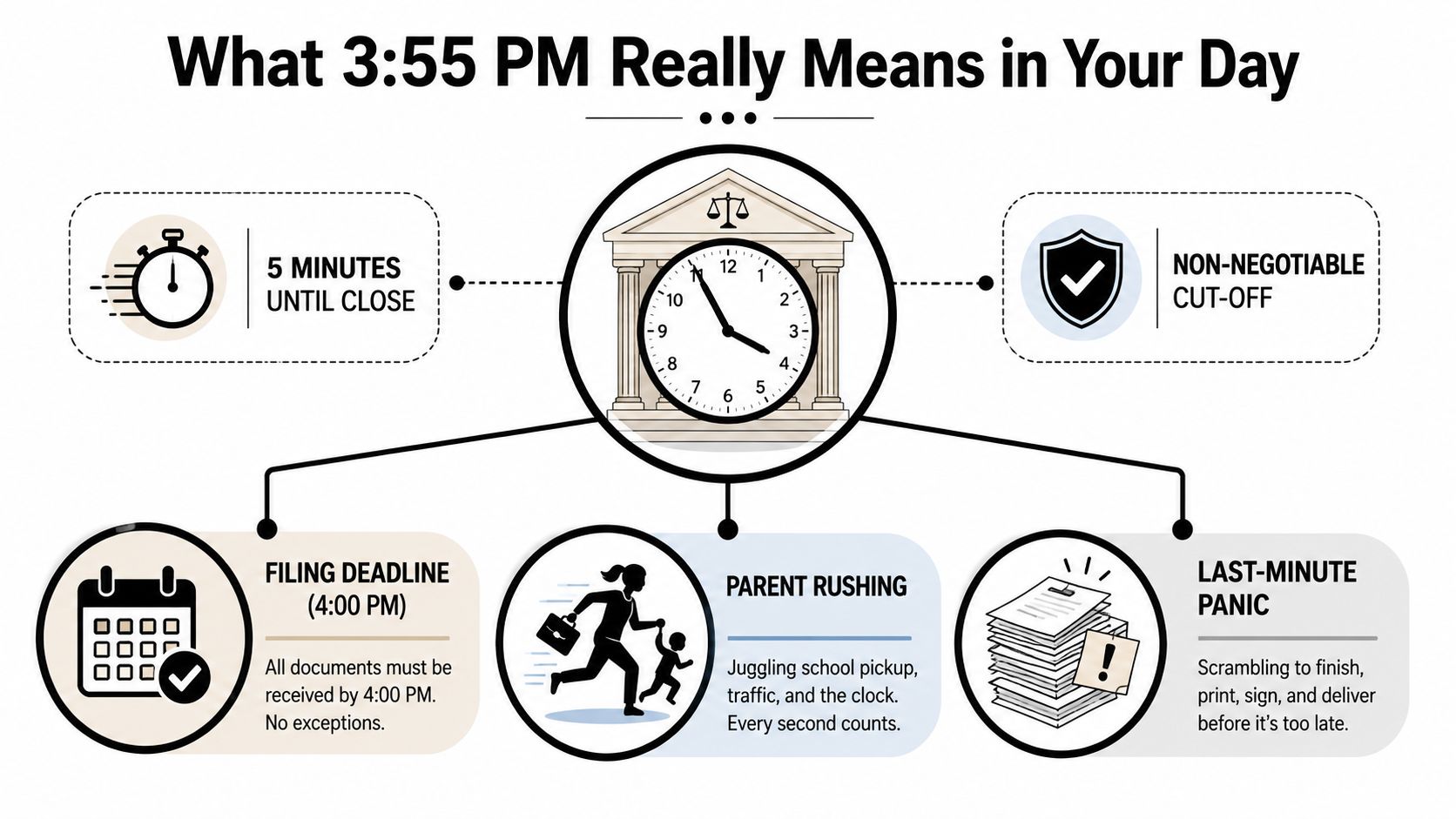
What 3:55 PM Really Means in Your Day
At 3:55 PM, you are in the last stretch of the afternoon, but you are not at the finish line yet. In the 12-hour clock, PM means post meridiem, the period from 12:00 noon to 11:59 at night, so this time is 3 hours and 55 minutes after noon and 5 minutes before 4:00 PM. That tiny window matters because a clerk, an eFile system, or a court calendar doesn't care that you were “almost there.”
If you've ever rushed papers into a clerk's office, you already know how fast a late afternoon can disappear. One minute you're holding a motion packet, and the next minute you're staring at a closed counter or a timestamp that changed your day. The time 3:55 PM is one of those moments that feels ordinary until it becomes the moment a deadline turns into a problem.
Practical rule: treat the last five minutes before a deadline like a locked door, not an open invitation.
In plain terms, 3:55 PM is a decision point. It can be read as 15:55 in 24-hour time, or 1555 hours in military notation, which is why transportation, broadcasting, logistics, and military schedules often prefer that format for clarity (Time Unitarium). If you're reading a court notice, a calendar invite, or an email from opposing counsel, the safest habit is to translate the time in your head right away so you don't miss what it actually means.
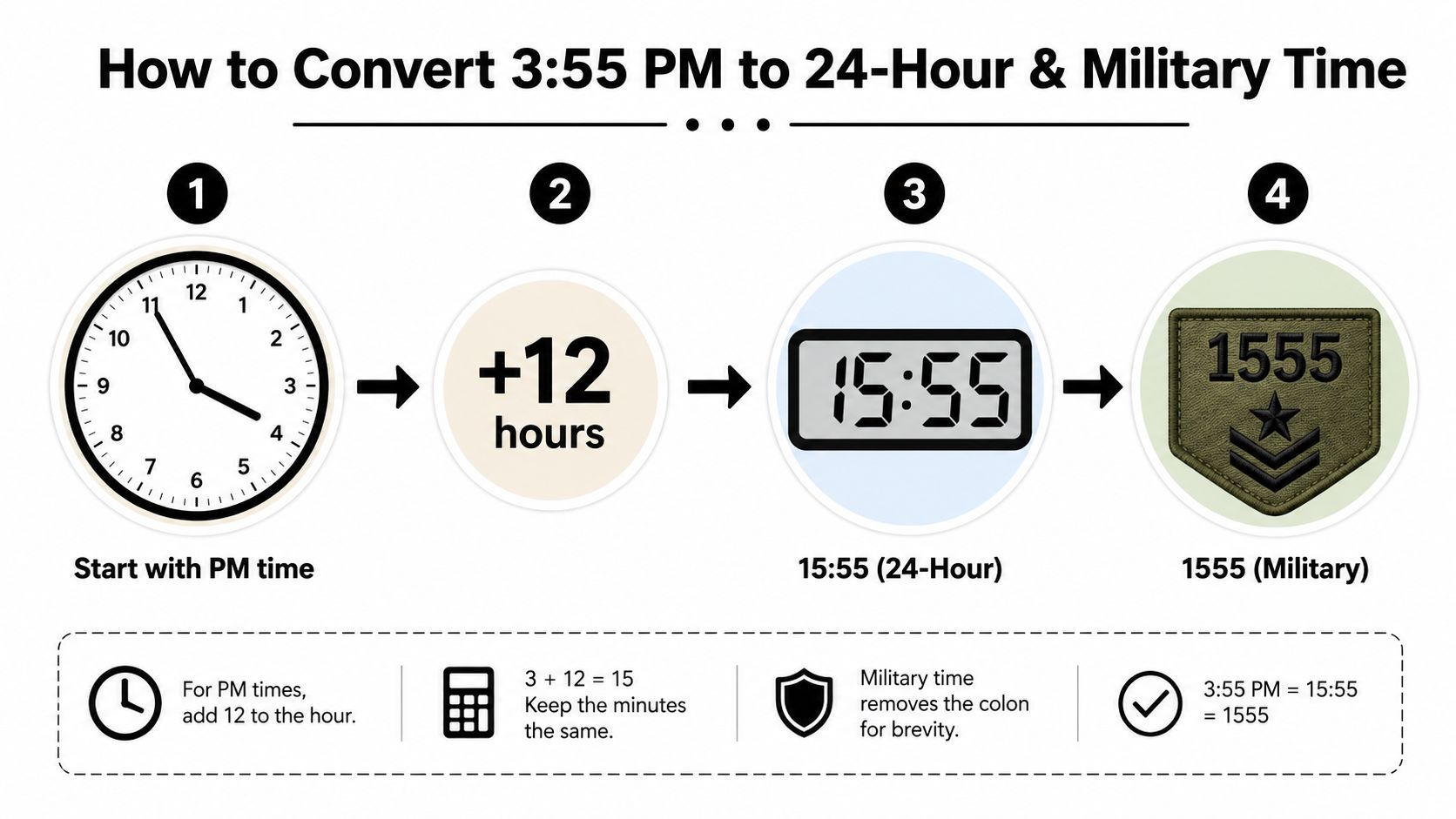
How to Convert 3:55 PM to 24-Hour and Military Time
A clock reading of 3:55 PM turns into 15:55 in 24-hour time. The conversion is simple once you know the rule. Since 3 PM is in the afternoon, you add 12 to the hour and leave the minutes alone. That leaves you with 15:55, which is the same moment written in military time as 1555 hours (CK-12).
The rule that keeps you from second-guessing
Start with the hour, then keep the minutes exactly the same. 3 PM becomes 15 because afternoon hours move past noon by adding 12, and 55 stays 55. It works the same way a court clock works, the minute hand does not change just because the hour format does.
Quick check: if the clock says PM and the hour is not 12, add 12. If the time is 12 PM, leave the hour alone.
That habit helps when a filing time shows up in a notice, a calendar invite, or a message from a clerk. A scheduler who sees 15:55 reads it one way, with no guesswork, and that matters when a deadline is sitting right on the edge of the afternoon.
If you are trying to understand how a filing deadline fits into a divorce timeline, How Long Does a Divorce Take in Texas? gives a realistic look at uncontested and contested cases without turning the process into guesswork.
What 3:55 PM Looks Like Across U.S. Time Zones
The same clock reading can mean different things depending on where you are. If it's 3:55 PM Central Standard Time, it's already later in the day on the East Coast and earlier in the Mountain, Pacific, and Alaska zones. That's why a missed virtual hearing often starts with a simple time-zone mistake, not a lack of effort.
Why the gap matters in real life
A parent in Texas who schedules a call for 3:55 PM CST may be reaching someone in another state who's still in midafternoon, or someone who's already closer to evening. The farther west you go, the more the clock shifts back. That matters for mediation links, conference calls, and witness preparation when people are joining from different cities.
Daylight saving time changes the picture twice a year, so the difference between zones can shift by an hour. If you travel, serve in the military, or divide your time between states, that means you should never trust memory alone. Always confirm the zone in writing.
Here's the practical way to think about it. If your Texas hearing starts at 3:55 PM CST, a California parent will see that as 1:55 PM PST. That kind of difference is exactly why join codes and calendar invites should include the time zone, not just the clock time.
3:55 PM in Five U.S. Time Zones at a Glance
| U.S. Time Zone | 12-Hour Clock | 24-Hour Clock | Offset from CST |
|---|---|---|---|
| Eastern Time | 4:55 PM | 16:55 | 1 hour ahead |
| Central Time | 3:55 PM | 15:55 | Base time |
| Mountain Time | 2:55 PM | 14:55 | 1 hour behind |
| Pacific Time | 1:55 PM | 13:55 | 2 hours behind |
| Alaska Time | 12:55 PM | 12:55 | 3 hours behind |
This chart is most useful when you're confirming a hearing, calling a witness, or checking a mediator's calendar invite at the last minute. A Texas parent can glance at it and know that a call set for 3:55 PM Central is not the same moment across the country. Hawaii sits even farther behind Pacific time, so the gap becomes larger still.
Why 3:55 PM Matters in Texas Family Law
In Texas family law, minutes can matter even when the rule is written in days. A motion, a response, or a proposed order can be perfectly prepared and still create stress if it arrives close to the filing cutoff. That's why many legal teams build their workflow around the clock, not just the calendar.

Filing windows, hearings, and the clock on the clerk's desk
A motion to modify filed at 3:55 PM is inside the final minutes before a 4:00 PM close, and that timing can shape how quickly the clerk's office processes it. The same document filed a few minutes later may still be accepted depending on the system and the rule, but it can land in a different review queue. In practical terms, that means your lawyer's office needs a buffer, not optimism.
Texas divorce practice also involves hearings, mediation deadlines, and post-divorce enforcement filings that all depend on clean timing. If you're sorting out how local delays affect scheduling, Texas divorce court scheduling and delays is a useful companion read. For couples still living under the same roof, Filing for Divorce While Living Together in Texas addresses why Texas has no separation requirement before filing.
Where the Family Code meets practical timing
Texas is a no-fault divorce state, and the Family Code allows divorce on the ground of insupportability when discord or conflict destroys the marriage and reconciliation isn't reasonably expected (Texas Family Law Review discussion). That legal standard doesn't erase the need to file on time, attend hearings on time, or appear for mediation on time. The law may focus on grounds and relief, but the courthouse still runs on a clock.
If your case involves a custody issue, property division, or enforcement motion, the safest practice is to submit before the pressure window starts. A five-minute cushion can be the difference between calm confirmation and a scramble that spills into the next court date. Texas families often discover that the time stamp matters as much as the paper itself.
For firms that manage filings, scheduling, and remote access, reliable systems matter too. That's why resources on IT compliance for law firms can be useful when you're thinking about electronic deadlines, secure document handling, and keeping appointment records clean.
Appointment Etiquette and Habits That Protect You
A missed hearing rarely starts with one huge mistake. More often, it starts with a small one, like logging in at the exact scheduled minute instead of a few minutes early. One parent joins a Zoom hearing right on time, misses roll call, and learns the court already moved on. That kind of error can push a case out far longer than anyone wants.
The habits that keep you out of trouble
If you're meeting a lawyer, appearing for mediation, or walking into a hearing, build your day around the court's clock, not your own. Arrive early, silence your phone, and keep your documents in order. When a deadline or appointment says 3:55 PM, treat that as your stop point, not your start line.
Show up early, log in early, and finish your paperwork before the pressure hits.
Here's a simple checklist you can use right away:
- Set two calendar alerts. One for the appointment itself and one for a buffer before it.
- Confirm the time zone. Don't assume everyone is using Central Time.
- Watch paper-file cutoffs. A clerk's window and an eFile timestamp are not the same thing.
- Save confirmation emails. Keep proof of filing, joining, or rescheduling in one place.
- Keep after-hours contacts handy. If a hearing changes, you need the right number fast.
- Add ten minutes to every deadline. That buffer protects you from traffic, login issues, and interruptions.
If you want a step-by-step way to get ready for court, how to prepare for divorce court in Texas walks through the process in plain language.
What to Do Next and How We Can Help
3:55 PM is simple on paper and stressful in real life. Add 12 to convert PM times into 24-hour notation, use 15:55 or 1555 hours when you need clarity, and treat the final five minutes before a deadline as a hard stop. When your case involves divorce, custody, support, mediation, or enforcement, that habit can save you from avoidable delay.
You don't need to guess your way through the next filing, hearing, or conference call. A clear plan, a confirmed time zone, and a little buffer can keep your case moving in the right direction. If you still prefer to fax or send paperwork from your phone between appointments, the best iPhone fax apps can help you handle documents while you're on the move.
If you want a better sense of what the first meeting looks like before you sit down with a lawyer, what happens at your first consultation with a divorce lawyer is a good place to start. You'll get a clearer picture of how to prepare and what questions to bring.
Key takeaway: the clock is not a detail in Texas family law. It's part of the strategy.
If you're worried about a divorce deadline, custody hearing, or last-minute filing, the Law Office of Bryan Fagan, PLLC can help you sort out the timing and the next step with clarity. Visit Law Office of Bryan Fagan, PLLC to schedule a free consultation and get practical guidance for your Texas family law matter.