Skip to content
You're staring at a marriage that feels broken, but the law does not care about feelings first, it cares about facts. In Texas, the question is whether your marriage was legally valid at the start, because that decides whether annulment vs divorce Texas is even the right fight.
| Issue | Annulment | Divorce |
|---|---|---|
| What it means | The court says the marriage was invalid from the beginning | The court ends a valid marriage |
| Best fit | Narrow fact patterns with proof | Any valid marriage, with or without fault |
| Timing pressure | Strict deadlines can control eligibility | Broader access, but with a waiting period |
| Children and money | Parenting and support still get decided | Parenting and property also get decided |
If you found out your spouse hid a prior divorce, or the ceremony happened before the license waiting period ran out, you need a different strategy than the person who wants out of a valid marriage. The Law Office of Bryan Fagan, PLLC handles both paths across Texas, and the right answer starts with validity, timing, and what happens to the children and property.
When a Texas Marriage Falls Apart and the Law Steps In
A wife walks into her kitchen, scrolls through a county record search, and realizes her husband was already divorced when they married. That is not a “bad marriage” problem, it is a validity problem, and Texas law treats those differently. Another couple may have rushed to the chapel before the 72-hour waiting period expired, then spent the next month wondering whether they need divorce papers or something else entirely.
That distinction matters because Texas does not let you choose annulment just because it sounds cleaner. An annulment says the marriage was never legally valid. A divorce says the marriage was valid, and now a court is ending it. Those are different legal stories, and the proof you need changes with the story.
The mistake I see most often is people asking, “Which one is faster?” before asking, “Was this marriage valid in the first place?” Speed matters, but it comes second. If the facts fit one of Texas's annulment grounds, the timing and evidence can make annulment the sharper tool. If the marriage was valid, divorce is the honest path, and Texas family court can still deal with children, property, and support.
Practical rule: start with the marriage certificate, the timeline, and any facts that show a defect at the start. If those facts are thin, stop chasing annulment and look at divorce.
Texas families across Houston, Dallas–Fort Worth, Austin, and San Antonio run into this exact fork in the road every day. The law does not reward wishful thinking. It rewards a correct legal theory and timely action.
What Annulment and Divorce Actually Mean in Texas
The plain-English difference
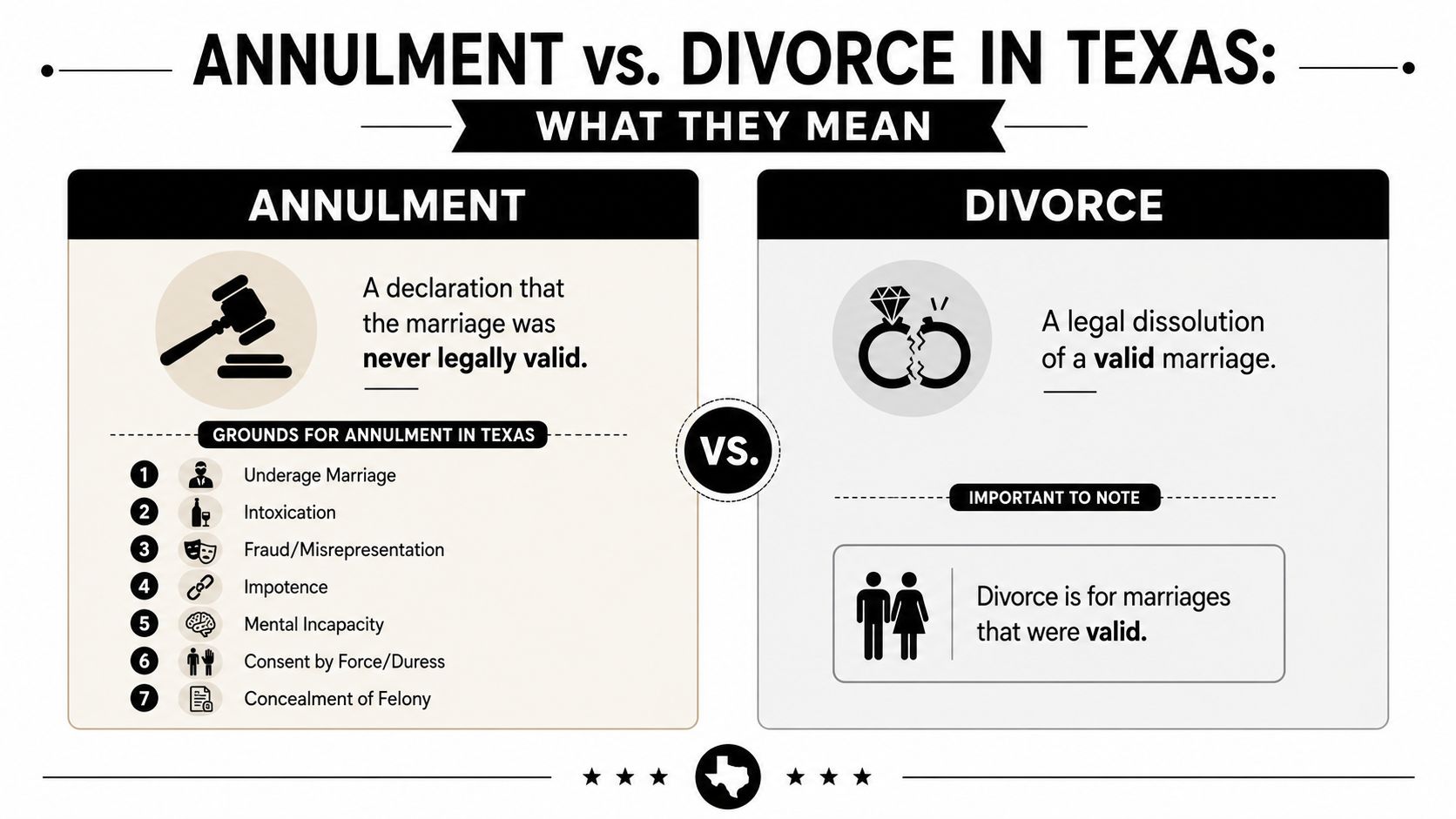
Annulment is Texas's way of saying the marriage should be treated as invalid from the beginning. Divorce is the court's way of ending a marriage that was valid when it started. That is the core distinction, and everything else flows from it.
Texas recognizes seven statutory grounds for annulment, including underage marriage without consent, intoxication, fraud or duress, mental incapacity, concealed prior divorce, impotence, and a ceremony held before the mandatory 72-hour waiting period expired.Texas annulment grounds explained Those grounds are narrow on purpose. Annulment is not a general escape hatch.
Divorce is broader. In everyday Texas cases, the most common route is no-fault insupportability, and that is why divorce works when the marriage is valid but the relationship is not. If you want a plain comparison of divorce grounds, see Grounds for Divorce in Texas: No-Fault and Fault. Annulment is about legality at the start, divorce is about ending a valid legal bond.
The 72-hour rule is narrower than most people think
Texas Law Help explains that the 72-hour waiting-period exception is narrow, with exceptions for active-duty military members, certain Department of Defense personnel, court-waived cases, and couples who complete an approved premarital education course.Texas Law Help annulment guide That matters because many people assume any rushed ceremony creates an easy annulment claim. It doesn't.
The legal question is simple, did the marriage violate a specific rule that Texas treats as important enough to undo the marriage?
If you do not fit one of those statutory grounds, annulment is off the table. That is not a moral judgment. It is a jurisdictional fact.
Filing Requirements, Waiting Periods, and Real Timelines
The deadlines that actually control your case
Divorce in Texas has a known track. One spouse generally needs 6 months of Texas residency and 90 days in the filing county, and the court cannot grant the decree until the 60-day waiting period passes.Texas divorce timing rules Annulment is different. It has no mandatory 60-day waiting period, but it still lives or dies on a qualifying ground and strict timing.
Some annulment deadlines are short enough to ruin a case if you wait. Texas Law Help says an underage spouse generally cannot seek annulment after 90 days once they turn 18, a concealed-divorce annulment must usually be filed within 1 year of the marriage, and a ceremony that happened before the 72-hour waiting period ended generally must be challenged within 30 days.Texas Law Help annulment requirements
| Requirement | Annulment | Divorce |
|---|---|---|
| Residency | Jurisdiction depends on the case, but not a divorce-style waiting rule | 6 months in Texas and 90 days in the county |
| Waiting period | No mandatory 60-day wait | Mandatory 60-day wait |
| Deadline pressure | Often short and ground-specific | Driven by court timing, not defect-based deadlines |
The other trap is service. Texas Law Help says annulment filings follow ordinary service rules, including a 10-day return-of-service requirement and a respondent answer window of 20 days plus the next Monday at 10:00 a.m.Texas Law Help service rules So even when annulment is available, it is not magic. The paperwork still has to move through court.
For a deeper look at the divorce clock, see the firm's resource on Texas divorce waiting period. The bottom line is simple. Annulment can be faster procedurally, but divorce is available more broadly.
Filing and timing at a glance
| Requirement | Annulment | Divorce |
|---|---|---|
| Ground required | Yes, one of the statutory grounds | No-fault or fault ground |
| 60-day wait | No | Yes |
| Service | Required, with formal court rules | Required, with formal court rules |
| Real-world speed | Can be quicker if uncontested | Predictable, but slower at the front end |
How Each Path Affects Children, Property, and Support
Children do not disappear because the marriage is challenged
Many people are disappointed to learn that annulment does not erase parentage. If you have children, Texas courts still handle conservatorship and support issues even when the marriage is annulled.Texas courts and SAPCR issues In many cases, a separate SAPCR, a Suit Affecting the Parent-Child Relationship, may be needed alongside the annulment case.
Common misconception: “annulment resets everything.” It does not. Parenting issues still have to be resolved, and the child's best interests still control.
That is why parents should not treat annulment like a legal erase button. If you are worried about custody, possession, or support, the court will still require orders. If your case involves children, look at your custody and support strategy early, not after the petition is filed.
Property and support still need a court plan
Texas divorce courts divide community property under the Family Code's just and right standard. In plain English, that means the court aims for a fair division, not a mindless 50/50 split. High-value estates, businesses, retirement accounts, and reimbursement claims need tracing and documentation, which is why property fights in divorce often become the central conflict.
Annulment cases still require the court to sort out money. The fact that a marriage is attacked as invalid does not mean the couple can leave debt, bills, or house proceeds unresolved. If you need help thinking through the property side, the firm's guide on separate property vs community property is a useful starting point.
Practical rule: if children, a house, retirement, or a business are in play, expect a real court case, not a quick signature.
Support questions also stay alive. Child support can be ordered in both paths, and parenting orders still need to be drafted carefully. For many Texas families, that makes the decision less about labels and more about how much litigation the facts will require.
The Texas Court Process From Petition to Final Decree
The case starts the same way in both paths
Whether you file for divorce or annulment, you begin with an original petition. If you want to see what starts a Texas divorce case, the firm's resource on The Original Petition for Divorce in Texas is the right place to begin. After filing, the other spouse must be served unless they sign a valid waiver.
Texas Law Help says annulment cases follow ordinary service rules, including the 10-day return-of-service requirement and the respondent's answer period of 20 days plus the next Monday at 10:00 a.m.Texas Law Help service timing That means the process is court-driven from day one. No one gets to skip notice just because the marriage may be invalid.
Temporary orders, mediation, and the finish line
Once the case is pending, either side can ask for temporary orders covering home use, bill payment, custody, and support. That matters because real life does not pause while you wait for a decree. Bills still come due, and children still need stable routines.
Most Texas family cases settle before trial through mediation or informal settlement talks. If the parties reach agreement, the court can approve the settlement and sign a final order. If they do not, the judge hears the dispute and signs the final decree after hearing or trial. That is true in annulment cases and divorce cases alike.
Bottom line: both are lawsuits. One attacks the validity of the marriage, the other ends the marriage. Either way, you need service, a response, and a final court order.
If you are deciding how to file, do not guess. Start with the pleading, the service plan, and the evidence. Then build the case around the facts that exist.
Which Option Fits Your Situation
Short marriage, no kids, strong annulment facts
If you married fast, have no children, and can prove one of the statutory grounds, annulment often makes sense. That is especially true when the facts point to intoxication, fraud, concealed prior divorce, or a ceremony that happened too soon after the license was issued.
If the marriage was legally defective from the start, don't force it into divorce just because divorce feels familiar.
Long marriage, house, retirement, or children
If you have a home, retirement accounts, or children, divorce is usually the cleaner path. You need full court tools for property division, child conservatorship, and support. Annulment rarely saves you effort in that kind of case, because the hard issues remain on the table anyway.
Concealed prior divorce or a rushed ceremony
A hidden prior divorce can support annulment, but only if you act within the statutory window. A marriage held before the 72-hour waiting period expired can also support annulment, but the filing deadline is tight. If you miss the window, you may still have a valid divorce case, but not an annulment case.
Military families and the waiting-period exception
Active-duty military members and certain Department of Defense personnel may fit the narrow 72-hour exception. That can matter when a ceremony happened quickly around deployment, leave, or relocation. Do not assume the exception applies automatically. Check the facts and document them.
High-net-worth or business-owner cases
When a business, multiple properties, or complicated tracing issues are involved, divorce is often the more practical route. You get the broader court structure for discovery, valuations, and property division. Annulment may look appealing on paper, but if the evidence burden is messy and the assets are complex, divorce is usually the cleaner litigation path.
My view is blunt. If the case is fact-light and ground-heavy, consider annulment. If the case is asset-heavy or child-heavy, divorce is usually the smarter move.
Costs, Records, and Remarriage Differences
Texas legal sources estimate district-court filing fees at about $250 to $350, while total annulment filing fees run roughly $300 to $400, depending on county and case expenses.Texas annulment filing fees That number matters, but it is not the whole bill. Attorney fees, mediation, and expert valuations can dwarf filing costs in either path, especially in contested property cases.
Both annulments and divorces show up in court records. That means future background checks, immigration questions, and benefit reviews can still see the case history. The label changes the legal outcome, but it does not make the proceeding invisible.
Remarriage works differently too. If your marriage is annulled, the law treats the ceremony as invalid, so you are free to remarry without waiting for a divorce decree. If you are divorced in Texas, you generally must wait at least 31 days after the decree is signed before remarrying, with limited statutory exceptions.
One short summary is enough here. Annulment is about invalidity, divorce is about ending a valid marriage, and both can still affect parenting, money, and records. If your main goal is speed, remember that the cheapest filing fee is not the same thing as the easiest case.
What to Do Next and How the Firm Can Help
Pull together the marriage certificate, any premarital education certificate, and every document that supports your ground. If you think annulment might fit, gather proof now, because the short deadlines can close your door fast. If you think divorce is the better path, organize pay stubs, account statements, property records, and parenting schedules before you file.
Then talk to a Texas family law attorney before you miss a deadline or serve the wrong case. Mediation can also save time, money, and stress when the facts are strong enough to support settlement. If you have children, ask about the SAPCR piece early so the parenting issues are not left hanging.
The Law Office of Bryan Fagan, PLLC works with contested and uncontested divorces, annulments, high-asset cases, military families, and post-decree disputes across Houston, Dallas–Fort Worth, Austin, San Antonio, and surrounding counties. The firm offers in-person and virtual consultations, and it can help you decide whether you should file, defend, or negotiate.
What to do next: stop guessing, gather your documents, and get a clear legal plan before time runs out. If you are unsure whether your situation calls for annulment or divorce, that conversation should happen now, not after the deadline passes.
If you need a straight answer about annulment vs divorce Texas, the Law Office of Bryan Fagan, PLLC can review your facts, explain your options, and help you move forward with a real plan. Visit Law Office of Bryan Fagan, PLLC to schedule a free consultation and get guidance on the next step for your case.