Skip to content
The night before you talk to a divorce lawyer, your mind usually runs in circles. You may be wondering whether you're overreacting, whether you can afford the process, or whether one meeting could really help at all.
It can.
A first consultation doesn't finalize your divorce, decide custody, or divide your property. What it does is give you something you may not have had for a while: clarity. If you've been searching for answers about what happens at your first consultation with a divorce lawyer, the most important thing to know is that the meeting is meant to turn confusion into a workable plan.
Your First Step Towards a New Beginning
You may be sitting at your kitchen table after the kids are asleep, looking at bank statements and wondering how your life got here. That moment is often when people finally decide to call a lawyer.
That call, and the first meeting that follows, is not a sign that you've failed. It's a sign that you're getting informed before you make a major decision.

Why the first meeting matters so much
In Texas, divorce affects more than your marital status. It can shape where your children live, how decisions get made, who stays in the home, how debt is handled, and what your financial life looks like after the case ends.
Your first consultation is where those issues start to come into focus. It helps answer questions like:
- What kind of case do you have
- What problems need immediate attention
- What documents should you protect and gather
- What the Texas court process usually looks like
- Whether this lawyer is the right fit for you
Practical rule: Your first consultation is not about telling a perfect story. It's about giving an honest one.
A lot of people also need emotional reassurance before they can even discuss legal strategy. If you're still sorting through whether your relationship is completely over, outside perspective can help. Some people find Expert advice from Therapy with Ben useful as they process the personal side of this decision.
In Texas, legal advice and emotional support do different jobs
Your lawyer helps you understand rights, risk, and next steps. A counselor, therapist, pastor, or trusted support person may help you manage grief, anger, or fear. You often need both.
Under the Texas Family Code, a divorce case can involve grounds for divorce, temporary orders, conservatorship of children, child support, and division of the marital estate. You don't need to know all of that before the meeting. You just need to show up ready to talk plainly about your life.
That's why the consultation is so important. It's the first time someone starts translating your real-world problems into legal issues that can be addressed.
The Meeting Agenda What to Expect During the Consultation
Most first meetings are more structured than people expect. A first divorce consultation is usually a short, information-dense intake meeting rather than a full strategy session, and firms often schedule it for about 30 minutes to an hour while expecting clients to bring core documents already assembled, as noted by Merel Family Law's consultation overview.

The first few minutes
The meeting usually begins directly. You sit down, the lawyer introduces themselves, and they explain the purpose of the consultation. They may also explain confidentiality and confirm basic background details.
Then the lawyer will ask you to tell your story in plain language. Not every detail. Just the important outline.
You may hear questions like:
- How long have you been married
- Do you have children
- Are you living together or apart
- What are your biggest immediate concerns
- Has anything already been filed in court
The middle of the meeting
Once the story is on the table, the lawyer starts sorting facts into legal categories. In a Texas divorce, that often means looking at three tracks at once:
| Issue | What the lawyer is trying to understand |
|---|---|
| Children | Who has been caring for the children, what schedule exists now, and whether temporary orders may be needed |
| Property | What you own, what you owe, and whether there are disputes over separate or community property |
| Immediate risk | Whether there are safety concerns, financial concealment, lockout threats, or urgent parenting problems |
The lawyer may give you a first-pass analysis. That doesn't mean a final answer. It means you begin hearing things like, "This may be a property tracing issue," or "A judge may want temporary parenting rules early in the case."
The first consultation is often where a client realizes that the problem isn't just "we're getting divorced." It's custody, the house, retirement, debts, business income, and what happens next week.
The end of the meeting
Near the end, the conversation usually turns to practical next steps. That may include whether to file, whether mediation may make sense, what records to gather next, and whether temporary orders are likely.
Fees are often discussed at this stage too. You should leave understanding how the lawyer bills, what happens if you hire them, and what the first action step would be.
How to Prepare for Your Consultation A Practical Checklist
Preparation changes the quality of the meeting. When you walk in organized, your lawyer can spend less time guessing and more time advising.
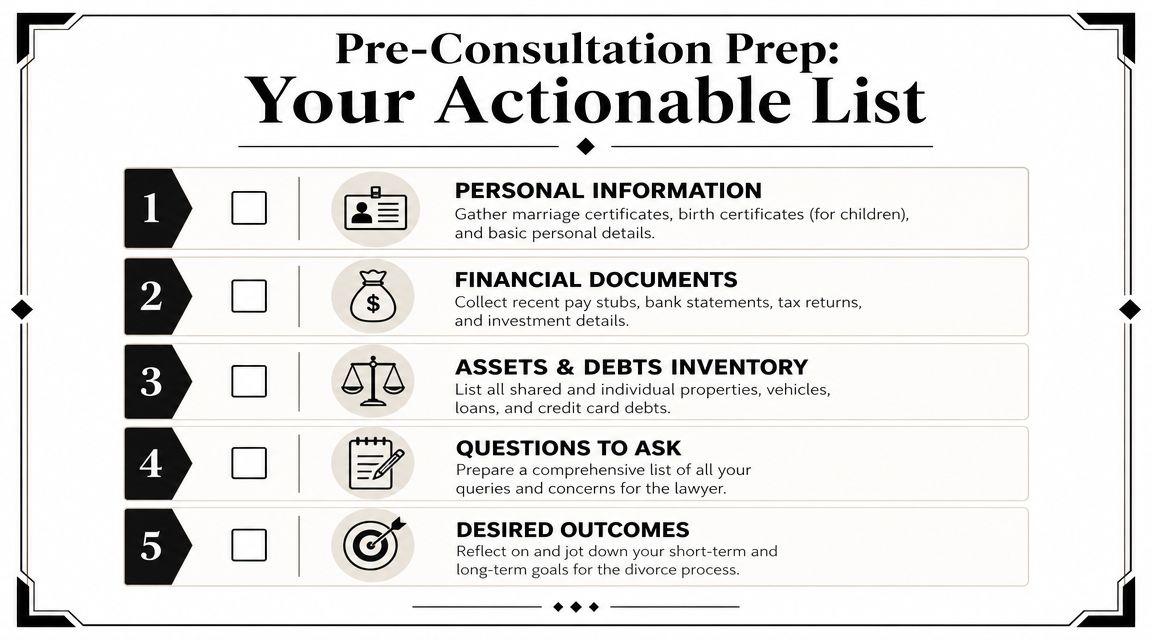
Gather the documents that matter most
Start with the basics. Bring what you have, even if your file isn't perfect.
Focus on these categories:
- Identity and family records like your marriage certificate, any prior divorce decree, and records involving the children
- Income proof such as pay stubs and tax returns
- Account records including bank statements and other financial statements
- Property and debt information for the house, vehicles, loans, and credit cards
- Existing court paperwork if another case involving your family is already pending
- Custody or support records if there have been prior agreements, payments, or disputes
If you want a more detailed starting point, this guide on what documents you should gather before filing for divorce can help you organize before the meeting.
Build a simple timeline
Lawyers think in timelines because judges do too. Write down a short sequence of key events so you don't forget them when emotions rise.
Your list might include:
- Marriage date and major moves
- Birth dates of children
- Date of separation, if there is one
- Major purchases or sales like a home or business interest
- Important incidents involving finances, parenting, or safety
Keep it short. A page is often enough.
Here's a helpful video if you'd like another plain-English overview before you go into the meeting:
Think about your goals before you walk in
A lawyer can't build a useful plan if they don't know what matters most to you. You don't need to know every answer, but you should think through your priorities.
Ask yourself:
- Children: What schedule feels workable and healthy?
- Home: Do you want to stay, sell, or negotiate time before a sale?
- Money: What are you worried about most right now?
- Conflict level: Are you hoping for settlement, or do you expect a fight?
- Urgency: Is there anything happening this week or this month that can't wait?
Bring documents, but also bring your priorities. A clean stack of records helps. Clear goals help even more.
What Your Attorney Will Evaluate and Advise
When you talk, your lawyer is doing more than listening politely. They are spotting legal issues in real time.
At a first consultation, the attorney often collects a structured set of facts about marriage duration, children, income, and assets, then maps those facts to property division, custody, and support issues. Preparation with tax returns, pay stubs, and bank statements helps the lawyer assess exposure and near-term action items, as explained in Stange Law Firm's discussion of the initial consultation.
Property questions under Texas law
Texas is a community property state. In plain English, that means property acquired during the marriage is generally presumed to be community property unless a spouse can prove it is separate property.
Your lawyer will be listening for facts tied to that distinction, including:
- When an asset was acquired
- Whether it was inherited or received as a gift
- Whether separate funds were mixed with marital funds
- Whether a business existed before marriage but grew during marriage
Texas courts divide the community estate in a manner the court considers just and right. This approach does not always mean a perfectly equal split. Facts matter.
Child-related issue spotting
If children are involved, the lawyer is usually evaluating conservatorship, possession, and support. Texas law focuses on the best interest of the child. That's the guiding principle behind many custody decisions.
A lawyer may ask about:
- the children's current routine
- school and medical needs
- each parent's work schedule
- who has handled daily care
- any concerns involving instability, conflict, or safety
If the facts fit, the lawyer may explain a Standard Possession Order in general terms. In many Texas cases, that order serves as a framework for parenting time, though parents can agree to something different and courts can order a different arrangement when the facts call for it.
Procedure from filing to final decree
The consultation is also where legal process starts making sense. A Texas divorce often moves through these stages:
| Stage | What it usually means |
|---|---|
| Filing | One spouse files an Original Petition for Divorce |
| Service or waiver | The other spouse is formally notified or signs a waiver if appropriate |
| Temporary orders | The court may set short-term rules for parenting, bills, property use, or conduct |
| Discovery and negotiation | The parties exchange information and work toward settlement |
| Mediation | Many cases attempt resolution in mediation before trial |
| Final decree | The court signs the final orders that end the marriage and set the lasting terms |
During the consultation, your lawyer is trying to identify where your case may become difficult and where it may be resolved efficiently.
Key Questions You Should Ask Your Divorce Lawyer
A consultation isn't only about whether the lawyer thinks they can handle your case. It's also about whether you trust them to guide one of the most personal transitions of your life.
Family-law guidance often tells clients to ask about the lawyer's experience, approach, communication habits, and financial terms, including retainer expectations. One Texas firm also notes that 30-minute consultations may be priced at $150 for lower-complexity matters, while regular consultations may be scheduled differently, showing that the first meeting is both a legal intake and a business decision point, according to Ramos Law Group's consultation information.
Questions that reveal fit
These questions can tell you a lot, quickly:
- Have you handled cases like mine before
- How do you approach negotiation, mediation, and trial
- What concerns you most when you hear my facts
- Who will work on my case day to day
- How do clients usually communicate with your office
If you'd like more ideas, this resource on what to ask a divorce attorney gives you a useful list to bring to the meeting.
Questions about strategy and expectations
You don't need a guaranteed outcome. No honest lawyer can give you that. You do need to understand how they think.
Try asking:
- What should I do right away, and what should I avoid doing
- Do you expect temporary orders to matter in my case
- Would mediation likely help here
- What information do you still need before giving stronger advice
A good consultation should leave you feeling informed, not pressured.
Questions about billing
Money conversations can feel awkward, but they are part of smart hiring. Ask plainly about the retainer, hourly billing, replenishment rules, and what kinds of work tend to increase cost.
You are not being difficult when you ask these questions. You're being careful.
Navigating Special Circumstances in Your Consultation
Some divorces are straightforward. Others need immediate, specific planning because the facts are more complicated than a basic checklist can capture.
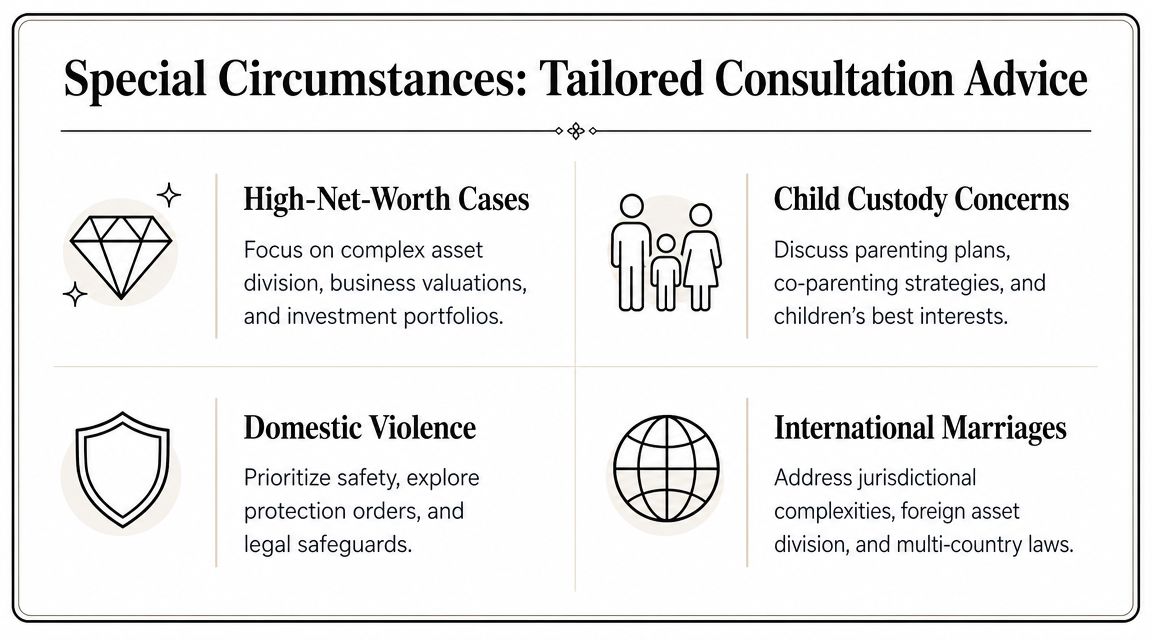
High-asset and hard-to-value property
A commonly missed consultation topic is complex property. Clients should flag business ownership, restricted stock units, options, crypto, retirement benefits with vesting schedules, and international property at the first meeting because those assets may require specialized valuation or tracing, as discussed in this family law consultation guide.
If any of these apply to you, say so early. Don't wait until the end of the meeting.
Important examples include:
- Business interests that may involve goodwill, valuation, or reimbursement claims
- Equity compensation tied to vesting schedules or employment agreements
- Cryptocurrency wallets that may be difficult to trace without careful records
- Property in another state or country that can raise both practical and legal complications
If the marital home is one of your largest concerns, it may also help to review practical options for selling your house during divorce so you can discuss realistic housing choices with your lawyer.
Military families and jurisdiction questions
Military divorce can raise special issues involving residency, filing location, military retirement, and parenting schedules affected by deployment or relocation. In a Texas consultation, the lawyer will want to know where each spouse lives, where they are stationed, and whether prior orders exist anywhere else.
That doesn't mean your case is impossible. It means the first meeting needs sharper focus on jurisdiction and paperwork.
Safety concerns and emergency court relief
If you're worried about family violence, stalking, intimidation, hiding children, draining accounts, or being locked out of the home, say that immediately. Don't save it for the last five minutes.
Texas courts can issue temporary orders in divorce cases, and in the right circumstances a person may also need a protective order or other urgent relief. The legal path depends on the facts, the timing, and the level of danger.
One practical option for Texans who want to discuss these issues in a first meeting is the Law Office of Bryan Fagan, PLLC, which offers consultations for divorce and family-law matters including high-asset cases, custody disputes, and temporary restraining order situations.
Understanding Fees and Deciding on Your Next Steps
By the end of the consultation, you should understand both the legal road ahead and the business terms of hiring counsel. If either part is fuzzy, ask more questions before you leave.
What a retainer usually means
A retainer is money paid up front for future legal work. In many family-law matters, the lawyer bills time against that amount as work is completed. If the agreement requires replenishment, you may need to add funds later to keep the representation active.
Hourly billing means the total cost often depends on what happens in the case. High conflict, emergency hearings, extensive document review, contested custody issues, and repeated court appearances can all affect cost.
If you're comparing options, this guide on the cost of a divorce lawyer in Texas can help you understand the terms you may hear.
What happens after you hire a lawyer
Once you decide to move forward, the next steps are usually concrete:
- You sign the engagement agreement
- You provide the retainer if required
- The firm gathers additional facts and records
- Your lawyer prepares the Original Petition for Divorce
- The case is filed and the other spouse is served, or a waiver is discussed if appropriate
- Temporary orders, negotiation, mediation, or discovery may follow depending on the facts
You don't need to know how to manage every stage today. You just need to know what your first next step is.
Frequently Asked Questions About the First Consultation
Is the first consultation always free
No. Some firms charge for an initial meeting, and some don't. Fee policies vary by office and by case type.
For this firm, the publisher information provided for this article states that free consultations are available. Even so, it's smart to confirm current scheduling and consultation terms when you call.
Is what I say confidential if I don't hire the lawyer
In general, people often worry that a first meeting is somehow less protected than a formal attorney-client relationship. In practice, lawyers commonly treat the consultation as a confidential setting for candid discussion, and that's one reason they can ask direct questions about money, parenting, and conflict.
Still, keep third parties out of the room unless the lawyer approves their presence. Bringing a friend or relative into the consultation can complicate confidentiality.
Can my spouse and I go to the same consultation
Usually, that's not the right move in a divorce consultation. A divorce lawyer cannot represent both spouses in a contested divorce, and separate consultations are almost always the safer way to protect each person's rights and avoid conflict problems.
If you and your spouse are considering an agreed divorce, each of you still needs to understand who the lawyer represents and who the lawyer does not represent.
What if I don't have every document yet
Go anyway. Missing paperwork is common at the beginning. Bring what you have, tell the truth about what you don't have, and ask what should be gathered next.
What matters most in the first meeting is honesty, not perfection.
If you're ready for clear answers about your rights, your children, your property, and the next step in a Texas divorce, schedule a free consultation with Law Office of Bryan Fagan, PLLC. A focused first meeting can help you move from uncertainty to a real plan, and that alone can make this season feel more manageable.