Skip to content
When you're ready to move on and your spouse refuses to sign, it can feel like your whole life is being held hostage.
That feeling is real. But in Texas, your spouse's signature is not a veto. If you're dealing with the question, what happens if your spouse refuses to sign divorce papers in Texas, the short answer is this: the divorce can still move forward if you follow the required court process.
A spouse who won't cooperate usually creates a fork in the road. One path leads to default divorce if they don't answer after proper service. The other leads to a contested divorce if they do answer and fight over terms. Your job is not to force a signature. Your job is to make sure the procedure is done correctly, protect your children and property along the way, and stay in control of the case instead of reacting to your spouse's behavior.
You Have Filed for Divorce But Your Spouse Will Not Sign What Now
A common version of this problem looks like this: you filed, you told yourself you were finally doing the hard thing, and then your spouse said, "I'm not signing anything." Sometimes they ignore you. Sometimes they say they can stop the divorce. Sometimes they use the refusal to gain an advantage regarding money, the house, or the kids.
That response is upsetting because it sounds powerful. Legally, it usually isn't.
In Texas, a spouse can make divorce harder, but they usually can't make it impossible. Refusing to sign often means your case won't stay on the easy agreed path. It may move to a default track or a contested track instead. That changes the procedure, not your right to pursue the divorce.
Practical rule: A missing signature often means "different process," not "dead end."
You also need to separate two different ideas that people often lump together:
- Refusing to sign voluntarily means your spouse won't cooperate with paperwork.
- Failing to respond after legal notice means the court may move forward without them.
- Fighting the case means they participate, but they disagree with what should happen.
Those are very different situations, and each one calls for a different strategy.
If you have children, own a business, manage substantial assets, or worry your spouse may drain accounts or hide property, the way you respond in the early stage matters even more. A delay may affect school schedules, mortgage payments, access to records, and day-to-day parenting arrangements.
You're not stuck. You need a roadmap, not permission.
Understanding Texas No-Fault Divorce and the 60-Day Waiting Period
Your spouse's refusal to sign can make it feel like the case is frozen. Texas law works differently. The court looks first at whether you have a legal basis to divorce and whether enough time has passed to finalize it. Your spouse's cooperation is a separate question.
What "insupportable" means in plain English
Texas is a no-fault divorce state. Under Texas Family Code § 6.001, a court can grant a divorce if the marriage has become insupportable because of conflict or discord and there is no reasonable expectation of reconciliation, as explained in this discussion of Texas no-fault divorce and the waiting period.
In plain terms, that means the marriage is no longer workable. You do not have to prove wrongdoing just to start and finish a divorce. You do not need your spouse to admit the marriage is over either. If one spouse testifies that the relationship cannot reasonably be repaired, that is usually enough to support a no-fault divorce.
That point matters for one reason. A refusal to sign does not erase your right to ask the court for a divorce.
Why the 60-day waiting period matters
Texas also requires a 60-day waiting period after the petition is filed before a divorce can be finalized. Even in an agreed case, the court usually cannot sign a final decree until at least day 61. If you want a fuller explanation of how that timeline works, this guide on the Texas divorce 60-day waiting period walks through the timing in more detail.
That delay frustrates many filing spouses, especially when the other side is already being difficult. But the waiting period is a court rule that applies whether your spouse signs quickly, ignores the case, or decides to fight over every issue. It is a stopwatch set by law, not a sign that your spouse has gained control of the case.
A helpful way to view it is this: filing opens the case, but time still has to run before the judge can close it.
How these two rules create the fork in the road
Put those two rules together and the path becomes clearer.
| Legal rule | What it means for you |
|---|---|
| No-fault divorce | One spouse can move the case forward even if the other refuses to agree |
| 60-day waiting period | The court needs time to pass before it can finalize, no matter which path the case takes |
This is the procedural fork in the road many people miss. During the waiting period, one of two things usually happens. Your spouse stays silent after proper notice, which may set up a default divorce after the waiting period expires. Or your spouse responds and disagrees with part of the case, which puts you on the contested divorce path.
That distinction changes strategy. If silence continues, your focus is usually on meeting deadlines, proving proper service, and preparing clean final paperwork for a default prove-up. If your spouse responds, your focus shifts to gathering records, defining disputes, and asking the court for temporary rules if needed.
What this means in real life
For parents, those 60 days can affect who handles school pickups, where the children sleep during the week, and how bills get paid while the case is pending. For spouses with businesses, retirement accounts, or uneven access to money, the same window can be a period when records need to be preserved and account activity watched closely.
So yes, the process may slow down. You are still on a path the court recognizes, and your spouse cannot block that path just by refusing to sign.
How Legal Notice Puts the Ball in Your Court
The moment that really matters is not the moment your spouse refuses to sign. It is the moment your spouse receives proper legal notice.
Refusing to sign is not the same as avoiding service
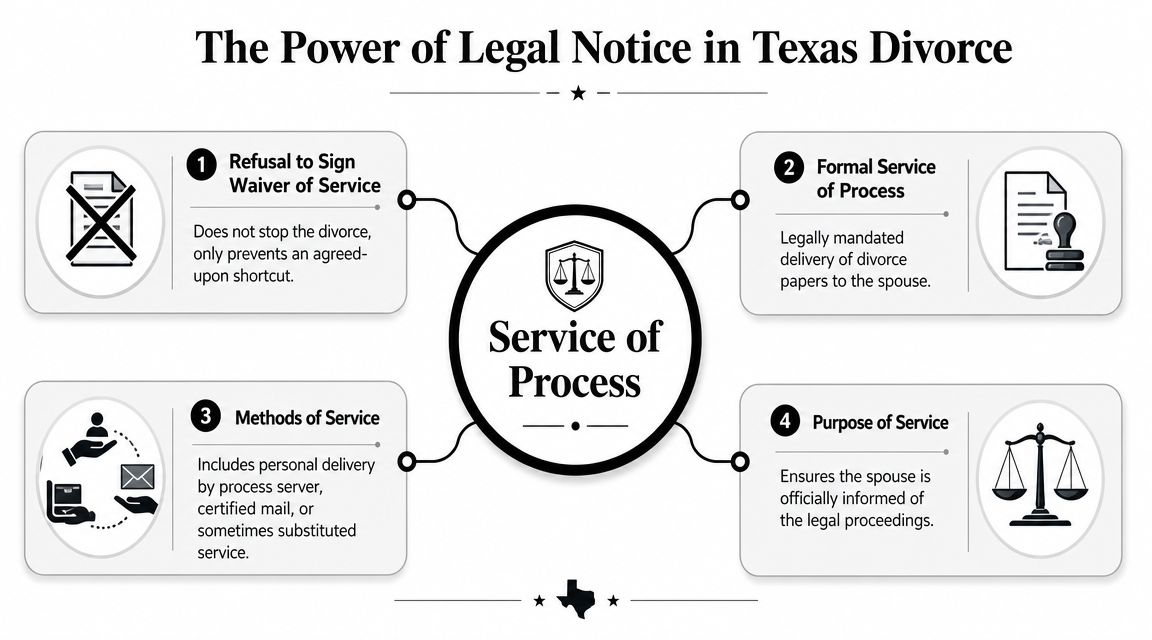
Many spouses won't sign a Waiver of Service because they think signing means they agree to the divorce. In most cases, it doesn't. A waiver usually just acknowledges receipt and avoids the need for formal service.
But if your spouse refuses to sign that waiver, the case doesn't stop. It means you use formal service instead.
Texas guidance on answering a divorce and service issues makes an important point: many people confuse refusal to sign with avoiding service, but the key legal issue is proper service and failure to answer by the deadline, not the signature itself. If you want a practical overview of that step, this article on how to serve divorce papers properly and respectfully gives useful context.
How service usually works
In plain English, service of process means officially delivering the divorce papers in a way the court recognizes.
That might involve:
- Personal service: A sheriff, constable, or private process server hands the papers to your spouse.
- Alternate service: If your spouse is evasive, the court may allow another approved method.
- Careful documentation: Proof of service matters because it protects your ability to ask for default later.
A lot of frustration comes from this stage. People think, "My spouse knows I filed, so why isn't that enough?" It isn't enough because courts need formal notice, not assumptions.
Why this step changes the power dynamic
Once service is completed correctly, your spouse has a legal choice to make. They can answer and participate, or they can ignore the case and risk default.
That is why service is so important for parents, professionals, and business owners. If your spouse controls records, occupies the marital home, or handles family finances, sloppy service can create avoidable delays. Proper service gives the court a clean foundation to act.
A spouse can ignore your texts. They can't safely ignore a lawsuit that was properly served.
Default Divorce vs Contested Divorce What Happens Next
After service, your case usually heads down one of two paths. At this stage, the process becomes much easier to understand.

Path one default divorce
After being served, a spouse generally has until 10:00 a.m. on the Monday following the expiration of 20 days to file an answer. If they don't, the court can enter a default judgment, as described in this explanation of Texas default timing and a Motion to Sign. If you want a focused explanation of that process, see this page on default divorce in Texas.
A default divorce doesn't mean the judge rubber-stamps everything automatically. You still usually have to appear and provide the court with the required testimony and paperwork. Many people call this a prove-up hearing. It is typically a shorter final hearing where you confirm the basics of your case and present the final decree you want the judge to sign.
This visual overview may help if you're weighing those two routes:
Path two contested divorce
If your spouse files an answer, the case becomes contested. That doesn't necessarily mean a trial is guaranteed. It means your spouse has appeared and preserved the right to participate in decisions about property, support, and any child-related issues.
A contested case may involve:
- Information exchange: Each side gathers financial records and other evidence.
- Negotiation: Lawyers may work toward a partial or full settlement.
- Mediation: Many Texas courts expect parties to try to resolve disputes before trial.
- Final hearing or trial: The judge decides unresolved issues if no agreement is reached.
A refusal to sign can also happen at the end
Sometimes both spouses negotiate, the terms are settled, and then one spouse still refuses to sign the final decree. In that situation, the same source above explains that the other spouse may file a Motion to Sign and ask the judge to make the judgment final.
So the main question isn't whether your spouse can stop the divorce. Instead, the question is which track their behavior creates, and how quickly you act once that track becomes clear.
Using Temporary Orders to Protect Your Family and Assets
While the paperwork is moving through the court, real life keeps going. Bills still come due. Children still need routines. Someone still has to decide who stays in the house, who pays what, and whether money in an account is safe.
That is where temporary orders matter.
Why temporary orders are often worth pursuing
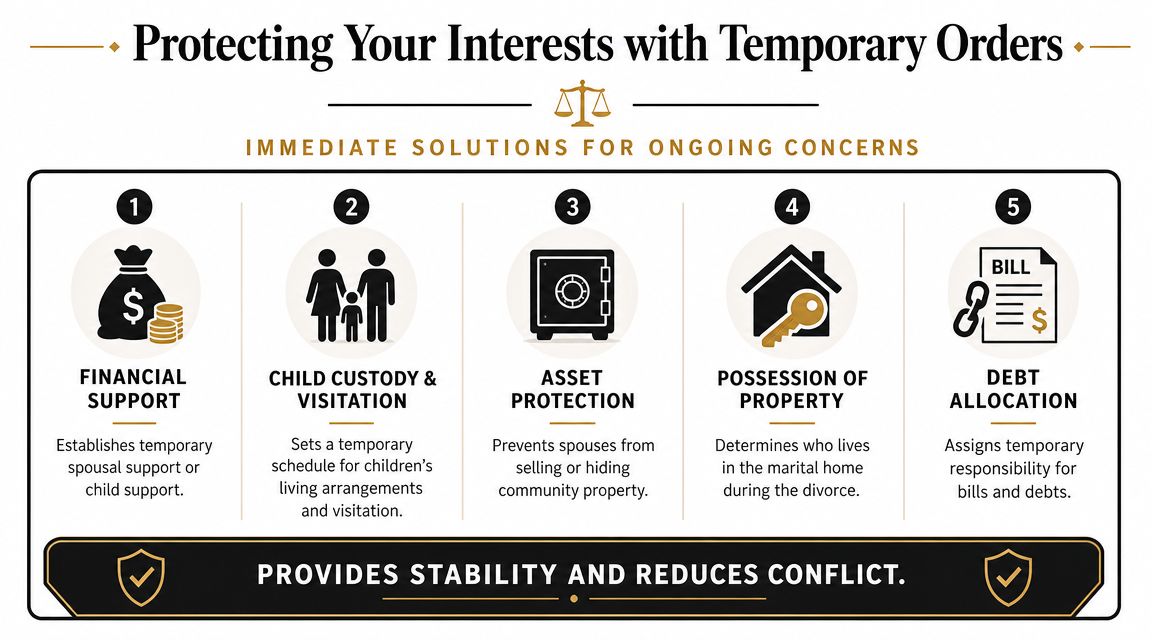
If your spouse is being difficult, waiting passively can create damage that is hard to undo later. Temporary orders let you ask the court to set rules while the divorce is pending.
Those rules can cover several urgent issues:
- Children's schedules: Temporary conservatorship, possession, and pickup routines can reduce chaos.
- Support: The court can address temporary child support and, in some cases, temporary financial support between spouses.
- Use of property: One spouse may receive temporary use of the marital home or a vehicle.
- Bill payment: The court can assign responsibility for mortgage payments, utilities, insurance, or credit cards.
- Asset protection: Orders can restrain a spouse from selling, hiding, or wasting property.
When this is especially important
Temporary orders become even more important when one spouse owns or controls a business, has access to investment accounts, or has handled most of the family finances during the marriage. They also matter when parents need a stable routine for school, medical appointments, and exchanges.
Important: If you're worried your spouse may empty accounts, interfere with parenting time, or shut off financial access, ask about temporary relief early. Delay can make a manageable problem much worse.
You don't need to wait for your spouse to become cooperative before protecting yourself. Court orders exist for exactly this kind of unstable middle period.
The Final Outcome Impact on Custody Property and Support
A spouse who refuses to cooperate doesn't get to rewrite Texas law. Judges still have to decide custody, property, and support based on the facts in front of them.
If the case ends by default
In a default setting, the court often looks closely at the relief you requested in your petition and final papers. If your requests are legally proper and fair, the nonparticipating spouse may lose the chance to shape the outcome.
That can matter in several ways. A parenting plan may be entered without your spouse offering an alternative schedule. Property division may proceed based on the evidence you present. Debt allocation, possession of the home, and support terms may also be decided without meaningful input from the spouse who stayed silent.
If the case becomes contested
In a contested case, a judge won't just punish someone for being stubborn. But noncooperation can still affect the case in practical ways. A spouse who delays document production, refuses reasonable settlement efforts, or creates needless hearings may hurt their credibility and increase legal friction for everyone involved.
For families dealing with real estate, the marital home often becomes one of the most emotional and expensive issues. Even though this resource discusses another state, its practical discussion of timing, logistics, and sale planning during divorce can still help if real estate is part of your conflict, especially if you're comparing options around listing or selling a home during separation. See divorce home sale in Florida for that broader perspective.
What judges are really looking for
Courts usually care less about dramatic statements and more about conduct, documentation, and reasonableness.
A judge may focus on questions like these:
| Issue | What helps your position |
|---|---|
| Custody and parenting | Consistent involvement, reliability, and child-focused decision-making |
| Property division | Clear records, accurate disclosures, and realistic proposals |
| Support disputes | Honest financial information and compliance with temporary obligations |
If you're a business owner or have significant assets, detail becomes especially important. Income records, company documents, account statements, and valuation issues can shape the final decree far more than your spouse's refusal to sign ever will.
Your Action Plan When Your Spouse Will Not Cooperate
You are not waiting for your spouse to "allow" the divorce to happen. At this stage, your job is to choose the right lane and keep the case moving.
A refused signature creates a fork in the road. One lane leads toward a default divorce if your spouse was properly served and still does nothing. The other leads to a contested case if your spouse answers, appears, or starts fighting over children, property, or support. That distinction matters because the next smart move depends on which lane you are in, not the one you hoped for.
As noted earlier, Texas Law Help explains what happens when an ex will not sign the papers. The key deadlines are procedural. Filing the case, serving your spouse correctly, tracking the answer deadline, and watching the waiting period are what keep you in control.
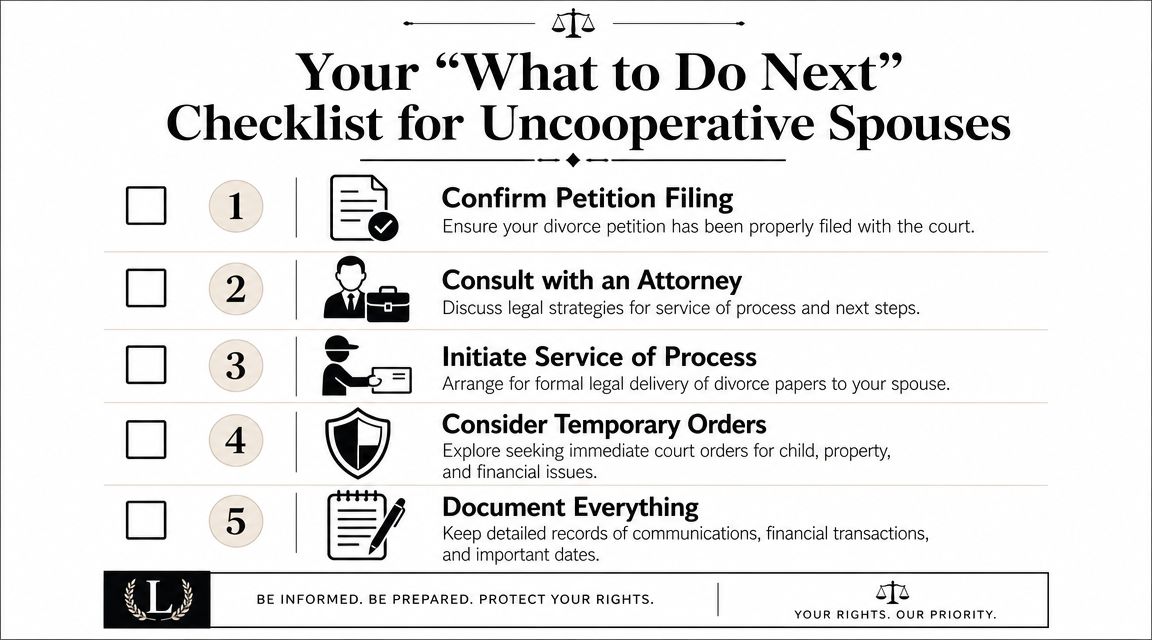
What to do next
Confirm that your filing sets out what you need.
Review the petition carefully. Make sure it was filed in the correct court and clearly asks for the relief you may need, including conservatorship, possession schedules, child support, property division, or temporary orders. A divorce petition works like the blueprint for the case. If something important is missing, it can limit what you ask the court to do later.Decide early whether you are dealing with silence or opposition.
If your spouse avoids service or ignores the case after being served, you may be heading toward default. If your spouse files an answer, hires counsel, or starts disputing terms, you are in contested territory. That is the procedural fork in the road. Your timeline, costs, hearing strategy, and settlement options can all change based on that one difference.Stop chasing signatures and start building a record.
Save texts, emails, account records, parenting calendars, and any proof that bills are unpaid or assets are being moved. Good documentation does two things. It helps your lawyer decide whether to push for default, temporary orders, or discovery, and it gives the judge something concrete to rely on if the case becomes contested.Ask for temporary orders if daily life is becoming unstable.
If money is disappearing, parenting time is chaotic, or someone is changing access to property or accounts, temporary orders can create rules while the divorce is pending. They can address who stays in the house, who pays which bills, temporary support, and temporary parenting arrangements. That can lower the pressure while the larger case gets resolved.Match your strategy to the lane your case is in.
In a likely default case, the focus is precision. Proper service, clean paperwork, and correct timing matter. In a contested case, the focus shifts to evidence, negotiation, hearings, and preparation for mediation or trial. The Law Office of Bryan Fagan, PLLC handles Texas divorce matters involving property, custody, support, mediation, and enforcement. Those are often the exact issues that become harder when one spouse refuses to cooperate.
One missed deadline can change the path of the case.
The practical goal is simple. Keep control of the procedure, protect what matters now, and make decisions based on your spouse's actual response, not their threats or silence. Your spouse can refuse to sign. They cannot trap you in place if the case is filed correctly and handled with a clear plan.
Common Questions About Uncooperative Spouses in Texas Divorces
What if I can't find my spouse to serve them
If your spouse can't be located, the court may allow alternate service methods after the required legal steps are taken. The exact method depends on the facts of your case and what efforts have already been made to find them. This is one of those moments when careful paperwork matters a great deal, because the court will want proof that you made real efforts before asking for another service method.
Can my spouse be forced to pay my attorney's fees because of their refusal
Sometimes that issue can be raised, especially if your spouse's conduct caused unnecessary delay, forced extra hearings, or drove up the cost of the case. It isn't automatic. Courts look at the broader circumstances, the conduct of both parties, and the overall fairness of the request. If fees are a concern, bring it up early so your attorney can build the record instead of trying to explain the problem at the end.
Does refusing to sign make my spouse look bad in court
Not by itself. A judge knows people in divorce cases are emotional, defensive, and sometimes poorly informed. But a pattern of evasion, missed deadlines, failure to follow orders, or refusal to provide information can absolutely affect how the court views that spouse's reasonableness and credibility.
Courts usually respond better to the spouse who stays organized, follows instructions, and focuses on practical solutions.
If you're facing this situation, you don't have to guess your way through it. A free consultation with Law Office of Bryan Fagan, PLLC can help you understand whether your case is heading toward default, contested litigation, mediation, child-related hearings, or enforcement issues, and what steps you should take now to protect your family, your finances, and your peace of mind.