Skip to content
You may be separated, sleeping in different homes, and emotionally done, but the court still sees one thing: you're married until the final decree is signed.
That's why the answer to “Can you date during a divorce in Texas?” is both simple and frustrating. Yes, you can date. No, that doesn't mean it's risk-free. Texas generally doesn't recognize legal separation as a separate status, and spouses remain legally married until the divorce is final. During that time, a judge can still look at your conduct when deciding property division, spousal maintenance, and sometimes custody, as explained in this Texas divorce dating overview.
This isn't about judging your personal life. It's about understanding how a new relationship can affect your money, your children, and your advantage in court. Judges usually aren't interested in policing romance for its own sake. They care when dating creates evidence that fits a legal issue already in the case.
The Question Every Separated Person Asks
Once you've decided the marriage is over, dating can feel like the first normal thing you've done in months. You want companionship. You want a future. You may also want proof that life is moving forward.
The legal system doesn't view that moment the same way you do.
In Texas, there is no formal “safe” separation status that ends the legal duties of marriage before divorce. Until the judge signs the final decree, your spouse can still argue that a new relationship matters. Sometimes that argument goes nowhere. Sometimes it becomes a central issue.
What judges actually look for
A Texas judge usually won't ask whether dating is morally right or wrong. The court is more practical than that. The important questions are:
- Did the relationship support an adultery claim
- Did you spend community funds on the new person
- Did the relationship affect your children's stability
- Did your choices make settlement harder or increase conflict
- Did your conduct hurt your credibility
Practical rule: Dating isn't usually the problem by itself. The problem is what dating creates on paper, online, or in front of the children.
That distinction matters. A quiet dinner with someone, kept private and separate from your children, creates different risks than trips, gifts, overnight stays, joint expenses, or social media posts. If your divorce is still in the filing, temporary orders, discovery, or mediation stage, those details can become evidence quickly.
The Legal Line Between Dating and Adultery in Texas
Texas gives spouses two different paths to divorce. One path is no-fault, often based on insupportability. The other includes fault-based grounds, and adultery is one of them. That means even if your case starts as a no-fault divorce, your spouse may still raise fault if it helps with strategy or settlement pressure.

Separation doesn't end the marriage
Many people assume that once they move out, they're free from adultery concerns. That's not how Texas family courts analyze it. If the divorce isn't final, the marriage still exists as a matter of law.
So if a new relationship becomes intimate before the decree is signed, your spouse may try to frame it as adultery. That doesn't mean every allegation succeeds. It does mean the allegation can become part of the case.
If you want a fuller breakdown of how fault allegations can affect divorce strategy, this guide on adultery and divorce under Texas law is a useful next read.
Why fault still matters in a no-fault state
People hear “Texas is a no-fault state” and stop there. The more complete statement is this: Texas is no-fault for filing, but fault can still matter later.
A judge may care about fault if it connects to an issue the court must decide. Adultery can matter because it may influence how the court views the breakdown of the marriage and whether one spouse should receive a more favorable share of community property. That's why dating during an open divorce often becomes less about romance and more about proof.
Your spouse's lawyer doesn't need your relationship to be dramatic. They need it to be relevant.
What counts as relevant conduct
Not every coffee date changes a case. What tends to draw attention is conduct that is easy to prove and easy to explain to a judge, such as:
- Sexual intimacy before the final decree
- Text messages or photos that suggest an affair timeline
- Public posts showing a new partner during the pending case
- Statements to friends or family that later become evidence
- Living arrangements that look like cohabitation
The legal takeaway is straightforward. Dating becomes risky when it gives the other side a clean factual story to tell. If that story supports fault, weakens credibility, or makes the court question your judgment, it can shape the case even if dating itself wasn't illegal.
How a New Relationship Can Impact Your Finances and Property
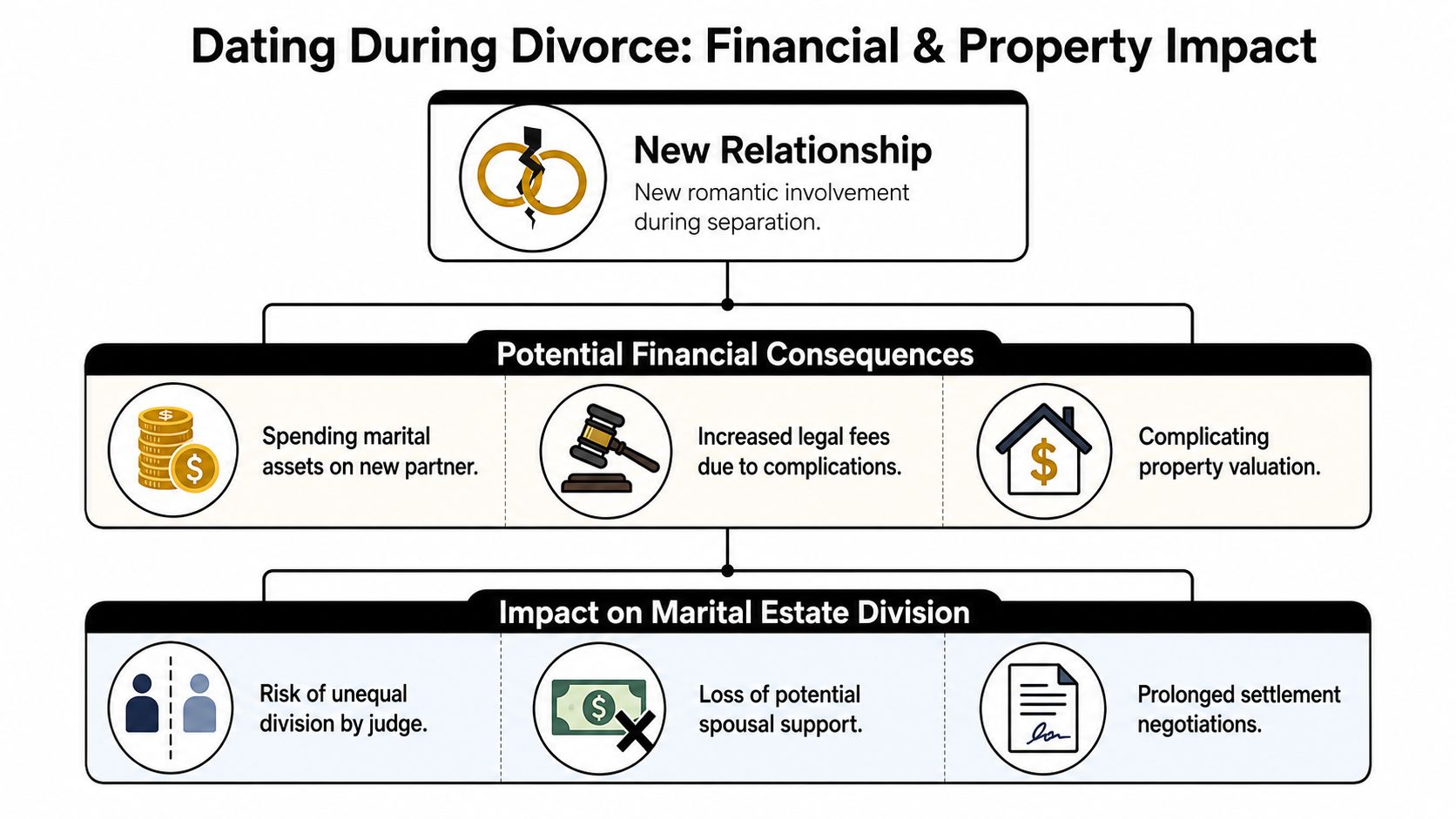
Money is where dating during divorce often stops being personal and starts becoming expensive. Texas courts can treat dating during an open divorce as legally relevant when it maps onto a statutory factor. Adultery is a fault ground, and it can influence the “just and right” division of community property under Texas Family Code § 7.001. Courts also look at dissipation of community assets and credibility when a new relationship overlaps with the marriage, as discussed in this analysis of dating during divorce in Texas.
Community funds are not dating funds
During divorce, people often make a costly mistake. They think, “I earned this money, so I can spend it how I want.” In many marriages, that isn't how the court sees it. If the money is community property, spending it on a new partner can become a reimbursement or waste argument.
That includes more than obvious gifts. It can include:
- Meals and entertainment paid from joint accounts
- Travel costs tied to the relationship
- Rent, hotel, or housing support for a new partner
- Transfers, cash withdrawals, or hidden purchases
- Subscriptions, event tickets, or shared living expenses
A judge usually cares less about whether you had dinner with someone and more about whether the dinner was funded with money that should have stayed in the marital estate.
Fault can change leverage even before trial
Most divorces settle before a judge makes every final call. That makes dating-related financial evidence powerful in a different way. It can shift negotiation advantage.
If your spouse has bank records, credit card statements, messages, or photos that support adultery and spending, settlement discussions become harder. Mediation can still work, but the other side may demand more favorable terms on property because they believe they now have a stronger story for court.
Here's how that usually plays out:
| Issue | Lower-risk conduct | Higher-risk conduct |
|---|---|---|
| Spending | Separate, modest, documented personal spending | Community funds used for gifts, trips, or support |
| Timing | Private relationship with no overlap in finances | Relationship tied to spending during active divorce |
| Evidence | Little documentary proof | Clear bank, card, text, or social media trail |
| Property negotiations | Fewer side disputes | More claims for unequal division or reimbursement |
If your case involves a business, deferred compensation, investment accounts, or multiple properties, dating can create side disputes that distract from the larger financial issues you should be protecting.
High-asset cases need extra discipline
If you own a business, receive irregular income, or have substantial assets, the paper trail matters even more. Opposing counsel will look closely at accounts, reimbursements, expense categories, and unusual transfers. A relationship that might have been a sideshow in a simpler case can become a major issue in a high-asset divorce.
That's why the best financial advice is often the least exciting. Keep your accounts clean. Keep your records complete. Don't mix romance with community spending.
Your Custody Case and the Best Interest of the Child
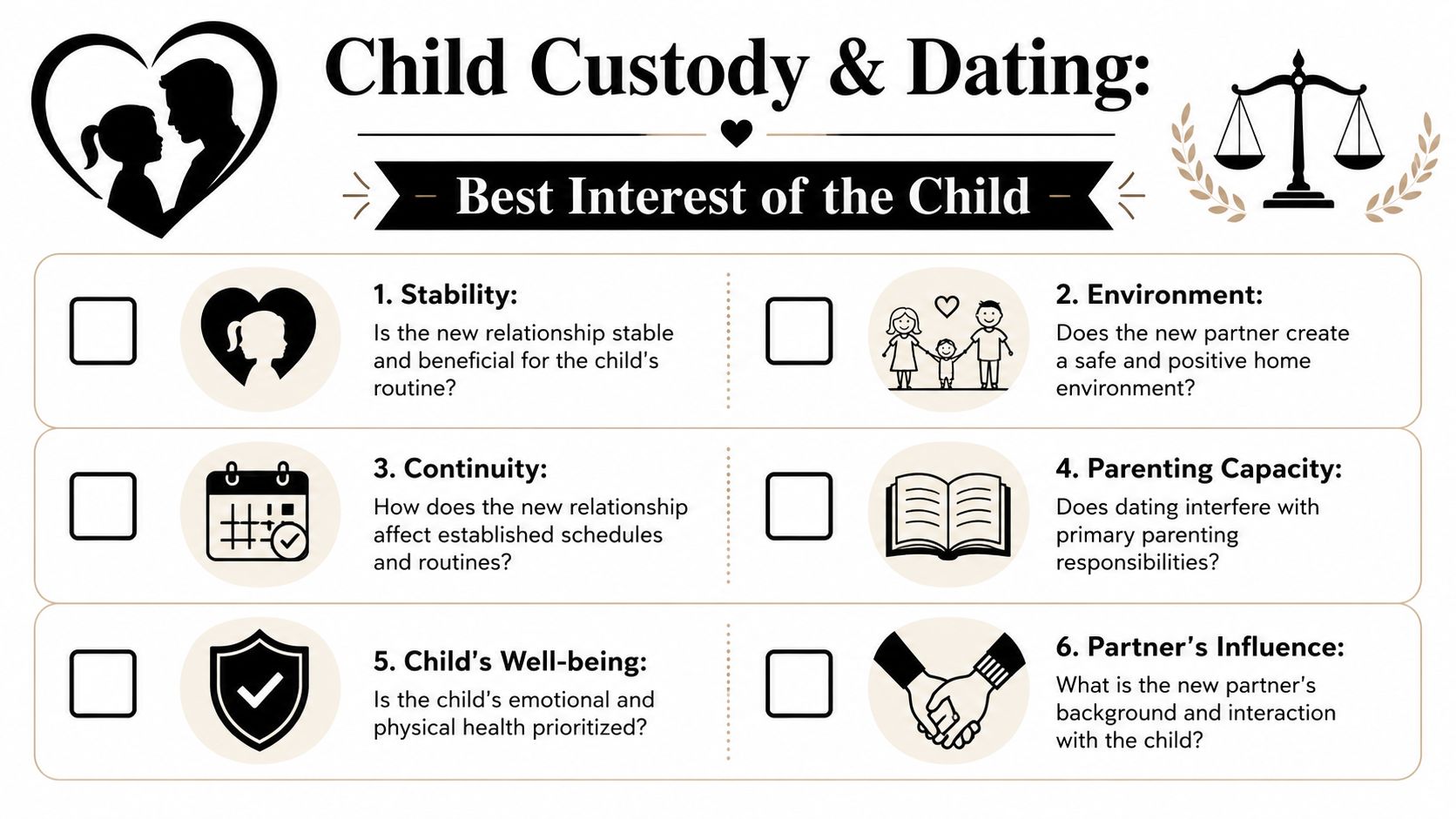
If you have children, this is usually the most important part of the discussion. In custody cases, judges generally evaluate dating through the best interest of the child lens. The technical issue is not whether you're single. It's whether the new relationship affects parenting capacity, stability, or household risk. Texas family-law commentary often points to the same high-impact behaviors: introducing a new partner too early, overnight stays when children are present, allowing a partner to discipline the child, or letting dating interfere with scheduled possession time, as outlined in this Texas custody and dating discussion.
Judges focus on stability, not labels
Courts don't award conservatorship based on who moved on first. They look at how your choices affect the child's day-to-day life. A parent can date and still be a strong parent. A parent can also date in ways that make the court question judgment.
If you want to understand the broader custody framework, review these best interest of the child principles in Texas custody decisions.
The behaviors that create problems fast
Some facts are easy for the other side to present and hard to explain away. These tend to cause the most trouble:
Introducing a new partner too soon
Children already deal with uncertainty during divorce. A fast introduction can be framed as putting your emotional needs ahead of their adjustment.Overnight stays during your parenting time
This often becomes evidence in custody fights because it raises questions about household structure, boundaries, and exposure to adult relationships.Letting the new partner act like a parent
If your boyfriend or girlfriend starts disciplining the child, handling exchanges, or making parenting decisions, your spouse may argue that you've created confusion and instability.Missing or shortening possession time
Dating is a problem when it looks like you're giving up parenting time or arriving late because of the relationship.
A short video can help clarify how these choices are viewed in practice.
How these facts get used in court
Your spouse's attorney may not need dramatic evidence. Ordinary proof often does the work:
- Photos and social posts suggesting overnights or cohabitation-like routines
- Calendar records showing missed exchanges
- Texts about who is watching the child
- Statements from family members who observed the partner's role
- School or activity issues that line up with distractions at home
Children don't need a front-row seat to your next relationship while they're still adjusting to the end of your marriage.
A better custody approach
If you choose to date before the divorce is final, keep the relationship separate from the children for as long as possible. During your possession time, do the ordinary things that build a strong custody case: show up, be on time, handle school and medical needs, and maintain a calm household.
For parents, this is rarely about one date. It's about whether your conduct helps the judge see you as the parent who protects routine, boundaries, and emotional safety.
Risks in Temporary Orders and Protective Order Hearings
The focus on dating tends to be in terms of the final decree. The immediate danger often shows up much earlier, in the first hearings that shape the case.
Temporary orders can decide who stays in the home, who pays which bills, how parenting time works while the case is pending, and what the basic rules will be until final trial or settlement. If a new relationship becomes part of the facts before that hearing, it can hand the other side useful material.
Why early hearings are so sensitive
In a temporary orders setting, the judge is making quick decisions based on limited evidence. That means impressions matter. If your spouse can point to a new partner and connect that person to spending, conflict, secrecy, or instability, the court may become more cautious about your requests.
This is especially true when the relationship has already created financial activity. In high-net-worth cases, dating-related spending, gifts, vacations, or living expenses can become part of the reimbursement or dissipation narrative. Proving adultery usually requires more than suspicion, and the answer is often more about financial conduct than romance itself, as noted in this discussion of dating and divorce in San Antonio.
If your case is heading toward an early hearing, it helps to understand how a temporary orders hearing in a Texas divorce typically works and what evidence tends to matter.
Conflict can escalate fast
A new relationship doesn't just create legal arguments. It often raises the emotional temperature of the case. That can affect communication, settlement efforts, and co-parenting almost immediately.
Common flashpoints include:
- Arguments during exchanges after your spouse learns about the relationship
- Accusations of harassment tied to texts or calls about the new partner
- Claims that the children are being exposed to unsafe or inappropriate conduct
- Requests for restraining language in temporary orders about overnight guests or spending
Early hearings reward discipline. If your spouse is emotional and you stay measured, that helps. If both sides are escalating, everyone loses leverage.
Protective order concerns
Protective order allegations are serious. Even when the underlying dispute started as anger about a new partner, the legal consequences can spill into possession, communication rules, and public reputation. That's one reason it's smart to reduce opportunities for confrontation.
If you're dating during divorce, avoid in-person arguments, don't taunt your spouse, and don't involve the new partner in messages, pickups, or home visits. A relationship that should have stayed private can become the spark for emergency filings if no one is exercising restraint.
A Practical Guide What to Do and What to Avoid
You are halfway through a divorce, your phone lights up with a date invitation, and the question becomes practical fast. Not whether dating is morally acceptable, but whether the choices you make this week could become exhibits at a temporary hearing, mediation, or trial.
Texas courts do not punish dating for its own sake. The problem is how dating can supply evidence for the claims judges decide: adultery, waste of community assets, and the best interest of the child. If you understand those tests, you can make decisions with your eyes open instead of reacting out of fear.
Analysts writing about Texas filing patterns have noted that divorce cases often surge after the holiday period, with annual filings having increased from an average of 68,898 in 2015 to 2017 to 111,202 by 2024, according to this Texas divorce filing analysis. In practice, that means many people start dating during the same stage of the case when temporary arrangements, budgets, and parenting routines are still fragile.
What works
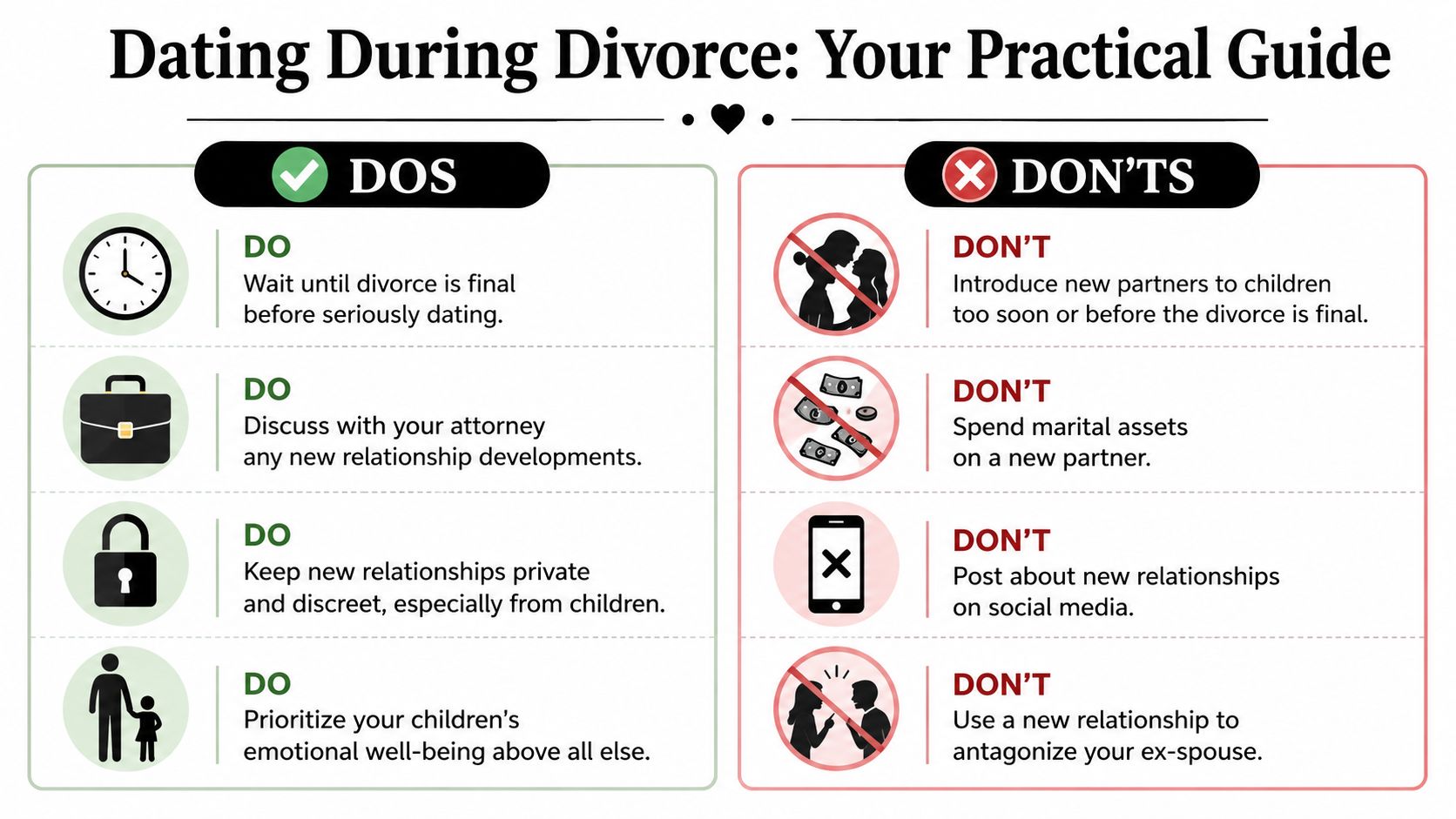
Keep the relationship private
Privacy limits evidence and lowers the odds of avoidable conflict. No social posts, no public declarations, and no involving friends who may later become witnesses.Spend with discipline
Use your own funds carefully, keep records, and avoid paying a new partner's expenses in ways that can be framed as wasting community property.Keep parenting steady
Judges notice patterns. Show up on time, follow the schedule, and keep your focus on the children rather than the relationship.Tell your lawyer early
A new relationship is manageable if your attorney knows about it before the other side builds a story around it. Timing, photos, messages, travel, and spending all matter.
What does not work
- Moving in together before the decree
- Introducing the children before the relationship is stable
- Posting photos, comments, or location tags
- Using the relationship to irritate your spouse
- Letting a new partner act like a parent
A good rule is simple. If a judge saw it in a screenshot, bank statement, or school record, could you explain it calmly and would it sound reasonable?
| If you're about to do this | Ask yourself |
|---|---|
| Post a photo together | Would I be comfortable seeing this attached to a court filing? |
| Take a trip | Can I clearly account for how it was paid for? |
| Have an overnight visit with kids home | Does this create a parenting argument I do not need? |
| Bring the partner to an exchange | Will this reduce tension or make the situation worse? |
| Let the partner help parent | Will this look like support, or confusion and poor boundaries? |
If you're meeting people online
Meeting someone online is not a legal problem by itself. Sloppy judgment is.
If you are re-entering the dating world, a non-legal resource like this online dating guide for men may help with the social side. Keep that separate from your divorce strategy. Good dating advice does not answer whether a post, purchase, overnight stay, or introduction to your children will create unnecessary risk in family court.
Protecting Your Future and Your Family
You're allowed to want companionship. You're allowed to feel ready before the paperwork is over. But family court won't evaluate your new relationship by your feelings. It will evaluate it through evidence, timing, money, and the effect on your children.
The safest answer is often to wait. If you don't wait, be careful. Keep your finances clean, keep your children out of the relationship, stay off social media, and make decisions that would still look reasonable if they were read out loud in court.
Key Takeaway: A new relationship usually becomes a legal problem only when it supports a fault claim, a property claim, or a custody argument. If you understand those tests, you can make decisions based on strategy instead of fear.
If you're facing divorce and trying to protect your children, your property, and your peace of mind, schedule a free, confidential consultation with Law Office of Bryan Fagan, PLLC. You can get clear Texas-specific guidance on divorce procedure, temporary orders, mediation, custody, support, and the practical risks of dating before your final decree, so you can move forward with confidence.