Skip to content
Discovering your spouse has been unfaithful is a world-shattering moment. When you're facing this deep personal betrayal, it's important to know that under adultery divorce Texas law, that infidelity carries specific legal weight and can significantly impact the outcome of your divorce.
Understanding Adultery and Your Texas Divorce

The wave of anger, confusion, and grief you’re feeling is completely understandable. While those emotions are intensely personal, the law provides a structured way for you to handle this breach of trust. In Texas, you do not have to settle for a "no-fault" divorce when infidelity has torn your marriage apart. You have the right to file for a fault-based divorce, citing adultery as the specific cause.
This isn’t just about assigning blame on paper; it's a legal tool that can have a real impact on your case's outcome. Proving adultery can influence how your marital property is divided and can even play a role in decisions about financial support.
The Legal Grounds for an At-Fault Divorce
The Texas Family Code § 6.003 clearly defines adultery as "the voluntary sexual intercourse of a married person with one who is not the spouse." When you file for divorce on this ground, you are officially telling the court that your spouse’s actions are the direct reason the marriage has ended. That declaration sets the stage for a different kind of negotiation and gives you leverage in court proceedings.
Your sense of betrayal is recognized by the law. By citing adultery, you are not just expressing your pain—you are using a specific provision in the Texas Family Code to protect your rights and seek a just outcome.
This guide will walk you through what adultery means in a courtroom, how to prove it, and how it can affect your finances and your children. Understanding your options is the first step toward getting your feet back on solid ground and moving forward with confidence.
What Counts as Adultery in a Texas Courtroom
Discovering a suspicious text message or a string of late-night emails can feel like a punch to the gut, and for many, it’s definitive proof of an affair. But in a Texas family court, what feels like an obvious betrayal often falls short of the legal standard for adultery.
When you're building a case for a fault-based divorce, it’s crucial to understand that a judge’s definition of infidelity is much stricter than our own. It isn’t about hurt feelings or emotional affairs; legally, it comes down to one specific physical act. Under Texas law, adultery is the voluntary sexual intercourse of a married person with someone other than their spouse. A judge won't grant a divorce on adultery grounds for flirting, sending explicit photos, or even other forms of physical intimacy. The legal standard requires proof of actual sexual intercourse.
The High Bar for Evidence
Because the legal definition is so narrow, the evidence you bring to court must be incredibly persuasive. You can't just accuse your spouse of cheating; you have to prove it by "clear and convincing evidence." This is a much higher standard of proof than what’s required in most other civil cases.
Think of it this way: the usual standard, "preponderance of the evidence," just means it's more likely than not (think 51%) that something happened. But "clear and convincing evidence" means the judge must have a firm belief or conviction that the adultery took place. This higher bar exists to prevent divorces from being granted on suspicion or jealousy alone.
What Kind of Proof Actually Works?
So, how do you meet this high standard? Direct proof, like a video or photograph of the act, is almost nonexistent and often obtained illegally. Instead, courts rely on a strong pattern of circumstantial evidence—facts that, when woven together, point to only one logical conclusion. Your goal is to build a case so compelling that adultery is the only reasonable explanation.
Effective evidence often includes:
- Financial Records: Credit card statements are powerful. They can show charges for hotel rooms, lavish gifts you never received, or airline tickets for two. This demonstrates that marital funds—your community property—were likely spent furthering the affair.
- Incriminating Communications: While texts and emails alone may not prove intercourse, a long history of romantic or sexually explicit messages helps paint a very clear picture for the judge, especially when combined with other evidence.
- Testimony from a Private Investigator: A licensed professional can provide credible, third-party observations. Their testimony about seeing your spouse and their affair partner enter a hotel or residence together for the night and leave the next morning can be very difficult to refute.
- Admissions from Your Spouse: Sometimes, a spouse admits to the affair in a text, email, or even a recorded conversation (if obtained legally). A direct admission is often the strongest piece of evidence you can have.
Understanding these legal realities is the first step in building a smart strategy. It helps you focus on gathering evidence that will actually make a difference in your adultery divorce Texas law case, rather than getting bogged down by painful betrayals that don't meet the legal standard. If you're considering this path, you might be interested in a deeper look at the fault-based divorce process in Texas.
How Adultery Can Reshape Your Property Division
Figuring out the finances in a divorce is already one of the most stressful parts of the process. But when you discover infidelity was involved, it adds a whole new layer of questions—especially about what happens to the assets you built together. In an adultery divorce Texas law case, this is often where the most significant financial impact is felt.
While Texas is a community property state, proving adultery can completely change how a judge divides your assets and debts. Normally, the law presumes that property acquired during the marriage belongs equally to both spouses. In a standard no-fault divorce, a judge aims for a “just and right” division, which often starts out looking like a 50/50 split.
However, once adultery is proven as a fault-based ground for the divorce, that starting point can shift dramatically. A judge has the authority to award you, the non-cheating spouse, a disproportionate share of the community estate—meaning more than 50%. This isn't meant to be a punishment. Instead, the court is rebalancing the scales to account for the breach of trust and the harm done to the marriage.
When Marital Funds Are Used for the Affair
The financial argument becomes much stronger when your spouse used shared money to fund the affair. This is what the law calls "fraud on the community" or “marital waste.” When money that belongs to both of you is spent on something that clearly doesn’t benefit the marriage—like an affair—the court has the power to make it right.
Think of your community estate as a joint savings account. If one spouse secretly dips into that account to buy lavish gifts, pay for secret trips, or rent an apartment for their affair partner, they’ve unfairly drained funds that rightfully belong to both of you.
Here are some examples of marital waste tied to adultery:
- Expensive Gifts: Jewelry, designer bags, or even a car bought for the affair partner.
- Secret Trips: Flights, luxury hotels, and fancy dinners paid for with community funds.
- Financial Support: Paying rent, covering bills, or giving a cash allowance to a paramour.
If you can prove this waste happened, a judge can order your spouse to essentially "reimburse" the community estate before the remaining assets are divided. This is a critical step to ensure you aren't left paying for your spouse's affair.
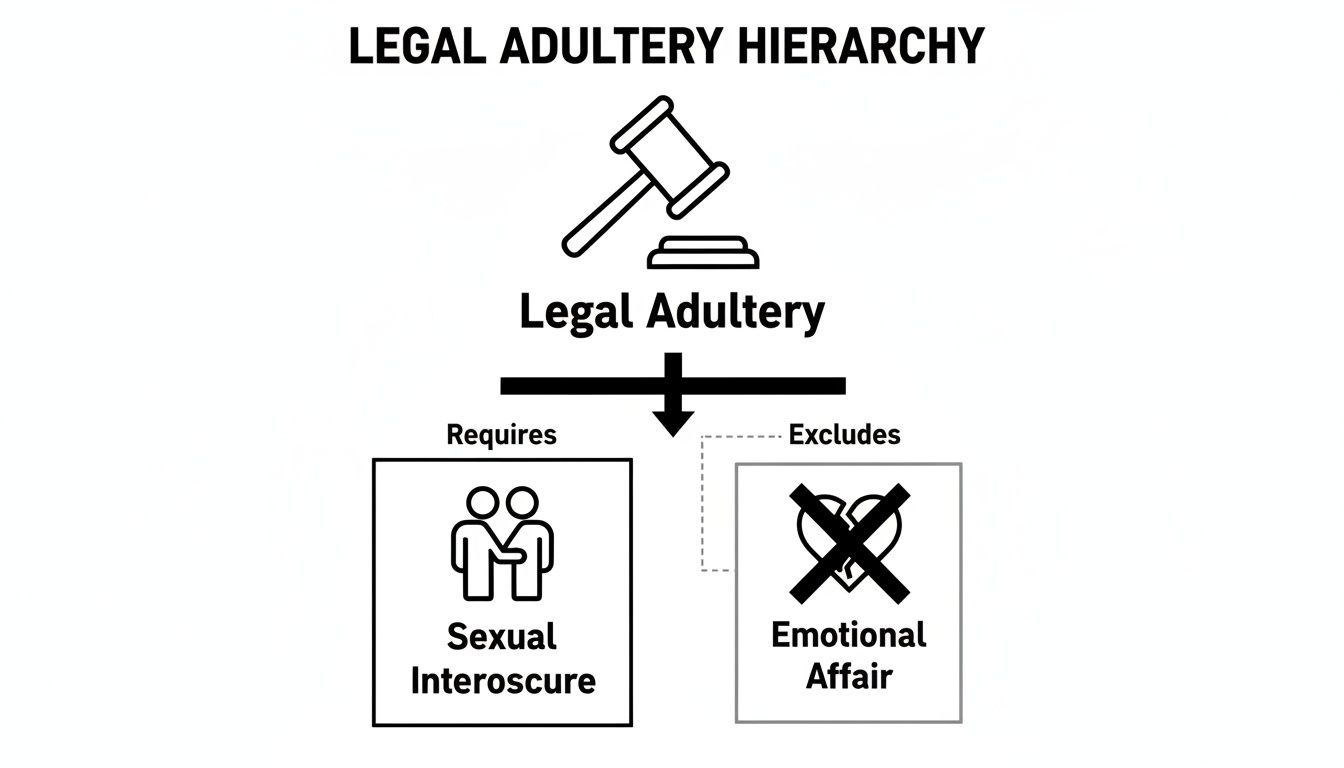
As the diagram shows, a court needs proof of sexual intercourse. Text messages or an emotional connection alone won’t trigger these financial consequences.
How a Judge Might Adjust the Numbers
So, how does a judge actually make this adjustment? Under Texas Family Code § 7.001, the court is instructed to order a division that is "just and right," taking into account the rights of each party and any children. Proving fault, like adultery, is a key factor the judge will consider.
When there's also evidence of marital waste, the math gets even more direct. For example, if you can prove your spouse spent $50,000 of your shared money on gifts and hotels for their affair partner, the court can "reconstitute" the estate. This means they add that $50,000 back into the total value of the community property on paper before splitting it, and that squandered amount is assigned to the cheating spouse's side of the ledger.
The table below gives a simplified look at how this might play out.
Potential Impact of Adultery on Property Division
This table illustrates how a 'just and right' division of community property might shift from a standard 50/50 split when adultery is proven, especially with financial waste.
| Scenario | Standard No-Fault Division (Example) | Potential Fault-Based Division (Example) |
|---|---|---|
| No Adultery Proven | Community Estate: $500,000 Spouse A: $250,000 (50%) Spouse B: $250,000 (50%) | Not Applicable |
| Adultery Proven (No Waste) | Not applicable. A judge would likely award a disproportionate share. | Community Estate: $500,000 Judge awards a 55/45 split to the non-cheating spouse. Spouse A (Non-Cheating): $275,000 Spouse B (Cheating): $225,000 |
| Adultery Proven (with $50k Waste) | Not applicable. With proof of waste, a simple split is unjust. | Reconstituted Estate: $500,000 Spouse B is assigned the $50k they wasted. From the remaining $450k, Spouse A gets $250k and Spouse B gets $200k. Final Tally: Spouse A gets $250k; Spouse B is held accountable for the wasted $50k. |
As you can see, proving adultery and waste isn’t just about making a point—it has a real, tangible effect on the final numbers. This ability to recalculate the division is one of the most powerful tools you have. It makes sure the final property settlement reflects the financial reality of what happened during your marriage, including the damage caused by the affair. To get a deeper look at the numbers, check out our guide on how cheating affects divorce settlements in Texas.
Does Adultery Affect Spousal Maintenance Awards
When you find out your spouse has been having an affair, your mind often races to one question: How will I be able to support myself after the divorce? It’s a common belief that proving adultery in court automatically means you’ll get spousal maintenance, but the reality in Texas is more complicated. While it’s not a golden ticket, an affair can absolutely be a deciding factor for a judge.
First, it's important to understand that Texas has strict rules for who can even ask for spousal maintenance. In most cases, you have to have been married for at least 10 years and show that you can’t earn enough to meet your “minimum reasonable needs.” Even if you meet these qualifications, the judge has the final say. This is where adultery becomes a powerful part of your story.
Adultery as a Factor in the Judge’s Decision
When a judge weighs whether to award spousal maintenance—and for how long—they look at a specific list of factors in Texas Family Code § 8.052. Marital misconduct, including adultery by either spouse, is right on that list.
- If you are the one asking for maintenance: Proving your spouse’s affair can give your request serious weight. It helps your attorney show the judge that your spouse’s choices are what broke the marriage and left you in a difficult financial spot.
- If you are the one who had the affair: Your chances of receiving spousal maintenance, even if you meet the basic qualifications, will be slim. A judge is very likely to see your actions as the cause of the divorce and may decide against awarding you any support.
A judge has the discretion to consider your spouse's infidelity when determining if you need financial support. While not a guarantee, it can tilt the scales in your favor by showing the court you are the 'innocent spouse' in the dissolution of the marriage.
The Role of Marital Waste
The link between cheating and spousal maintenance gets even stronger if your spouse used marital money to fund the affair. If they wasted community property on gifts, lavish trips, or a secret apartment for their affair partner, this is known as "marital waste." A judge can see this as fundamentally unfair. When your spouse’s spending on an affair has drained the assets you would have otherwise received, a judge is much more likely to award you maintenance to help make up for that financial damage.
It’s critical to have realistic expectations. Spousal maintenance is not guaranteed and payments are capped by Texas law. However, a proven affair can lead a judge to reduce or even deny a maintenance award to the unfaithful spouse, even if they technically meet the eligibility criteria.
Ultimately, while adultery doesn’t create an automatic right to spousal support, it is a powerful piece of evidence. It allows your attorney to tell a compelling story to the judge about why the marriage ended and why you deserve assistance as you transition to a new, independent life. You can learn more about how to qualify for spousal support in Texas in our detailed guide.
Understanding the Impact of Adultery on Child Custody
When you discover an affair, one fear often rises above all others: "Will I lose my children because of this?" It’s a thought that can keep you up at night, imagining the worst-case scenario in a custody battle.
Let’s be clear: in a Texas courtroom, your spouse’s adultery does not automatically mean they will lose custody. The court has one guiding principle: the best interest of the child. A judge’s role isn’t to punish a parent for their choices within the marriage; it's to create a safe, stable, and loving environment for the children. An affair, on its own, is often viewed as an issue between the spouses, not something that automatically affects a person's ability to be a good parent.
However, the line between marital misconduct and poor parenting can get blurry. While the act of cheating itself might not be the deciding factor, the behavior surrounding the affair absolutely can be.

When Adultery Can Influence Custody Decisions
A judge will start to look much more closely when the cheating parent’s actions show poor judgment that directly puts the child’s physical or emotional well-being at risk. Your attorney’s job is to connect the affair to specific, harmful behaviors.
Here are a few situations where a parent’s affair can have a major impact on a judge’s custody ruling:
- Exposing Children to Inappropriate Behavior: If the cheating spouse brought their new partner into the family home, let them stay overnight while the kids were there, or showed inappropriate affection in front of them, a judge will take that seriously. This is seen as prioritizing personal desires over the child’s need for stability.
- The New Partner Poses a Risk: If the affair partner has a criminal record, a history of drug or alcohol abuse, or a reputation for dangerous behavior, they present a direct threat to the child's safety. A court can—and will—issue orders, like a morality clause, to keep that person away from your children.
- The Parent's Actions Show Poor Judgment: When a parent gets so wrapped up in their affair that they start neglecting their kids—missing school functions, forgetting doctor's appointments, or leaving them unsupervised—it stops being about the affair and becomes a clear parenting problem.
- Using Marital Funds on the Affair: While this is primarily a property division issue, a judge can see it as a serious failure of parental responsibility if a parent is spending thousands on gifts and trips for an affair partner while the children's needs are going unmet.
Under the Texas Family Code § 153.002, all custody decisions must be based on the “best interest of the child.” The court will weigh a list of factors, including the child's emotional and physical well-being, any potential dangers, and the stability of the home. Adultery only matters if it negatively impacts one of these factors.
Ultimately, your goal in court isn’t to prove your spouse is a bad partner. It’s to show, if it's true, how their actions related to the affair have made them an unstable or unsafe parent. This is a critical distinction that can make or break your custody case.
What to Do Next When Adultery Has Wrecked Your Marriage
The shock and betrayal of discovering your spouse’s infidelity can leave you feeling completely adrift. While the emotional healing process is a journey of its own, the legal path forward requires you to take clear, decisive steps. It’s time to shift from reacting to what happened to actively protecting your rights, your finances, and your children.
Step 1: Schedule a Consultation with an Experienced Divorce Attorney
This is the single most important move you can make right now. Trying to handle an adultery divorce Texas law case by yourself is a huge gamble. A seasoned family law attorney isn't just a legal expert; they become your advocate, explaining your rights and helping you build a smart strategy from day one. In a free consultation, you can get the facts, ask the hard questions, and feel the weight lift off your shoulders as a professional takes the lead.
Step 2: Begin Gathering Evidence
With your attorney guiding you, the focus shifts to carefully gathering and preserving evidence. This isn’t about emotional confrontations; it's about methodically documenting the facts. Your goal is to build a solid case that proves the affair and, just as importantly, any money that was spent on it.
Start by collecting things like:
- Bank and Credit Card Statements: Look for and highlight unusual charges for hotels, expensive gifts, flowers, or frequent dinners you weren't at.
- Digital Communications: Screenshot incriminating text messages, emails, or social media DMs. Be sure you obtain this information legally.
- Photos or Videos: Any images showing your spouse with their affair partner can serve as powerful circumstantial evidence. You can even use online tools like those in the ultimate guide to finding anything online through reverse image search to identify unknown people.
Step 3: Understand Your Options: Mediation vs. Litigation
The vast majority of divorce cases, even those involving cheating, settle without a full-blown court battle. Mediation is a process where a neutral third-party helps you and your spouse negotiate a settlement. It’s often quicker, cheaper, and puts you in control of the final agreement. However, if your spouse refuses to negotiate in good faith, litigation—taking your case to a judge—is the next step. Your attorney will help you weigh the pros and cons of each path and will be ready to fight for you in the courtroom if that's what it takes.
Key Takeaway
Proving adultery in a Texas divorce can give you significant leverage, potentially leading to a larger share of the community property and influencing spousal support decisions. However, the legal standard for proof is high, and the affair must be shown to have negatively impacted your children to affect custody. The most critical step you can take is to seek immediate legal counsel from an experienced attorney who can help you gather the right evidence and build a strategic case.
We know how challenging a divorce involving adultery can be, but you don’t have to go through it alone. The compassionate and experienced attorneys at The Law Office of Bryan Fagan, PLLC, are here to give you the clear guidance and strong advocacy you deserve. We'll listen, explain your rights under Texas law, and help you craft a plan to protect your family and your future.
Take the first and most important step today. Call us or visit our website to schedule your free, confidential consultation and start moving forward with confidence.
Frequently Asked Questions About Adultery and Divorce Law
When you’re dealing with a divorce that involves infidelity, you’re often wrestling with a storm of painful and confusing questions. You deserve clear, direct answers to help you understand your rights and figure out what comes next. Here, we tackle some of the most common concerns we hear from clients navigating the complexities of adultery divorce in Texas.
Can I Sue My Spouse’s Affair Partner?
This question comes from a place of deep betrayal, and it’s completely understandable to want to hold every person involved accountable. In Texas, however, the law does not allow for what are called "alienation of affection" lawsuits. You cannot sue your spouse's affair partner for money to compensate for the breakup of your marriage. The court's job is to focus squarely on dissolving the marriage between you and your spouse. The best strategy is to channel your energy into the divorce itself, using evidence of the affair to help you secure a better outcome on property division.
Does Adultery After Separation Still Matter?
Yes, it absolutely can. Many people assume that once they’ve physically separated, a new relationship is fair game. But under Texas law, you are legally married until the moment a judge signs your Final Decree of Divorce. Any sexual relationship with someone new before that decree is signed is still considered adultery. A judge can and will consider post-separation infidelity, especially if marital money was spent on the new relationship, and it can still impact how the court divides your community property.
What If We Both Committed Adultery?
When both spouses have been unfaithful, it creates a much more complicated legal picture. A judge may see the fault as mutual, which can neutralize either spouse’s ability to use adultery as a reason for a fault-based divorce. This is sometimes called "recrimination." If both parties are at fault, the court is less likely to award a disproportionate share of the assets to one side based on infidelity. Your divorce would then likely proceed more like a standard no-fault case, with the property division aiming closer to a 50/50 split, unless other factors like one spouse wasting significant community funds are in play.
How Much More Property Can I Realistically Get?
Proving your spouse committed adultery gives a judge the authority to award you a disproportionate share of the marital estate, but it’s not a blank check. The final percentage depends entirely on the specific facts of your case. A common outcome is a shift from a 50/50 split to something in the neighborhood of 55/45 or 60/40 in favor of the non-cheating spouse. That number might go up if you can prove your spouse wasted a substantial amount of community funds on the affair. The court’s goal is fairness, not punishment, so the final division will reflect the actual financial impact of the affair.
The emotional turmoil and legal hurdles of a divorce involving infidelity can feel like too much to handle alone, but you don’t have to. At The Law Office of Bryan Fagan, PLLC, our compassionate attorneys are here to offer the clear guidance and strong advocacy you need to protect your future. We know the ins and outs of adultery divorce in Texas and are ready to help you build a strategy that safeguards your family and finances.
Take the first step toward clarity and confidence. Schedule your free, confidential consultation with our team today by visiting https://texasdivorcelawyer.us.