 Skip to content
You may be sitting at your kitchen table right now, staring at your phone, wondering whether calling a divorce lawyer would calm things down or make everything feel more real.
That question matters in Texas because timing changes outcomes. The issue usually isn't just whether you need a lawyer. It's when you need one, and what could happen if you wait too long. If your divorce involves children, a house, retirement accounts, a business, debt, or a spouse who controls the money, early legal advice can protect you before the case starts shaping itself without you.
Is Now the Right Time to Call a Lawyer?
Many people assume they can wait until they're “sure” a divorce will happen. In practice, some of the most important decisions happen earlier than that. You may be gathering records, moving money, discussing parenting schedules, or responding to threats about who gets the house. Those choices can affect the rest of the case.
Texas also has a built-in timeline. A divorce can't be finalized until at least 60 days after filing, and contested cases involving custody, support, or property often take much longer, which is one reason early counsel can help protect their interests and avoid hard-to-fix mistakes during the opening phase of a case, as explained in this discussion of when to see a divorce lawyer.
Why waiting feels easier, but can cost you
You might still hope the divorce will stay civil. That's understandable. But an “amicable” divorce can become contested fast once people start talking about parenting time, who keeps the home, or how to divide accounts.
A lawyer doesn't automatically turn your case into a fight. Often, the opposite is true. Early advice helps you understand your options, prepare documents, and avoid emotional decisions that create bigger problems later.
Practical rule: If you're already asking whether you should call a lawyer, it's usually time to get answers before you sign anything, move out, or agree to a temporary arrangement.
What early legal advice can help you protect
Before filing, many Texans benefit from a short strategy conversation about:
- Your children's routine: School, pickup schedules, medical decisions, and overnights often become the backbone of a custody case.
- Your finances: Bank records, tax returns, debt, retirement accounts, and business documents are easier to organize before conflict escalates.
- Your next steps: Whether to file first, wait, negotiate, or prepare depends on your specific facts.
If you're still in the planning stage, this guide on how to plan your exit strategy before divorce in Texas can help you think through the practical side of leaving safely and strategically.
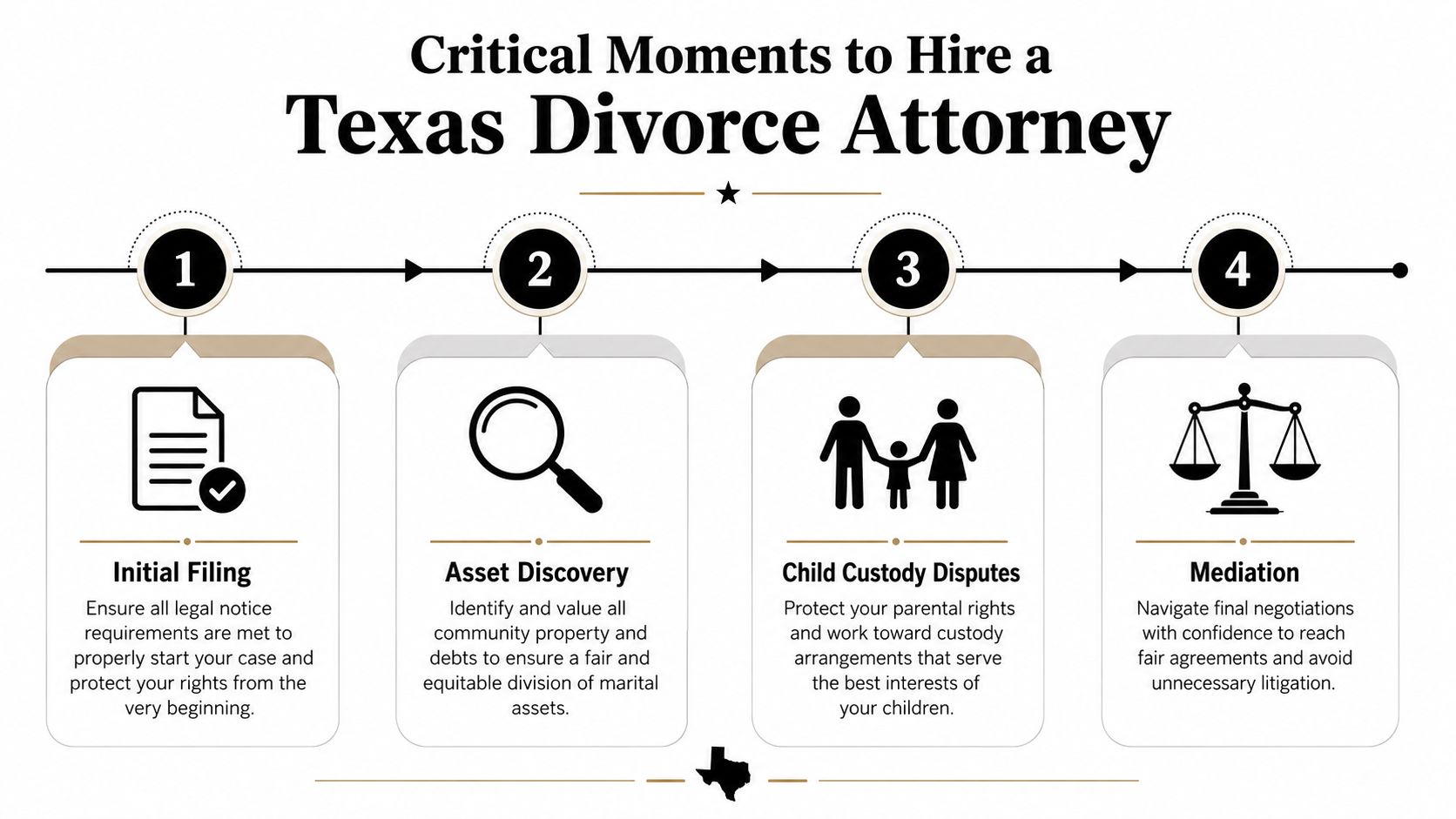
Critical Moments to Hire a Texas Divorce Attorney
There isn't one perfect moment for every family. There are, however, a few points in the timeline when hiring counsel becomes much more urgent.
Before you file
This is often the best time to get legal advice if your case may involve children, property disputes, support, or a spouse who manages the finances. Filing is not just paperwork. It starts a legal process with deadlines, disclosures, and strategic decisions.
A lawyer can help you sort out what may be community property and what may be separate property. In plain English, community property usually means property acquired during the marriage, while separate property usually means property owned before marriage or received by gift or inheritance. That distinction sounds simple, but accounts, businesses, and real estate often blur the line.
The day you're served
If a process server, constable, or sheriff delivers divorce papers, don't treat that as a routine notice. Service means a case is already active, and your response matters.
At that stage, a lawyer helps you read the petition carefully, identify immediate risks, and avoid default problems. If your spouse filed first, this article on what happens if your spouse files for divorce first explains the practical effect of that move and why your response should be deliberate.
When conflict starts climbing
Sometimes people begin without lawyers and plan to “work it out.” Then one of these things happens:
- Money stops flowing: One spouse cuts off access to accounts or starts controlling spending.
- Parenting gets tense: A parent keeps the children longer than agreed or starts making unilateral decisions.
- Communication breaks down: Texts become hostile, manipulative, or threatening.
- Documents go missing: Statements, deeds, business records, or account access suddenly become harder to get.
When your spouse has already started acting strategically, you need to stop treating the divorce like an informal discussion.
During temporary orders or mediation
Texas courts often use temporary orders to create structure while the divorce is pending. These orders can address possession of the home, payment of bills, use of vehicles, temporary support, and parenting schedules. What gets decided early can shape settlement talks later.
Mediation is another key point. A lawyer can prepare you for what to ask for, what to trade, and what not to give away just to get the case over with.
What Your Lawyer Will Do at Each Stage of the Divorce
Hiring a lawyer can feel abstract until you understand the actual tasks involved. In a Texas divorce, a good attorney does much more than fill out forms or appear in court. Your lawyer builds the structure of the case.

Consultation and case mapping
The first meeting is usually about facts, goals, and risk. Your lawyer will ask about children, income, property, debts, safety concerns, and anything your spouse has already said or done. They'll also help you spot issues you may not realize are legal issues yet.
Legal terms become practical as follows:
| Texas divorce term | What it means in plain English |
|---|---|
| Petition | The document that starts the divorce case |
| Respondent | The spouse who did not file first |
| Service | Formal delivery of the divorce papers |
| Temporary orders | Short-term rules while the case is pending |
| Final decree | The court order that ends the marriage and sets the terms |
Discovery and document control
If the case involves disputed finances, the lawyer's role becomes investigative. Discovery is the formal process for exchanging information and documents. That can include account statements, tax returns, business records, loan documents, and retirement information.
Your lawyer also helps preserve evidence. That may mean organizing texts, emails, calendars, photos, school records, or financial records in a way the court can use.
Why this matters: Courts decide cases based on evidence, not just on who sounds more upset or more convincing.
Temporary orders and day-to-day stability
Temporary orders can decide who stays in the house, who pays which bills, and how parenting time works while the case is open. If you have children, this stage can strongly influence later custody negotiations because the temporary routine often becomes the reference point everyone argues from.
A lawyer prepares the requests, gathers supporting facts, and presents your position clearly. If there are safety concerns, your attorney can also advise you about protective steps and emergency requests.
Mediation and final documents
Most Texas divorce cases resolve without a full trial. Mediation is a structured settlement process where both sides, usually through counsel, try to reach an agreement. A lawyer helps you prepare before mediation, evaluate proposals during mediation, and review written terms before you sign.
If settlement doesn't happen, your lawyer prepares for trial. That includes witness planning, exhibits, legal arguments, and a presentation focused on what the judge needs to decide. If settlement does happen, your attorney still has a critical job: making sure the final decree actually says what you agreed to and can be enforced later.
High-Stakes Scenarios That Demand Legal Counsel
Some divorces are hard. Some are risky. When your case falls into the second category, legal representation moves from helpful to necessary.

If children are involved
Parents often assume custody will work itself out if both sides love the children. Love matters, but court orders deal with calendars, exchanges, decision-making, child support, school issues, medical care, and holiday schedules. Those details are where conflict usually lives.
Texas family law uses the concept of conservatorship, which covers parental rights and duties, and possession and access, which covers time with the child. You don't need to memorize the vocabulary, but you do need to understand that parenting rights are separate from parenting time.
In one Texas family-law breakdown, fathers were reported to receive about 33% of custody time, or roughly 120.5 days per year, a reminder that parenting time is not something you should leave to assumptions or informal promises, especially when you want a meaningful role in your child's life, according to these Texas family law statistics.
If spousal maintenance may be an issue
Texas uses the term spousal maintenance for court-ordered post-divorce support in qualifying cases. It is not automatic. It depends on the facts, and the rules are narrower than many people expect.
The same Texas source notes that the state places a statutory cap on maintenance of $5,000 per month or 20% of the payer's average monthly gross income, whichever is less. That cap can shape negotiation strategy when one spouse earns much more, one spouse stayed home for years, or a business produced most of the family income.
If you own a business or have complex assets
Business owners face unique problems. A business may be partly separate, partly community, or disputed altogether. Revenue, payroll, retained earnings, goodwill, reimbursements, and debts can all become points of conflict. A careless approach can affect both the divorce and the business itself.
You should be particularly careful if your spouse had limited access to records or if one of you handled all banking and bookkeeping. That kind of imbalance can turn valuation and disclosure into a serious battle.
Here's a short explanation that may help:
- A house isn't just a house: Equity, mortgage liability, refinancing ability, and tax questions all matter.
- Retirement funds aren't cash in a checking account: They often require precise drafting and extra steps to divide properly.
- A business isn't just “mine because I started it”: The court looks at when value was created and how marital effort affected it.
A short video can help you think through the risks in a more practical way before you make early decisions.
If you suspect hidden assets or face safety concerns
When one spouse controls the money, controls the information, or controls the emotional climate of the home, self-representation becomes much more dangerous. The same is true when there has been intimidation, stalking, threats, or family violence.
In high-conflict divorces, the legal problem is rarely just the divorce. It's the imbalance of power around the divorce.
If your instincts tell you your spouse is hiding money, draining accounts, influencing the children, or trying to pressure you into a quick deal, trust that concern enough to get legal advice.
The True Cost of a DIY Divorce vs a Strategic Legal Investment
Cost worries are real. For many families, attorney's fees feel intimidating at the exact moment life already feels unstable. But the right comparison isn't “lawyer versus no lawyer.” The better comparison is upfront cost versus long-term risk.

What the survey data actually shows
A Custody X Change survey found a wide cost spread in divorce and custody matters. Respondents reported a median spend of $18,000 when both parents were represented, nearly $8,000 when only one parent was represented, and $500 when neither parent was represented. The same survey reported that 79% of respondents had a lawyer, and 70% of those represented said they were satisfied with that lawyer. It also reported a median case length of eight months from the start of negotiations to final ruling. You can review those figures in the survey on why many people hire a divorce attorney.
Those numbers don't mean every case should be lawyer-driven from day one. They do show something important. The cheaper path upfront often reflects simpler or less contested cases, not a guarantee that self-representation is safer or smarter.
Where DIY divorce often goes wrong
The most expensive divorce mistake usually isn't a filing fee issue. It's a bad agreement.
Common examples include:
- Unclear final orders: If a decree is vague, enforcement later becomes harder and more expensive.
- Missed assets or debts: A retirement account, reimbursement claim, stock option, or loan can slip through the cracks.
- Unsustainable parenting terms: A schedule that looks fair on paper may collapse once school, work, and holidays collide.
- House decisions made too quickly: Before you agree to keep or give up a home, it helps to understand related issues like insurance, mortgage responsibility, and even homestead tax relief for Texas homeowners, which can affect the practical cost of staying in the property.
Key takeaway: The right legal help is often less about “fighting harder” and more about drafting smarter.
Why timing matters to cost
There's a real gap in published Texas-specific data comparing people who hire a lawyer at the start with people who try DIY first and then bring counsel in after mistakes. That missing data matters. In practice, however, late hiring often means your attorney must spend time fixing filings, reworking proposals, correcting expectations, and responding to a case that has already taken shape.
That's one reason many people ask for an early case review, even if they hope to settle quickly. If you're weighing legal fees against the risks in your own situation, this breakdown of the cost of a divorce lawyer in Texas can help you think more concretely about budgeting and value.
How to Choose the Right Texas Divorce Firm for Your Family
Once you've decided to hire counsel, the next question is who should guide you. Not every lawyer handles divorce the same way, and not every firm is built for the kind of case you have.
Start with fit, not slogans
Look for a firm that focuses on family law and regularly handles the kind of issue you're facing. That may be custody, business valuation, high-conflict litigation, mediation, enforcement, military divorce, or negotiated settlement.
You also want a lawyer who can explain things in plain English. If you leave a consultation more confused than when you arrived, that's a warning sign.
Ask practical questions in the consultation
Bring your facts and ask direct questions. Good questions often reveal more than polished marketing language.
Consider asking:
- How do you approach temporary orders? Early stability often affects everything that follows.
- What documents should I gather first? This shows whether the lawyer thinks strategically.
- How do you handle settlement versus trial preparation? You want someone prepared for both.
- Who will communicate with me? Ask whether you'll hear from the attorney, staff, or both.
- What happens if my spouse is hiding information? This is especially important in cases involving business control or uneven financial access.
Pay close attention to information imbalance
One of the clearest signs that you should hire a lawyer early is information asymmetry. That means one spouse knows much more than the other about the finances, property, or children's daily records.
A Texas divorce attorney source explains that early representation is especially important when there may be hidden assets, debt, a business, or a custody dispute because it improves documentation, reduces billing inefficiency, and can materially affect property and custody outcomes, as discussed in this article on when to hire a divorce lawyer in Houston and how much it costs.
Look for resources and a process you can live with
You're not just hiring legal knowledge. You're choosing a working relationship during a stressful period of your life.
A few things to look for:
- Clear educational resources: Articles, videos, and FAQs can tell you whether the firm teaches clients well.
- Consultation options that fit your life: Virtual meetings can help if you work long hours, travel, or need privacy.
- A process for related issues: If your case may involve custody, support, mediation, or enforcement, ask how those issues are handled together rather than in isolation.
The Law Office of Bryan Fagan, PLLC is one example of a Texas family law firm that offers divorce-related guidance, consultations, and educational resources for people navigating these decisions. Whether you contact that firm or another one, the key is finding a lawyer who listens carefully, explains your options clearly, and can handle the level of complexity your case presents.
What to Do Next A Clear Path Forward
If you've made it this far, you probably already know your situation isn't something you want to leave to guesswork. That doesn't mean you need to rush into court tomorrow. It means you should take the next informed step.
A simple checklist you can use today
- Gather core documents: Start collecting tax returns, pay stubs, bank records, retirement statements, mortgage information, and business records if applicable.
- Write down your top goals: Focus on what matters most to you, such as parenting time, keeping the home, protecting a business, or reaching a peaceful settlement.
- Save key communications: Keep texts, emails, calendars, and notes about parenting routines or financial concerns in one place.
- Avoid informal deals you don't understand: Don't sign settlement language or agree to major property changes without legal review.
- Schedule a consultation: Even one meeting can help you understand risk, timing, and your best options.
The most important idea to remember
When Should You Hire a Divorce Lawyer in Texas? Usually, the answer is before the case starts controlling you. That may be before filing, right after service, or the moment conflict starts rising. The right time is not always the most dramatic moment. Often it's the first moment you realize your future, your children, or your finances could be affected by choices you don't fully understand yet.
You don't need to have every answer before you call a lawyer. You just need enough clarity to ask for help.
Take the next step while you still have room to plan instead of react.
If you're weighing your options and want clear, practical guidance, schedule a free consultation with Law Office of Bryan Fagan, PLLC. You can talk through your timeline, your concerns about children or property, and the stage your case is in right now. You don't have to sort this out alone, and you don't have to wait until things get worse to get answers.


