Skip to content
Facing a divorce is overwhelming, and one of the first questions on your mind is almost always about money: How much is this going to cost me?
In Texas, there’s no single price tag for a divorce. The cost of a divorce lawyer can range from a few thousand dollars for a simple, amicable split to well over $20,000 for a complex case that goes to trial. The final number boils down to the unique details of your family, your finances, and how well you and your spouse can work together.
Your First Question: How Much Will a Divorce Lawyer Cost?
Financial uncertainty is one of the most stressful parts of starting a divorce. You need clarity, not more confusion.
The simple truth is, quoting a flat fee for a divorce is like a contractor quoting a price for a "home renovation" without seeing the house. A quick paint job is one thing; a full kitchen remodel with custom cabinets is something else entirely. In the same way, a divorce where you and your spouse have already agreed on everything will be far less expensive than one where you’re fighting over the house, the kids, or the retirement accounts.
Our goal is to pull back the curtain on these costs from the very beginning. We want to give you a clear financial picture so you can feel more in control as you plan for your future.

What Do the Averages Say?
While every case is different, looking at statewide averages can give you a solid baseline. In 2025, the median cost of a Texas divorce is around $15,600 for couples without children. For couples with children, that number jumps to about $23,500.
These figures don't just cover attorney's fees. They also include court filing costs, fees for expert witnesses, and other expenses that come with resolving disputes over custody, support, and property. You can find more details on Texas divorce expenses on bryanfagan.com.
The difference in those numbers highlights the single most important factor: conflict costs money. The more you and your spouse argue, the more time, energy, and legal fees it will take to reach a final resolution.
The Two Main Paths: Uncontested vs. Contested Divorce
Generally, your divorce will go down one of two roads, and the path you take will have the biggest impact on your total cost.
- Uncontested Divorce: This is the smoother, more affordable route. An uncontested divorce means you and your spouse agree on all the major issues—how to divide property, who the kids will live with (conservatorship), and how support will be handled. Here, your attorney’s job is mostly to draft the official paperwork and make sure your agreement is fair, legal, and ironclad.
- Contested Divorce: This is where things get more complicated and expensive. If you and your spouse can’t agree on one or more key issues, the divorce is considered "contested." This requires much more hands-on legal work, including formal negotiations, mediation sessions, and potentially even court hearings to let a judge decide for you.
Decoding Your Attorney's Fee Structure
Trying to figure out the cost of a divorce lawyer in Texas can feel like learning a new language. But getting a handle on how attorneys charge is the key to managing your budget and feeling like you're in the driver's seat. To make smart decisions, you need to be fluent in the three main ways lawyers set up their fees. This knowledge will give you the confidence to ask the right questions during your initial consultations and choose a path that works for your finances.
Think of it like hiring someone to work on your house. Some projects come with a fixed price, while others are billed by the hour. Legal services are a lot like that, and knowing the difference is your first step toward financial clarity.

The Upfront Retainer
The most common payment model you'll run into is the retainer fee. A retainer is basically a down payment for your lawyer's services. It’s not the total cost of your divorce, but an initial deposit held in a special trust account just for you.
As your attorney works on your case—making phone calls, writing documents, or showing up in court—they bill their time against this fund. You’ll get detailed monthly invoices that show exactly how the money was used. If the retainer gets low, you’ll be asked to add more money to the account to cover upcoming work.
Key Insight: A retainer makes sure your lawyer has the funds to get started on your case right away. It secures their availability and covers the initial expenses of filing petitions and kicking off the discovery process.
The Hourly Rate
Your retainer is used up based on your attorney's hourly rate. This is the price you pay for each hour (or sometimes, a fraction of an hour) of your legal team's time. In Texas, these rates can be all over the map, usually depending on a lawyer's experience, reputation, and where their office is located.
It might be tempting to just pick the lawyer with the lowest hourly rate, but that can backfire. A more experienced attorney with a higher rate might work more efficiently, solving complex problems in a fraction of the time it would take a less seasoned lawyer. Their expertise can actually save you a ton of money and stress in the long run by helping you avoid costly mistakes and pointless delays. For a deeper dive, you can learn more by analyzing attorney fees and court costs in a Texas divorce in our detailed guide.
The Flat Fee Model
In some cases, a flat fee might be an option. This is a single, agreed-upon price for a specific legal service. Flat fees are most common in straightforward, uncontested divorces where both spouses have already worked out all the major issues.
Because the amount of work is predictable, the attorney can give you a fixed price to handle all the necessary paperwork from start to finish. This model gives you certainty about the cost, but it really only works for simple cases where the time commitment is easy to estimate.
Here’s a quick breakdown of how these payment structures compare:
| Fee Structure | Best For | What It Covers |
|---|---|---|
| Retainer & Hourly Rate | Contested or complex divorces with unpredictable timelines and issues. | All legal work, billed in increments of time. The retainer is the "down payment." |
| Flat Fee | Simple, uncontested divorces where all terms are already agreed upon. | The entire legal process for a predictable case, from filing to final decree. |
Understanding these models is your first step toward having a productive conversation with a potential attorney. By knowing how they charge, you can better figure out what the cost of a divorce lawyer in Texas might look like for your situation and start planning.
What Drives Divorce Costs Up or Down?
Trying to figure out what a divorce will cost isn't about finding some magic number online. It’s about looking at the specific ingredients in your own life that will end up on the final bill. Every divorce is its own story with a unique set of challenges, and those challenges are what really drive the cost of hiring a lawyer in Texas.
If you can get a handle on these key variables, you’ll have a much clearer picture of the financial road ahead. You might even find ways to keep those costs under control.
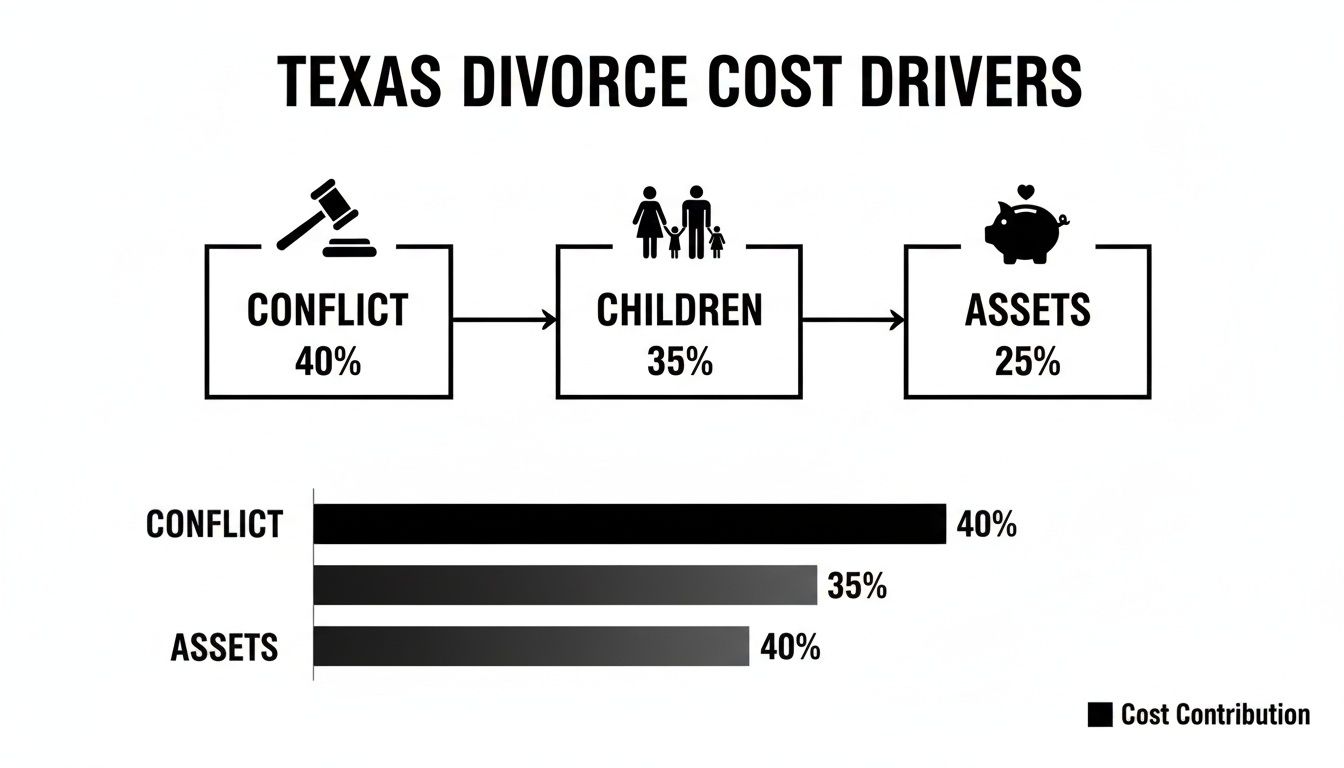
Think of it this way: your legal fees are directly tied to the amount of time and effort your attorney has to put in. The messier or more hostile your situation gets, the more hours it’s going to take to sort everything out.
The Impact of Child Custody Disputes
When kids are in the mix, the emotional stakes are higher—and so are the potential legal costs. Fights over conservatorship (custody), possession and access (visitation schedules), and child support can easily become the single biggest driver of your legal expenses.
If you and your spouse can't see eye-to-eye on a parenting plan, your attorneys will have to spend a ton of time on things like:
- Negotiating Temporary Orders: These are critical hearings that happen early on to decide where the kids will live and who pays support while the divorce is still moving forward.
- Discovery and Depositions: This is the formal process of gathering information, which can mean sitting down for hours to give sworn testimony.
- Expert Evaluations: In really heated cases, a court might bring in a custody evaluator or an amicus attorney to represent the children's best interests. That adds a whole other layer of professional fees to the pile.
Every single one of these steps requires careful prep work, legal strategy, and billable hours. A simple disagreement over a holiday schedule can quickly spiral into a dozen emails, phone calls, and formal court filings, each one adding to your final invoice.
Property Division and Financial Complexity
Splitting up your marital estate is another huge factor that shapes what you'll pay for a divorce lawyer in Texas. According to Texas Family Code Section 7.001, all community property has to be divided in a way that is "just and right." It sounds simple enough, but the process can get incredibly complicated and expensive, especially if you own a business or have a high-value estate.
Dealing with complex assets isn't your standard legal work. For example, if you own a family business, have a few real estate properties, or hold hefty retirement accounts, you're almost certainly going to need:
- Business Valuations: A professional appraiser has to figure out the fair market value of any business interests.
- Forensic Accounting: If you think your spouse might be hiding assets or fudging income numbers, a forensic accountant may need to come in and trace the money.
- Real Estate Appraisals: Every property has to be valued to make sure the division is equitable.
These outside professionals add their own costs directly to your case. Plus, they require your attorney to spend more time digging through reports and negotiating a fair settlement based on what they find.
For couples with a prenup, understanding the implications of a prenuptial agreement during divorce can completely change the cost equation. A solid prenup often simplifies the property division fight and brings legal fees way down.
The Most Important Factor: Cooperation
Here’s the thing, though. The biggest variable in what your divorce will cost is the one you have the most control over: how well you and your spouse can cooperate. A partner who is uncooperative or just plain combative can drag out the process—and drive up the bill—at every single turn.
Refusing to hand over financial documents, ignoring emails, or picking fights over minor issues forces your attorney to take formal, more expensive actions. A simple request for a bank statement can turn into a formal Motion to Compel, which means scheduling a court hearing. All of that costs you money.
It’s a hard truth, but Texas is one of the five most expensive states for a divorce. When custody disputes are involved, the average cost can shoot well past $23,000. While the basic court filing fees are only about $300, the real expenses pile up when conflict drags things out. You can discover more insights about Texas divorce expenses and see just how fast these factors add up.
At the end of the day, the more you and your spouse can find a way to work together, the more control you’ll have over the final bill.
Comparing Costs For Different Divorce Scenarios
Trying to nail down the exact cost of a divorce can feel like hitting a moving target. To give you a clearer picture, let’s walk through three common Texas divorce scenarios. Think of these as blueprints that show how conflict, complexity, and cooperation directly impact your final legal bill.
Scenario 1: The Amicable Uncontested Divorce
Picture a couple with no kids and a modest estate. They’ve already agreed to go their separate ways and have worked out how to divide their property, like the house and retirement accounts. This is an uncontested divorce—the most straightforward and budget-friendly path.
In this situation, you just need an attorney to handle the legal paperwork, like the Original Petition for Divorce and the Final Decree of Divorce. The lawyer’s job is to make sure your agreement is legally sound and all court filings are handled correctly.
- Legal Activities: An initial meeting, drafting and filing the petition, preparing the final decree, and a quick court appearance to finalize everything.
- Cost Driver: Minimal attorney time. Since there are no disagreements, you skip the lengthy negotiations, mediation, or court battles.
- Estimated Cost: This usually lands on the lower end, often between $1,500 and $5,000 per person. In some cases, it can be even less if a flat-fee arrangement is an option.
Scenario 2: The Moderately Contested Divorce With Children
Now, let’s imagine a couple with two young children and a family home. You agree you need to divorce, but you can’t see eye-to-eye on the parenting plan or who gets the house. This is a contested divorce, and those disagreements mean more legal work is required.
Your case will involve several steps required by the Texas Family Code, including mandatory mediation to work out disputes over custody and visitation schedules. If you still can't agree, you might need temporary orders hearings to set ground rules for custody and support while the divorce is ongoing.
For this couple, every mediation session, discovery request, and court hearing adds to the billable hours. It’s always smart to explore your options, and you can learn more about why divorce mediation could be a more cost-effective choice for Texas couples in our detailed guide.
Scenario 3: The Complex High-Net-Worth Divorce
Finally, consider a high-asset divorce with a business owner and a spouse who has significant investments and multiple properties. Here, the arguments often revolve around identifying separate vs. community property and figuring out the true value of complex assets like a family business.
This kind of case requires a whole team of professionals, not just lawyers.
- Forensic Accountants: To trace assets and uncover any hidden money.
- Business Valuators: To put a fair market value on the business.
- Real Estate Appraisers: To accurately value every property involved.
These expert fees, on top of extensive legal discovery and potentially drawn-out litigation, can make costs skyrocket. Contested divorces in Texas with disputes over custody or valuable assets often start with retainers of $5,000 to over $10,000. The total bill can easily reach $20,000 or more per person.
Cost Scenario Breakdown by Divorce Complexity
| Divorce Scenario | Common Legal Activities | Estimated Total Cost Per Person |
|---|---|---|
| Uncontested Divorce | Initial consultation, document drafting (petition, decree), court filing, final prove-up hearing. | $1,500 – $5,000 |
| Contested Divorce | Everything in uncontested, plus discovery, depositions, mediation, temporary orders, and potentially multiple court hearings. | $7,500 – $25,000+ |
| High-Asset Divorce | All activities of a contested divorce, plus hiring expert witnesses (forensic accountants, business valuators), complex asset tracing, and possible trial. | $25,000 – $100,000+ |
This table makes it clear: the more you have to fight over, the more you can expect to invest in legal fees. The path you choose—cooperation versus conflict—has a direct and powerful impact on your final legal bill.
Smart Strategies to Help Control Your Legal Fees
When you're in the middle of a divorce, it's easy to feel like the legal costs are a runaway train. But you have more power than you might think. While you can't control every move your spouse makes, you can be smart about how you manage your own legal budget. This isn't about cutting corners on what matters; it's about working smarter to protect your resources for the future you're building.
Honestly, the single most effective way to keep your divorce lawyer's costs in check is to take an active, organized role in your own case. When you do the legwork, your legal team can focus on high-level strategy and advocacy—not administrative tasks that eat up billable hours.

Be Organized and Efficient
Think of your attorney’s time as a valuable, and expensive, resource. The more organized you are, the less of that resource you'll need for basic tasks. Having your lawyer sort through a shoebox of crumpled receipts is like paying a master chef to chop your vegetables—it’s an expensive misuse of their expertise.
To get the most value out of every dollar, try to build these habits:
- Gather Documents Promptly: When your attorney asks for bank statements, tax returns, or pay stubs, get them together quickly and completely. This simple step cuts down on the back-and-forth emails and phone calls, all of which are billable.
- Communicate Efficiently: Instead of firing off five separate emails as questions pop into your head, try consolidating them. Keep a running list of non-urgent questions and send them in a single, organized email. This lets your attorney address everything at once, which is far more efficient.
- Be Prepared for Meetings: Before you talk with your lawyer, jot down a few bullet points about what you need to discuss. This keeps the conversation focused and productive, ensuring you cover all your bases without getting sidetracked.
Choose Your Battles Wisely
Emotions run high in a divorce, making it tempting to fight over every single thing. But arguing over who gets the sentimental coffee table or the holiday decorations can cost you thousands in legal fees—often far more than the items are actually worth. The key is learning to separate what's emotionally important from what's legally and financially significant.
A hard truth of divorce: Not every battle is worth the cost of fighting it. Focusing your energy and financial resources on the big-ticket items—like child custody, the house, or retirement accounts—is the smartest long-term strategy.
Before you tell your attorney to draft a motion or spend hours negotiating a minor point, ask yourself a blunt question: "Is the potential outcome here worth the money it will cost to get there?" Sometimes, the most powerful and cost-effective move is to let the small stuff go. It saves you money and reduces the emotional toll on you and your family. Making these tough calls is a huge part of the process, and understanding how to choose a divorce lawyer who will give you this kind of practical, honest advice is essential.
Explore Cost-Effective Alternatives to Court
Going to trial is, without a doubt, the most expensive way to finalize a divorce. Luckily, the Texas Family Code actually encourages—and often requires—couples to try resolving things outside of the courtroom first. These more cooperative methods can slash your legal fees by avoiding a long, drawn-out fight.
Two of the most effective options in Texas are:
- Mediation: Here, you and your spouse meet with a neutral third-party mediator who helps you negotiate a settlement. In most Texas counties, mediation is a required step before you can ever have a final trial. A single successful mediation session can resolve your entire case for a fraction of what litigation would cost.
- Collaborative Divorce: This is a more structured process where you, your spouse, and your specially trained attorneys all sign an agreement pledging to work together without going to court. It’s designed to be a team-based approach focused on creative, respectful problem-solving.
By staying organized, picking your battles, and being open to these cooperative solutions, you can keep a firm grip on your legal expenses and pave the way for a much more secure financial future.
What to Do Next
Staring down the potential cost of a divorce lawyer in Texas can feel overwhelming, but you’ve just taken the most important step: getting informed. You now understand the key factors that influence legal fees and how you can take an active role in managing them. The most powerful thing you can do right now is to take what you've learned and build a real plan for your future.
- Gather Key Financial Documents: Start pulling together your important paperwork. Think recent tax returns, bank statements, pay stubs, and any retirement account information. Having these ready makes your first consultation incredibly productive.
- Outline Your Goals: Take a moment to think about what a successful outcome looks like for you. What are your non-negotiables when it comes to your kids, your home, and your financial future?
- Schedule a Consultation: This isn't just another meeting. It's your chance to get legal advice that’s tailored to your unique situation. This is where you can ask tough questions about costs and start building a strategy that protects what you’ve worked so hard to build.
While lawyer fees are a big piece of the puzzle, don't forget that divorce can create other financial ripples. It’s always a good idea to talk with your legal team about potential tax issues that can arise in divorce so you have a complete picture of your finances moving forward.
Key Takeaway: You don't have to figure all this out by yourself. The Law Office of Bryan Fagan, PLLC, is here to offer the expert guidance and steady support you need. Schedule your free, no-obligation consultation with us today to talk about your situation and take that first confident step toward your new beginning.
Common Questions About Divorce Costs in Texas
When you’re facing a divorce, the financial side of things can feel like a huge, confusing cloud. You deserve clear, straight answers to feel prepared. Let's tackle some of the most common questions we hear from clients about what a divorce lawyer in Texas really costs.
Can I get my spouse to pay for my divorce lawyer in Texas?
Yes, that is a possibility. In Texas divorces, a judge can order one spouse to cover some or all of the other's attorney fees. This isn't automatic, though. A court will consider this when there’s a significant difference in your incomes or if one spouse’s actions have intentionally dragged out the process and driven up legal costs.
This request is often made early in the case through a motion for interim attorney's fees. The judge's decision will ultimately be based on what is fair and equitable under the Texas Family Code.
Is mediation cheaper than going to court?
Almost always, yes. There's a reason most Texas counties require you to try mediation before you can have a final trial—it's dramatically cheaper than a full-blown court battle. While you will have to pay for the mediator’s time (usually split between you and your spouse), settling your case this way can save you tens of thousands of dollars in litigation costs.
Going to trial involves extensive preparation, potential expert witness fees, and many more billable hours from your lawyer. However, it is absolutely critical to have your own attorney advising you during mediation to make sure any agreement you reach truly protects your rights and your future.
Key Insight: Mediation puts you in the driver's seat. It lets you and your spouse make decisions about your family's future instead of leaving those critical choices in a judge's hands. It's a powerful tool for controlling costs and reaching a more collaborative solution.
What is a retainer fee and how does it work?
Think of a retainer as a down payment for legal services. It’s an upfront fee most family law attorneys require to officially begin working on your case. That money doesn’t just go into your lawyer's pocket; it’s placed into a special trust account.
From there, your lawyer will bill their time against those funds at the hourly rate you agreed upon. It is not a flat fee that covers your entire divorce. You'll get detailed monthly statements showing exactly how that money was used—for phone calls, drafting documents, court time, and so on. If the retainer funds start to run low, your attorney will likely ask you to replenish the account to cover the work ahead.
Are court filing fees included in my lawyer's bill?
Usually, no. The fees you pay your lawyer are for their time, legal expertise, and the strategy they bring to your case. The other costs associated with moving your case through the court system are separate. These typically include:
- Court Filing Fees: Expect to pay around $250-$350 just to file a divorce case in Texas.
- Process Server Fees: This is the cost to have a professional formally deliver the divorce papers to your spouse.
- Expert Witness Costs: If your case requires specialists like property appraisers or child custody evaluators, their fees are also separate.
Your attorney will often pay these costs for you upfront and then bill them back to you as case expenses, which are then typically paid from your retainer trust account.
Trying to figure out the costs of divorce can feel like a heavy weight, but you don't have to carry it by yourself. The experienced team at The Law Office of Bryan Fagan, PLLC is here to offer the clarity and compassionate guidance you need. We invite you to schedule a free, no-obligation consultation to talk through your specific situation and start building a strategy for your future. Visit us at https://texasdivorcelawyer.us to take the first step.